[PART 1] Population Ecology Population Characteristics, Dynamics, Growth, and Life History
 Call Kai
 Learn
Learn Practice Test
 Spaced Repetition
 Match
Match Flashcards
 Knowt Play
1/33

There's no tags or description
Looks like no tags are added yet.
Name | Mastery | Learn | Test | Matching | Spaced | Call with Kai |
|---|
No analytics yet
Send a link to your students to track their progress
34 Terms
POPULATION
A group of individuals belonging to the same species occupying the same space at the same time
POPULATION ECOLOGY
Answers the following questions:
Why do populations grow and decline?
What regulates population size?
Size
How large is the population?
How fast is the population growing?
____________ - total number of individuals in a population and can indicate the health of a population
Density
How dense is the population?
___________________ – size of a population in relation to a definite unit of space; number of individuals of the same species per unit area
Crowding affects the health of a population
relative abundance; Species abundance; relative abundance
Two communities may be equally rich in species but differ in relative abundance. For example, each community may contain 5 species and 300 individuals, but in one community all species are equally common (e.g., 60 individuals of each species), while in the second community one species significantly outnumbers the other four.
Species diversity is determined not only by the number of species within a biological community—i.e., species richness—but also by the _____________ of individuals in that community. ______________ is the number of individuals per species, and _________________ refers to the evenness of distribution of individuals among species in a community.
Basal area
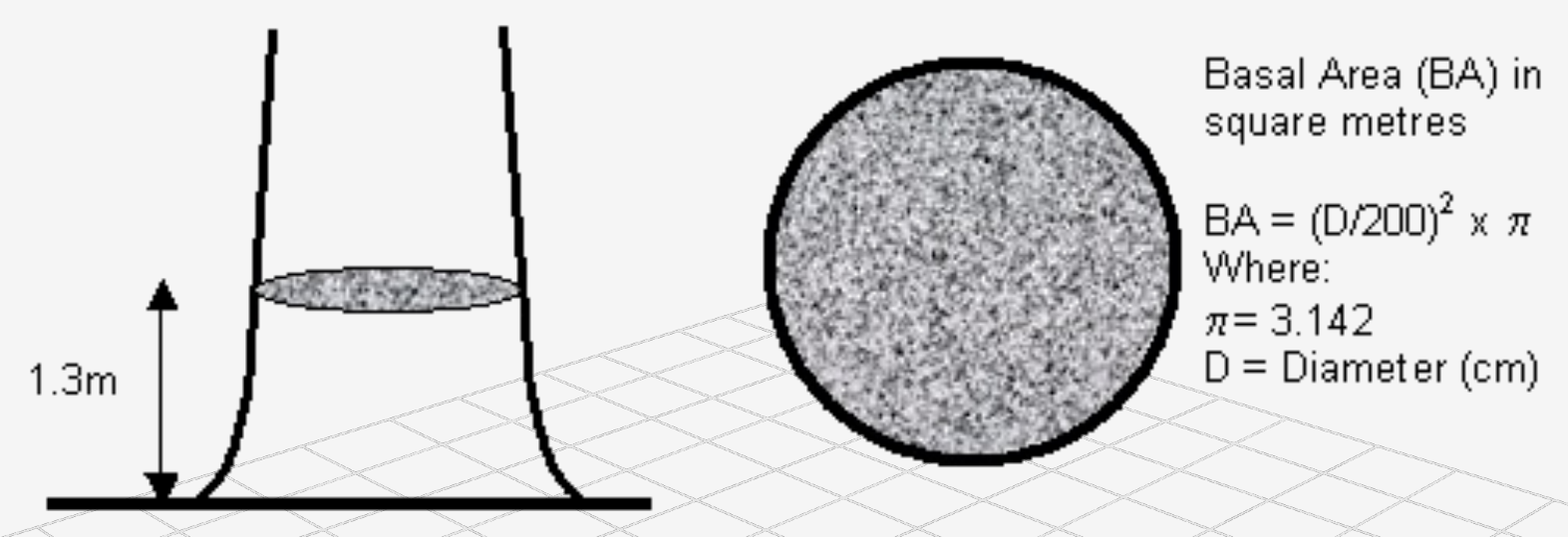
_______________ - total cross-section area of tree trunks; used by forest ecologists
Also provide the formula.
Biomass
____________ - the mass or weight of living tissue
Frequency
_______________ – the number of times a plant species occurs in a given number of quadrats; usually expressed as a percentage
Cover
_– percentage of ground surface covered as determined by the projection of areal parts
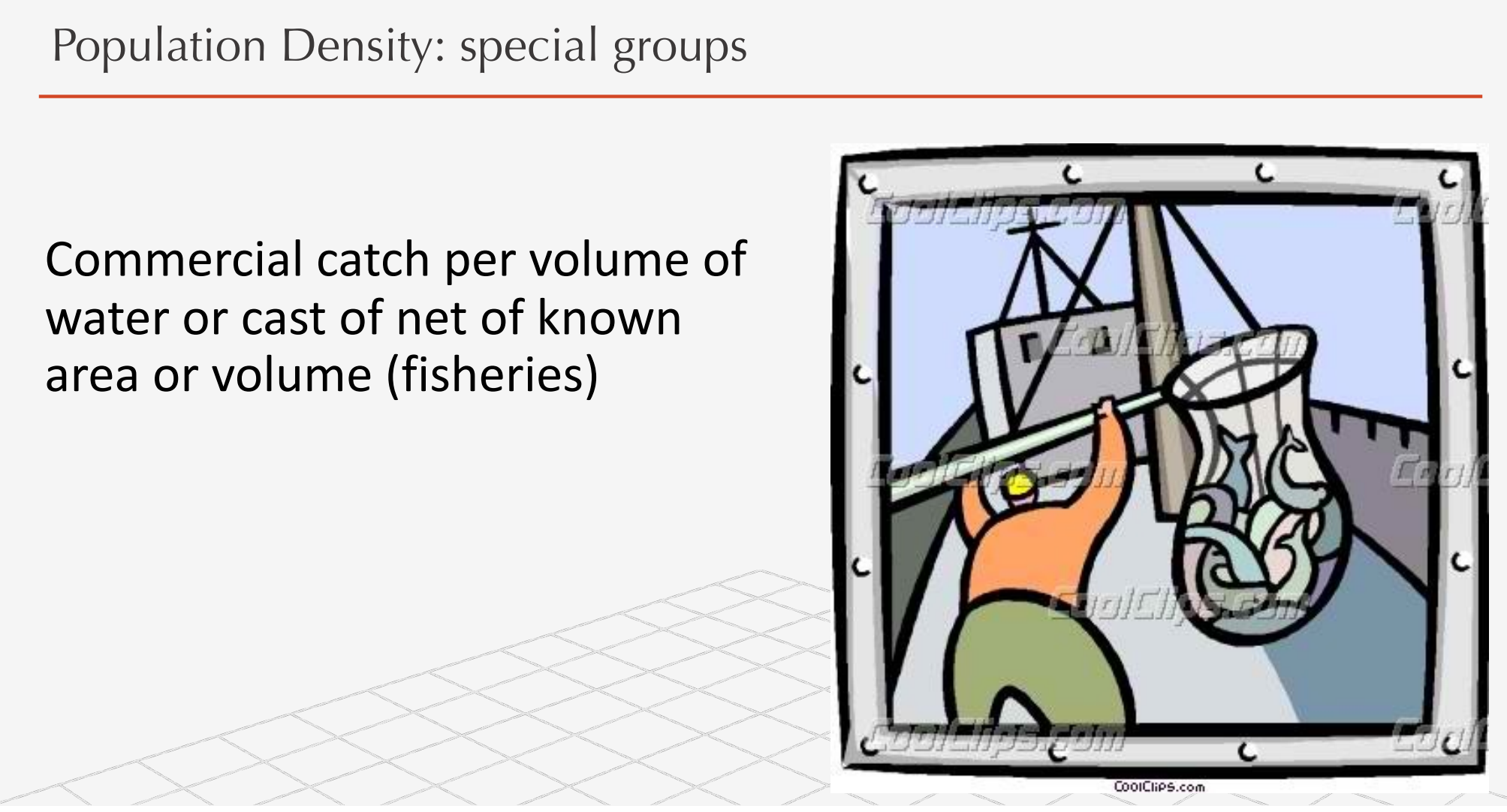
Transect-Quadrat sampling
Plotless methods (point quarter method)
Importance percentage value
Lincoln-Petersen Index (Capture Mark Recapture)
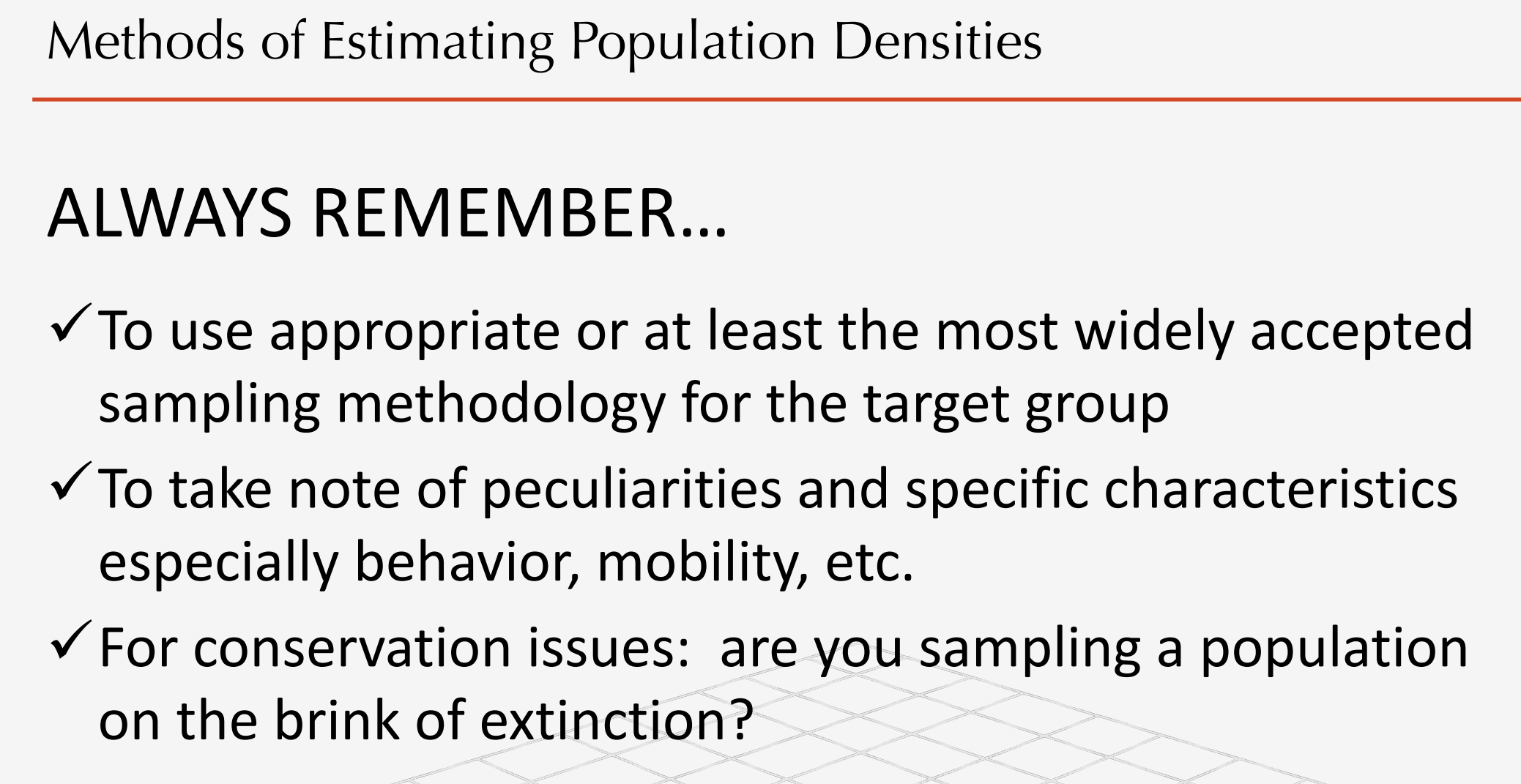
What are all the Methods for Estimating Population Densities?
Transect-Quadrat sampling
What does it mean by “appropriate”?
Body size (range) of target groups
Behavior (obvious or cryptic etc.)
Mobile, sessile; weak-/strong-flying etc.
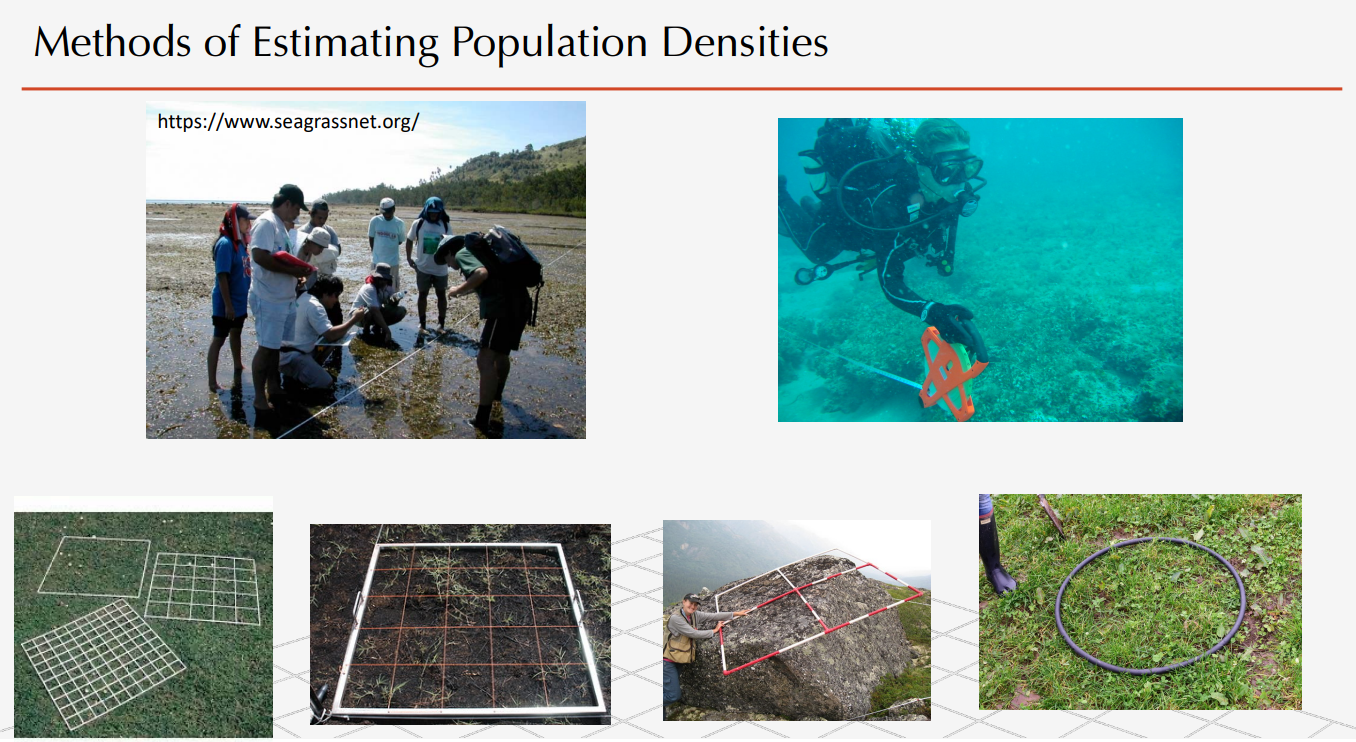
Methods of Estimating Population Densities
Involves counting of organisms of a single species in plots or transects of appropriate size and number
Transect-Quadrat sampling
Methods of Estimating Population Densities
Objective: to get an estimate of the density of the area sampled
Transect-Quadrat sampling
Methods of Estimating Population Densities
Applicable to a wide variety of terrestrial and aquatic species in environments ranging from forests to the bottom of the sea
bird & butterfly transect – 2 km
Ant transect – 180-250 m
Weed sampling – 1 sq m quadrat
Forest – 1 sq km plot
Methods of Estimating Population Densities
Transect-Quadrat sampling
___________________ – 2 km
______________ – 180-250 m
______________ – 1 sq m quadrat
________ – 1 sq km plot
Plotless methods
Methods of Estimating Population Densities
Based on random points (0 dimensional method)
Applicable to sessile organisms (trees)
Plotless methods
Methods of Estimating Population Densities
advantages over quadrat-based techniques:
Usually faster (especially in sparse communities)
Does not require selection or adjustment in quadrat size
Plotless methods
Methods of Estimating Population Densities
advantages over quadrat-based techniques:
Requires less equipment - just need a way to measure distance (e.g., meter stick, tape measure, or laser range finder)
Point center quarter method
Methods of Estimating Population Densities - Plotless methods
based on a series of random points
Distance to nearest individual is measured in each of 4 quarters at each point along this series of random points
Point center quarter method
Methods of Estimating Population Densities - Plotless methods
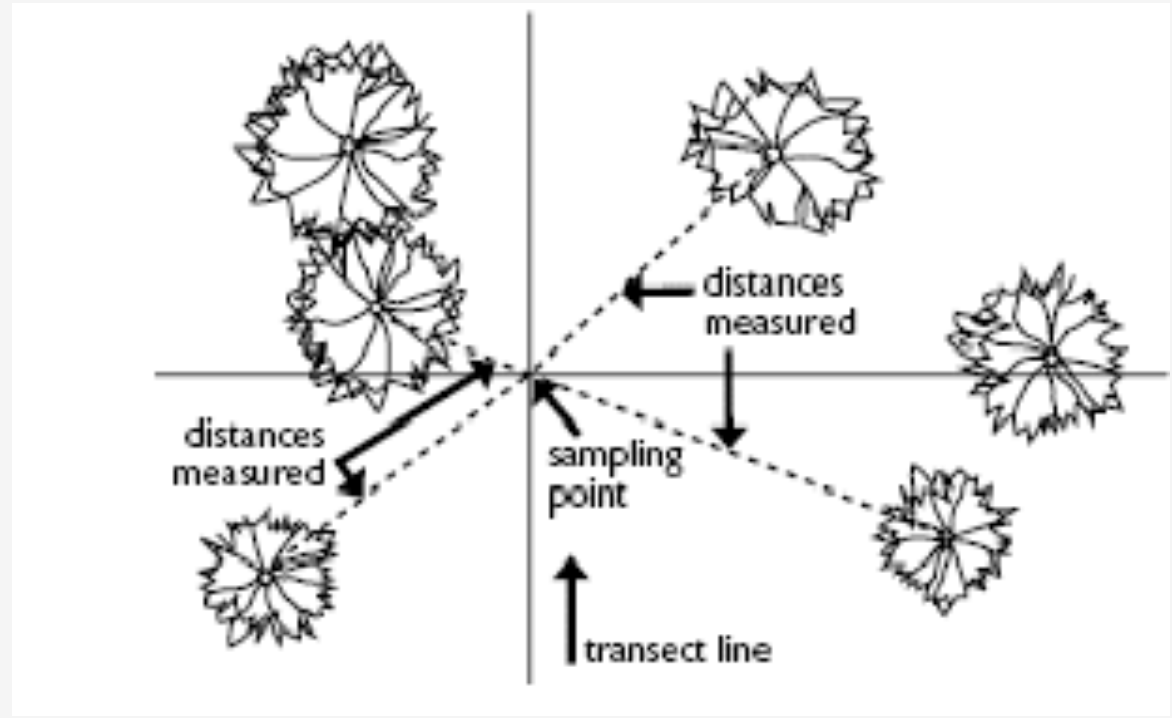

Methods of Estimating Population Densities - Plotless methods - Point center quarter method
What is the formula for point center quarter method?
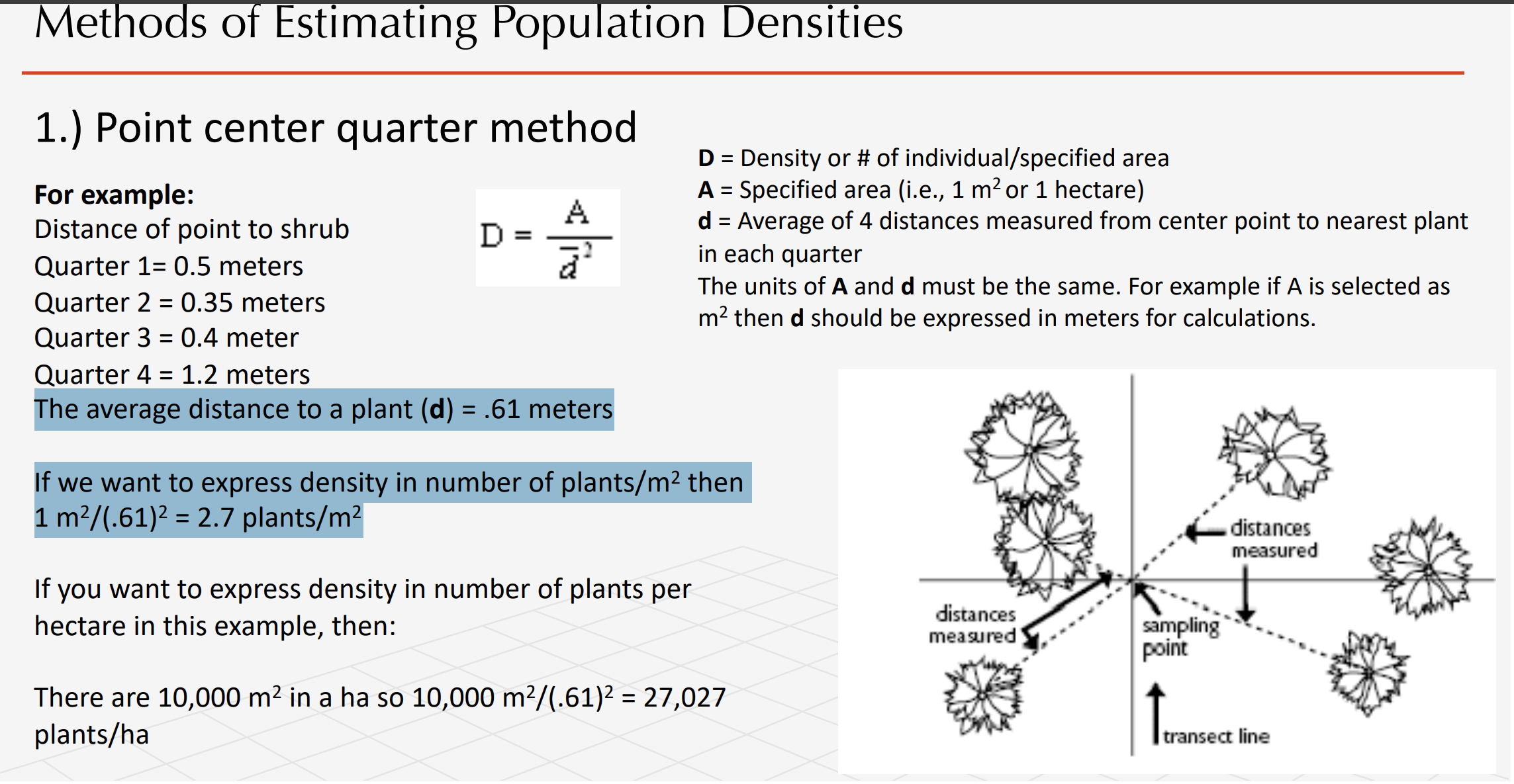
Methods of Estimating Population Densities - Plotless methods - Point center quarter method
For example:
Distance of point to shrub with 1 m2 area
Quarter 1= 0.5 meters
Quarter 2 = 0.35 meters
Quarter 3 = 0.4 meter
Quarter 4 = 1.2 meters
Solve for Density or # of individual/specified area.
Nearest neighbor
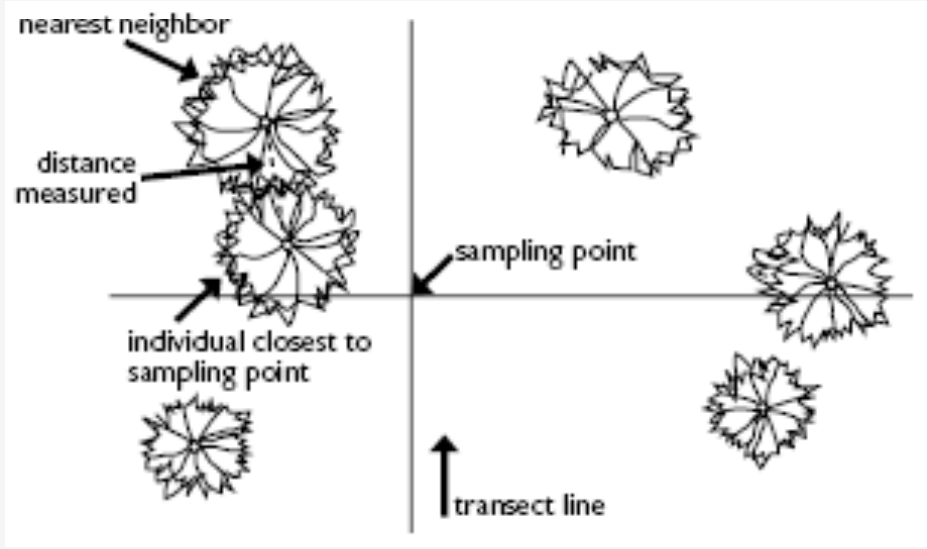
Methods of Estimating Population Densities - Plotless methods
The distance from a selected plant to its nearest plant (neighbor) is measured.
Nearest neighbor
Methods of Estimating Population Densities - Plotless methods
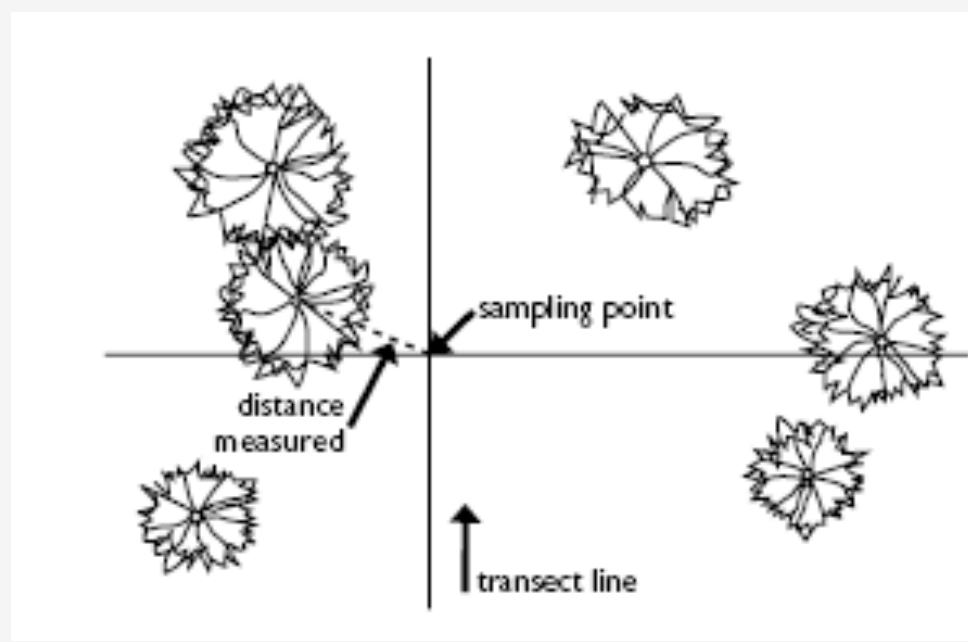
Choose a referent plant - (usually the closest individual to a selected point.)
Identify the plant closest to the referent plant and measure the distance between these two plants
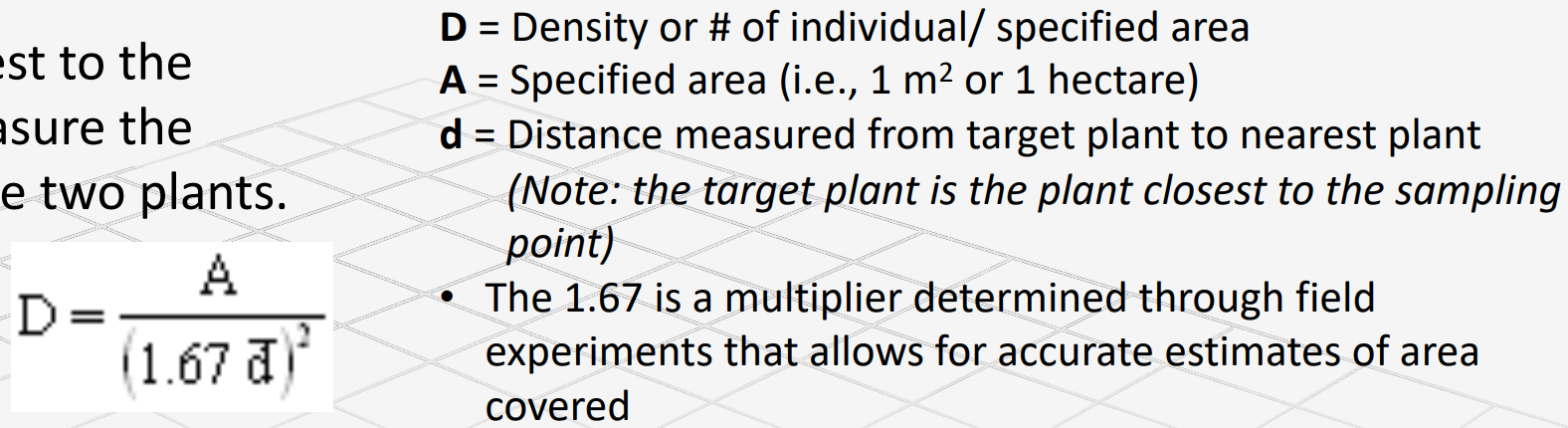
Methods of Estimating Population Densities - Plotless methods - Nearest neighbor
What is the formula for Nearest neighbor?
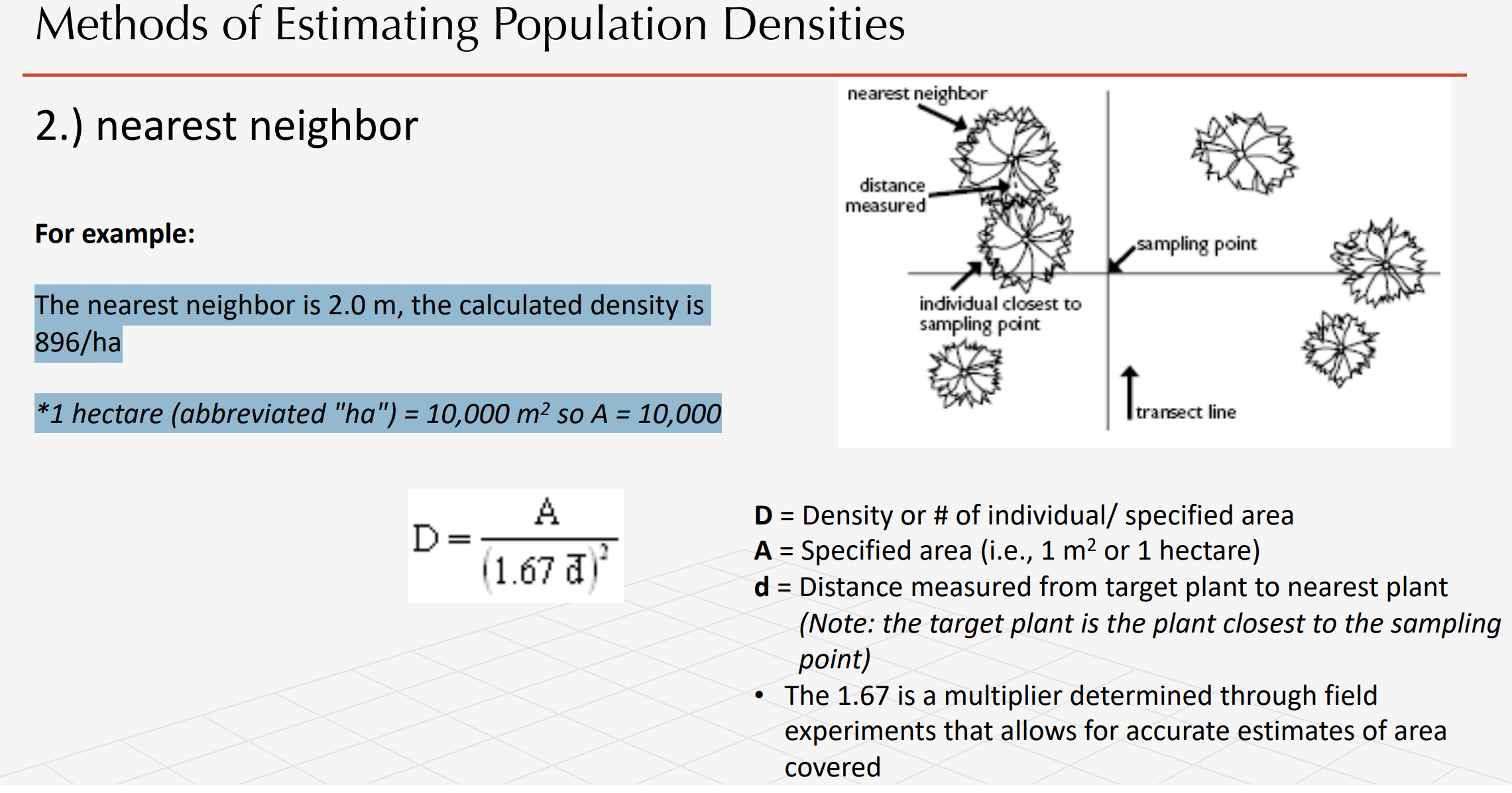
Methods of Estimating Population Densities - Plotless methods - Nearest neighbor
For example: The nearest neighbor is 2.0 m in an area of 1 ha.
Solve for the Density or # of individual/ specified area.
Closest individual
Methods of Estimating Population Densities - Plotless methods
The distance from a sample point to the closest individual is measured.
Choose a series of points in the sample area
Measure the distance to the closest plant of interest

Methods of Estimating Population Densities - Plotless methods - Closest individual
What is the formula for Closest individual?
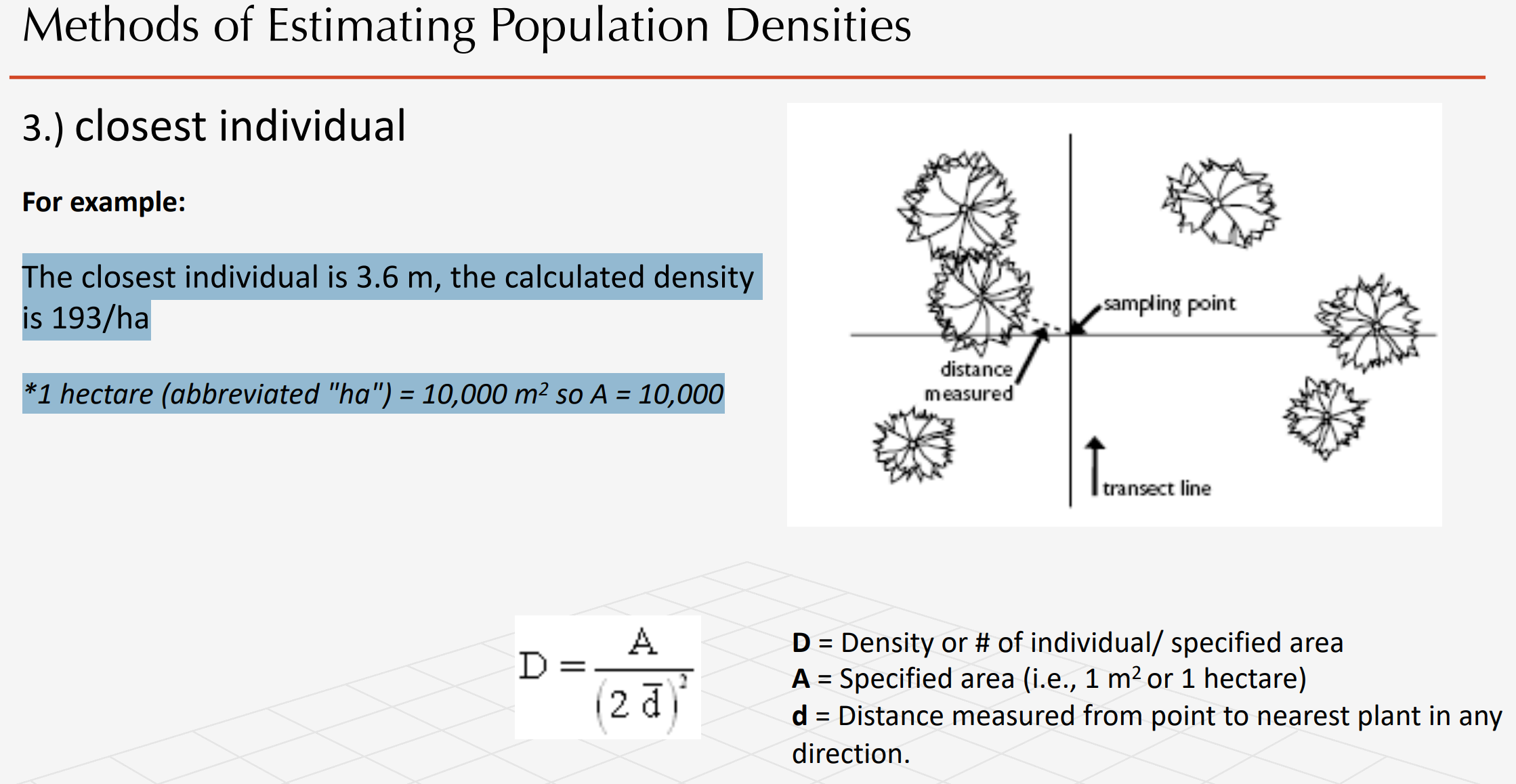
Methods of Estimating Population Densities - Plotless methods - Closest individual
For example: The nearest neighbor is 3.6 m in an area of 1 ha.
Solve for the Density or # of individual/ specified area.
Importance percentage value = sum of relative density (RDen), relative dominance (RDom) and relative frequency (RF) of a species in a community = RDen + RDom + RF
Rden = density of a species / total density for all species x 100
Rdom = basal area for a species / total basal area for all species x 100
RF = frequency for a species in a plot / total frequency for all species x 100
Methods of Estimating Population Densities - Importance values
What is the formula for Importance values and their respective variables (how to solve for them)?
Lincoln-Petersen Index (capture mark recapture)
Methods of Estimating Population Densities
random samples of the population are captured and these individuals are marked and then released to mingle with the general population
the population is resampled after enough time has passed to allow complete remixing of the marked individuals
Lincoln-Petersen Index (capture mark recapture)
Methods of Estimating Population Densities
Assumes that the proportion of marked animals in the second sample is the same as the proportion of marked animals to non-marked within the whole population
Assumptions:
the population is closed (births, deaths, emigration, and immigration are negligible)
all individuals have the same probability of capture and recapture
marked animals are randomly distributed in the population at the time of recapture
Methods of Estimating Population Densities - Lincoln-Petersen Index (capture mark recapture)
What are the assumptions of Lincoln-Petersen Index (capture mark recapture)?
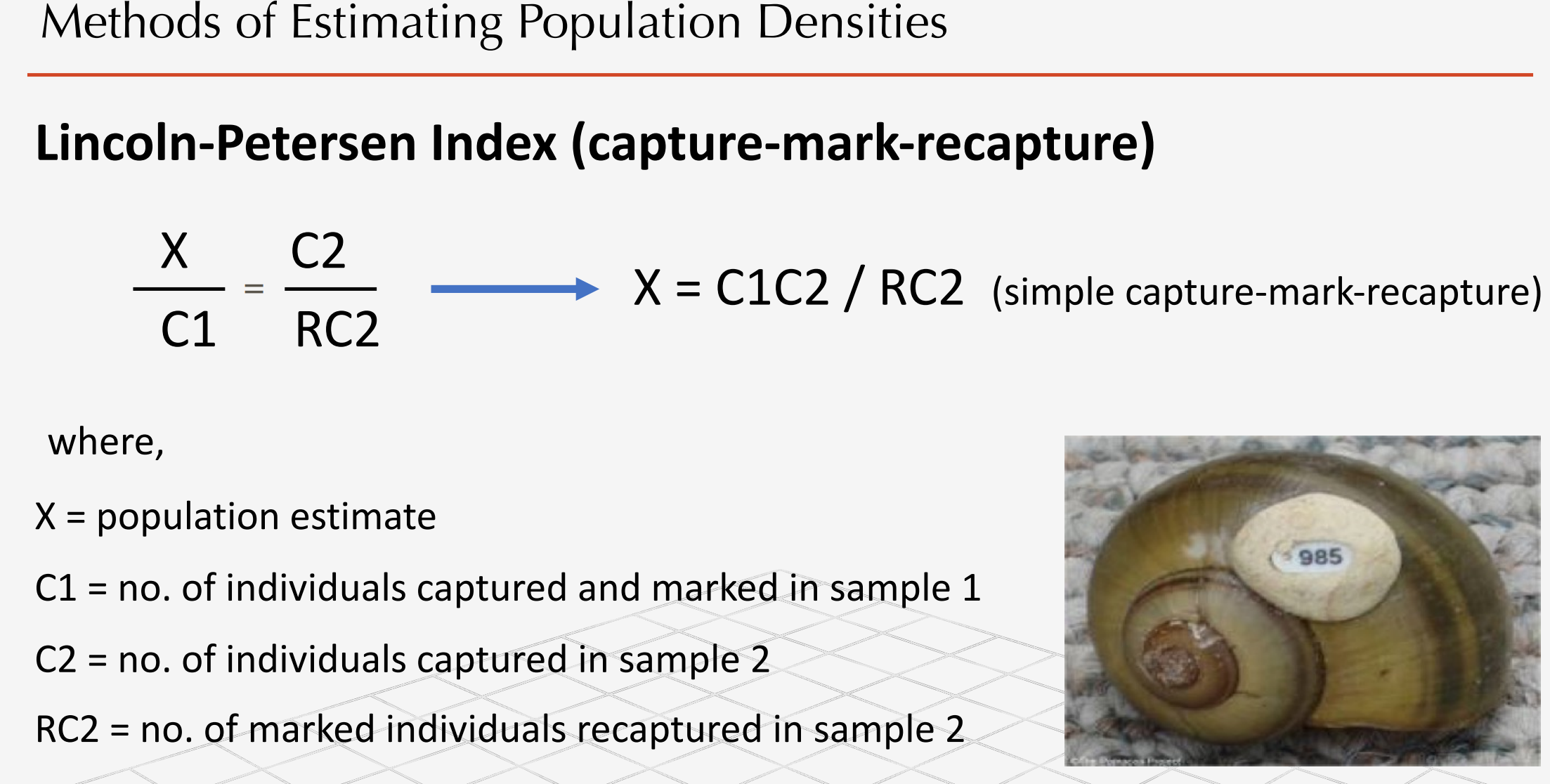
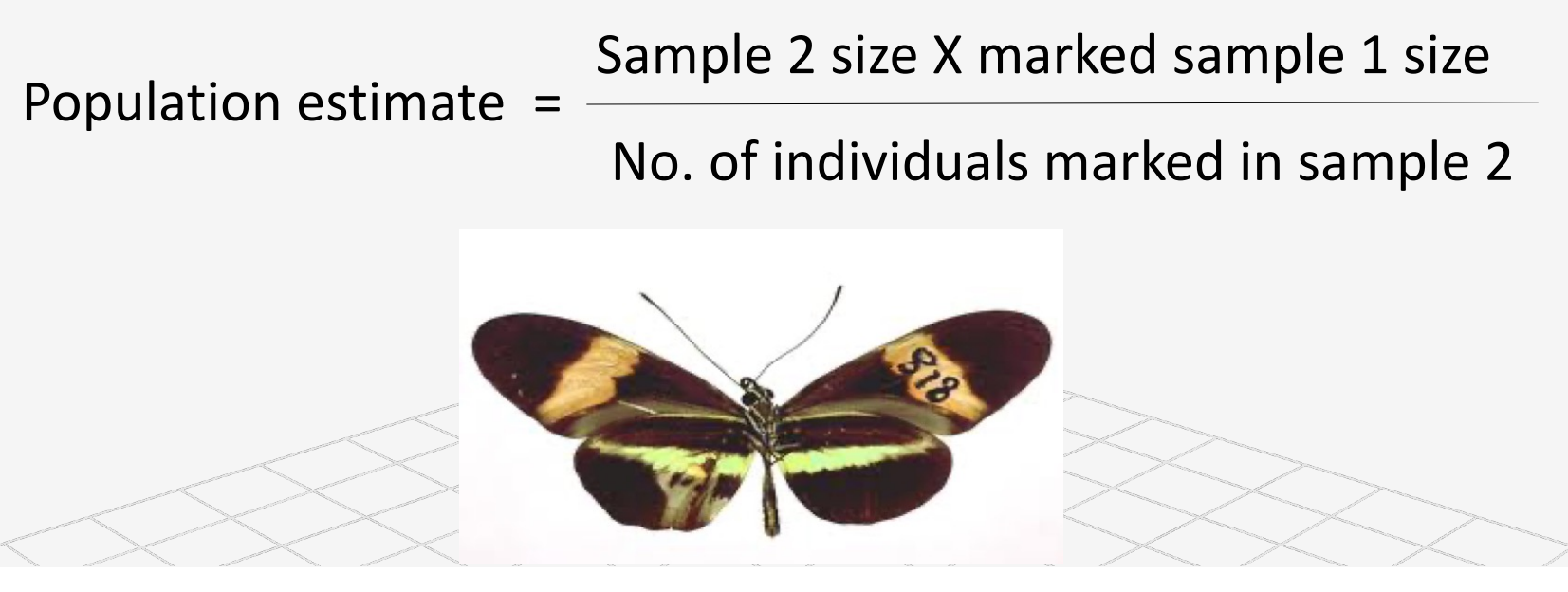
Methods of Estimating Population Densities - Lincoln-Petersen Index (capture mark recapture)
What is the formula for Lincoln-Petersen Index (capture mark recapture)?

