Lecture 15: Glycogen Metabolism (Glycogenolysis+Glycogenesis) and Pentose Pathway
 Call Kai
 Learn
Learn Practice Test
 Spaced Repetition
 Match
Match Flashcards
 Knowt Play
1/20

There's no tags or description
Looks like no tags are added yet.
Name | Mastery | Learn | Test | Matching | Spaced | Call with Kai | Chat |
|---|
No analytics yet
Send a link to your students to track their progress
21 Terms

Glycogen
The primary stored form of glucose in the body, acts as quick-release energy source kept mainly in your liver and skeletal muscle.
Made of two main types of covalent glycosidic bonds: alpha-1,4 (90%) and alpha-1,6 linkages (10%).
Has one reducing end and many nonreducing ends
People think that liver glycogen is primarily used to fuel local liver metabolism,but this is not true
Glycogenolysis
The breakdown of stored glycogen into glucose, retrieving stored glucose.
Happens when blood glucose level is low
During Fasting State

Glycogenolysis: Step 1
An enzyme called Glycogen Phosphorylase a starts at the nonreducing ends and throws phosphates at the α(1→4) bonds, which break the bonds and releases glucose-1-phosphate (G1P).
0 ATP molecules are used in the release of glucose-1-P from glycogen.

Glycogenolysis: Step 2
Glycogen phosphorylase stops doing it breaking 4 glucose’s before an α(1→6) branch.
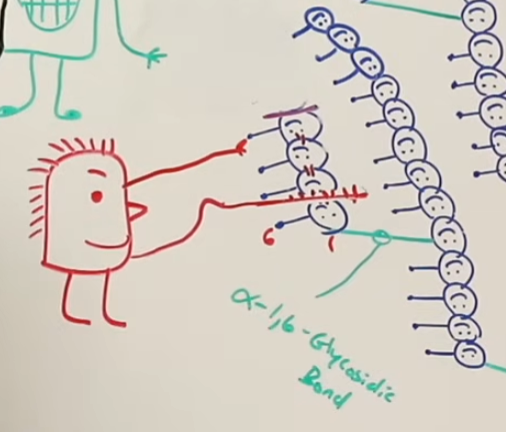
Glycogenolysis: Step 3
Debranching Enzyme:
Transferase sliced an a(1,4) bond between one of the 4 glucose chain and moves 3 glucose molecules to another chain.
Glucosidase hydrolyzes/breaks the α(1→6)- branch point and releases 1 free glucose.


Glycogenolysis: Step 4
Phosphoglucomutase converts glucose-1-phosphate (G1P) into glucose-6-phosphate (G6P) before it can enter glycolysis.
Hormones that facilitate Glycogenolysis
Hormones do not act only in the tissue in which they are synthesized, they typically travel through the bloodstream to distant targets
Glucagon
Epinephrine (Adrenaline): Hormone tells organ to start breaking glycogen when energy is needed.
Glucagon and epinephrine both stimulate glycogen breakdown in the liver and muscles to raise blood sugar and provide quick energy during fasting, exercise, or stress.
Hormone Signaling Cascade: Retrieving Stored Glucose/Breaking down Glycogen
Epinephrine activates Adenylate Cyclase which converts ATP into cAMP - Irreversible reaction
cAMP is the second messenger because it carriers the hormone’s signal inside the cell
cAMP then activates a kinase
Protein Kinase then phosphorylates (adds a phosphate group to) glycogen phosphorylase b, usually on the serine hydroxyl R group.
Kinase turns Glycogen phosphorylase b into Glycogen phosphorylase a, which is activated and starts glycogenesis.
Hormones work through a signaling cascade rather than binding directly to the metabolic enzyme, Cascades are designed for rapid signal amplification
Regulation of Glycogenolysis
Glycogen breakdown is tightly regulated, regulation occurs by enzyme activity.
Dismutase is NOT involved in regulation of glycogen synthesis
Glycogenesis
The process of turning extra glucose into glycogen for storage. It happens mostly in the liver and muscle cells when blood sugar levels are high, such as after a meal.
Glycogen Synthesis

Glycogenesis: Step 1
Glucose is phosphorylated to glucose-6-phosphate (G6P) by Hexokinase (muscle) or Glucokinase (liver) using ATP being turned into ADP.
Glycogenesis: Step 2
Phosphoglucomutase converts glucose-6-phosphate (G6P) into glucose-1-phosphate (G1P).
Glycogenesis: Step 3
Glucose-1-phosphate is converted into UDP-glucose (the activated form of glucose) by UDP-glucose pyrophosphorylase taking a phosphate group off of UDP nucleotide which make its UDP.
Glycogenesis (Step 3): Pyrophosphate (PPi).
Formation of UDP-glucose, when G1P combines with UTP, it also releases remaining inorganic pyrophosphate (PPi).
Hydrolysis of inorganic pyrophosphate releases a significant amount of energy to drive the glycogen synthesis reaction forward.
Glycogenesis: Step 4
Glycogenin takes the glucose from UDP-glucose and attaches it to one of its own tyrosine amino acids.
Glycogenesis: Step 5
Glycogen synthase adds glucose from UDP-glucose to the nonreducing ends of glycogen, forming α(1→4) glycosidic bonds.
Branching Enzyme creates a(1,6) brances
Glycogen Synthesis Regulation
Glycogen synthesis is tightly regulated.
Occurs through:
Enzyme regulation.
Signaling pathways.
Glycogenesis: Insulin
High blood glucose increases insulin release, which turns glycogenesis ON to store extra sugar as glycogen
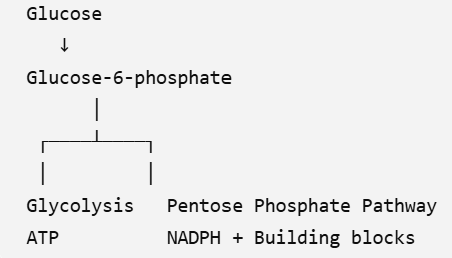
Pentose Phosphate Pathway
A metabolic process running alongside glycolysis in the cell cytoplasm that starts with glucose-6-phosphate and produces NADPH and biosynthetic building blocks.
Product 1: Biosynthetic Intermediates (Ribose 5-Phosphate (5 carbon sugar): Make DNA, RNA
Product 2: NADPH: Electron carrier for reducing power (Anabolism)
Does NOT make ATP
Pentose Phosphate Pathway: Oxidative Phase
First Half of the PPP.
Starts with glucose-6-phosphate (G6P).
Glucose-6-phosphate Dehydrogenase Enzyme removes a hydrogen (electrons) from G6P and transfers it to NADP⁺, producing the first NADPH. The product becomes 6-phosphoglucono-δ-lactone.
Lactonase adds water and opens the ring, converting 6-phosphoglucono-δ-lactone into 6-phosphogluconate.
6-Phosphogluconate dehydrogenase removes another hydrogen (electrons) from 6-phosphogluconate, producing the second NADPH.
During this same reaction, one carbon is released as CO₂, changing the molecule from a 6-carbon sugar to a 5-carbon sugar.
The final product of the oxidative phase is ribulose-5-phosphate (a 5-carbon sugar phosphate).
Main purpose of the oxidative phase: Produce 2 NADPH for biosynthetic reactions.
Glyceraldehyde-3-phosphate is NOT produced during the oxidative phase, focus on NADPH, not glycolysis intermediates.

Pentose Phosphate Pathway: Nonoxidative Phase
Second half of the PPP.
Starts with ribulose-5-phosphate
Phosphopentose Isomerase converts ribulose-5-phosphate into ribose-5-phosphate, which is used for nucleotide (DNA/RNA) synthesis.
Phosphopentose epimerase converts ribulose-5-phosphate into xylulose-5-phosphate, another 5-carbon sugar used in the pathway.
Transketolase transfers 2-carbon units between sugar molecules, rearranging them into different sugar phosphates. (Requires thiamine pyrophosphate (TPP) as a cofactor.)
Transaldolase transfers 3-carbon units between sugar molecules, creating additional sugar-phosphate intermediates.
Main purpose of the nonoxidative phase: Rearrange sugars and provide intermediates for glycolysis or nucleotide synthesis, negatively charged due to phosphate groups.
