A. Monosaccharides
 Call Kai
 Learn
Learn Practice Test
 Spaced Repetition
 Match
Match Flashcards
 Knowt Play
1/29

There's no tags or description
Looks like no tags are added yet.
Name | Mastery | Learn | Test | Matching | Spaced | Call with Kai | Chat |
|---|
No analytics yet
Send a link to your students to track their progress
30 Terms
d. Xylose
aldopentose
The monosaccharide known as wood sugar
a. Glucose
b. Galactose
c. Fructose
d. Xylose
d. Xylose
Aldopentose obtained from boiling straw of corn crops
a. Glucose
b. Galactose
c. Fructose
d. Xylose
b. Diagnostic aid for intestinal malabsorption
The diagnostic use of Xylose
a. Test for presence of ketones
b. Diagnostic aid for intestinal malabsorption
c. Test for presence of fructose
d. Diagnostic aid for renal function
d. Xylose

This is produced when heat was applied to xylan (polysaccharide)
a. Glucose
b. Galactose
c. Fructose
d. Xylose
a. Glucose
The monosaccharide known as dextrose, blood sugar, physiologic sugar, and grape sugar
a. Glucose
b. Galactose
c. Fructose
d. Xylose
a. Vitis vinifera
grapes
The plant source of Glucose
a. Vitis vinifera
b. Saccharum officinarum
c. Gossypium hirsutum
d. Solanum tuberosum
c. Purified type
The type of Glucose used as a parenteral nutrient source
a. Liquid glucose
b. Pharmaceutical necessity type
c. Purified type
d. Dextrose type
c. Purified type
The type of Glucose used in D5W
a. Liquid glucose
b. Pharmaceutical necessity type
c. Purified type
d. Dextrose type
b. Pharmaceutical necessity type
The type of Glucose that is not rigorously purified
a. Purified type
b. Pharmaceutical necessity type
c. Crystalline type
d. Liquid glucose
b. Pharmaceutical necessity type
What type of Glucose that is sweetener?
a. Purified type
b. Pharmaceutical necessity type
c. Crystalline type
d. Liquid glucose
d. Liquid glucose
The type of Glucose that is a syrupy liquid from incomplete hydrolysis of starch
a. Purified type
b. Pharmaceutical necessity type
c. Crystalline type
d. Liquid glucose
a. Fructose
The monosaccharide known as levulose or fruit sugar
a. Fructose
b. Galactose
c. Xylose
d. Glucose
a. Fructose
The sweetest monosaccharide but has bitter after taste
a. Fructose
b. Galactose
c. Xylose
d. Glucose
c. Fructose
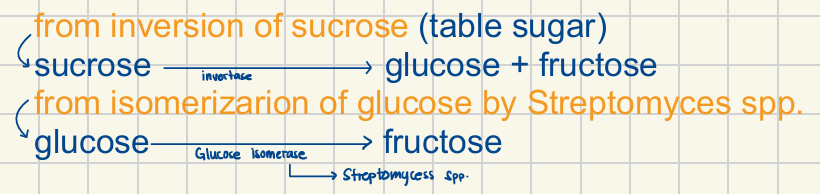
Formed from inversion of sucrose (table sugar).
a. Galactose
b. Mannose
c. Fructose
d. Lactose
c. Invertase
Enzyme that converts sucrose into glucose and fructose.
a. Maltase
b. Sucrase
c. Invertase
d. Lactase
b. Glucose + Fructose
Products of sucrose after inversion.
a. Glucose + Galactose
b. Glucose + Fructose
c. Fructose + Mannose
d. Glucose + Ribose
b. Fructose
Formed from isomerization of glucose by Streptomyces spp.
a. Galactose
b. Fructose
c. Maltose
d. Lactose
b. Glucose isomerase
Enzyme that converts glucose to fructose.
a. Invertase
b. Glucose isomerase
c. Sucrase
d. Amylase
b. Streptomyces spp.
Microorganism used in the isomerization of glucose to fructose.
a. Bacillus spp.
b. Streptomyces spp.
c. Escherichia coli
d. Lactobacillus spp.
b. Fructose
Sugar recommended for diabetes because of its low glycemic index.
a. Glucose
b. Fructose
c. Sucrose
d. Maltose
a. Fructose
Sugar used in infant feeding formula.
a. Fructose
b. Glucose
c. Lactose
d. Maltose
c. Seliwanoff test
Test for the presence of fructose.
a. Benedict's test
b. Fehling's test
c. Seliwanoff test
d. Molisch test
c. Galactose
Brain sugar.
a. Glucose
b. Fructose
c. Galactose
d. Mannose
b. Glucose and galactose
Sugar present in cerebrosides.
a. Fructose and galactose
b. Glucose and galactose
c. Glucose and fructose
d. Mannose only
b. Galactose
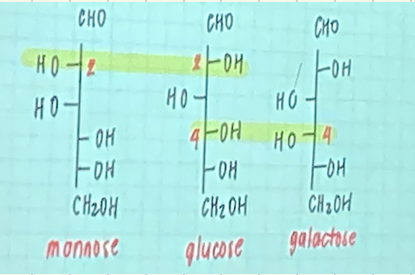
C4 epimer of glucose.
a. Mannose
b. Galactose
c. Fructose
d. Ribose
c. Galactose
Formed from the breakdown of lactose from milk.
a. Fructose
b. Mannose
c. Galactose
d. Ribose
c. Lactose
Disaccharide that is broken down into glucose and galactose.
a. Maltose
b. Sucrose
c. Lactose
d. Cellobiose
b. Lactase

Enzyme that converts lactose into glucose and galactose.
a. Sucrase
b. Lactase
c. Maltase
d. Invertase
b. Glucose + Galactose
Products of lactose hydrolysis.
a. Glucose + Fructose
b. Glucose + Galactose
c. Glucose + Mannose
d. Galactose + Fructose
c. Mannose
C2 epimer of glucose.
a. Galactose
b. Fructose
c. Mannose
d. Ribose