[THE ATOM AND SUBATOMIC PARTICLES] Atomic Model & Nuclear Chemistry
 Call Kai
 Learn
Learn Practice Test
 Spaced Repetition
 Match
Match Flashcards
 Knowt Play
1/44

Earn XP
Description and Tags
Proverbs 16:3
Name | Mastery | Learn | Test | Matching | Spaced | Call with Kai | Chat |
|---|
No analytics yet
Send a link to your students to track their progress
45 Terms
Atom
[ATOMIC MODEL]
______ is the smallest identifiable unit of matter - identifiable meaning one can assign names to it ( the name being the element , e.g copper, hydrogen, carbon, etc)
Proton
Electron
Neutron
[ATOMIC MODEL]
Today, smaller particles (the subatomic particles such as the ______ [3] ) exist but those have no unique names and are called the same way across all elements
Democritus
[ATOMIC MODEL]
Coined the term “atom” for the smallest identifiable unit of matter
John Dalton
[ATOMIC MODEL]
Formed the atomic theory (founded on the 3 fundamental laws of chemistry)
John Dalton
[ATOMIC MODEL]
Introduced the Billiard Ball Model that matter is made up of atoms as its basic unit
JJ Thomson
[ATOMIC MODEL]
Discovered the negatively -charged electrons via cathode ray tube experiments and assumed there are positive -charged particles balancing them out → plum pudding model
JJ Thomson
[ATOMIC MODEL]
He is known for the plum pudding model
Ernest Rutherford (with Hans Geiger and Ernest Marsden)
[ATOMIC MODEL]
Confirmed the positively -charged protons through gold foil experiments and proposed them to be concentrated in a small area (the nucleus) → nuclear model
Ernest Rutherford (with Hans Geiger and Ernest Marsden)
[ATOMIC MODEL]
He is known for the nuclear model
James Chadwick
[ATOMIC MODEL]
Discovered the uncharged neutrons by bombarding beryllium with polonium
Robert Millikan
[ATOMIC MODEL]
Measured the elementary electric charge (I.e. the real value “-1” or “+1” in coloumbs through the oil drop experiment)
Robert Millikan
[ATOMIC MODEL]
He is known for the oil drop experiment
Neil Bohr
[ATOMIC MODEL]
Proposed that electrons reside in energy levels/shells outside the nucleus → planetary model
Neil Bohr
[ATOMIC MODEL]
He is known for the planetary model
Werner Heisenberg
[ATOMIC MODEL]
Formulated the uncertainty principle , stating that one cannot accurately determine both the momentum and position of an electron at the same time (as if arguing againts the idea of fixed energy levels)
Ewin Schrodinger
[ATOMIC MODEL]
Improved on Bohr’s ideas and devised the quantum model where electrons lie dynamically in electron clouds rather than in fixed energy levels.
Ewin Schrodinger
[ATOMIC MODEL]
He is known for the quantum model
Nucleons
[ATOMIC MODEL]
Since protons and neutrons both belong to the nucleus , they are sometimes called _____
Atomic number
Mass number (aka atomic mass)
[ATOMIC MODEL]
The nucleons give rise to the:
______ → protons
______ → neutrons + protons
Atomic Mass
[ATOMIC MODEL]
Mass number is also known as _____
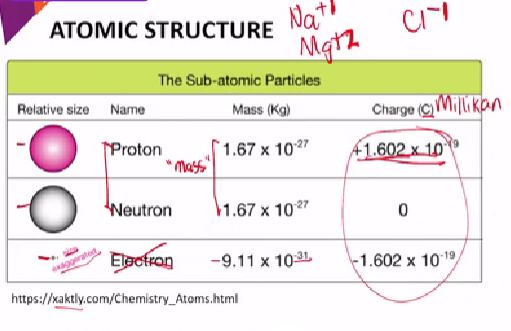
Hindi daw sya Lumalabas sa Board Exam sabi ni Sir!!!
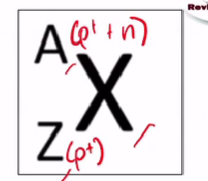
SUB-ATOMIC PARTICLES [DIAGRAM]:
A= mass number
Z = atomic number
NOTE: How to find the number of electrons?
Under the assumption that the element is neutral (no charge) it will only be neutralize if the number of protons and electrons are equivalent so # proton = # electron
[ATOMIC MODEL]
Figure 2.Element “X”
6
Atomic number = number of proton
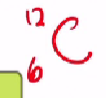
Find the atomic number
a. 6
b. 12
c. 8
d. 10
12
Atomic Mass = Mass number
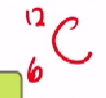
Find the atomic mass
a. 6
b. 12
c. 8
d. 10
6
Number of Proton (Atomic number) = Number of Electron
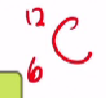
Find the number of electrons
a. 6
b. 12
c. 8
d. 10
6
Neutron = Atomic mass (mass number) - Electron

Find the number of neutrons
a. 6
b. 12
c. 8
d. 7
Nuclides
A term for atoms when they have similar nucleons
Isotopes
Isotones
Isobars
Types of Nuclides [3]
Isotopes
[ATOMIC MODEL]
Same protons but different neutron and mass number
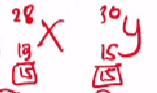
Isotones
[ATOMIC MODEL]
Same neutron but different proton and mass number
Example:
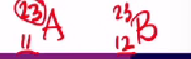
Isobar
[ATOMIC MODEL]
Same mass number but different proton and neutron
Example:
Radioactivity
[NUCLEAR CHEMISTRY]
____ is the property to perform radioactive decay ramdomly
Radioactive decay
[NUCLEAR CHEMISTRY]
_____ is the release of energy, which can be accompanied by change in the quantity of nucleons (either protons or neutrons)
Alpha
Beta
Gamma
Types of Radioactive Decay [3]
Alpha
Example:
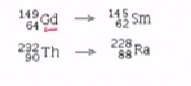
[TYPE OF RADIOACTIVE DECAY]
Release of 2 proton and 2 neutrons
Loss of 4 in mass number
a. Alpha
b. Beta
c. Gamma
Beta
Example:
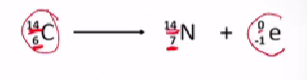
[TYPE OF RADIOACTIVE DECAY]
Release of 1e accompanied by conversion 1n to 1p
No loss in mass number
a. Alpha
b. Beta
c. Gamma
Gamma
Example:
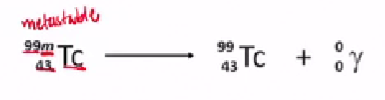
m = means metastable (unstable) it has a lot of energy that wants to release all we have to do is to erase the "m"
[TYPE OF RADIOACTIVE DECAY]
Release of high energy protons
No loss in mass number
a. Alpha
b. Beta
c. Gamma
Penetration
Ionization
[TYPE OF RADIOACTIVE DECAY]
The crucial properties of decays are their _____ (capabiity to pierce through berriers) and _____ (capability to damage things / cause death)
Alpha
[TYPE OF RADIOACTIVE DECAY]
Have the LEAST PENETRATION (stopped by skin or paper)
a. Alpha
b. Beta
c. Gamma
Beta
[TYPE OF RADIOACTIVE DECAY]
Have the MIDDLE PENETRATION (stopped by a sheet of alimunum)
a. Alpha
b. Beta
c. Gamma
Gamma
[TYPE OF RADIOACTIVE DECAY]
Have the MOST PENETRATION (stopped by thick layer of lead)
a. Alpha
b. Beta
c. Gamma
Alpha
[TYPE OF RADIOACTIVE DECAY]
Have the MOST IONIZATION
a. Alpha
b. Beta
c. Gamma
Beta
[TYPE OF RADIOACTIVE DECAY]
Have the MIDDLE IONIZATION
a. Alpha
b. Beta
c. Gamma
Gamma
[TYPE OF RADIOACTIVE DECAY]
Have the LEAST IONIZATION
a. Alpha
b. Beta
c. Gamma
Measurement Type | Common Unit | SI Unit |
|---|---|---|
Radioactivity | Ci (Curie) | Bq (Becquerel) |
Absorbed Dose | RAD (radiation absorbed dose) | Gy (Gray) |
Effective Dose | REM (roentgen equivalent man) | Sv (Sievert) |
Exposure | R (roentgen) | C/kg (Coulomb/kg of air) |
Units For Radioactivity