GENE223 - Mod 2, Animal Development
 Call Kai
 Learn
Learn Practice Test
 Spaced Repetition
 Match
Match Flashcards
 Knowt Play
1/74

There's no tags or description
Looks like no tags are added yet.
Name | Mastery | Learn | Test | Matching | Spaced | Call with Kai | Chat |
|---|
No analytics yet
Send a link to your students to track their progress
75 Terms
What are some of the most popular model multicellular organisms?
Drosophila (flies), C. Elegans (roundworms), Danio rerio (Zebrafish), S. cerevisiae (Yeast), A. thaliana (mustard plant)
Describe the embryonic strategy employed by Zenopus (frogs)
Xenopus females lay large eggs with provisions for 12 cell divisions
• The cells divide holoblastically: the whole embryo is sliced into cells - this is cleavage.
Describe cleavage during development
The whole embryo is sliced into cells. This is called cleavage.Cleavage cycles are shortened cell cycles which are rapid and synchronous.
What is the most difficult stage of triblastic organisms’ development?
Gastrulation, this is the switching of many cells from blastrulation into three different segments, exoderm, mesoderm and ectoderm. These segments can develop further into different body parts.
Describe the different ways an embryo develops into multicelularity
Cohesive multicellularity:
Starts with a single cell, spore or fertilized egg, that divides by mitosis to become an embryo. Cells remain together and feed in the multicellular stage.
Aggregative multicellularity:
Single cells feed and proliferate, only coming together when starved. Aggregates form fruiting bodies that can become dormant cysts or spores.
Describe the process of D. discoideum switching to aggregate multicellularity
The trigger is High pre-starvation factor and high cell density. This is facilitated by a chemotaxis, as amobae move towards high [cAMP].
cAMP triggers the GtaC, a GATA transcription factor which upregulates three proteins to be produced for cell adhesion.
~10^5 cells gather, cAMP pulses from the top shape the slime slug development.
Describe what germ cells are and why they are set aside early in development
Germ cells are pre-sex cells used to form gametes, they have different development patterns as they perform meiosis and their different developmental pattern causes them to be differentiated early.
What does a fate map show?
Inside a drawing of an embryo different portions of the system will be coloured or otherwise indicated to show what system they will develop into.
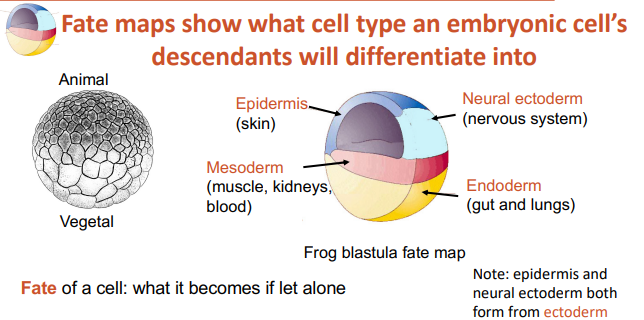
What is determination versus specification
Determination is the process where a cell develops into a certain kind of cell regardless of it environment, its cell type is already determined.
Specification is development to a kind of cell type in response to its environment. Usually the developing cell receives chemical messengers telling it to express certain genes and develop to be part of a tissue.
What is the main process through which cells segregate to different fates?
a) Localized determinants: proteins/RNA elements that push expression of a cell towards one tissue type. It is not cloned during mitosis and so only ends up in one of the daughter cells.
b) Inductive signalling: the localised determinant in the cell makes the cell produce chemical messengers that specify its surrounding cells.
c) Different Environments: After cell polarization and embryo compaction, the inner cells are cut off from the rest of the organism. This environment can cause specification of all those cells into a tissue.
What are some different chemical signalling mechanisms used by cells to specifiy others during development?
Paracrine Signalling. This is generla release of chemical messages by a cell and it is released into extracellular space, binding to any cells with correct receptors.
Juxtacrine Signalling. This only works through on adjacent cells and induces them through gap or tight junctions.
What is the cell called containing a determinant that specifies surrounding cells to form a specific organ/tissue?
The Anchor cell
What are some genetics experiments used to understand how to vulva develops in C. elegans?
By lasering and destroying the anchor cell that signals vulva development, a phenotype formed is a vulva-less worm that isn’t able to excrete embryos.
Mutant-testing. Finding mutants via their phenotype and making deductions from there, using reduced function mutations and loss of function mutations to see how development is affected by certain proteins. (Lin3 is mentioned in slides)
Let23 encodes the Lin3 receptor, so non-functional Let23 causes no vulva development.
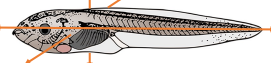
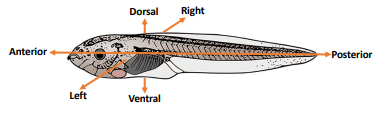
Label the early axes of bilatarians (6) like xenopus
Anterior - front
posterior - back
Dorsal - top like dorsal fin
Ventral - bottom, containing more organs while dorsal is spine.
Explain the experiment that lead us to understand how axes develop in amphibian embryos
Spemann-Mangold Organiser: By splitting embryos very gently at different angles to separate different parts, a grey section of the embryo was found to be required to be partially in each split part of the embryo to ensure proper development of the organism. This was the discovery of the Organiser.
How does the Organiser turn mesoderm cells from blood to dorsal muscle tissue?
Regular mesoderm cells produce BMPs (Bone morphogenetic proteins) that instruct cells to become and stay ventral mesoderm (blood cells). The organiser produces diffusing BMP inhibitor, which creates a [BMP] gradient which is interpreted by transcription factor promoters.
What is a morphogen
An information (chemical) gradient across cells, a long range signal that is secreted from cells at one loaction and diffuse away, forming a signal gradient. Cells along different points of the gradient directly respond to the signal, developing along different fates.
How is chemical concentration across the signal gradient from a morphogen interpreted by cells.
Cells will have multiple receptors with different binding affinities to the chemical signal, so they will have different responses based on their location in the signal gradient.
Explain how symmetry is broke in early amphibian development by the gray crescent containing a dorsal determinant
The grey crescent containing the dorsal determinant forms opposite the point of sperm entry due to cortical rotation, the dorsal determinant will determine the fates of surrounding cells and forming the dorsal region tissues.
How do transcription factors set off from morphogens switch genes on/off?
By allowing the transcription a gene; if this gene encodes a transcription factor as its protein product, it could potentially upregulate its own expression, thus starting a positive feedback loop that continues, that same transcription factor could block other genes from ever being expressed.
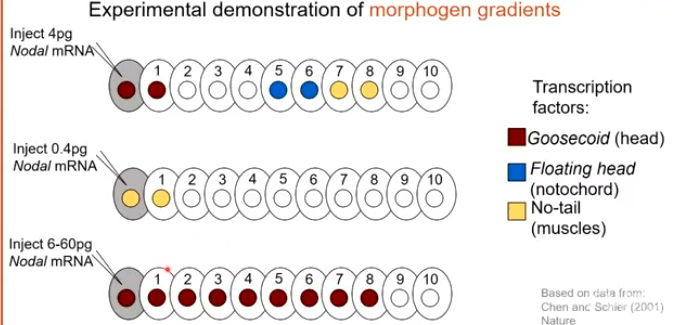
Describe and interpret experiments in zebrafish that demonstrate morphogen gradients.
By using expression markers to show what transcription factors are being expressed, experimenters injected different concentrations of an mRNA called Nodal. There were three distinct TFs and phenotypes at different signal concentrations, expressed in different cells depending on the concentration of Nodal added to the start cell.
Outline ways we can show where a gene is expressed in developing embryos.
Immunohistochemistry (for proteins), in situ hybridization (for mRNA)
Using reporter genes, getting a promoter for a gene expressed in nerve cells, then have that promoter express GFP and you can observe where those genes are usually expressed.
What is one method for finding the candidate genes within a molecular organiser?
Gene “fishing” to find genes expressed within the molecular organiser. On a dorsal blastopore area, there is a ‘lip’ where the organiser sits. You can dissect out organiser regions to extract mRNA being produced there, RT it into cDNA to make an expression library.
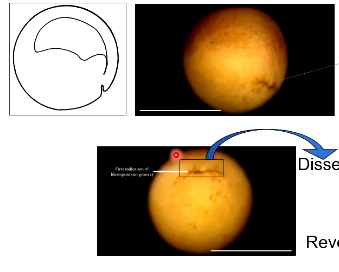
Explain and interpret experiments that led to the identification of the organiser candidate gene that encoded the TF in zebrafish.
Gene “fishing” in the organiser: discovery of Goosecoid gene
1. Isolate homeobox sequences from expression library: identify Goosecoid
Gsc is expressed only in the organiser.
Inject synthetics Gsc mRNA into ventral blastomeres, this causes two axes to form, indicating that Goosecaod is a candidate gene in vertebrates. Gsc is a TF tho, so it can’t be the actual morphogen.
Describe the experiment used to determine the morphogen element in the organiser of xenopus (amphibian) embryos.
using UV ventrilation, which destroys the dorsal determinant, causing only a belly of a zebrafish to form. They then injected pools of mRNA from their expression library, those that restored regular development were split in half and injected again, thus narrowing down the candidate genes until we could identify the determinant one.
How were candidate genes identified in zebrafish via experiments
Via mutagenic screening, we identified mutants with defects in the ventral regions organiser gene.
What drives assymetric cell division?
The positioning of the mitotic spindle during cytokinesis can change if a determinant is split between or goes to one daughter cell.
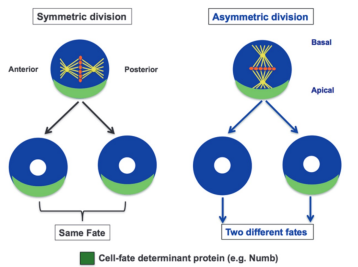
Describe how Numb regulation results in the formation of sensory hairs in Drosophila
Numb is a genetic determinant transcription factor that is produced and blocks signalling from Notch (which tells cells to become hair and socket cells). This allows for asymmetric cell division, as Numb falls into only one of the cells post-cytokinesis, forming SOP (Sensory organ precursor) cells to differentiate into socket and hair cells, or neuron and sheath cells in Drosophila sensory hairs. If the Numb gene is mutated to be non-functional, then Notch will be active in both cells and cause differentiation into hair and socket cells always, whereas if it’s overexpressed, there is enough Numb to spread around the whole cell, so only neuron and sheath cells will be formed.
How do Par genes work with mitotic spindle orientation, Inscutable and Numb/notch signalling to cause neuron differentiation in Drosophila larval neuroblasts
Polarity forms: An embryonic neuroblast in the epithelium of an embryo (the outer cell layer) delaminates, moves into the center of the embryo and maintains the positions of its determinants, including Par6.
Spindle orientation: Par6 (also called Bazooka/Baz) anchors Inscuteable/Insc, which is an adaptor protein that connects Par6 with a complex called Mud. Mud binds to microtubules to direct spindle orientation for asymmetric cell division. Mud, Baz, and Insc are on the apical side (top), and Brat, Pros, and Numb are on the basal side (bottom) of the cell.
Asymmetric cell division: After division, Numb, Pros, and Brat are inherited only by the GMC. Mira is degraded and Pros enters the nucleus, promoting differentiation. Also, during mitosis, Miranda (Mira) tethers Pros to the basal cortex during mitosis, stopping it from acting as a transcription factor (what does Pros do)
Neural differentiation: Numb promotes endocytosis of the Notch receptor (inhibits juxtacrine Notch signalling). Pros inhibits cell cycle and activates neural differentiation

Describe how asymmetric cell divisions regulate the formation of the brain neocortex in mammals
Neurogenesis begins as oblique (oblique angle so not parallel or perpendicular) cell divisions create one Neural stem cell (NSC) adhered to the lumen and one neuroblast that is free to migrate to the preplate layer (beginnings of the neocortex).
Numb is inherited only by the neuroblast, where it turns off Notch signalling and activates differentiation.
The other daughter cell has the Par (partitioning-defective) complex and no Numb, and remains a stem cell.

Compare how the Y chromosome determines sex in Mammals vs Drosophila
In mammals, presence of a Y chromosome determines an organism to be male, via developmental changes made to gametes to form testis. This determination is signalled throughout the whole body.
In Drosophila, every cell independently decides whether it is male or female. It decides based on X chromosome to Autosome ratio. If the ratio of X chromosome to autosome is 1:1, the Drosophila will be male, if its 0.5 it will be female. This is more observable in cells/drosophila with aneuploidy.
Describe the genetic cascade leading to sex determination in Drosophila.
A high X chromosome-to-autosome ratio causes expression of the sex-lethal gene, producing a sex-lethal protein.
This protein is a splicing factor that causes a stop codon to be missed from an exon, allowing a transformer protein to be produced
Active Transformer is a splicing factor that causes active female double-sex protein to be made.
If there is a low ratio of X chromosomes to autosomes, then active sex-lethal and transformer are not made, so the male version of double-sex is formed.

What are the three main requirements for mutagenic screenings?
A scorable/observable phenotype
A way to make homozygous mutants (most mutations cause heterozygous organisms so we usually need to be able to breed them)
A way to keep mutants, so they need to survive and we need to control them.
What are the elements of a balancer chromosome?
Balancers are chromosomes constructed with three elements.
• Dominant morphological markers.
• Recessive lethal mutations.
• Multiple inversions
What is the purpose of including multiple inversions in balancer chromosomes?
To suppress recombination (specifically crossing over) in the chromosomes during meiosis. The inverted segments mean that if the segments cross over with another, both chromosomes will have big breaks in the sequence so the organism will not survive. This selects for non-crossed over chromosomes in offspring.
What are maternal effect genes?
Genes that don’t follow Mendelian inheritance patterns, they only follow the maternal gene patterns, so they are a subgroup of parental inheritance. Often these maternal effect genes control development of the egg oocyte post-fertilization. Genes that show only maternal effects could mean the mother is responsible for causing that part of development.
What is an example of a maternal effect gene in Drosophila? And how does it drive its development pathway?
Bicoid has been identified and sequenced and encodes a transcription factor that turns some genes on, and some off. Bicoid acts as a master regulator gene of anterior development.
Bicoid mRNA is made in the ovary and placed into the unfertilised egg at the anterior end.This mRNA is a morphogen translated after fertilisation forming a gradient of Bicoid protein, highest at the anterior, lowest at the posterior.

How does a morpogen concentration gradient cause segmentation across Drosophila during development?
Using Gap genes, which ‘read’ a morphogen concentation, like Bicoid, can cause segmentation between developing gene areas. Gap genes mark the identity of different parts of a developing embryo, specifying its growth pathways Gap genes have different patterns that they can cause.
How can we determine the order of gene expression during development?
Using Epistasis, since a lot of genes are sequential during development, knocking one out will pause development in all the rest.

Why is there epistasis between development Gap genes?
Because there is a clear sequential pathway. Gap genes, like
Hunchback, are regulated by maternal genes by responding to levels of the Bicoid transcription factor.
Other Gap genes, like Krüppel, are regulated by Hunchback and other maternal genes in similar ways. The entire segmented area of the embryo is marked out by overlapping domains of gap genes.
How do Gap genes generate different segmentation patterns, give two examples.
Hunchback is a gap gene that is regulated by maternal genes, by responding to Bicoid Concentration, at a certain concentration it starts expressing.
Kruppel on the other hand is regulated by Hunchback and other maternal genes, but only responds to intermediate levels of Hunchback concentration, so it forms somewhat centrally in the body (remember Bicoid and therefore hunchback have a concentration gradient from High anterior to low posterior)
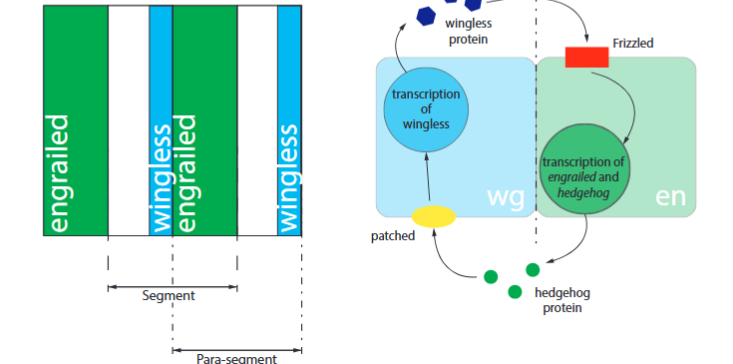
What are pair-rule genes?
The first set of genes to be expressed in a segmented way are the pair-rule genes. These genes are expressed in a stripe in every other para-segment. Para-segments next to each other is defined by the presence of expression in one segment and absence in the next. All 14 para-segments of the embryo are marked out, but not by the expression of any single gene.
How are pair-rule genes regulated by Gap genes? Say an example
Each stripe of each pair-rule gene is regulated independently by the Gap genes. For example, eve stripe 2 is activated by the expression of hunchback and bicoid and repressed by giant and krüppel. The overlapping expression patterns of the Gap genes thus define all the stripes of each pair-rule gene. This is done by the pair-rule genes location on DNA, with the repressors and enhancers at distances that relate to their location-signal. Every pair-rule gene has different Gap genes regulating it.

What is the difference between para-segments and segments, and why does expression actually differentiate at para-segments?
Segments go from trough to trough of differentiated cells, whereas parasegments are displaced by half a cell-length, so go from peak to peak. It is believed that this is because muscle fibres go from parasegment to parasegment and so lots of other expression occurs there too. Muscles need to go from parasegments because if a segment occurs and differentiates a cell, the muscle won’t be connected to it so it may be bisected along its length, making it useless.

What is the final step in the pair-rule segmentation cascade?
The segment polarity genes. These are activated by the pair-rule genes such that each segment has the same expression pattern of segment polarity genes. The activation of these genes is driven by complex patterns of overlapping pair-rule gene expression. These genes express at the segment boundaries with a different gene on the other side, and form a feedback loop that maintains difference between the sigments.
What is Homeosis?
The process where one body part of an organism is replaced by another.
What are homeotic genes?
Homeotic genes seem to encode the ‘identity’ of body parts. Many of these changes are heritable, indicating the presence of homeotic genes - genes that, when mutant, give a homeotic phenotype
What are HOX complexes in Drosophila, and give two examples.
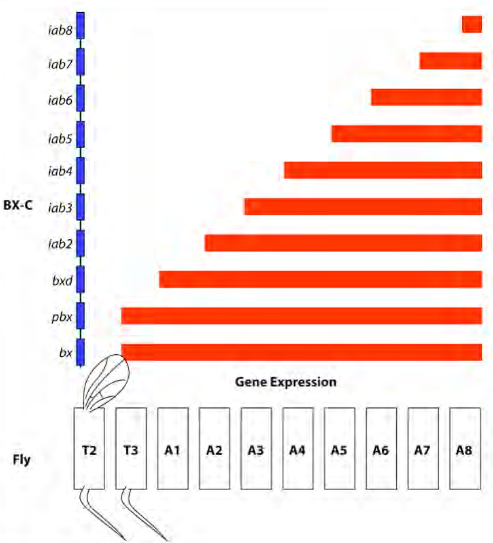
Hox complexes are groups of Homeotic genes packed close together on a genome.The ANT-C complex controls the identify of anterior segments,while the BX-C complex controls the identity of more posterior segments.
What was found by mutated BX-C genes in Drosophila?
It was found that dominant mutations in BX-C tended to change segment identity to the next most posterior segment and recessive mutations acted in the opposite way.
Thus bithoraxoid allele (bxd) changes the first abdominal segment (A1), to a third thoracic segment (T3)- giving a fly with 4 pairs of legs.
bithorax (bx) gene variant changes the anterior part of T3 to T2, and postbithorax (pbx) changes the posterior part of T3 to that of T2, giving a fly with four wings
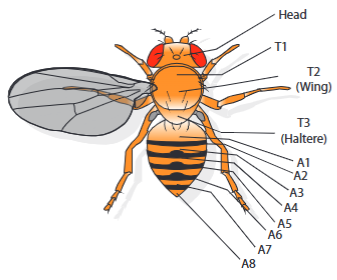
Describe Lewis’ Model about Hox genes expression
He proposed that each of the genes he had identified were expressed in limited patterns in the fly.
• In T2, no genes were expressed (because when all genes were deleted the segments all became T2).
• In T3 bx and pbx were expressed, in A1 bx, pbx and bxd were expressed. Thus when bxd was mutant, A1 became like T3.
• etc etc down the body.
Describe the makeup and function of the ANT-C?
Appears to act in the same way as BX-C, it contains 5 genes, they are expressed along the Anterior-Posterior axis of the body and regulate segment identity.
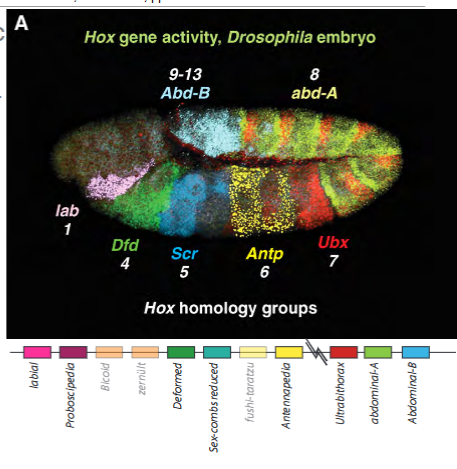
How is the ANT-C and BX-C regulated?
two complexes are regulated by the segmentation cascade.
• The genes recieve positional information form the maternal, gap and pair-rule genes.
• While the segmentation genes form the segmental pattern, the Hom-C genes define the identity of each segment
How are the Hom-C (Hox) genes organised?
The genes are organised on the chromosome in the same order as they are expressed in the body.
What is the gene motif common to all Hom-C or Hox genes?
they all contain a DNA binding motif named the Homeobox.
• All of these genes are transcription factors that activate and/or repress genes
What is the mechanism through which Hox genes act?
We used to think they were transcription factors, turning genes on/off. Recent studies show thats not quite true. (PD says its like constantly reminding every cell process what kind of segment it is in, more constant reguiding).
What were the findings of experiments in other organisms where they knocked out Hox genes? And what does this mean?
Mouse that have Hox genes knocked out show phenotypes that indicate that these genes regulate identity of structures along anterior posterior axis, just like they do in Drosophila.
The ancestor of all animals had a Hox complex which regulated identity along the A/P axis. This has been conserved for 600 My. Thus Drosophila development studies have great cross-over.
How were Hox genes discovered?
Via homeotic mutants in Drosophila, they had very strong phenotypic differences, and the mutations were identified.
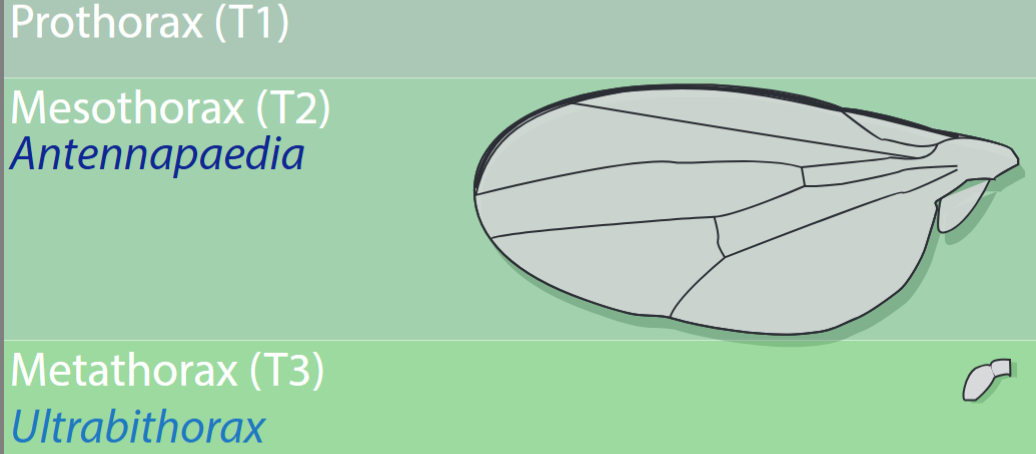
How is wing formation in Drosophila controlled?
Flies have a wing and a haltere. The difference is driven by the expression of Ubx. Ubx = haltere.
Other insects have two pairs of wing
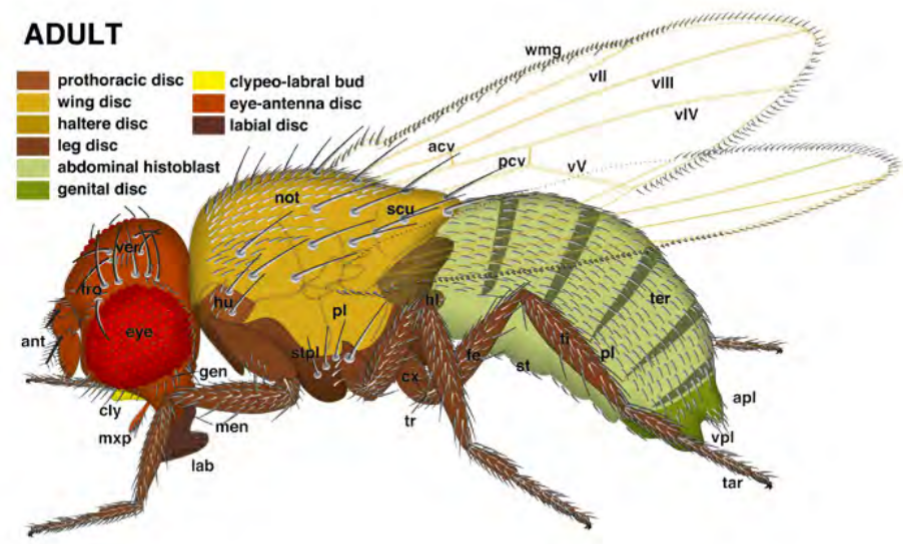
Describe the two different phases of development in Flies
1) Embryonic development- which makes a maggot
2) Imaginal development- which makes an adult. The adult derives from bits of epidermal tissue set aside in the embryo
These are called Imaginal discs.
How do the Imaginal dics affect development?
Imaginal discs expand in the pupae while the rest of the body tissue is degraded.
The discs expand to fill out the body and the structures of the limbs, so it is from the pupa that the wing starts to develop.
How is the development of wings from imaginal discs directed?
The wing is a segment, and inherits segment polarity gene expression (though it is slightly different in the disc).
In the wing disc, hedgehog doesn’t talk to wingless, it talks to a gene called decapentaplegic.
Decapentaplegic is expressed in the cells just anterior to the anterior posterior boundary of the wing. Decapentaplegic is a morphogen, diffusing across the wing disc.
Decapentaplegic (dpp) protein forms a concentration gradient, with high expression in the centre of the disc, and low expression at the edges
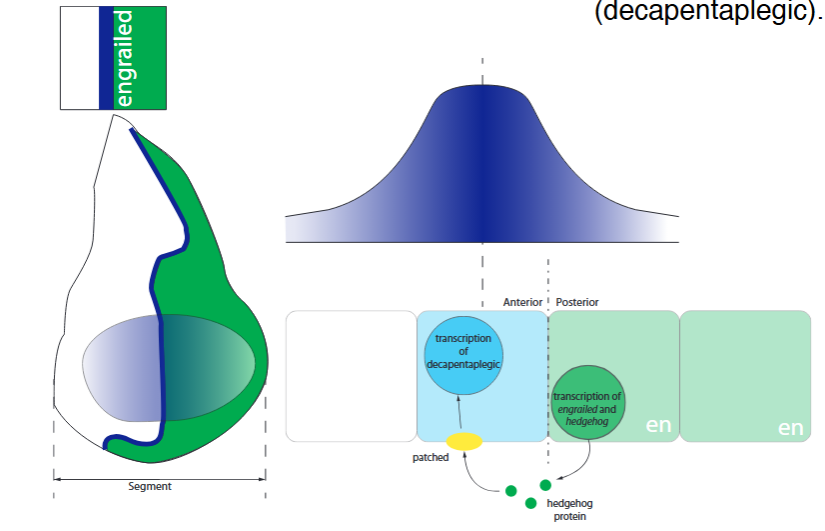
How do flies make sure that their wing veins can connect despite differential segmentation of the anterior/posteror sides?
Spalt is required to make the middle of the wing- at its boundaries veins 3 and 4 form. It is a transcription factor. Spalt is expressed at high conc. of dpp. Optomotor blind is another transcription factors that is affected by dpp concentration, allows the ant-post pattern to form.

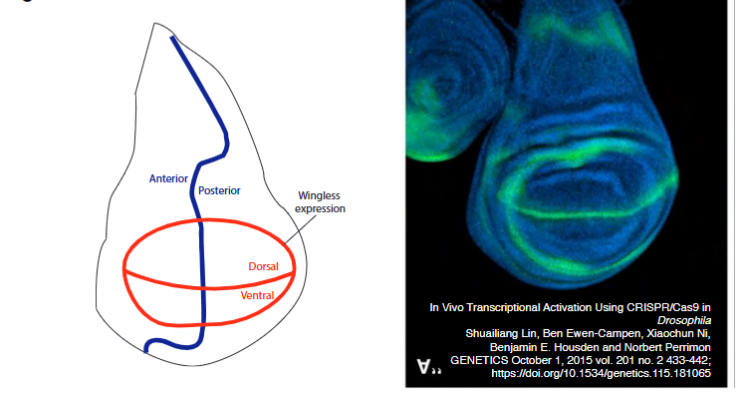
What is the function of the wingless gene?
When wingless is mutated, there are no wings on the fly. Wingless is expressed along the wing margin and around the hinge and is required for wing margin growth. Requied for the dorsal-ventral boundary of the wing, and of the boundary of the hinge that lets the wing buzz.
Why would we make transgenic animals?
You want to test the function of a gene with a known sequence.
• You want to try to discover which part of a gene does what.
• You want to see if a known gene rescues an unknown mutation.
• You want to knock out or knock in a gene
• You want to make an animal with a commercially useful character
What is a p element and how is it used to make transgenic flies?
P elements are DNA transposons than can insert themselves into Drosophila chromosomes in the presence of a transposase enzyme.The P element normally contains it’s own transposase gene, which is developmentally regulated
• The transposase is alternatively spliced, giving a defective protein in somatic cells and an active protein in germ cells.
• P-elements thus normally only pop in and out of the genome in germ cells.
• Alan and Gerry modified the transposase (P{∆2-3}) to be active in all cells .
How are Delta 2-3 transposons used to transform Flys with recombinant genes?
By breaking one end of the p element in the delta 2-3 P transposon, it can’t transpose by itself, so we combine it with a carrier element containing the gene of interes, the marker gene and a P-elemen end. By transforming an organism with both, p{del2-3} can move the carrier into the genome.

Why do we inject Fly embros in very early development to transform the fly genome?
• Because early Drosophila embryos are non-cellular allowing the gene of interest direct contact with the Drosophila genome
• when you do this you are aiming to get the DNA into the germ cells because insertion into somatic cells will not be carried on to the next generation
How do we know what flys we have transformed successfully?
A marker gene on the carrier gene element, as it contains the functional white gene, which makes the eyes red. Thus breeding heterozygous reessive white eyed flied, any red-eyed offspring will be transgenic.
What are the two ways to make transgenic mice?
1) Pronuclear injection of your DNA of interest into fertilised (0.5 day old embryo)
• DNA is inserted randomly into the genome
• Implant embryos into host mother
• sometimes the transgene will form part of the germ line and will be passed on to the offspring.
2) using Embryonic stem cell technology.
• Stems cells are extracted from very young embryos and kept in culture.
• These can be transformed easily with DNA.
• The DNA inserts randomly into the genome of the Emrbyonic Stem cells.
• The ES cells can be induced to form embryos and thus transgenic mice (see later)
• both of these methods allow us to put DNA into a mouse
• Can tell us something about a genes function
What are the cost/benefits of using embryonic stem cells to make transgenic mice?
Its more scaleable than pronuclear injection and often easier, much easier to screen a bunch;
BUT
• the expression of the gene will be abnormal (not near its native enhancer)
• Insertion is random - so you might disrupt another gene when you insert the DNA.
• multiple copies can insert and you can get chromosome rearrangements amongst those copies
How do you make a knockout transgenic mouse?
You want to replace a specific gene segment, so we use homologous recombination to produce these. To ensure the transforming gene agent is not jus inserted into the genome, the fragment has a negative selectable marker tk+ and a positive selectable marker, neomycin resistance, so it has to recombie to just get the positive bit and the gene of interest.
What are the three possibilites when transforming mouse embryonic cells and how do we observe them?
1) The construct is not inserted into mouse DNA. Will die from AB as lacks an AB resistance gene.
2) The construct is inserted randomly into mouse DNA, will have AB resistance but be tk+ so die.
3) The construct is copied into mouse DNA via homologous recombination, which is the target. This is noticeable as some target will be recombined such that only the AB resistance gene is recombined into the chromosome, but tk-, tk allows an organism to metabolise Ganciclovir into a poison, so only tk- mice survive.
Why do we make chimeric mice while making KO mice?
This acts as another selection marker. We grow brown mice embryos from ES cells and transform them, selecting out the transgenic ones using ganciclovir and neomycin screens, then we inject the early embrys into blastocysts in a female black mouse, a surrogate mother. Those offspring that have a mix of black and brown mice will be the transgenic ones, observable by their striped fur.
After breeding transgenic, chimeric mice, how do we form homozygous knock-out mice?
We breed the brown striped chimeric mouse with a black mouse, since brown is dominant to black. Brown offspring means that the genes are germline so they can be passed down. However, the orginal mutation was heterozygous, so to make homozygous recessive ones so the phenotype can be observed (or we may have to PCR sequence them), we breed the next generation of heterozygous brown mice.
How does CRISPR work?
1) a Cas9 protein
• protein found in bacteria
• 2) a guide RNA
• RNA that is homologous to the region that you want Cas9 to cut the genome
• The cut will be repaired by non-homologous end joining.
• Two guide RNAs can be used to delete larger regions of the gene.
• Knock-outs, Knock ous
• If you put in a piece of DNA that has homology it will get incorporated! (by homologous recombination)
