Bioenergetics
 Call Kai
 Learn
Learn Practice Test
 Spaced Repetition
 Match
Match Flashcards
 Knowt Play
1/62

There's no tags or description
Looks like no tags are added yet.
Name | Mastery | Learn | Test | Matching | Spaced | Call with Kai | Chat |
|---|
No analytics yet
Send a link to your students to track their progress
63 Terms
zero
1st law of thermodynamics state the energy is neither created nor destroyed which means that the delta E is ___
increasing
2nd law of thermodynamics state that the entropy of the universe is always ___
water
___ is the driving force of hydrophobic interactions as it tries to form less cages and increase entropy
work
an organism must be able to do ___, in order to remain ordered in opposition of the universe’s tendency to disorder e
energy
___ is the capacity to do work
sunlight
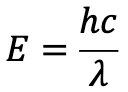
the major, original source of energy for most life on earth
can be calculated using this equation:
reduced
complex, ___ compounds are potential sources of energy
gibbs free energy
the energy of molecules in a solution required to do work; impacted by temperature, pressure, and concentration
∆G
the maximum amount of energy potentially available for useful work at a constant temperature and pressure, consistent with the conditions seen in the cell; tells you what the reaction will do under actual cellular conditions
∆Gº’
tells you the inherant tendency of a reaction
at equilibirum
when ∆G = 0, this means the reaction is ___
heat
if an exergonic reaction occurs by itself, the energy will be lost as ___
energy coupling
when the energy released from an exergonic reaction is used to drive an endergonic reaction
mechanism of reaction
a negative ∆G does not guarentee a reaction will happen, it depends on the ___, which is independent of ∆G
standard state
P = 1 atm
T = 25 ºC (298 K)
concentration of reactants and products = 1 M
reaction quotient
Keq when the reaction is not at equilibrium; used to calculate ∆G at a random point in the reaction
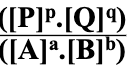
Keq
used to get ∆Gº’
inverse
Keq’ and ∆Gº’ have an ___ relationship
spontaneous
the oxidation of glucose into CO2 and water is a ___ process
non-spontaneous
the assembly of glucose from simple molecules is ___; driven by photosynthesis in plants
metabolite concentrations
cells regulate ___ to alter ∆G and drive reactions in the desired direction
energy quanta
units of energy released gradually to control the release of energy from high-energy reactions like the combustion of glucose; reduced electron carriers and nucleotide triphosphates
-2840 kJ/mol
energy released from the combustion of glucose
oxidation state
(# of bonds to O, N, and S) - (# of bonds to H)
+4
the highest oxidation state for carbon
-3
the lowest oxidation state for carbon
electrons
the direction of electron flow in redox reactions is determined by the affinity of ___ by the atoms compared to the affinity of a proton to form hydrogen gas under biochemical standard conditions
standard reduction potential (Eº)
the affinity for electrons (V); determined by a voltmeter measuring the voltage difference between 2 half cells
reductions
all half reactions are written as ___
+ Eº’
strong oxidizing agent, reduced; substance has a high affinity for electrons
- Eº’
strong reducing agent, oxidized; substance has low affinity for electrons
net potential (∆Eº’)
Eº’(electron-acceptor) - Eº’(electron-donor); oxidized - reduced; reducing agent - oxidizing agent
FMN and FAD
electron carrier that can donate or accept two electrons and two protons and are tightly bound to their enzyme, and cannot diffuse away from their enzyme
NAD/NADH
electron carriers that accepts electrons from catabolic degradation and then delivers the elctrons to the mitochondrial electron transport respiratory chain; oxidized form accepts 2 electrons and a proton
NADP/NADPH
electron carrier that supplies electrons for synthetic pathways; oxidized form accepts 2 electrons and a proton
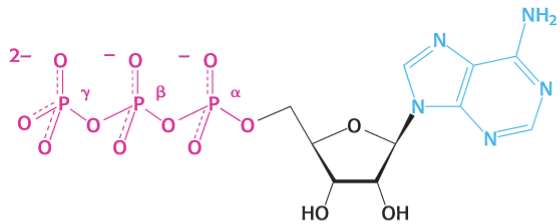
ATP
energy currency that serves as a major linking intermediate between energy yielding and energy requiring reactions
hydrolysis
ATP ___ yields free energy because:
it causes release of charge repulsion
there are more resonance forms of ADP + Pi than ATP which increases ∆S
ADP dissociates 1 proton and has 3 negative charges capable of resonance
___ is stabilized by water
phosphoryl group transfer potential
the ability of a phosphorylated compound to give up its phosphate group; the same magnitude as ∆Gº’, but with a negative charge
high
if PGTP was too ___. it would be difficult to transfer a phosphate group to it, and the energy released would be much more than what is needed for the reaction so it would be considered a waste of energy
low
if the PGTP was too ___, the energy would not be enough to do work with; this is in line with phosphate acceptors like glucose and ADP
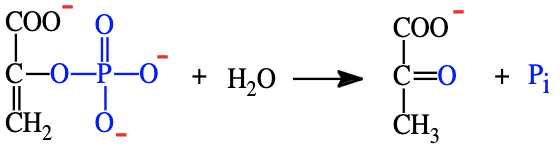
donor
phosphoenolpyruvate is a great phosphate ___, because its product pyruvate is highly stabilized due to resonance
substrate level phosphorylation
process of making ATP that utilized energy from high PGTP molecules like PEP, 1,3-bis-phosphoglycerate, and phosphocreatine

kinases
enzymes that phosphorylate other molecules (activates them)
increases the free energy of a molecule and adds a negative charge to it (stays in cell)
phosphatases
enzymes that dephosphorylates other molecules (deactivates them)
glutamine synthetase
enzyme that facilitates the creation of glutamine from glutamic acid and NH3 with the help of ATP and a Mg2+ cofactor

thioester bonds
a form of energy currency that’s not resonance stabilized, so they store more free energy than oxygen esters
electron transport chain
a series of proteins with prosthetic groups that become oxidized and reduced alternately as electrons and proteins are passed along
ATP is generated when the electrons created from the oxidation of electron carriers like NADH and FADH2 are transported through this chain
water is also created
oxidative phosphorylation
creates ATP through energy-releasing redox reactions in the mitochondria; uses ATP synthase
photophosphorylation
ATP formation couples to the energy gotten from the absorption of visible plants in the chloroplast of plants and some microorganisms
inner membrane
the electron transport chain is located in the ___ of the mitochondria which is impermeable to most small molecules and ions
matrix
the ___ of mitochondria contains pyruvate dehydrogenase, TCA cycle enzymes, and other enzymes for oxidation of amino acids and fatty acids
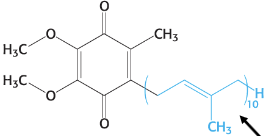
ubiquinone
oxidized form of coenzyme Q, a lipid soluble electron carrier that accepts 2 electrons from either Complex I or II of the ETC
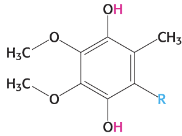
ubiquinol
reduced form of conenzyme Q
cytochrome C
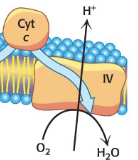
peripheral membrane protein electron carrier with an iron-containing heme group that transfers 1 electron from Complex III to IV
Fe+2 → Fe+3: complex III and the reverse is done by complex IV
has cysteine bonded to heme group through disulfide bonds
iron
in Fe-S proteins, ___ has electron carrier function because it can be oxidized and reduced
oxygen
ETC ends in the transfer of electrons to ___ which result in water, and an accumulation of proteins in the mitochondrial intermembrane space
Complex I
NADH gives its electrons to ___ at the entrance of the ETC; makes 2.5 ATP
Complex II
FADH2 gives its electrons to ___ at the start of the ETC; makes 1.5 ATP
Complex I
4 protons pumped through the membrane

Complex II
no protons pumped across the membrane

Complex III
4 protons pumped across the membrane

Complex IV
2 protons pumped across the membrane

proton-motive force
