BIOL 371 Vascular Seed Plants
 Call Kai
 Learn
Learn Practice Test
 Spaced Repetition
 Match
Match Flashcards
 Knowt Play
1/49

There's no tags or description
Looks like no tags are added yet.
Name | Mastery | Learn | Test | Matching | Spaced | Call with Kai | Chat |
|---|
No analytics yet
Send a link to your students to track their progress
50 Terms
What are angiosperms?
Covered seeds
Are angiosperms gametophyte or sporophyte dominant?
sporophyte
What do angiosperms reproductive organs contain?
flowers containing haploid spores
What is the ovule?
Sporophyte structure that houses and protects the megaspore that gives rise to the
female gametophyte, the embryo sac
What is the embryo sac?
The embryo sac is the female gametophyte of a flowering plant (angiosperm). In most flowering plants, a mature embryo sac contains eight nuclei distributed among seven cells.
Where do ovules typically develop in angiosperms?
the ovary
What does the ovary do?
Houses and protects the ovule
can aid in dispersal and nourishment of the seeds
What happens to the ovule after fertilization?
the ovule becomes the seed, and the ovary becomes the fruit
What are sieve tubes and companion cells?
Sieve tubes and companion cells work together as a crucial vascular partnership in plant phloem. Sieve tubes act as hollow pipelines that transport sugars, while companion cells provide the necessary metabolic energy and logistical support to keep the enucleated sieve tubes alive and functioning.
How do angiosperms allow for efficient transport of water and nutrients?
vessel elements
sieve tubes and companion cells
What characteristics do flowers offer in angiosperms?
compact reproductive organs
often hermaphroditic/bisexual
attractive to pollinators
What is the double fertilization in angiosperms?
production of both embryo and nutritive tissue (endosperm) by utilizing both sperm cells
When does nutritive tissue develop?
only if pollination is succesfull (fertilization occurs)
Where is the ovary?
the base of the carpal
What part of the plant becomes the fruit after fertilization?
the ovary
What is the carpel/pistil an what is it made up of?
the female reproductive parts that are made up of the stigma, style and ovary/ovaries
What is the stamen and what is it made up of?
the male reproductive parts made up of the anther and filaments
What is the Stigma?
The stigma is the sticky or feathery uppermost tip designed to catch pollen grains during pollination.
What is the Style?
The style is the slender, stalk-like tube that connects the stigma to the ovary. It provides a pathway for the pollen tube to grow down to the egg cells.
Angiosperm reproduction cycle
Sporophyte (flowering plant, 2n) → flowers → anthers & ovules → meiosis → microspores + megaspore → pollen grain (male gametophyte) + embryo sac (female gametophyte) → pollination → pollen tube → double fertilization → zygote (2n) + endosperm (3n) → seed (in fruit) → germination → new sporophyte (2n)
Mature flowering plant (sporophyte, 2n) develops flowers containing stamens (male) and carpels/pistils (female).
Stamens contain anthers with microsporangia, where meiosis produces haploid microspores (n).
Microspores develop into pollen grains (male gametophytes), each containing sperm cells.
Carpels (pistils) contain an ovary with ovules. Inside each ovule is a megasporangium, where meiosis produces four megaspores (n), but three degenerate, leaving one functional megaspore.
The functional megaspore undergoes three rounds of mitosis without cytokinesis forming a single large cell with eight nuclei.
Then cytokinesis occurs to form the female gametophyte (embryo sac), which contains 7 cells. The egg cell, the central cell composed ofo two nuclei (becoming the endosperm) and 5 remaining cells that end up degenerating.
Pollen from the pollen sac is released. Pollination occurs when a pollen grain lands on the stigma. The pollen grain germinates and grows a pollen tube through the style to the ovule, carrying two sperm cells.
Double fertilization occurs: one sperm fertilizes the egg to form the zygote (2n), while the other fertilizes the central cell to form the endosperm (3n).
The zygote develops into an embryo, and the ovule becomes a seed containing the embryo and endosperm. The ovary develops into a fruit.
The seed disperses and germinates into a seedling, which grows into a mature flowering plant (sporophyte, 2n), completing the cycle.
What is the seed made up of from inner to outer?
embryo (2n), endosperm (3n) and seed coat (integument)
What is the endosperm?
a trinucleate cell that will give rise to triploid endosperm which is a nutritive tissue that will nourish the developing embryo
What guides pollen tube growth?
pollen attractant released from the embryo sac
How can angiosperms be pollinated either than just wind?
through specific animal pollinators
How do pollinators undergo coevolution with angiosperms?
plants evolving to attract pollinators through things like showy, mimicry, scent, nectar
animals evolve various parts of their body for pollination like tounges or other mouth parts
What are integuments?
2n protective seed coat
In what plants is the the embryo smaller?
In grains and in some eudicot seeds, the endosperm fills most of the seed and the embryo is small.
How do seeds attain dormancy?
Seeds will fully dry prior to dispersal to attain dormancy
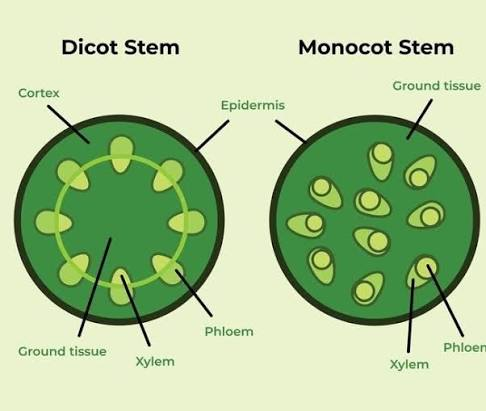
Monocot vs Eudicot vasculature
monocot: Bundles of vascular tissue scattered in stem
eudicot: Bundles of vasculature arranged in a ring
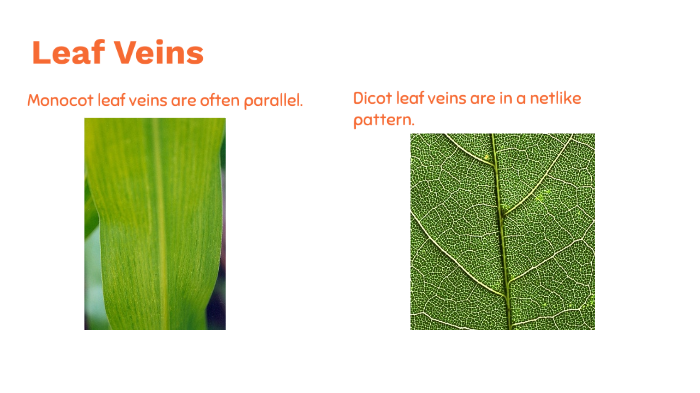
Monocot vs Eudicot veins
monocot: Parallel-veined leaves common
eudicot: reticulate veins
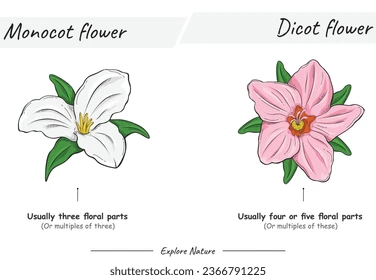
Monocot vs Eudicot floral parts
monocot: floral parts in groups of 3
eudicot: floral part sin groups of 4 or 5
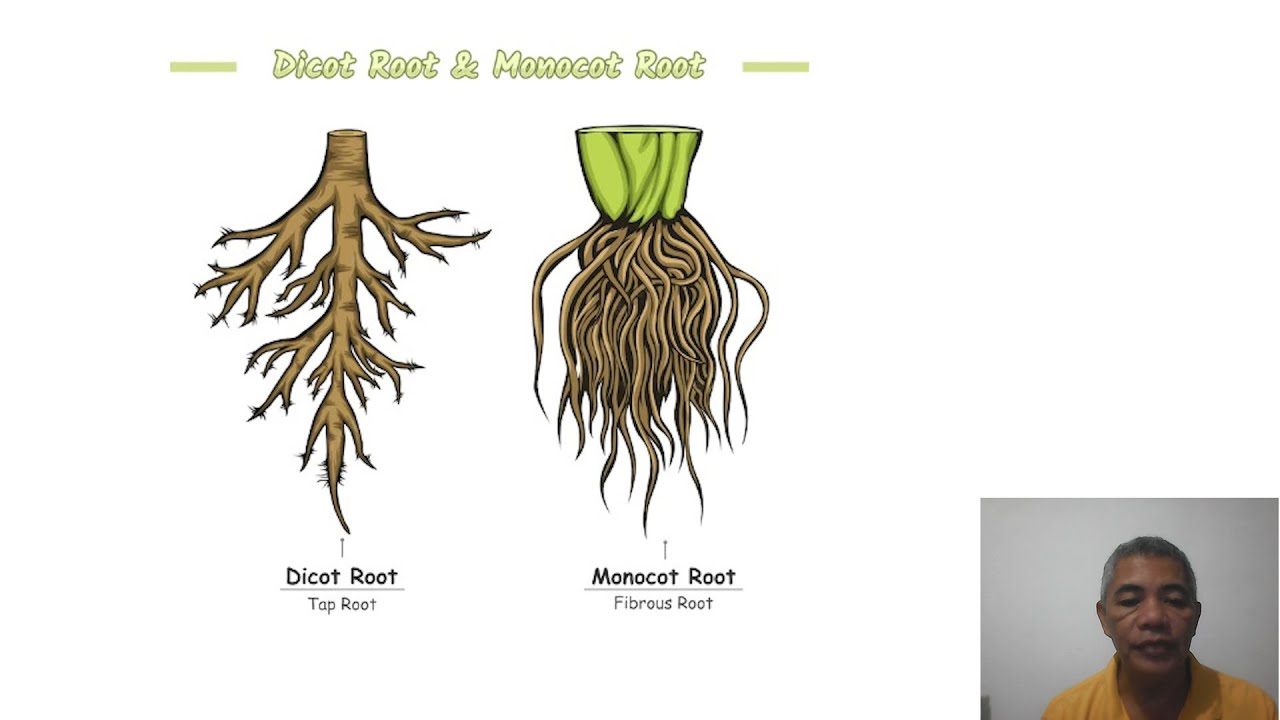
Monocot vs Eudicot root system
monocot: fibrous root system
eudicot: branching roots with strong tap root
Monocot vs Eudicot pollen grain
monocot: pollen grain with 1 aperature → monocolpate
eudicot: pollen grain with 3 aperature → tricoplate
What are cotyledons?
A cotyledon is the first embryonic leaf that appears from a germinating seed. Also known as a "seed leaf," it provides essential nutrients to the developing seedling and frequently acts as its first photosynthetic organ until the true leaves can grow.
What are monocots vs eudicots?
Monocots (Monocotyledons): Plants that have exactly one seed leaf (e.g., corn, wheat, grasses, and lilies).
Eudicots: Plants that have two seed leaves (e.g., beans, sunflowers, and most broadleaf trees).
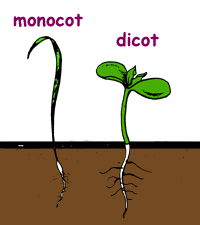
Monocot vs Eudicot endosperm
monocot: endosperm majority
eudicot: little/no endosperm
gymnosperms vs angiosperm reproductive organs
gymnosperms: unisexual cones
angiosperms: bisexual flowers
gymnosperms vs angiosperm seeds
gymnosperms: naked at maturity
angiosperms: contained at maturity
gymnosperms vs angiosperm integuments
gymnosperms: single integument covers ovule
angiosperms: two integuments cover ovule
gymnosperms vs angiosperm female gametophyte cell number
gymnosperms: 100s of cells
angiosperms: 7 cells most often
gymnosperms vs angiosperm microsporangia
gymnosperms: microsporangia housed on male cones
angiosperms: housed inside anthers
gymnosperms vs angiosperm main pollen dispersal method
gymnosperms: wind
angiosperms: animal pollinators and wind
gymnosperms vs angiosperm main pollination time
gymnosperms: about 2 years
angiosperms: minutes-hours
gymnosperms vs angiosperm sperm cells used
gymnosperms: 1 sperm cell for fertilization
angiosperms: 2 sperm cells for fertilization
gymnosperms vs angiosperm nutritive tissue
gymnosperms: the remanent female gametophyte (n)
angiosperms: endosperm (3n)
gymnosperms vs angiosperm xylem composition
gymnosperms: tracheids
angiosperms: tracheids and vessels
gymnosperms vs angiosperm phloem composition
gymnosperms: sieve elements
angiosperms: sieve tubes and companion cells
When do seeds germinate?
Seeds will germinate when they are in suitable conditions (i.e. when they have sufficient water and access to resources)
How do seeds know when the appropriate conditions are met?
• Absorbance of red light activates Phytochrome B
• Repeated/extended Red Light exposure converts sufficient amounts of Phytochrome to
the active state to initiate seed germination
• Reabsorption of far-red light inactivates the Phytochrome
• Lack of light also causes Phytochrome to revert to inactive form
*Far-red light is not absorbed well by plants → reception of Far-red light alone indicates plant coverage overhead (Red light absorbed above) and not enough light for photosynthesis
Why do seeds need to sense whether or not they will receive enough light to photosynthesize?
Germination will use up all of the nutritive tissue present in the seeds
If the plant is unable to photosynthesize once it emerges then it will quickly die