MCAT Equations & Chem/Ochem/Physic Section
 Call Kai
 Learn
Learn Practice Test
 Spaced Repetition
 Match
Match Flashcards
 Knowt Play
1/284

There's no tags or description
Looks like no tags are added yet.
Name | Mastery | Learn | Test | Matching | Spaced | Call with Kai | Chat |
|---|
No analytics yet
Send a link to your students to track their progress
285 Terms
Avogadro’s Constant
(Constants to memorize)
6.022x10^23 entities per mole
Plank’s Constant
(Constants to memorize)
6.626x10^-34 J*s (although this is often given)
Gravity Constant
(Constants to memorize)
9.8 m/s^2
Fundamental Charge of an electron (and proton) constant:
(Constants to memorize)
eF = ∓1.6x10⁻¹⁹ C (Coulombs) (this is also often given)
At STP constant:
(Constants to memorize)
1 mol gas = 22.4L
Standard Unit Prefixes to Memorize
Pico
Nano
Micro
Milli
Centi
Deci
Kilo
Mega
Pico (p): 10^-12; 1 pm = 1x10^-12 meters
Nano (n): 10^-9; 1 nm = 1x10^-9 meters
Micro (µ): 10^-6, 1 µm = 1x10^-6 meters
Milli (m): 10^-3, 1 mm = 1x10^-3 meters (aka .001m)
Centi (c): 10^-2, 1 cm = 1x10^-2 meters (aka .01m)
Deci (d): 10^-1; 1 decimeter = 1x10^-1 meter
Kilo (k): 10^3, 1 km = 1x10^3 meters (aka 1000m)
Mega (M): 10^6, 1 Megawatt = 1x10^6 Watts
Standard Unit to Memorize
Volume
Mass
Pressure/Stress
Temperature
Amount
Displacement/Distance
Velocity
Acceleration
Period/Time
Intensity
Electric Field
Magnetic Field
Current
Entropy
Volume: Liters (L)
Mass: kilograms (kg) in physics, grams (g) in chemistry
Pressure/Stress: atmospheres (atm) for everything except fluids (Pascals, Pa)
Temperature: Kelvin (K), NOT Celsius (K=C+273)
Amount: moles (mol)
Displacement/Distance: meters (m)
Velocity: m/s
Acceleration: m/s2 (linear) or v2/r (centripetal/circular)
Period/Time: seconds (s)
Intensity: Watts/meters2 (W/m2)
Electric Field: Volts/meter (V/m) or Newtons/Coulomb (N/C)
Magnetic Field: Teslas (T)
Current: Amps (A), or Coulombs/second (C/s)
Entropy: J/OK
Detailed Standard Unit to Memorize
Frequency
Force
Work, Energy, heat, Enthalpy, and Gibbs Free Energy
Power
Pressure/Stress
Charge
Electric Potential Difference
Resistance
Capacitance
Electric Conductance
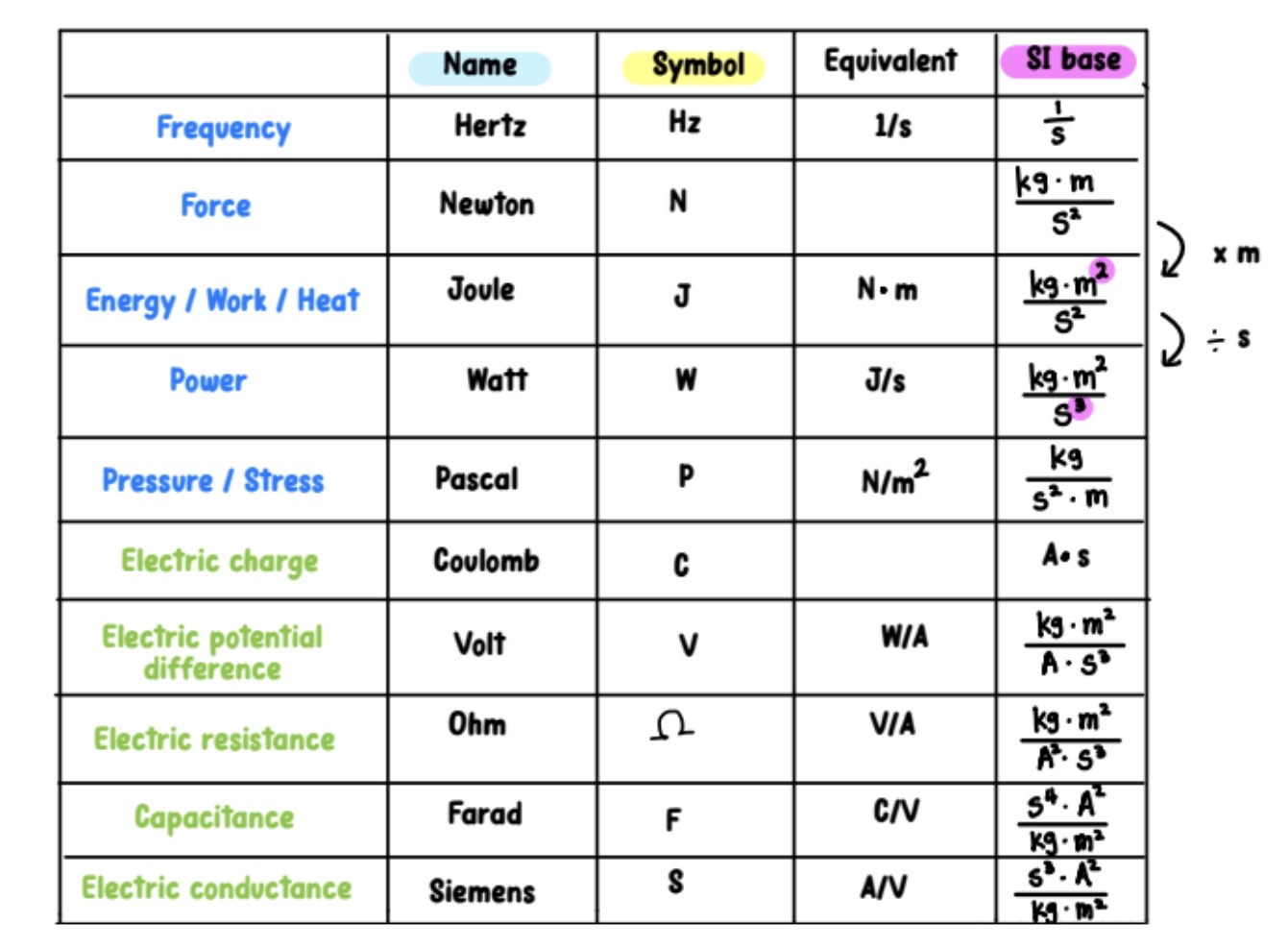
Frequency: Hertz (Hz) = 1/s
Force: Newtons (N) = (kg*m)/s^2
Work, Energy, Heat, Enthalpy, and Gibbs Free Energy: Joules (J) = N*m = (kg*m^2)/s^2
Power: Watts (W) = J/s = (kg*m^2)/s^3
Pressure/Stress: Atmospheres (atm) for everything except fluids (Pascals, Pa). For Pascal: N/m^2 = kg/(s^2*m)
Charge: Coulombs (C) = A*s
Electric Potential Difference (Voltage): Volts (V) = W/A = (kg*m^2)/(A*s^3)
Resistance: Ohms (Ω) = V/A = (kg*m^2)/(A^2*s^3)
Capacitance: Farads (F) = C/V = (s^4*A^2)/(kg*m^2)
Electric Conductance: Siemens (S) = A/V = (s^3*A^2)/(kg*m^2)
Conversions
Pressure:
Temperature:
Parts per million (ppm):
1 eV:
Area and Volume Conversion:
Pressure: 1 atm = 760 torr = 760 mmHg = 100 kPa (rounded!). 1 Pa = 1 N/m2 (Newtons per meters2)
Temperature: OK = OC + 273
Parts per million (ppm) = (amount of solute/amount of solvent)*106
1 eV = 1.6x10⁻¹⁹J; eV = electron volt (unit of energy)
Area and Volume Conversions: 1 meter = 102 cm; 1 square m = (102)2 cm2; 1 cubic m = (102)3 cubic cm
Concentration:
(Basics - General Chemistry)
Molarity (M) = mol/L
Density
(Basics - General Chemistry)
𝜌 = m/V
Molality
(Study)
m = molsolute / kgsolvent
Mole Fraction
(Basics - General Chemistry)
XA = nA/ntotal
n = moles
Normality (N):
(Basics - General Chemistry)
(Study)
(S1)
N = M*(# equivalents)
M = molarity (mol/L); # equivalents = # of reactive units per mole
Gram Equivalents
(Basics - General Chemistry)
(Study)
meq = mass/equivalent weight
Eq Weight = molar mass/n
n = # equivalents
Dilutions:
(Basics - General Chemistry)
C1V1 = C2V2
C = Concentration = Molarity (mol/L); V = Volume (L)
Atomic Weight
(Basics - General Chemistry)
AW = m1p1 + m2p2 + …
m = mass; p: probability of isotope
Percent Yield:
(Basics - General Chemistry)
% Yield = (Actual/Theoretical)*100
Equilibrium Constant
(Equilibrium - General Chemistry)
For aA + bB ⇌ cC + dD:
Keq = [C]c[D]d/[A]a[B]b
Keq > 1 → More products; Keq < 1 → More reactants; Keq = 1 → products ≈ reactants
Reaction Quotient
(Equilibrium - General Chemistry)
For aA + bB ←→ cC + dD: Q = [C]c[D]d/[A]a[B]b
When Q>Keq, reverse rxn favored (shift left)
When Q<Keq, forward rxn favored (shift right)
When Q=Keq, at equilibrium
Arrhenius Equation for Rate Constant
(Kinetics- General Chemistry)
k = Ae-Ea/RT
k = Rate Constant; A = Collision frequency; Ea = Activation Energy; R = Gas Constant; T= temperature
Do not need to do calculation but need to know relationship: Rate ↑ with ↑ temperature & collision frequency or ↓ Ea
Rate Law
(Kinetics- General Chemistry)
rate = k[A]x[B]y
X and Y are orders of A and B; k,x,y are determined experimentally
Rate
(Kinetics- General Chemistry)
For aA + bB ⇌ cC + dD
Rate = -Δ[A]/aΔt = -Δ[B]/bΔt = Δ[C]/cΔt = Δ[D]/dΔt
Integrated Rate Laws:
(Kinetics- General Chemistry)
Zeroth: slope = -k on [A] vs time
First: slope = -k on ln[A] vs time
Second: slope = k on 1/[A] vs time
![<p><span style="background-color: transparent;">Zeroth: slope = -k on [A] vs time </span></p><p><span style="background-color: transparent;">First: slope = -k on ln[A] vs time </span></p><p><span style="background-color: transparent;">Second: slope = k on 1/[A] vs time</span></p>](https://assets.knowt.com/user-attachments/dd36167c-8bf1-471b-83ec-b57fcd6fbdc8.png)
1st Law of Thermodynamics
(Thermodynamics - General Chemistry)
(Study)
ΔU = Q − W
Q = heat; W = Work
Work done on/by Gas
(Thermodynamics - General Chemistry)
W = −PΔV
Heat (no phase change):
(Thermodynamics - General Chemistry)
(Study)
Q = mCΔT
Q > 0 heat gained; Q < 0 heat lost
Q = heat energy; m = mass; ΔT = temp change (kelvin); C: specific heat (energy needed to raise 1g by 1°C or K; Water: c = 4.18 J/g·°C)
Heat of Phase Change
(Thermodynamics - General Chemistry)
Q = mL
Q = heat energy; m = mass; L = latent heat
Gibbs Free Energy, ΔG
(Thermodynamics - General Chemistry)
(Study)
(S1)
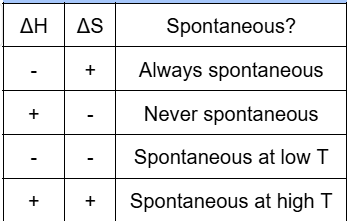
ΔG = ΔH − TΔS
G < 0: Spontaneous, forward reaction favored
G = 0: Equilibrium
G > 0: Non-spontaneous, reverse reaction favored
ΔH = change in enthalpy; ΔS = change in entropy; T = temperature (Kelvin)
Hess Law of Summation
(Thermodynamics - General Chemistry)
(Study)
ΔHreaction = ∑ΔHf∘products − ∑ΔHf∘reactants
ΔHreaction = ∑ΔHbonds broken − ∑ΔHbonds formed
Breaking bonds requires energy (+ΔH).
Forming bonds releases energy (−ΔH).
Enthalpy
(Thermodynamics - General Chemistry)
(Updated 6/27/26)
Heat energy stored in chemical bonds.
ΔHrxn = Q/n
ΔH < 0 = exothermic
ΔH > 0 = endothermic
Q = heat; n = number of moles
Entropy
(Thermodynamics - General Chemistry)
(Study)
Measure of disorder (energy dispersal).
S = Q/T
Higher entropy: gas > liquid > solid
Q = heat; T = temperature (kelvin)
Thermal Expansion
(Thermodynamics - General Chemistry)
ΔL = 𝛼LΔT
𝛼: constant, L: length; ΔT = temperature change (kelvin)
Volume Expansion
(Thermodynamics - General Chemistry)
(Study)
(S1)
ΔV = βVΔT
β: constant, V: Volume; ΔT = temperature change (kelvin)
Ideal Gas Law:
(Gases - General Chemistry)
PV = nRT
Boyle’s Law:
(Gases - General Chemistry)
PV = k
k = constant
Charle's Law:
(Gases - General Chemistry)
V/T = k
T = temp; k = constant
Avogadro’s Law:
(Gases - General Chemistry)
n/v = k
n = moles; v = volume; k = constant
Combined Gas Law:
(Gases - General Chemistry)
P1V1/n1T1 = P2V2/n2T2;
Cancel out constant variables
Pressure:
(Gases - General Chemistry)
P = F/A
Absolute Hydrostatic Pressure:
(Gases - General Chemistry)
P = P₀ + ρgh
P₀ = surface pressure; ρ = fluid density; g = gravity constant (9.8 m/s^2); h = height
Dalton’s Law of Partial Pressures
(Gases - General Chemistry)
PA = XAPtotal
XA = mole fraction of A; Ptotal = PA + PB + PC + …
Raoult’s Law of Vapor Pressure:
(Gases - General Chemistry)
PA = XAPAO
XA = mole fraction of A; PAO: Vapor Pressure of A
Henry’s Law (Solubility of Gas)
(Gases - General Chemistry)
(Study)
(Updated 7/22/26)
CA = kPA,
↑Pressure = ↑ Solubility or ↓ Pressure = ↑ Solubility
C: Gas Solubility (Concentration); k: gas constant; PA: Partial Pressure of A
Graham’s Law of Effusion
(Gases - General Chemistry)
rate1/rate2 = √(m2/m1)
m = molar mass
Internal Energy of a Gas
(Gases - General Chemistry)
Ugas = 3/2 nRT
n = # of moles; R = ideal gas constant; T = temp (Kelvin)
Kinetic Energy of a Gas
(Gases - General Chemistry)
(Study)
KE = ½mv2 = 3/2kT, k is a constant
Weight:
(General Chemistry)
Any Object: Fg = mg
Fluid: Fg = ρVg
Fb > Fg: Floats
Fb < Fg: Sinks
Fb = Fg: Neutral
m = mass; g = gravity; ρ = density; V = volume
Pascal's Principle:
(Gases - General Chemistry)
F1/A1 = F2/A2
F = Force; A = Area
Poiseuille's Law:
(Gases - General Chemistry)
Q = (πr⁴ΔP)/(8ηL)
Q = flow rate; r = radius; ΔP = pressure difference; η = viscosity; L = length
Flow Rate (Continuity Equation):
(Gases - General Chemistry)
Q = v1A1 = v2A2
Q = flow rate; v = velocity; A = area
Bernoulli's Equation:
(Gases - General Chemistry)
P1 + ½ρv1² + ρgh1 = P2 + ½ρv2² + ρgh2
P = pressure; ρ = density
Solubility Constant
Ex: AgCl
(Solubility- General Chemistry)
How much ionic solid can dissolve in water
For AxBy ←→ xAy+ + yBx- :
Ksp = [Ay+]x[Bx−]y
Big Ksp = more soluble & small Ksp = less soluble
Ex: AgCl(s) ⇌ Ag⁺ + Cl⁻ → Ksp = [Ag⁺][Cl⁻]
Osmotic Pressure
i examples: C6H12O6, NaCl, CaCl2
(Solubility- General Chemistry)
(Study)
Pressure needed to stop water crossing the membrane due to solute concentration differences
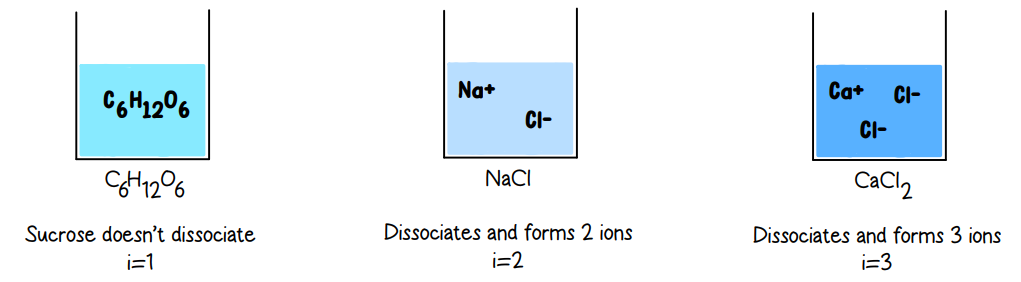
Π = iMRT
i: van’t Hoff factor; M = molarity, R = ideal gas constant; T = temperature
i examples: C6H12O6, NaCl, CaCl2
Boiling Point Elevation & Freezing Point Depression
(Solubility- General Chemistry)
Boiling: ΔT = iKbm
Freezing: ΔT = iKfm
i = van’t Hoff factor; Kb/f: boiling/freezing constant; m: molality
Retention Factor
(Solubility- General Chemistry)
Rf = dcompound / dsolvent, d: distance
pH & pOH:
(Acids and Bases- General Chemistry)
pH = -log[H+] or 10-pH = [H+]
pOH = -log[OH-] or 10-pOH = [OH-]
Formulas of pKa, pKb, Ka, Kb. What happens when pka/ka or pkb/kb ↑ or ↓?
(Acids and Bases- General Chemistry)
(Updated 7/23/26)
pKa = -log(Ka) or 10-pKa = [Ka]
pKb = -log(Kb) or 10-pKb = [Kb]
Ka = [H+][A-]/[HA]
KB = [B+][OH-]/[BOH]
↑ Ka = ↓ pKa = ↑ acid strength = ↓ conjugate base strength
↓ Ka = ↑ pKa = ↓ acid strength = ↑ conjugate base strength
↑ Kb = ↓ pKb = ↑ base strength = ↓ conjugate acid strength
↓ Kb = ↑ pKb = ↓ base strength = ↑ conjugate acid strength
Ionization Constant of Water
(Acids and Bases- General Chemistry)
KaKb = KW = 10-14
pH + pOH = 14
pKa + pKb = 14
pH Classification:
(Acids and Bases- General Chemistry)
pH < 7: Strong Acid + Weak Base = Acidic ([H+] > [OH-])
pH = 7: Strong Acid + Base = Neutral ([H+] = [OH-])
pH > 7: Weak Acid + Strong Base = Basic ([H+] < [OH-]
Henderson-Hasselbalch Eq (for Buffers)
(Acids and Bases- General Chemistry)
pH = pKa + log([conj. base = A-]/[acid = HA])
pOH = pKb + log([conj. acid = B+]/[base = BOH])
pI of Amino Acids:
(Acids and Bases- General Chemistry)
pI = pH where net charge = 0
pI = (pKa1 + pKa2) / 2
Acidic: (pKa,carboxyl+pKa,R-Group)/2
Basic: (pKa,amino+pKa,R-Group)/2
Neutral: (pKa,carboxyl+pKa,amino)/2
Neutralizations (and Dilutions)
(Acids and Bases- General Chemistry)
CH+Vacid = COH-VBase
Standard Reduction Potential:
(Redox Chemistry and Electrochemistry - General Chemistry)
ECELL or emf° = E°cathode - E°anode & ΔG = −nFEcell
ΔG = Gibbs free energy; n = mols; F = Faraday’s constant (96,485 C/mol)
+ Ecell or - ΔG = spontaneous
- Ecell or + ΔG = non-spontaneous
Nernst Equation:
(Redox Chemistry and Electrochemistry - General Chemistry)
(S1)
E = EO - (RT/nF)(logQ)
E = Actual Cell potential; EO = Standard cell potential
R = gas constant; T = Temp; n = mol; F = Faraday’s constant (96485 C/mol)
Q = reaction quotient. [C]^c[D]^d / [A]^a[B]^b from aA + bB ⇌ cC + dD
Current caused by n electrons:
(Redox Chemistry and Electrochemistry - General Chemistry)
I = nF/t
n = mol e- ; F = Faraday’s constant (96485 C/mol); t = time
Cell Potential
(Redox Chemistry and Electrochemistry - General Chemistry)
ECell = Ereduction,cathode + Eoxidation,anode or ECell = Ereduction,cathode - Ereduction,anode (they’re the same thing)
SOH CAH TOA
(Trigonometry and Geometry - General Chemistry)
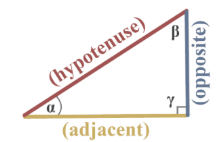
Sinθ = Opposite / Hypotenuse
Cosθ = Adjacent / Hypotenuse
Tanθ = Opposite / Adjacent
Sin/Cosine/Tan to Memorize for 0O, 30O, 45O, 60O, 90O:
(Trigonometry and Geometry - General Chemistry)
sin: 0, 1/2, √2/2=0.71, √3/2=0.87, 1
cos: 1, √3/2=0.87, √2/2=0.71, 1/2, 0
tan: 0, 1/√3=0.58, 1, √3=1.7, undefined
Pythagorean Theorem
(Trigonometry and Geometry - General Chemistry)
A2 + B2 = C2
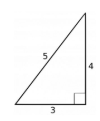
3, 4, 5 Triangles
(Trigonometry and Geometry - General Chemistry)
-Significance: If you see a vector with components of 6&8 or 30&40, you know the hypotenuse is 10 or 50
Areas (Circle, Sphere, Triangle):
(Trigonometry and Geometry - General Chemistry)
Circle: 𝜋r2
Sphere Surface Area: 4𝜋r2
Triangle: ½base*height
Work
(Work and Energy - General Chemistry)
(Study)
(S1)
W = Fd = Fdcosθ = qEd = qV = ΔEnergy (J)
d = distance; q = charge, E = electric field strength, V =Electric potential difference (voltage)
Power
(Work and Energy - General Chemistry)
(Study)
(S1)
P = W/t = Fv = IV
W = Work; t = time; F= force; v = velocity; I = Current; V = Potential Difference (Voltage)
Mechanical Advantage
(Work and Energy - General Chemistry)
MA = FResistance/FEffort
Efficiency
(Work and Energy - General Chemistry)
Eff = Woutput/Winput = Poutput/Pinput
W = Work; P = Power
Kinetic Energy:
(Work and Energy - General Chemistry)
KE = ½ mv2
m = mass; v = velocity
Gravitational Potential Energy
(Work and Energy - General Chemistry)
Ug = mgh
Conservation of Energy:
(Work and Energy - General Chemistry)
Ui + KEi = Uf + KEf + W
U = PE; W = Work; i = initial; f = final
Momentum
(Work and Energy - General Chemistry)
p = mv
m = mass; v = velocity
Force
(Work and Energy - General Chemistry)
F = ma
m = mass; a = acceleration
Force of Friction
(Work and Energy - General Chemistry)
Kinetic friction: Ff = μkFn
Static friction (max): Fs, Max = μsFn
μk = coefficient of kinetic friction; μs = coefficient of static friction; Fn = normal force
Forces on an Inclined Plane
(Work and Energy - General Chemistry)
(Updated 7/23/26)
-Into the incline (perpendicular): FN = mgcosθ
-Friction: F𝜇 = 𝜇mgcosθ
-Down the incline (parallel): Fg = mgsinθ
FN = normal force; F𝜇 = Friction Force; Fg = gravity force
Acceleration Pulley with Two Masses
(Work and Energy - General Chemistry)
anet = ((m1 - m2)g) / (m1 + m2)
Center of mass
(Work and Energy - General Chemistry)
xc = (m1x1 + m2x2 + …)/(m1 + m2 + …)
x = center of mass; x = position of each mass; m = mass
Gravitational Force between Two Objects
(Work and Energy - General Chemistry)
FG = GMm/r2
G = gravitational constant (6.67 x 10^-11 N*m^2 / kg^2) → should be given
M = larger mass; m = smaller mass; r = distance center to center
Elastic Force
(Work and Energy - General Chemistry)
Fk = -kx,
k = spring constant x = amount stretched
Elastic Potential Energy
(Work and Energy - General Chemistry)
(S1)
Uk = ½kx2
k = spring constant; x = amount stretched
Torque
(Work and Energy - General Chemistry)
𝛕 = rF = rFsinθ
Rotational Equilibrium: 𝛕1 = 𝛕2
r = radius; F = Force
Centripetal Force
(Work and Energy - General Chemistry)
Fc = mv2/r
m = mass; v = velocity; r = radius
Centripetal Acceleration
(Work and Energy - General Chemistry)
ac = v2/r
v = velocity; r = radius
Mass Defect (Nuclear Binding Energy):
(Atomic/Nuclear Physics - General Chemistry)
(Study)
(S1)
E = Δmc2
E = Energy; m = mass; c = speed of light (3.0x10^8 m/s)
Energy of Electron n Level
(Atomic/Nuclear Physics - General Chemistry)
(Study)
En = -13.6/n2
n = energy level
Rydberg Equation (Change in n Level)
(Atomic/Nuclear Physics - General Chemistry)
(Study)
(S1)
EΔn = hf = R((1/nf2)-(1/ni2))
R = Rydberg constant (will be given); n = energy level
Number of Half Lives
(Atomic/Nuclear Physics - General Chemistry)
N=No(½)n,
n: # of half lives
N: final amount
No: initial amount
Total Time of Half-Life Decay
(Atomic/Nuclear Physics - General Chemistry)
ttotal = n*t1/2
n = # of half life; t1/2 = half life of substance
Types of Nuclear Decay
(Atomic/Nuclear Physics - General Chemistry)
(Study)
(S1)
Alpha: AZX → A-4Z-2X + 42He (or 42𝞪)
Beta-: AZX → AZ+1X + 0-1β (or 0-1e)
Beta+: AZX → AZ-1X + 01β (or 01e)
E- Capture: AZX + 0-1β → AZ-1X
Gamma: AZX → AZX + 𝜸
Photoelectric Effect
(Atomic/Nuclear Physics - General Chemistry)
(S1)
KE = ½mvₑ² = Ephoton - W = hf − W
E or hf > W → electron emitted
E or hf = W → KE = 0
E or hf < W → no electron emitted
Ephoton = Photon Energy; W = Work; m = mass; v = velocity; h = planck constant (6.626 x 10^-34 J*s); f = frequency
Series vs Parallel Circuit:
(Atomic/Nuclear Physics - General Chemistry)
Series Circuits → Same Current
RT = R1 + R2 + R3 + ...
ΔV = V1 + V2 + V3 + ...
IT = I1 = I2 = I3 = ...
Parallel Circuits → Same Voltage
1/RT = 1/R1 + 1/R2 + 1/R3 + ...
VT = V1 = V2 = V3 = ...
IT = I1 + I2 + I3 + ...
Capacitance
(Atomic/Nuclear Physics - General Chemistry)
(Study)
C = Q/V = ͼoA/d
C = Capacitance; Q = source charge, V = Potential Difference (Voltage); ε₀ = permittivity of free space; A: Area; d= distance