Auditory Pathologies/Disorders
 Call Kai
 Learn
Learn Practice Test
 Spaced Repetition
 Match
Match Flashcards
 Knowt Play
1/62

There's no tags or description
Looks like no tags are added yet.
Name | Mastery | Learn | Test | Matching | Spaced | Call with Kai | Chat |
|---|
No analytics yet
Send a link to your students to track their progress
63 Terms
outer ear pathologies
these affect the pinna and the ear canal leading up to the eardrum
includes cerumen, stenosis, acute external otitis, carcinoma, trauma, periochondritis, staff infections
cerumen
also known as ear wax
caused by q-tip use (which pushes wax further in the ear canal to the eardrum), hearing aids, and oddly shaped ear canal
more common in older people, especially men
stenosis
means small ear canal
very narrow/small ear canals, easy for wax or water to get trapped
acute external otitis
known as swimmer’s ear
any water source that stagnates in the ear canal can cause inflammation
VERY painful
that wax has built up for a long time
what could dark wax mean?
earwax
consists of sweat secretions, dead skin cells, and hair
carcinoma
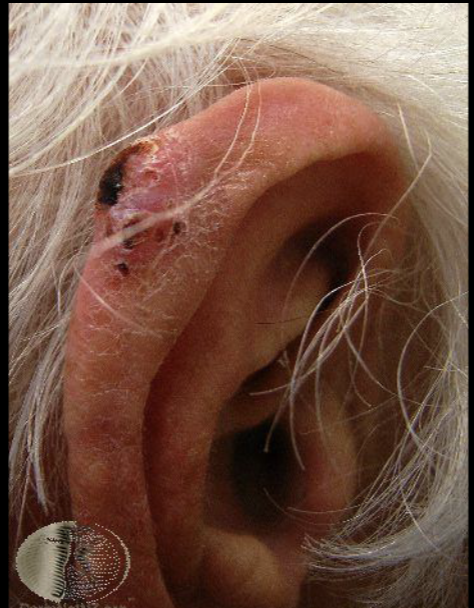
skin cancer that can present on the outer ear
includes basal cell, squamous cell, and melanoma
basal cell carcinoma
most common form of skin cancer, often found on head, neck, and arms

squamous cell carcinoma
second most common form of skin cancer, often appears as red bump, scaly patch, or sore that doesn’t heal

melanoma
deadliest form of skin cancer, can spread quickly to other body parts if not diagnosed early
trauma
can be from frostbite, rugby, football, wrestling, piercings
includes cauliflower ear
periochondritis
is infection and inflammation of the perichondrium of auricular cartilage/red, swelling, hot, tender outer ear that can lead to serious complications
causes include infection of haematoma auris, complication of severe otitis externa, laceration, mastoid surgery, and high ear piercing
the pinna is uniformly enlarged and thickened and its surface is red and shiny with severe pain and tenderness
outer ear malformations
includes atresia, microtia, cysts/pits/tags, and goldenhar syndrome
atresia
little or no ear formation, NO ear canal
can be unilateral or bilateral
can be syndromic (treacher-collins) or an isolated finding

microtia
very small ear; may or may not have open ear canal (ear canal is still present unlike atresia)
often low set, or rotated toward back of head
unilateral or bilateral
can by syndromic (goldenhar syndrome) or isolated
cysts/pits/tags
congenital and representative of error in ear formation
pits can weep fluid from middle ear, easily infected
goldenhar syndrome
rare congenital disorder that causes craniofacial abnormalities typically affected eyes, ears, and spine
underdeveloped bones and muscles on one side of the face
microtia typically seen with this syndrome

otalagia
means ear pain
can come from different places, not necessarily the ear
jaw pain from grinding teeth, incoming molars (TMJ)
otorrhea
foul odor emanating from the ear
could be a fungal infection, middle ear infection, or foreign object
occluding
blocked ear
(can be from cerumen or foreign objects)
non-occluding
not blocked ear
middle ear pathologies
these stop sound from moving clearly to the inner ear
includes otitis media, tympanic membrane perforation, cholesteatoma, mastoiditis, otosclerosis, malleus fixation, ossicular discontinuity, trauma, eustachian tube dysfunction, and glomus tumor
otitis media
also known as an ear infection, is the most common middle ear pathology; especially in children
serous otitis media
ear infection where effusion (build up of fluid behind ear drum) is thin, clear
mucoid otitis media
ear infection where effusion is thicker and yellowish
suppurative otitis media
ear infection where effusion is thick with yellow pus
adhesive otitis media
ear infection where thickening of eardrum causes deep retraction
acute otitis media
ear infection where there is quick onset, red, inflamed, and painful
recurrent otitis media
getting an ear infection more than 3 times in 6 months
this is when doctors decide to put tubes in eardrum
chronic otitis media
ear infection lasting more than 8 weeks
persistent otitis media
ear infection lasting more than 6 weeks with treatment
comes back even with antibiotics
tympanic membrane perforation
means hole in eardrum
can be from foreign objects, a blow to the head, barotrauma (scuba diving/flying), and otitis media

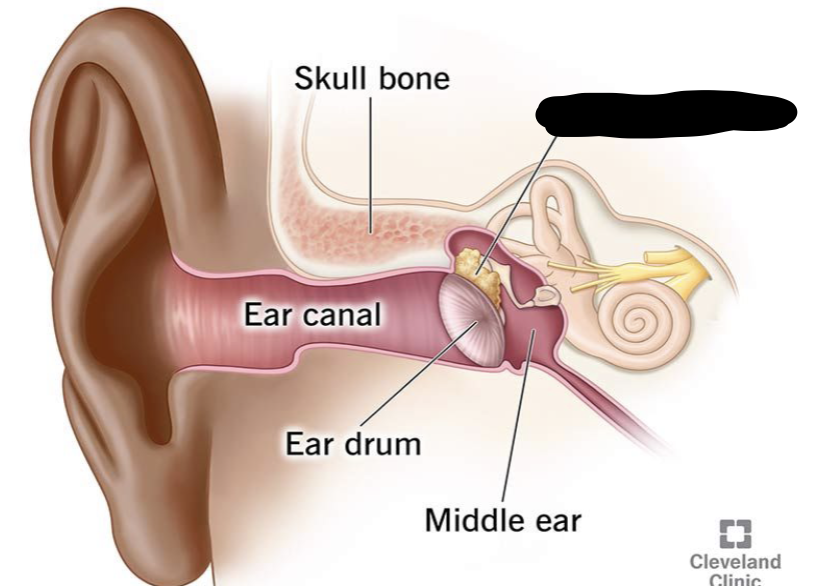
cholesteatoma
benign growth filled with skin cells/debris
ETD, retracted eardrum, allergies, URI
mastoiditis
infectious invasion of the porous mastoid bone (bone behind ear and fluid fills the holes in the bone)
from streptococcus pneumoniae or untreated middle ear infection (this is why tubes are important)
otosclerosis
fixation of the ossicular chain (connection between the malleus, incus, and stapes)
often a genetic disorder appearing in mid ‘40s, mostly in women
can get a surgery that removes bony growth and parts of the ossicles to make bones move

ankylosis
fixation of stapes only
malleus fixation
cannot move
loss of sound transmission
genetic or from chronic ear infections
eustachian tube dysfunction
this is when pressure is not being equalized
from allergies, asthma, respiratory disorders, anatomical shape and size, enlarged adenoids, and changes in air pressure
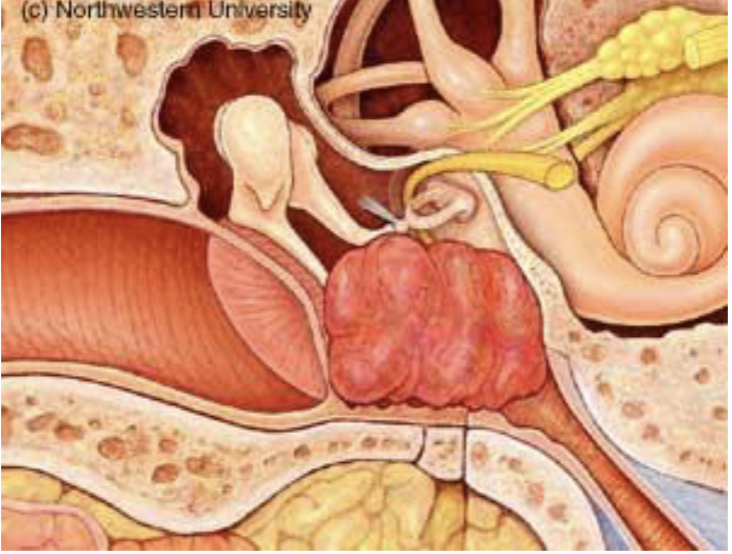
glomus tumor
a tumor that is not malignant, is very slow growing, and can disrupt the ossicular chain (needs surgical removal)
patients complain that they can hear their heartbeat in their ear
eustachian tube
connects the middle ear to the back of the nose and upper throat, it helps equalize pressure, drains fluid, and protects the middle ear
is normally closed and opens during actions that activate the muscles of the soft palate
tips to help support its health is swallowing, yawning, or chewing gum, during flights, swallow or yawn during takeoff and landing, manage colds, allergies, and sinus congestion, and avoid smoke and environmental irritants
inner ear disorders
disorders that affect your balance and hearing
includes vestibular schwannoma, neurofibromatosis, facial nerve disorders, diabetes, meniere’s disease, noise induced hearing loss, presbycusis, trauma, and ototoxicity
vestibular schwannoma
also called an acoustic neuroma
usually unilateral slow growing tumor of VIII nerve
very poor speech discrimination compared to thresholds (ear with loss may not be able to repeat speech)
patients report full feeling in the ear and dizziness is also common

neurofibromatosis
NF1 rarely involves the ear
NF2 faster growing acoustic tumors (bilateral)
usually sudden onset of hearing loss/deafness
removal of tumors severs VIII nerve, complete deafness
cochlear neuritis
inflammation of VIII nerve
facial nerve disorders
bell’s palsy (most common)
test finding: ipsilateral acoustic reflex absent with normal hearing
can cause hearing loss and facial numbness (which is why it’s inner ear)
diabetes
in children and adults
progressive bilateral sensorineural hearing loss
meniere’s disease
usually seen as hearing loss, vertigo, and tinnitus
fullness in the ear
hearing loss can FLUCTUATE
often a “dumping ground” for unknown etiologies
fluctuating low frequency hearing loss mostly in one ear (symptoms can come some days and other days not)
noise induced hearing loss
repeated exposure leads to progressive loss
single episode > 140 dB HL can cause deafness
classic “noise notch” in hearing test
wear hearing protection to prevent loss
presbycusis
aging of the ear
can involve degradation of cochlear structures and/or central auditory cell structures
typically, very poor speech recognition compared to hearing tests results
isolation can cause hearing degradation (lack of communication and hearing speech)
noise notch

half
after increasing 3 dBs on continuous dB, permissible exposure time decreases by how much?
trauma
longitudinal fracture usually involves middle/outer ear systems (often repairable) like being in a car accident
transverse fractures typically involve inner ear systems (non repairable)
ototoxicity
drugs that are toxic for the ear
“mycin” drugs: aminoglycosides
anti-inflammatory (aspirin, blood thinners)
chemotherapy drugs
quinine (malaria)
central pathologies
include multiple sclerosis, disrupted blood supplies, and hereditary motor sensory neuropathies (HMSN)
multiple sclerosis
demyelination of nerves
plaque adhesions at the brainstem
can hit balance nerve
disrupted blood supplies
TIAs (transient ischemic attacks)
arteriosclerosis (hardening of the arteries)
aneurysm (burst blood vessel)
hereditary motor sensory neuropathies (HMSN)
charcot-marie-tooth (mutation on the X chromosome)
friedreich’s ataxia (mutation of the FXN gene that produces frataxin protein)
voluntary movement (affects balance)
auditory neuropathy spectrum disorder
wide range of audiometric results
many causes, including genetic
often misdiagnosed as central auditory processing disorder
triage audiological test: acoustic reflex testing, OAE (normal), ABR (absent)
cochlea works fine, but beyond cochlea is not, which is why patient can’t understand speech
causes of hearing loss in children
genetics, in utero infections (CMV, syphilis, rubella, toxoplasmosis), prematurity (NICU > 5 days = risk factor), postnatal infections (herpes, chicken pox), chemotherapy, trauma, and noise induced
genetics
non-syndromic: isolated hearing loss without other findings, recessive 70%, dominant 15%, x-linked, mitochondrial 15%, approximately 120 genes identified
10 most common syndromes
hearing loss in addition to another symptom
waardenburg (pigment issues), treacher-collins (craniofacial), pendred (thyroid/goiter), usher (deaf blindness), branchio-oto-renal (kidney malformation), stickler (connective tissue), alport (renal failure), NFII/NF2 (tumors on VIII nerve), jervell-lange-neilson (cardiac), CHARGE (complicated and diverse)
mondini malformation (dysplasia)
a type of malformation of the cochlea where the cochlea only has 1 ½ turns
estimated to occur at 7 weeks gestation
many malformations lumped into that term
enlarged vestibular aqueduct (EVA)
a type of malformation of the cochlea where it can be congenital or acquired in first 3 years of life, genetics not fully understood
can be associated with pendred syndrome