Kaplan Biochemistry - Chapter 6: DNA and Biotechnology
 Call Kai
 Learn
Learn Practice Test
 Spaced Repetition
 Match
Match Flashcards
 Knowt Play
1/70

There's no tags or description
Looks like no tags are added yet.
Name | Mastery | Learn | Test | Matching | Spaced | Call with Kai | Chat |
|---|
No analytics yet
Send a link to your students to track their progress
71 Terms
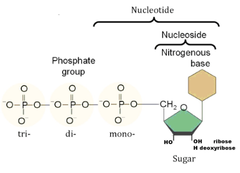
Nucleosides
Five-carbon sugar (pentose) bonded to nitrogenous base (A,T,G,C,U) and formed by covalently linking C-1 of sugar to base.
Nucleotides
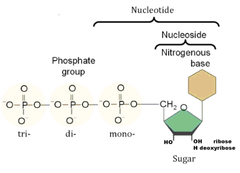
A nucleoside to which one or more phosphate groups are added at C-5 of pentose.
Why are nucleotides high energy compounds?
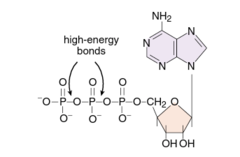
The close proximity of negatively charged phosphate groups create high energy compound that is exothermic upon bond breaking.
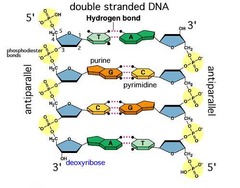
DNA backbone?
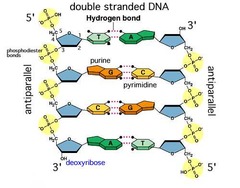
The negatively charged backbone of DNA is composed of alternating sugar and phosphate groups.
1) It determines the directionality of DNA and is always read from 5' to 3'. Meaning the Phosphate group links the 3' carbon of one sugar to the 5' phosphate group of the incoming sugar in the chain.
What charge does an RNA backbone have?
Both DNA and RNA backbones carry a negative charge due to phosphate groups.
How can you distinguish 5' vs 3'?
The 5' end has a -OH or phosphate group on C-5' of sugar.
The 3' has a -OH on the C-3' of the sugar.
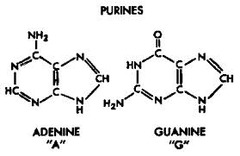
Purines
Contain two rings in there structure:
1) Adenine (A)
2) Guanine (G)
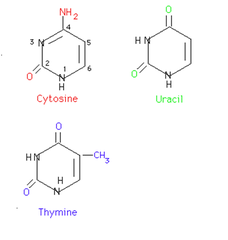
Pyrimidines
Only one ring in there structure:
1) Thymine
2) Cytosine
3) Uracil
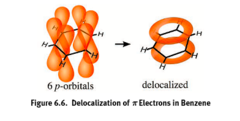
Aromatic
unusually stable ring system because of delocalized pi electrons
Aromatic criteria:
1) Cyclic
2) Planar
3) Conjugated (alternating double/single bonds/lone pairs)
4) Huckel's rule: 4n + 2 pi electrons
Heterocycles
ring structures that contain at least two different elements in the ring.
Ex) Purines and pyrimidines!
Watson-Crick model
1) Two stands of DNA are anti-parallel
2) Sugar-phospahte backbone is on outside
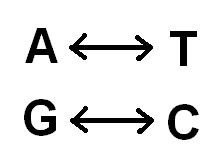
3) Complementary base paring (A-T, G-C)
4) Due to complementary pairing, [A]=[T],[G]=[C]
5) Right handed double helix
Chargoff's rule
Due to complementary base pairing, the amount of A in and DNA sequence must equal the amount of T, and the the amount of G must equal amount of C.
DNA stability
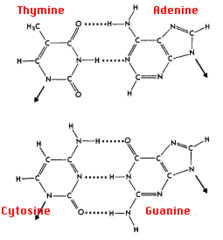
1) Intermolecular hydrogen bonds between base pairs
2) Delocalization of electrons in p orbitals of base pairs
3) Increased entropy due to sequestered hydrophobic base pairs + exposed - charged phosphate groups.
H bonds in bases?
G-C has three H bonds and is stronger.
A-T has two and is therefore weaker.
DNA will a higher denaturation point will have more G-C base pairs because intermolecular forces are higher!
B-DNA
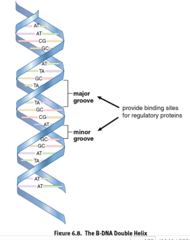
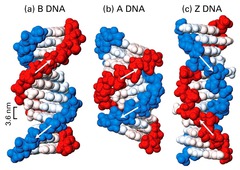
DNA forming a right-handed helix.
1) Makes turn every 3.4 nm and ~10 bases
2) Turns create major and minor grooves and are sites of protein binding.
Z-DNA
Left-handed helix.
1) No biological activity attributed to it.
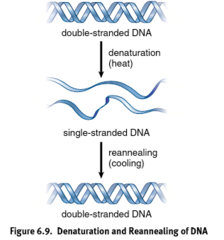
Denaturation
The disruption of hydrogen bonding and base-pairing, resulting in a "melting" of the double stranded helix into two single strands.
What factors can cause DNA denaturation?
1) Heat
2) alkaline pH
3) Chemicals like urea or formaldehyde
Reanneal
Bringing single-stranded DNA back together.
1) Must be performed slowly to get correct use pairing
2) Important step in PCR
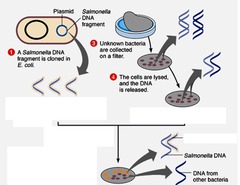
probe DNA
(DNA with known sequence)
added to a mixture of target DNA sequences, when it binds to target DNA sequences, it may provide evidence of the presence of a gene of interest
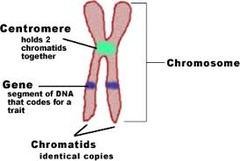
Chromosomes
A single piece of coiled DNA and associated proteins found in linear forms in the nucleus of eukaryotic cells and circular forms in the cytoplasm of prokaryotic cells; contains genes that encode traits. Each species has a characteristic number of chromosomes.
Chromatin
Clusters of uncondensed DNA, RNA, and proteins in the nucleus of a cell
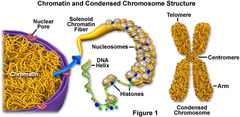
Histones
(list five)
Small, basic proteins that chromosomes wind around.
Five basic histones:
H2A, H2B, H3, and H4 form histone core and about 200 base pairs of DNA are wrapped around protein complex.
The last histone, H1, seals off the DNA as it enters and leaves the nucleosome, adding stability to structure.
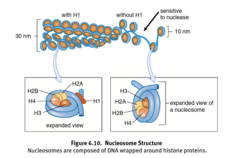
What do the five histones do?
1) H2A, H2B, H3, and H4 (the first 4) form a protein complex and have chromosomes wind around them.
2) H5 seals off the ends of these chromosome-histone complex and stabilizes structure.
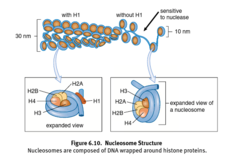
What happens to the chromosomes that do not have histone H1?
They begin to unravel and are susceptible to nuclease.
At what stage does DNA replicate?
DNA replicates in S phase.
At this phase, the majority of DNA needs to be uncondensed and accessible to make the process more efficient.
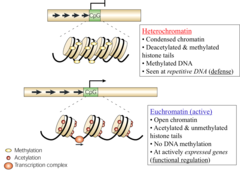
Heterochromatin
Chromatin that remains compact during interphase and appears dark under light microscopy.
1) Transcriptionally silent
2) Often has DNA with repetitive sequence
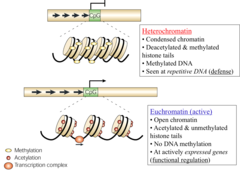
Euchromatin
Dispersed chromatin, which appears light under light microscopy.
contains genetically active DNA - expressed
Telomeres
Repeating units (TTAGGG) at the end of DNA that protect eukaryotic chromosomes.
1) Have high GC content that creates strong attraction at end of chromosome and serves as a protection "knotting off"
2) Linked to aging due to shortening w/ each replication
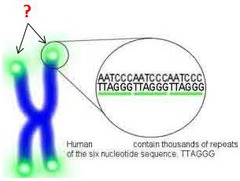
Why are telomeres necessary?
DNA replication cannot extend all the way to the end of the chromosome and as a result, we lose sequences of information with each round of replication.
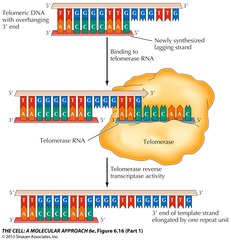
Telomerases
Enzymes that replace/repair telomeres by adding back onto the degraded DNA strand.
1) Expressed in rapidly dividing cells
Centromeres
Region of DNA found in the center of a chromosome.
1) Composed of heterochromatin, with high GC content.
2) Allows sister chromatin to remain connected there until microtubules pull them away in anaphase.
DNA replication
the process of making a copy of DNA
Origin of replication
The initiation site of replication
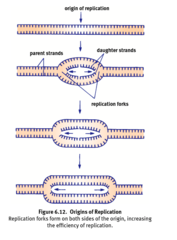
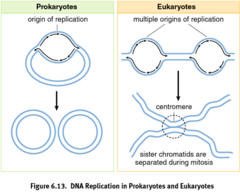
Bacterial origin of replication vs Eurkayote formation?
Bacteria have circular dsDNA:
-form two circular molecules.
Eukaryotic formation:
One linear sequence requires multiple organ sites. As they move toward each other, sister chromatid are created and remain bound to centromere.
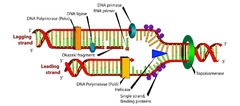
Lagging strand
Parent stand oriented in the 5' to 3' direction
Copied in the direction opposite of the direction of the replication fork. The parental strand is 5' to 3', which means DNA cannot simply read and synthesize strand.
DNA polymerase can only synthesize 5' -> 3', producing Okazaki fragments.
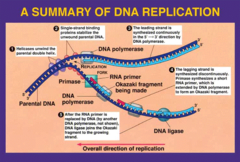
Leading strand
Parent strand oriented in 3' to 5' direction
This parental strand will be read 3' to 5' and its compliment will be synthesized in a 5' to 3' manner.
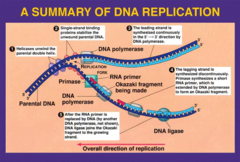
Okazaki fragment
short pieces of new DNA on lagging strand
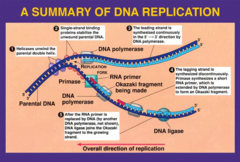
Replication fork
junction where nucleotides are being added to the growing DNA chain during replication (looks like a Y)
DNA Replication conserved?
Process is semi-conserved because one parental strand is retained in each of the two resulting identical double stranded DNA molecules.
Parent strands copied into:
Parent strands are copied to form daughter strands through complementary base pairing, resulting in two copies of DNA.
DNA replication steps:
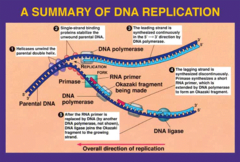
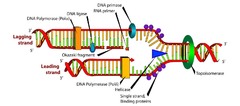
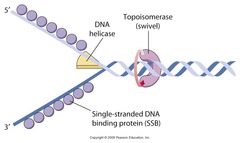
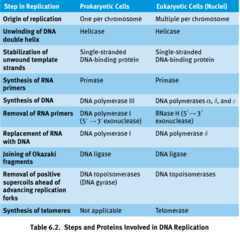
1) Helicase- unwinds the parental double helix
2) DNA topoisomerase - upstream of helices alleviating torsional strain
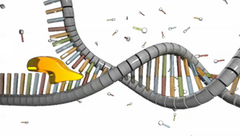
3) Single-strand binding proteins (SSBP) stabilize unwound DNA, aided by DNA gyrase.
4) Primase synthesizes a short RNA primer for DNA polymerase to bind to in the 5' to 3' direction to start replication on each strand.
5) DNA polymerase synthesizes the leading strand in 5' to 3' direction while the lagging strand is made discontinuously by primase making short pieces and then DNA polymerase extending these to make Okazaki fragments.
6) DNA ligase joins the Okazaki fragments together
Helicase
Enzyme responsible for unwinding DNA, generating two ssDNA template strand ahead of DNA polymerase.
single-stranded DNA binding proteins (SSBP)
Supercoiling
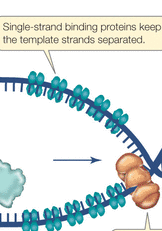
Wrapping of DNA on itself toward telomeres during replication. Creates tension via positive supercoils.
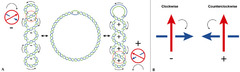
DNA topoisomerases
Alleviate the torsional stress and reduce the risk of strand breakage in DNA by introducing negative supercoils.
DNA polymerase
Responsible for reading the DNA template, or parental strand, and synthesizing the new daughter strand.
1) Reads 3' to 5'
2) Synthesizes 5' to 3'
*results in new double helix that is antiparallel.
How does DNA polymerase extend the primer strands?
Incoming nucleotides in the form of 5' deoxyribonucleotide triphosphate: dATP, dCTP,dGTP, and dTTP.
As the new phosphodiester bond is formed, pyrophosphate (PPi) is released.
Differences in DNA replication between prokaryotes and eukaryotes?
Oncogenes
Mutated genes that cause cancer. Oncogens primarily encode cell cycle-related proteins.
Proto-oncogens
oncogenes before they are mutated
These are responsible for regulating cell cycle division and turning off when division is finished. "Gas Pedal".
Antioncogens
Tumor supressor genes like p53, that encode proteins that inhibit the cell cycle.
What happens when antioncogens are mutated?
Mutations of antioncogens result in loss of tumor suppression activity, and therefore promote cancer.
DNA proofreading
During synthesis, DNA polymerase will proofread.
Can detect incorrectly paired H-bonds, and excises/ replaces with correct pair.
Proofreading: How does DNA polymerase discriminate between template strand and incorrect daughter strand?
The template strand has a higher level of methylation.
Where are errors in proofreading most likely?
The likelihood of mutations in the lagging strand is considerably higher due to the lack of proofreading ability of DNA ligase.
Mismatch repair
Cells also have machinery in G2 phase of cell cycle for mismatch repair.
Enzymes detect and remove errors in replication that were missed during DNA replication in S phase.
Nucleotide and Base Excision Repair
During excision repair, damaged nucleotides are removed and replaced by DNA polymerase. DNA ligase will join the new strand to the existing stand.
Endonucleases
Remove the damaged DNA.
Recombinant DNA
DNA that has been formed artificially by combining constituents from different organisms.
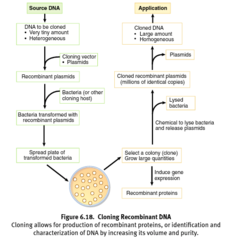
DNA cloning
1) Introduce DNA fragment into a vector plasmid.
2) A restriction enzyme (restriction endonuclease) cuts both the plasmid and fragment, which are left at stick ends.
3) Fragment then binds to the plasmid, and can be introduced into bacterial cell and permitted to replicate, generating multiple fragment copies.
4) Vectors contain the origin of replication, the fragment of interest, and at least one gene for antibiotic resistance.
5) Once replicated, bacterial cell cane be used to create a protein of interest, or lysed to allow isolation of magnified fragment.
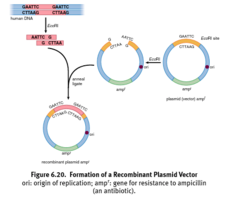
Hybridization
The joining of complementary base pair sequences
Polymerase chain reaction (PCR)
1) Denature DNA
2) Anneal primer
3) Extend ssDNA
Cool down to dsDNA
Repeat
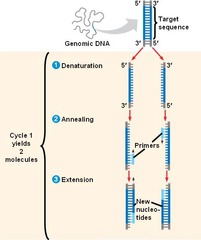
Agarose Gel electrophoresis
Type of Chromatography, used to separate nucleic acids based on size/length of chain. The media serves as the stationary phase and the nucleic acid as the mobile phase. Negatively charged nucleic acids travel toward the anode (positive end). Smaller strands travel faster than larger chains.
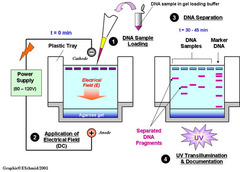
Southern blotting
Used to detect presence and quantity of various DNA strands in a sample.
1) After electrophoresis, the sample is transferred to membrane and can be probed with ssDNA molecule to look for DNA of interest.
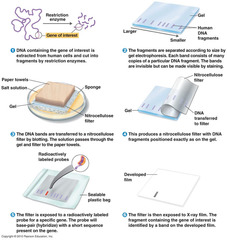
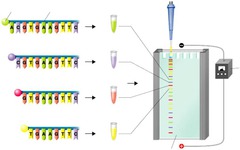
DNA sequencing
1) Using ddNTP's (no -OH on C-3)
2) DNA polymerase
3) dNTPS
DNA sequencing in which ddNTP's randomly add and terminate sequence. Then can separate by gel electrophoresis and read ddNTP ends for sequence.
Gene therapy
The insertion of working copies of a gene into the cells of a person with a genetic disorder in an attempt to correct the disorder
Transgenic mice
created by integrating a gene of interest into a germ line or embryonic stem cell of developing mouse.
1) Can be mated to select for transgene
Chimeras
organisms that contain cells from two different lineages
Ethical issues of biotechnology?
1) Pathogen resistance
2) Selecting child's traits
3) unethical gene therapy