CSI: Sketching and Mapping
 Call Kai
 Learn
Learn Practice Test
 Spaced Repetition
 Match
Match Flashcards
 Knowt Play
1/78

There's no tags or description
Looks like no tags are added yet.
Name | Mastery | Learn | Test | Matching | Spaced | Call with Kai | Chat |
|---|
No analytics yet
Send a link to your students to track their progress
79 Terms
How does the initial responding officer set the stage for successful crime scene processing?
Establishing control of the scene
5 goals of incident management the initial responding officer is responsible for in order to safely/effectively gain control of the scene
Document provided information
Not becoming a casualty
Provide for emergency care
Secure and control the scene and those within it
Release the scene to the appropriate authorities (detective or CSI)
Initial responding officer order of responsibility
Safety
Lifesaving
Scene control
What’s more important: lifesaving or evidence preservation?
lifesaving
3 points the primary officer needs to consider in order to secure/control the area
Primary focal points
Natural Entry and Exit Points
Secondary Scenes
Primary focal points
Areas that stand out within a scene
3 examples of primary focal points
a body, fired cartridge casings, a ransacked room
Natural Entry and Exit Points
Can determine where perpetrators enter and exit the scene
Secondary Scenes
Areas on the outer edge of/surrounding the scene
Suspect staging areas
a secondary crime scene where a suspect prepares or alters things related to the crime
Items dropped when the suspect fled a crime scene is considered…
a secondary crime scene
Who is responsible for the initial documentation of a crime scene?
The responding officer
Initial documentation of a crime scene includes
Who said what upon arrival
Noting transient evidence (smells, sights, sounds)
Times when ppl arrive or leave the scene
How is a scene physically secured?
Barrier tape
A designated ___ and ___ point should be a established
exit and entry point
Once CSI arrives, the first responding officer should…
conduct a debriefing
Purposes of the debriefing between the 1st responding officer and CSI is to consider (5things)…
Scope of the scene
Scene integrity and contamination control
Team approach and composition
Search methods to be used
Personal protective measures
Primary goal of scene processing
collect as much evidence as possible in the most pristine conditions
Multilevel Containment System
An effective way to maintain science integrity and reduce contamination by establishing at least two perimeters, creating 3 distinct zones (inner, middle, and outer)
Multilevel Containment System: Outer Area
typically where onlookers, media and non-essential personnel are kept
Multilevel containment system: middle area
A working zone that serves as a staging area for equipment such as cameras, bulky gear, or investigative kits. May also be used for trash collection and temporary evidence storage.
Multilevel containment system: Inner Area
Restricted to personnel actively involved in scene processing
CSI: Assessing
Before taking any action, the CSI must assess the circumstances to determine an appropriate course of action
CSI: Observing
The CSI visually inspects and mentally registers the condition of the scene and any artifacts present
CSI: Documenting
Documentation includes a variety of methods such as written notes of observations, photography, video recordings, and sketch creating
CSI: Searching
Always intrusive, involves moving items to examine surfaces that aren’t visible
CSI: Collecting
The physical removal of items at the scene is intrusive
CSI: Processing/Analyzing
Involves applying methods such as fingerprint powder, chemical enhancements, or other forensic techniques
CSI series of 6 systematic actions to handle and preserve evidence
Assessing
Observing
Documenting
Searching
Collecting
Processing/Analyzing
4 factors considered when determining the area/search swath a single searcher is responsible for
Nature of Ground Being Searched
Lighting
Environmental Conditions
Size of Items Being Searched for
Example of the nature of the ground being searched
An asphalt parking lot may be easier to search than a field of knee high grass due to visibility and surface uniformity
Ambient lighting and the time of day
are lighting conditions that will significantly affect a searcher’s ability to visualize evidence
Poor lighting conditions may…
obscure small or subtle evidence
On-scene environmental conditions (2) of INDOOR scenes that can impact focus and efficiency
temperature extremes
strong odors
On-scene environmental conditions (3) of OUTDOOR scenes that can impact focus and efficiency
Rain
Snow
Wind, etc
Example of how the size of an item being searched for effects CSI
searching for a small fired cartridge case on a mowed lawn requires more precision than searching for a larger item, like a pistol, in the same area
Circle/Spiral Search: Commonly used for…
interior scenes
Circle/Spiral Search
The searcher begins on the outer edge of the area and moves inward in a slow, controlled spiral pattern (can be conducted in reverse)
Circle/Spiral Search Key Consideration
maintain a consistent pace to ensure thorough coverage and minimize the risk of overlooking evidence
Strip Search is commonly used for…
exterior scenes when evaluating large areas
Strip Search
The searcher begins at one end of a designated strip and proceeds in a straight line to the opposite end, then moves to the next adjacent strip and continues in the reverse direction
Strip search pattern ensures…is particularly effective for…
systematic coverage of the entire area and its particularly effective for open fields, parks or large outdoor scenes
Line Search
Variation of strip search, the difference is the number of searchers involved. A group of searchers forms a line across an area, each responsible for a specific lane. The team moves together in a single direction, systematically scanning their assigned lanes.
Line searching is useful for….
large outdoor scenes w uneven terrain
Line search key consideration
team moves as a unit, maintaining the pace set by the slowest searched to ensure thorough coverage
Grid Search
Variation of the strip search where the area is divided into two sets of strips/lanes that intersect at 90-degree angles. The searcher conducts a standard strip search up and down each lane. Then perform a second search along the perpendicular set of lanes to create double coverage.
Grid search method provides more ______ than strip search
detailed examination
Zone Search
Two variations-small/confined spaces and large exterior scenes-where the space is divided into manageable zones and each zone is thoroughly searched before moving onto the next.
Zone search for small/confined spaces
ideal for areas that are difficult to search using patterned movements (inside a car)
Large exterior scenes
area is divided into physical grids or zones. particularly useful for extensive outdoor scenes with scattered evidence, remains or debris (airplane crash)
Point to Point Search
Rarely practiced in US. CSI identifies primary focal point and determines which order to process them. The investigator fully processes the first focal point and its surrounding area before moving onto the next. Without proper training and experience this method can become disorganized
Manual mapping methods allow for documenting (3)…
size of the scene
elements within the scene like furniture
precise location of evidence
Three people in a typical sketching and mapping team
Two take measurements and one makes the rough sketch
Baseline Coordinates are best suited for…
exterior scenes without obvious landmarks
Baseline Coordinates
Begins at datum point established by triangulating nearby landmarks. Tape measure is extended along the cardinal direction from this point and the distance to each item is measured at right angles. CSI records the position along the baseline where evidence measurements intersect.
Rectangular Coordinates are best suited for…
crime scenes with clear boundaries like interior walls
Rectangular Coordinates
CSI fixes evidence by measuring right angles from the evidence to the surrounding walls. Typically two measurements to the center of the item are taken. For regularly shaped items (furniture) two measurements from different points can be taken.
Rectangular Coordinates are ____ compared to triangulation
less precise
Triangulation is the…
most effective method for fixing evidence.
Triangulation: Regularly shaped items
CSI uses a minimum of four measurements from two distinct landmarks in the room to two points on the item for regularly shaped items.
Triangulation: Irregularly shaped items
(like a pile of clothes) two measurements to the center mass as sufficient.
Polar Coordinates: A _____ technique used for…
An older technique used for mapping large, open exterior scenes where evidence is scattered, such as airplane crashes or bombing scenes
Polar Coordinates
Using a sighting device, 2-3 measurements from a known point are taken to the evidence (horizontal distance, horizontal angle and elevation distance)
The amount of effort devoted to creating a sketch depends primarily on (2)…
severity of the crime
important of evidences spatial relationships
Formal Sketch 5 Basic Elements
Heading
Diagram Area
Legend
Title Block
Scale and Direction Notations
Formal Sketch Heading
a notation that explains the purpose of the sketch and why it was created
Formal Sketch Diagram Area
The actual drawing of the scene showing layout and evidence
Formal Sketch Legend
A key that explains symbols, labels or markings used in the diagram
Formal Sketch Title Block
Relevant information like location of the scene, date, and name of the artist
Formal Sketch Scale and Direction Notations
indicates whether a scale is used and specifies the ratio. shows the orientation of the sketch relative to compass directions
Standard Crime Scene sketch view
birds-eye view showing only horizontal surfaces and evidence on them
cross-Projection/exploded sketch
combines birds eye view of horizontal surfaces with the walls “laid down” flat to show evidence on vertical surfaces
Elevation Sketch
Provides a side view of a specific portion of the scene, like an interior wall or other vertical structure. Used to map and document evidence on walls
3D Sketch
Offers a more realistic perspective by presenting the scene in 3D. helps visualize spatial relationships more accurately
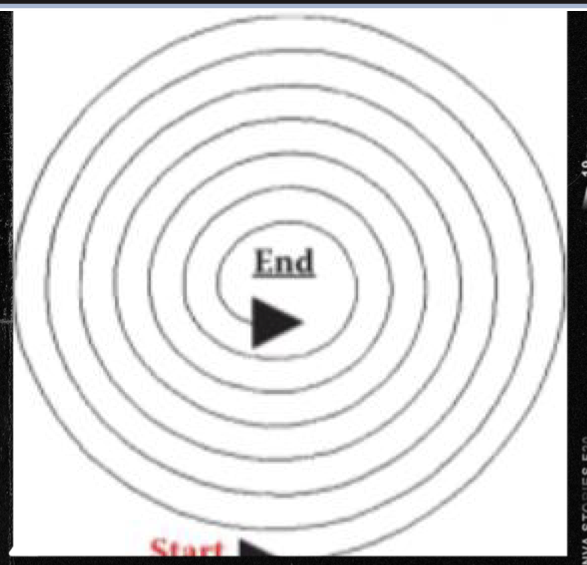
Spiral/Circle Search Pattern

Strip Search

Line Search

Grid Search

Baseline Coordinates