All Previous CAFS HSC MC Questions - untill the start of time
 Call Kai
 Learn
Learn Practice Test
 Spaced Repetition
 Match
Match Flashcards
 Knowt Play
1/78

Earn XP
Description and Tags
CAFS NSW Australia - Multiple Choice Quiz
Name | Mastery | Learn | Test | Matching | Spaced | Call with Kai | Chat |
|---|
No analytics yet
Send a link to your students to track their progress
79 Terms
Which of the following sample groups would best minimise bias in the research process?
a) 3 males and 9 females
b) 6 males and 6 females
c) 0 males and 12 females
d) 10 males and 2 females
b
What is a benefit of using interviews as a research method?
a) It allows in-depth exploration of a topic.
b) It ensures an easy and quick analysis of data.
c) It provides the most reliable form of research.
d) It collects a large amount of quantitative data.
a
When conducting research, sample size refers to
a) how participants were selected to take part.
b) the number of people selected for the research.
c) a section of the population selected for research.
d) the demographic information about participants in the research.
b
Which of the following lists best reflects health behaviours that people should adopt when preparing to become a biological parent?
a) Following a healthy diet, listening to music, creating a budget
b) Purchasing a pram, installing ramps, taking appropriate medication
c) Ensuring adequate sleep, installing childproof locks, attending antenatal classes
d) Using recommended vitamin supplements, exercising regularly, limiting caffeine intake
d
Which of the following lists contains ONLY examples of formal carers?
a) Grandparent, nurse, teacher
b) Counsellor, sibling, babysitter
c) Teacher, nurse, childcare worker
d) Friend, childcare worker, counsellor
c
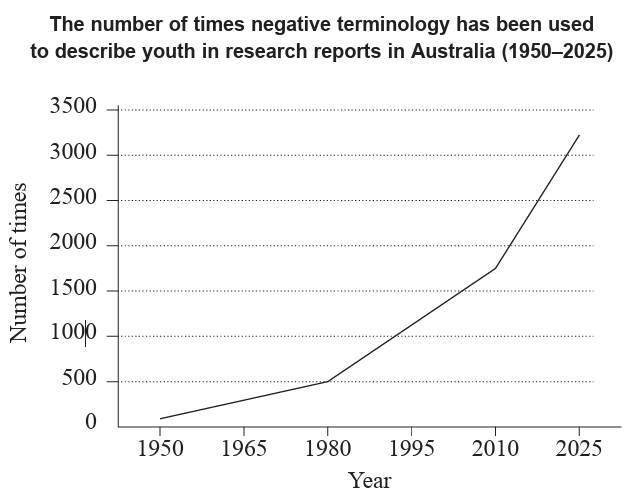
Refer to the following data to answer Question 6.
Which of the following research methods would most likely have been used to produce the results shown in the graph?
a) Interview
b) Case study
c) Questionnaire
d) Literature review
d
Which of the following best describes a bibliography?
a) A list of the sources collected for a research project
b) A list of the materials that were developed during a research project
c) A list of sources that have been used when carrying out a research project
d) A list of all materials that have been ordered alphabetically during a research project
c
Which of the following is the most important question for a student to ask when analysing their primary data?
a) What evidence is presented in my findings?
b) What was expressed by most people I spoke to?
c) What were my positive and negative experiences?
d) What type of graph is most suitable to present my data?
a
A school is concerned about the inactivity of its students and wants to collect data about the number of minutes per day that these students participate in physical activity. The school will use the data to develop and implement strategies to promote students’ physical activity. Which of the following statements best represents the school’s purpose in collecting this data?
a) Developing a research question and proposing a hypothesis
b) Increasing understanding and educating the community
c) Advancing knowledge and monitoring wellbeing
d) Informing practice and addressing a health need
d
Which of the following statements is true about surrogacy in Australia?
a) A surrogate can accept payments for financial benefit.
b) Surrogacy legislation is consistent across all states and territories.
c) There is no biological connection between the baby and the surrogate parent.
d) A surrogate may have parental responsibility if the intended parent arrangements fail.
d
Refer to the stimulus to answer Question 11.
Statement 1: A hypothesis asks why there is a relationship between variables in a given population.
Statement 2: The credibility of print and digital sources of data used in a research project relies on it being relevant, reliable, valid and properly cited.
Which of the following is correct?
a) Both statements are true.
b) Both statements are false.
c) Statement 1 is false and Statement 2 is true.
d) Statement 1 is true and Statement 2 is false.
c
Jamie is a Year 10 student. He has football training during school hours, and tutoring or work after school. He has difficulty managing stress, is constantly tired and wants to see his school counsellor again.
A shortage of which of the following resources will have the greatest effect on Jamie’s access to the school counsellor?
a) Energy and time
b) Money and energy
c) Time and knowledge
d) Knowledge and money
a
How can advocacy best contribute to positive community attitudes?
a) By preventing the sharing of stories
b) By creating legal and moral obligations
c) By raising awareness of issues and injustices
d) By developing programs and activities for family members
c
Why is it essential for a researcher to credit the sources that they have accessed?
a) To show respect to researchers of previous studies
b) To ensure the reliability of their research
c) To maintain the privacy of the authors
d) To prevent bias in their research
a
It would be appropriate to adopt a permissive style of parenting when
a) there is a safety concern.
b) negotiating a curfew time in school holidays.
c) assisting a child to select an extracurricular activity.
d) establishing trust in a child to make the right decision.
d
Kim and Ashley plan to care for their three-year-old grandchild in their home when the child’s parent returns to part-time work.
What would be the most appropriate preparation for Kim and Ashley?
a) Purchasing food and toys for the child
b) Discussing the child’s sleep routines and installing ramps
c) Reviewing potential hazards in the home and undertaking first aid training
d) Determining hours of care for the grandchild and planning carer payments
c
Which of the following best explains the recent reduction in the number of couples requesting adoptions within Australia?
a) There is a preference for foster care rather than adoption.
b) The public activism against overseas adoption has increased.
c) The process to become an adoptive parent has become easier.
d) There have been significant improvements in reproductive technology.
d
A research study is to be conducted to determine the time spent by rural and remote families travelling to access health care services.
Which of the following actions would contribute to the reliability of the research?
a) A rural town is selected and a case study is conducted.
b) Qualitative data is graphed and shared with rural and remote governments.
c) Rural and remote health services submit this data and share client’s personal details.
d) A random sample of health services is chosen and their rural and remote clients are surveyed.
d
Which of the following steps in conducting an observation is most likely to be ethical?
a) Ensure all participants are debriefed after the data collection
b) Use hidden video cameras to monitor participants to ensure nothing is missed
c) Place participants in pressure situations to monitor exactly how they will respond
d) Share the final report with participants including all data gathered and how it was interpreted
a
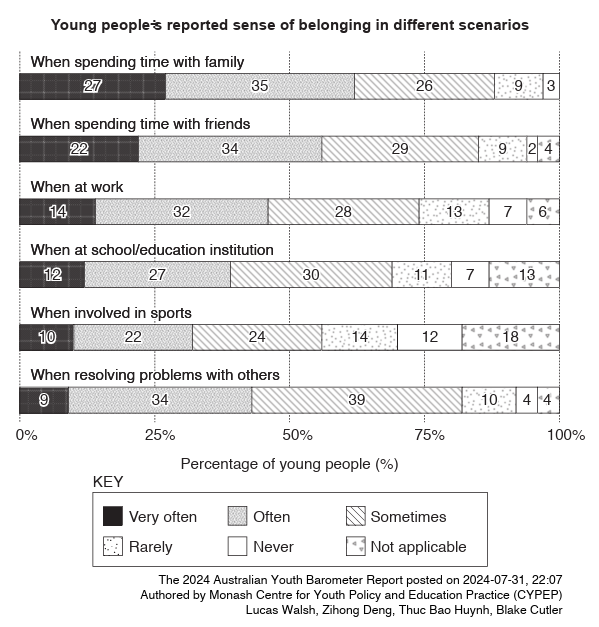
A group of young people were surveyed about their sense of belonging in different scenarios. The findings are presented in the graph shown.
Which of the following is best supported by the survey findings provided?
a) Young people have a greater sense of belonging in schools, which suggests that schools have successfully met the social needs of youth.
b) Young people’s greater sense of belonging within their families suggests that resolving problems in friendships is not important.
c) Young people learn problem solving with friends, which suggests that schools are the most important place for developing a sense of belonging.
d) Young people’s lower sense of belonging at work and in sports suggests that support in these areas is needed to help young people feel more connected.
d
a)
b)
c)
d)
a)
b)
c)
d)
a)
b)
c)
d)
a)
b)
c)
d)
a)
b)
c)
d)
a)
b)
c)
d)
a)
b)
c)
d)
a)
b)
c)
d)
a)
b)
c)
d)
a)
b)
c)
d)
a)
b)
c)
d)
a)
b)
c)
d)
a)
b)
c)
d)
a)
b)
c)
d)
a)
b)
c)
d)
a)
b)
c)
d)
a)
b)
c)
d)
a)
b)
c)
d)
a)
b)
c)
d)
a)
b)
c)
d)
a)
b)
c)
d)
a)
b)
c)
d)
a)
b)
c)
d)
a)
b)
c)
d)
a)
b)
c)
d)
a)
b)
c)
d)
a)
b)
c)
d)
a)
b)
c)
d)
a)
b)
c)
d)
a)
b)
c)
d)
a)
b)
c)
d)
a)
b)
c)
d)
a)
b)
c)
d)
a)
b)
c)
d)
a)
b)
c)
d)
a)
b)
c)
d)
a)
b)
c)
d)
a)
b)
c)
d)
a)
b)
c)
d)
a)
b)
c)
d)
a)
b)
c)
d)
a)
b)
c)
d)
a)
b)
c)
d)
a)
b)
c)
d)
a)
b)
c)
d)
a)
b)
c)
d)
a)
b)
c)
d)
a)
b)
c)
d)
a)
b)
c)
d)
a)
b)
c)
d)
a)
b)
c)
d)
a)
b)
c)
d)
a)
b)
c)
d)
a)
b)
c)
d)
a)
b)
c)
d)
a)
b)
c)
d)
a)
b)
c)
d)
a)
b)
c)
d)
a)
b)
c)
d)