P&O Quiz ?s Exam 2
 Call Kai
 Learn
Learn Practice Test
 Spaced Repetition
 Match
Match Flashcards
 Knowt Play
1/19

There's no tags or description
Looks like no tags are added yet.
Name | Mastery | Learn | Test | Matching | Spaced | Call with Kai | Chat |
|---|
No analytics yet
Send a link to your students to track their progress
20 Terms
A patient is 7 months post-op a transtibial amputation. The patient can ambulate short distances in the community without varying their cadence significantly. What is the patient’s K-level?
A) K0
B) K1
C) K2
D) K3
C) K2
A patient is 7 months post-op a transtibial amputation. The patient can ambulate short distances in the community without varying their cadence significantly. What kind of foot might the patient use for ambulation?
A) SACH
B) SAFE
C) Multi-axis
D) STEN
E) A and B
F) A, B, and C
G) All of the above
G) All of the above
A patient with R knee ligamentous laxity wears a foot that allows minimal coronal or transverse plane torque absorption and has a durable bumper. What foot is the patient wearing?
A) SACH
B) SAFE
C) Single axis
D) Multi axis
C) Single axis
A patient with a TTA has 15% residual limb remaining. What would be the MOST beneficial socket for this patient?
A) PTB
B) PTB-SC
C) PTB-SC/P
D) Total Surface Bearing
C) PTB-SC/P
Which of the following is not a weight sensitive area for a TTA?
A) Fibula shaft
B) Fibula head
C) Anterior tibial crest
D) Anterior tibia condyle
A) Fibula shaft
Match the following Medicare Functional Levels:
Community ambulation and the ability to vary cadence with vocational, therapeutic, or exercise needs
Limited community ambulation
Household ambulation
High levels of activity such as demonstrated by active adults and athletes
Not a candidate for a prosthesis
K0, K1, K2, K3, K4
Community ambulation and the ability to vary cadence with vocational, therapeutic, or exercise needs - K3
Limited community ambulation - K2
Household ambulation - K1
High levels of activity such as demonstrated by active adults and athletes - K4
Not a candidate for a prosthesis - K0
A patient who is a warehouse worker is able to vary their cadence significantly while ambulating community distances and at work. The patient is able to negotiate most environmental barriers. Based on this information, which statement is MOST accurate?
A) The patient is a K1 ambulator who could ambulate with a SACH foot
B) The patient is a K2 ambulator who could ambulate with a SACH foot
C) The patient is a K3 ambulator who could ambulate with a SAFE foot
D) The patient is a K4 ambulator who could ambulate with a SAFE foot
C) The patient is a K3 ambulator who could ambulate with a SAFE foot
A new patient, who is post op a transtibial amputation, has altered mental status. Fortunately, the patient’s spouse is present so that the therapist can educate them in proper positioning onf the patient to prevent the typical contractures in the patient. Which statement is accurate?
A) The therapist should stress that the patient should as frequently as possible maximize out-of-bed time with sitting in a chair
B) The therapist should stress that the patient be positioned in prone lying with full knee extension
C) The therapist should stress that the patient be positioned in prone lying with slight knee flexion
D) The therapist should stress that the patient be positioned in supine with a small pillow under the knee
B) The therapist should stress that the patient be positioned in prone lying with full knee extension
A patient has a short right transtibial residual limb and presents with knee instability. The patient tends to hyperextend during the stance phase of gait because of weak quads. Based on this information, what type of socket would provide the MOST knee stability and be MOST beneficial to the patient?
A) Total Surface Bearing (TSB)
B) Patella Tendon Bearing (PTB)
C) PTB Supracondylar (PTB-SC)
D) PTB-SC Suprepatellar (PTB-SC/P)
D) PTB-SC Suprepatellar (PTB-SC/P)
Which area is a weight tolerant area for the patient in the previous question? (A patient has a short right transtibial residual limb and presents with knee instability. The patient tends to hyperextend during the stance phase of gait because of weak quads. PTB-SC/P)
A) Anterior Tibia Condyle
B) Anterior Tibia Crest
C) Fibula Shaft
D) Fibula Head
C) Fibula Shaft
Where would you expect weight tolerated areas (bulges/build ups) on a Transfemoral (TF) socket?
A) Perineum
B) Greater trochanter
C) Ischial tuberosities
D) Distal lateral femur
C) Ischial tuberosities
A therapist is educating their patient on positioning to prevent contractures following a transfemoral amputation. Which statement provides the BEST advice to prevent contractures from developing in this patient?
A) Lie sidelying with three pillows between the hips while reading a book
B) Lie supine with a bolster under the knees while talking on the phone
C) Lie prone on the elbows to watch TV for 30min
D) Sit in a wheelchair while crotcheting a baby hat
C) Lie prone on the elbows to watch TV for 30min
A patient who has a left transfemoral amputation (TFA) walks household distances. The patient presents with a long leg gait pattern. What type of knee unit is the patient MOST likely using?
A) Pneumatic knee
B) Hydraulic knee
C) Manual locking knee
D) Micropressor knee
C) Manual locking knee
A patient who has a left TFA uses 8 ply socks. Which statement is MOST accurate?
A) The patient should use one 5-ply sock and one 3-ply sock.
The 5-ply sock should contact the patient's skin, and the 3-ply sock should be placed over the 5-ply sock.
B) The patient should use one 5-ply sock and three 1-ply socks.
The 5-ply sock should contact the patient's skin, and the 1-ply sock should be placed over the 5-ply socks.
C) The patient should use one 5-ply sock and one 3-ply sock.
The 3-ply sock should contact the patient's skin, and the 5-ply sock should be placed over the 3-ply sock.
D) The patient should use one 5-ply sock and three 1-ply socks.
The 1-ply socks should contact the patient's skin, and the 5-ply sock should be placed over the 1-ply socks.
A) The patient should use one 5-ply sock and one 3-ply sock.
The 5-ply sock should contact the patient's skin, and the 3-ply sock should be placed over the 5-ply sock.
For the patient with a TFA, which suspension is used for a patient who requires gluteus medius support and has a short residual limb and weak hip abductors?
A) Silesian belt
B) Hip joint and pelvic band
C) Lanyard system
D) Seal in liner
B) Hip joint and pelvic band
A patient’s socket was donned in malrotation, and the knee bolt was externally rotated. Gait analysis showed that the heel travelled medially during the terminal stance phase of gait. What is the patient’s gait deviation/compensation?
A) Lordosis
B) Terminal impact
C) Lateral rotation of the foot at heel strike
D) Medial whip
D) Medial whip
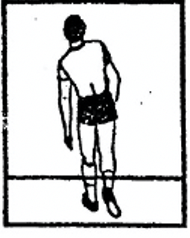
Which of the following is NOT a cause of this gait deviation?
A) Short prosthesis
B) High medial wall
C) Right hip pain
D) Abduction contracture
C) Right hip pain
A patient with a transtibial prosthesis complains of knee instability and an uncomfortable pressure on the medial and proximal aspect of their knee when they’re in the midstance subphase of gait. When standing in midstance, the socket is excessively adducted, and the foot is outset. What gait deviation would the patient MOST likely demonstrate?
A) Lateral thrust
B) Medial thrust
C) Insufficient knee flexion
D) Premature knee flexion
B) Medial thrust
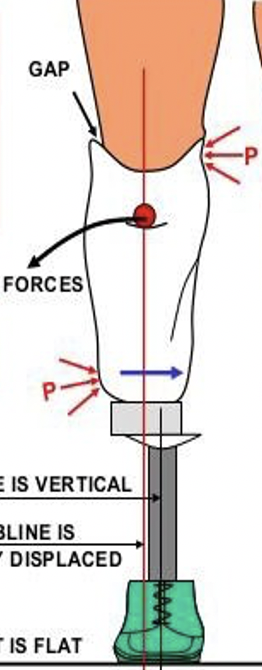
Which gait deviation matches the photo?
A) Insufficient knee flexion
B) Premature knee flexion
C) Lateral displacement
D) Medial displacement
C) Lateral displacement
Which of the following is the MOST appropriate clinical action for a therapist treating a patient with knee instability during stance?
A) Maintain the current stiffness to preserve stability during terminal stance
B) Contact the prosthetist to soften the heel wedge to reduce knee instability
C) Replace the plantarflexion bumper with a firmer component to encourage faster knee extension
D) Contact the prosthetist to adjust the prosthetic knee alignment into more flexion to compensate for the instability
B) Contact the prosthetist to soften the heel wedge to reduce knee instability