Conti Basics
 Call Kai
 Learn
Learn Practice Test
 Spaced Repetition
 Match
Match Flashcards
 Knowt Play
1/66

There's no tags or description
Looks like no tags are added yet.
Name | Mastery | Learn | Test | Matching | Spaced | Call with Kai | Chat |
|---|
No analytics yet
Send a link to your students to track their progress
67 Terms
Class 1
6,000 lbs or less

Class 2
6,001 to 10,000

Class 3
10,001 to 14,000

Class 4
14,001 to 16,000

class 5
16,001 to 19,500
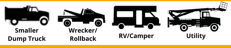
class 6
19,501 to 26,000

Class 7
19,501 to 33,000

Class 8
33,000 and up

Gross Vehicle Weight Rating (GVWR)
›Maximum allowable weight of the Truck + Payload (NOT trailer)
Gross Combined Weight Rating (GCWR)
Maximum allowable weight of Truck + Payload + Trailer
Gross Axle Weight Rating (GAWR)
Maximum allowable weight on one axle
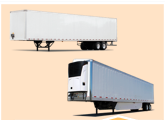
Dry Van / Reefer
Common enclosed freight trailer.
Insulated and fitted with a climate control unit
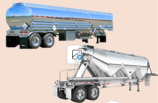
Tanker/Bulk
Trailer that is a large tank, they can hold liquid or granular materials that are transloaded into them.
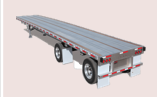
Flatbed
Used to haul equipment or large goods that would not fit inside an enclosed trailer. Caravan style tarps can also be used on these kinds of trailers.
Specialty
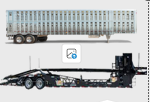
›Car Haulers, Livestock Trailers, Specialty Flatbeds for Heavy Haul, Gas (liquid O2 or NO) Trailers, or other custom trailers.
Descriptive Layout
Describes what the truck is used for or looks like
Technical Description
Looks at the number of wheel ends and the number of powered wheel ends

Single axle day cab (4×2)

Tandem Axle Sleeper (6×4 or 6×2)

Mixer Truck (6×4 or 6×2)

Residential Trash Truck (6×4)

Urban Bus (4×2)

Dump Truck (8×4)
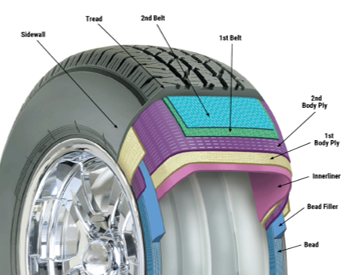
Bead
›Tire bead bundles (usually strands of wire) secure the tire to the wheel.
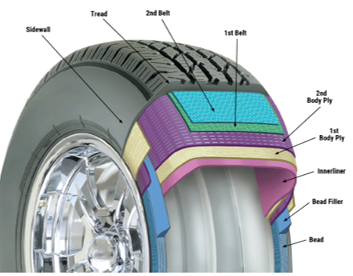
Bead Filler
A rubber compound placed above the bead bundle that may be used between the body plies which wrap around the bead to tune ride and handling characteristics
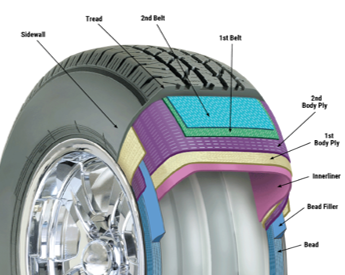
Belts
›Typically, two belts with steel cords laid at opposing angles. Belts provide stability to the tread area of the tire, which contributes to wear, handling and traction.
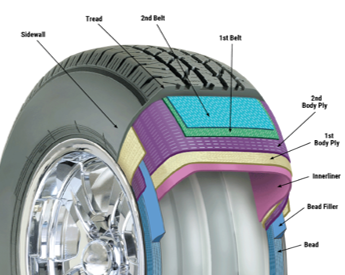
Body Ply
›: Most tires have one or two body plies, each typically comprised of polyester, rayon, or nylon cords within a rubber layer. Body plies function as the structure of the tire and provide the strength to contain the inflation pressure.
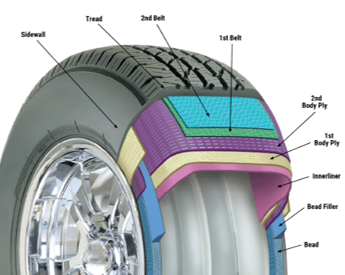
Innerliner
A rubber compound used to retain the inflation pressure inside the tire.

Sidewall
›A rubber compound used to cover the body plies on the sides of the tire, which provides abrasion, scuff and weathering resistance.
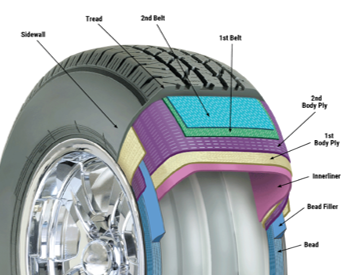
Tread
Rubber compound and tread pattern provide grip and abrasion resistance contributing to traction and treadwear.
Ply rating
Tire strength rating that indicates the tire’s load-carrying capability and durability.
Load Range
The modern tire classification system that identifies how much weight a tire can carry at a specified air pressure.
Load Index
Numerical code that indicates the maximum weight a tire can carry when properly inflated.
Speed Index (speed rating)
a letter code that identifies the maximum speed a tire can safely sustain under its rated load and inflation conditions.
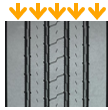
Ribs
Raised sections of the tread that run uninterrupted around the circumference of the tire.
*Primarily in Steer or Trailer Tires

Lugs or Tread Blocks
These are the raised rubber segments that contact the road.
*Primarily in Drive or Construction Tires

Sipe
This is a small usually linear slot that is molded into the tread.

Open Shoulder
The outside edges of the tread have openings or groves that cut into the outermost ribs.

Closed Shoulder
The outside edges of the tread are solid rubber with no openings or grooves cut into the outermost
Tall Tire
11R22.5, 11R24.5
Low Pro
275/80R22.5 or 295/75R22.5 (LP 22.5)
285/75R24.5 or 275/80R24.5 (LP24.5)
Wide Base/ Float
385/65R22.5
425/65R22.5
445/65R22.5
Specialty
315/80R22.5 (Urban Bus/Trash Truck)
305/70R22.5 (Coach Bus/Construction)
295/60R22.5 (Car Haulers)
Super Single (1 tire that replaces 2)
445/50R22.5
455/55R22.5
Closed Shoulder Design
Solid shoulder ribs
Increased tread stability
More even wear
Lower rolling resistance
Closed Shoulder Design
Improved fuel economy
Better resistance to irregular shoulder wear
Lower noise levels
Closed Shoulder Design
Steer tires
Trailer
Long-haul applications
Fuel-efficient fleet operations
Closed Shoulder Design
Reduced traction in mud & snow
Lower grip on loose surfaces
Open Shoulder Design
›Enhanced water evacuation
›Increased traction
›Can contribute to improved heat management in certain applications
›Improved self-cleaning performance
Open Shoulder Design
›Strong wet traction
›Better snow and mud performance
›Enhanced grip during acceleration
Open Shoulder Design
›Drive tires
›Regional haul operations
›Mixed-service environments
Open Shoulder Design
›Increased tread movement
›Higher rolling resistance
Potentially faster shoulder wear
Steer Tires
Steers can feature closed shoulders, and ribs, while long-haul tires can also feature a decoupler groove (the small groove that can be found on the outside edge of both shoulders). They can look very similar to trailer tires; however, steers commonly have a little higher tread depth.
Drive Tires
Drives are frequently a lugged design, and long-haul tires can feature closed shoulders while regional or construction tires frequently use an open shoulder for improved traction.
Trailer Tires
Trailer tires usually feature closed shoulders and ribs. They can frequently resemble steer tires but usually have a lower tread depth than a steer tire for the same application.
14 Ply Rating
Load Range G
16 ply rating
Load Range H
1st step of the retread process
Initial Inspection
2nd step of the retread process
shearography
3rd step of the retread process
Buffing
4th step of the retread process
skiving
5th step of the retread process
Repairs
6th step of the retread process
Extruding
7th step of the retread process
Tread Building
8th step of the retread process
Enveloping
9th step of the retread process
Curing
10th step of the retread process
Final Inspection