Bioequivalence and Orange Book
 Call Kai
 Learn
Learn Practice Test
 Spaced Repetition
 Match
Match Flashcards
 Knowt Play
1/38

There's no tags or description
Looks like no tags are added yet.
Name | Mastery | Learn | Test | Matching | Spaced | Call with Kai | Chat |
|---|
No analytics yet
Send a link to your students to track their progress
39 Terms
bioavailability
rate and extent to which the active drug ingredient or therapeutic moiety is absorbed from a drug product and becomes available to the site of drug action
no
Is bioavailability a criterion for clinical effectiveness?
pharmacokinetics
bioavailability data provides fraction of drug absorbed from the formulation, and _________________________ of the drug
relative bioavailability
_________ _____________ studies compare two drug product formulations (brand vs generic)
vivo
bioavailability and bioequivalence can be considered as performance measures of the drug product in __________
bioequivalence
the absence of a significant difference in the rate and extent to which the active ingredient or active moiety becomes available at the site of drug action when administered at the same molar dose under similar conditions in an appropriately designed study
bioequivalence
a ________________________ study is a specialized type of relative bioavailability study
new
bioavailability concerns the amount and rate of a drug or active moiety appearing in systemic circulation and has to be determined for any _________ drug
comparable
bioequivalence addresses whether other drug products are __________________ to an already approved drug product with respect to biological performance
therapeutic
bioequivalence study helps to determine the __________________ equivalence between the pharmaceutically equivalent generic drug product a reference drug product
therapeutically equivalent
if two drugs are pharmaceutically equivalent and bioequivalents, the can be assumed to be ___________________________________
pharmaceutical equivalence
the same drug from different companies; have the same dose, same name, and same amount makes it to the blood
development
during drug _________________, bioequivalence studies are used to compare:
-early and late clinical formulations
-formulations used in clinical trials and stability studies, if different
-clinical trial formulations and to-be-marketed drug products, if different
-product strength equivalence, as appropriate
postapproval
___________________, in vivo bioequivalence studies may be needed to support regulatory approval of major changes such as formulation, manufacturing, or site, in comparison to reference formulation
generic
__________________ drug manufacturer must demonstrate that the drug product is pharmaceutically equivalent, bioequivalent, and therapeutically equivalent to the comparator brand-name drug product
oral
drug product performance comparison for ____________ generic drug products:
-in vivo bioequivalence studies in normal healthy adult subjects
-in vitro may also include comparative drug dissolution/release profiles
superimpose
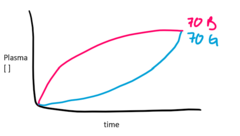
plasma-time profiles of drugs that are bioequivalent should perfectly _________________ eachother
generic drugs
affordable alternative of the FDA-approved copies of brand-name "innovator" drugs; should comply the same high standards for quality as the innovator drug; represent 88% of drugs dispensed in the United States
orange book
Approved Drug Products with Therapeutic Equivalence Evaluations book; prepared to fulfill the mandate as per 505(c) of Federal Food, Drug, and Cosmetic Act
daily
website and app for the orange book update ____________
positive formulary approach
Substitution limited to a specific list of drugs
negative formulary approach
substitution allowed for all drugs except those prohibited by a particular list
orange book contents
includes prescription products, OTC, discontinued drug products, patents, and exclusivity
referenced listed drug (RLD)
an approved drug product to which new generic versions are compared to show that they are bioequivalent
reference standard (RS)
the previously approved drug selected by FDA that an applicant must use in conducting any in vivo bioequivalence testing required for approval
monthly, annual
____________ and ____________ updates of the orange book are on website, app, and in publication
pharmaceutical equivalents
drug products are considered ____________________________:
-if they contain the same active ingredients and the same amounts
-are the same dosage form
-have same route of administration
-are identical in strength or concentration
differ
pharmaceutically equivalent drugs may ___________ in:
-shape and scoring configuration
-release mechanisms
-packaging and excipients
-expiration time
-labeling
pharmaceutical alternatives
drugs are considered _____________________ if they contain the same therapeutic moiety BUT are different salts, esters, or complexes of that moiety, or are different dosage forms or strength
not pharmaceutically equivalent but produce same therapeutic effect
alternatives
Ex: tetracycline hydrochloride 250 mg capsules and tetracycline phosphate complex 250 mg capsules are considered pharmaceutical _______________________
equivalent
if drugs are pharmaceutically _____________________, permission is not needed from a physician to switch drugs
alternative
if drugs are pharmaceutically _____________________, permission is required from the physician to switch
therapeutic equivalent
pharmaceutical equivalents + same clinical effect and safety profile when administered to patients under the conditions specified in the labeling
equivalent
If the first letter in the orange book code is "A", the multisource drugs are therapeutically ______________________
inequivalent
If the first letter in the orange book code is "B", the multisource drugs are therapeutically __________________________
third
the ________ character in an orange book drug code is assigned when more than one reference listed drug of the same strength has been designated under the same heading (more than one branded drug on the market)
second
the ___________ character of the orange book drug code gives description such as whether or not they have bioequivalence problems
bioequivalent
drugs must have the same orange book code (ex: AB1) to be considered ____________________
therapeutic
although these two drugs are bioequivalent because the same amount reaches the blood, they are NOT __________________________ because their absorption rates are different