Chapter 1
 Call Kai
 Learn
Learn Practice Test
 Spaced Repetition
 Match
Match Flashcards
 Knowt Play
1/92

There's no tags or description
Looks like no tags are added yet.
Name | Mastery | Learn | Test | Matching | Spaced | Call with Kai | Chat |
|---|
No analytics yet
Send a link to your students to track their progress
93 Terms
what parts of the body form the first defense
physical barriers: skin, mucosal surfaces, cilia, mucosal enzymes
what chemical barriers does the skin produce
fatty acid and lactic acid
where is lysozyme produced
salivary glands, lacrimal glands
innate immunity order of events
barrier breeched → patterns recognized → signals released → cells recruited → threat contained
immunity
defense against foreign material and abnormal cells
adaptive immunity
includes humoral (antibody-mediated) and cell-mediated responses
how does innate immunity influence adaptive immunity
it influences whether adaptive immunity activates, what kind of response adaptive immunity develops, and where the immune cells go
what does innate immunity recognize
patterns shared by microbes or damaged cells
what does adaptive immunity recognize
specific antigens
how does memory compare in innate immunity and adaptive immunity
memory is stronger in adaptive immunity
main purpose of innate immunity
contain, kill, and signal
main purpose of adaptive immunity
more targeted response
neutrophils
the most abundant; rapid phagocyte common in acute inflammation
monocyte/macrophage
phagocyte + signaling
what are three examples of external defenses
physical, chemical, and biological barriers
What is the role of normal microbiota in defense?
They compete with pathogens and help maintain local defense.
What are three key characteristics of innate immunity?
It is rapid, broad, and already present before exposure.
are nk cells innate or adaptive
innate
13. Q: What is the major role of dendritic cells?
A: Capture antigen and activate naïve T cells, bridging innate and adaptive immunity.
What do mast cells and basophils primarily produce?
release histamine, which is involved in allergic rxns and vasodilation
What are eosinophils associated with?
Parasites and allergy.
What is the major function of NK cells?
Innate cytotoxicity—killing altered host cells.
role of b cells
antibody lineage
t cell
cellular coordination/killing
where do plasma cells come from and what do they secrete
come from naive b cells and secrete antibodies
where are macrophages found
tissue
where are monocytes found
blood
in innate immunity which cell does cytokines come from
macrophages
what are 3 APC cells
dendritic, macrophage, b cell
CD what does it stand for
cluster of differentiation
What is the main marker for T cells?
CD3.
What marker identifies helper T cells?
CD4; helps coordinate immune response
What marker identifies cytotoxic T cells?
CD8; kills infected cells
What markers identify B-cell lineage?
CD19 and CD20
What markers are associated with NK cells?
CD16 and CD56
What are the primary lymphoid organs?
Bone marrow and thymus.
What are the secondary lymphoid organs?
Lymph nodes, spleen, tonsils, adenoids, Peyer patches, and MALT.
What happens in the bone marrow?
T and B cells produced, but only B cells mature
What happens in the thymus?
T-cell maturation and selection.
purpose of secondary lymphoid tissue
sites where immune cells encounter material from tissues, blood, or mucosa.
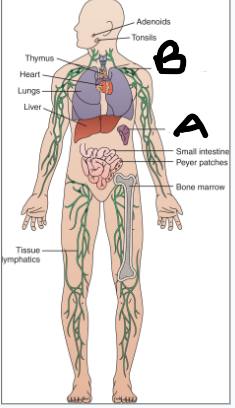
what is A and B?
A = spleen
B = lymph nodes
What is the main job of lymph nodes?
Monitor/filter tissue fluid and lymph and provide a site for B-cell and T-cell antigen encounters.
what is the job of the cortex/follicles of the lymph node
B-cell area; germinal centers form during active responses.
what is the role of the paracortex of the lymph node
T-cell area; important for APC and T-cell interaction.
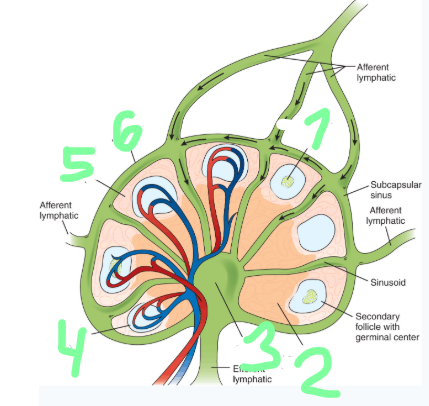
label parts of the lymph node
germinal center
paracortex (t cell area)
medulla
primary follicle
cortex (b cell area
capsule
Which lymphoid organ is associated with blood
spleen
Which lymphoid organ is associated with tissue fluid/lymph?
lymph nodes
Which lymphoid tissue is associated with mucosal surfaces?
MALT
purpose of white pulp in spleen
organizes lymphocytes
purpose of red pulp in spleen
filter blood cells and particles
example of MALT
peyers patch
_____ _____ starts the internal response.
pattern recognition
What is a PAMP?
A pathogen-associated molecular pattern—a common microbial structure.
What is a PRR?
A pattern recognition receptor on host cells that binds PAMPs or damage signals.
what is example of PRR
toll-like receptors
what happens when PAMP binds to PRR
triggers internal response leading to release of cytokines, chemokines, increased phagocytosis
cell surface TLR
detect microbial surface structures such as bacterial cell-wall components or flagellin.
endosomal TLR
detect microbial nucleic acids after uptake into vesicles.
What do cytokines do?
They are soluble messages that change cell behavior.
What do chemokines do?
Guide cell movement toward a site of infection or damage.
how does recognition turn on signaling
PRR activates → cytokines released → chemotaxis → vasodilation → leukocytes arrive
inflammation ____ the response.
localizes
how does swelling happen
increased permeability of blood vessel allows fluid to escape → edema
What are the four classic signs of inflammation?
Redness, heat, swelling, and pain. 5th could be loss of function
which 2 leukocytes respond in chemotaxis
neutrophil and macrophage
1st step of leukocyte recruitment
mediator release - macrophages and mast cells release chemokines which promote vasodilation and induce selectin expression on endothelial cells
2nd step of leukocyte recruitment
rolling - leukocytes bind to selectin and roll along the endothelium
3rd step of leukocyte recruitment
firm adhesion - chemokine-induced integrin on leukocytes attach to endothelial cell
4th step of leukocyte recruitment
diapedesis - integrins allow leukocytes to crawl between endothelial cells
5th step of leukocyte recruitment
chemotaxis - leukocytes have left the blood vessel and can now follow chemokine gradient to arrive at site of infection
acute phase reactants
blood proteins whose concentrations change during inflammation.
steps in acute-phase response
tissue injury/infection → cytokine signal → liver responds → serum protein changes
What is a positive acute-phase reactant?
A serum protein that increases during inflammation, injury, or infection.
What is a negative acute-phase reactant?
A serum protein that decreases during the acute-phase response.
What is CRP associated with?
C-reactive protein (CRP) Inflammation; it is an opsonin and can activate complement.
SAA
inflammatory acute-phase protein
compliment
opsonization, inflammation, and lysis support
AAT
protease inhibitor; protects tissue
What does haptoglobin do?
Binds free hemoglobin.
What does fibrinogen do?
Contributes to clotting/healing and increased ESR tendency.
ceruloplasmin
copper transport; oxidative protection
steps of phagocytosis
attachment → engulf → phagosome → lysosomal fusion → phagolysosome → killing → excretion
What is an opsonin?
A molecule that coats a target and improves phagocyte attachment.
What are three important opsonins
antibodies, C3B, CRP (c-reactive protein)
what are 2 enzymes used in phagolysosome
NADPH oxidase and myeloperoxidase
NADPH oxidase
generates RO species
myeloperoxidase
uses hydrogen peroxide and chloride to form hypochlorite (bleach).
Chronic granulomatous disease
NADPH oxidase deficiency impairs oxidative killing. the phagocyte can ingest microbe but cant kill it
symptom of Chronic granulomatous disease
reacurrent infections and persistent inflammation
What does “missing self” mean for NK cells?
An altered or infected cell has missing or abnormal MHC class I, removing the normal inhibitory signal and allowing NK-cell activation
What molecules do NK cells use to kill target cells?
Perforin and granzymes.
What is ADCC?
Antibody-dependent cellular cytotoxicity.
steps of ADCC
antibody coats target cell
NK cell uses CD16 to bind to Fc region of antibody
NK cell releases toxic molecules and target cell dies by apoptosis