IPS1- Introduction to Nucleic Acids p4
 Call Kai
 Learn
Learn Practice Test
 Spaced Repetition
 Match
Match Flashcards
 Knowt Play
1/84

Earn XP
Description and Tags
Name | Mastery | Learn | Test | Matching | Spaced | Call with Kai | Chat |
|---|
No analytics yet
Send a link to your students to track their progress
85 Terms
one
RNA is similar to DNA except has ____ [one/two] strand instead of two strands.
uracil
RNA is similar to DNA except has ___ instead of thymine
ribose
RNA is similar to DNA except has __ instead of deoxyribose
translated
DNA remains in the nucleus, but in order for it to get its instructions ____ [translated/transcripted] into proteins, it must send its message to the ribosomes
ribosomes
where proteins are made
Messenger RN
The chemical used to carry the message from DNA to protein is ___
1. Messenger RNA (mRNA)
2. Transfer RNA (tRNA)
3. Ribosomal RNA (rRNA)
THREE MAIN CLASSES OF RNA
size
function
general stability
Each class of RNA differ from the others by (3)
mRNA
[mRNA, tRNA, rRNA]
makes up about 5% of the RNA in cells
mRNA
[mRNA, tRNA, rRNA]
It carries gene information copied from DNA.
mRNA
[mRNA, tRNA, rRNA]
Its job is to deliver this information to the cell’s protein-making machinery.
mRNA
[mRNA, tRNA, rRNA]
In eukaryotic cells, ___ isn’t made directly. Instead, it starts as hnRNA (heterogeneous nuclear RNA) in the nucleus.
tRNA
[mRNA, tRNA, rRNA]
is the helper molecule that carries a specific amino acid to where proteins are made
tRNA
[mRNA, tRNA, rRNA]
It has 74 to 95 nucleotides and makes up about 15% of the cell’s RNA
tRNA
[mRNA, tRNA, rRNA]
There are at least 20 types of tRNA, one for each amino acid needed.
tRNA
[mRNA, tRNA, rRNA]
Its sequence folds into a cloverleaf shape due to base pairing within the molecule.
aminoacyl tRNA synthetases
[tRNA]
At the 3' end of a tRNA, a specific amino acid is attached by special enzymes called
aminoacyl-tRNA
[tRNA]
aminoacyl tRNA synthetases combination is called
tRNA
[mRNA, tRNA, rRNA]
At the bottom loop of the ___ cloverleaf shape is the anticodon, a set of three bases that match up with the complementary three bases (codon) on the mRNA.
rRNA
[mRNA, tRNA, rRNA]
is part of ribosomes, the cell’s protein factories.
rRNA
[mRNA, tRNA, rRNA]
makes up about 80% of the RNA in a typical eukaryotic cell.
18S, 5.8S, 28S, and 5S.
[rRNA]
Eukaryotic ribosomes have four types of rRNA:
23S, 16S, and 5S.
[rRNA]
Prokaryotic and mitochondrial ribosomes have three types:
“S” (Svedberg)
is a unit that measures the size of these RNA molecules.
Prokaryotic
[Prokaryotic/Mammalian]
The composition of ribosomes
![<p>[Prokaryotic/Mammalian]</p><p>The composition of ribosomes</p><p></p><p></p>](https://knowt-user-attachments.s3.amazonaws.com/84c4bcf5-4cf3-4107-858a-aaecb8a3b226.png)
Mammalian
[Prokaryotic/Mammalian]
The composition of ribosomes
![<p>[Prokaryotic/Mammalian]</p><p>The composition of ribosomes</p><p></p>](https://knowt-user-attachments.s3.amazonaws.com/50daabd4-dedf-4eff-a1a3-c9c32eb347fc.png)
INITIATION
[Translation]
The ribosome attaches to the mRNA at the start codon (AUG).
A. INITIATION
B. ELONGATION
C. TERMINATION
INITIATION
[Translation]
The initiator tRNA brings methionine (in eukaryotes) or formyl-methionine (in prokaryotes) to start protein synthesis.
A. INITIATION
B. ELONGATION
C. TERMINATION
ELONGATION
[Translation]
Amino acids attached to tRNAs match with mRNA codons by base pairing with the tRNA anticodon
A. INITIATION
B. ELONGATION
C. TERMINATION
ELONGATION
[Translation]
The ribosome moves along the mRNA, adding amino acids one by one to form a protein chain based on the mRNA code.
A. INITIATION
B. ELONGATION
C. TERMINATION
TERMINATION
[Translation]
A release factor binds to the stop codon UAG, UAA, UGA, terminating translation and releasing the complete polypeptide from the ribosome.
A. INITIATION
B. ELONGATION
C. TERMINATION
methionine (in eukaryotes) or formyl-methionine (in prokaryotes)
[TRANSLATION: Initiation]
The initiator tRNA brings ___ (in eukaryotes) or ____ (in prokaryotes) to start protein synthesis.
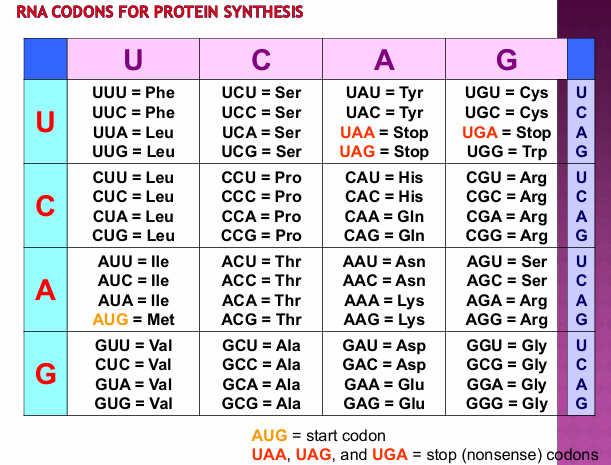
AUG
= start codon
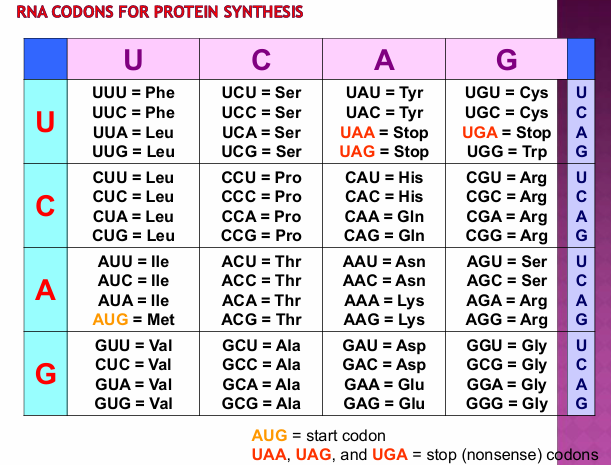
UAA, UAG, and UGA
= stop (nonsense) codons
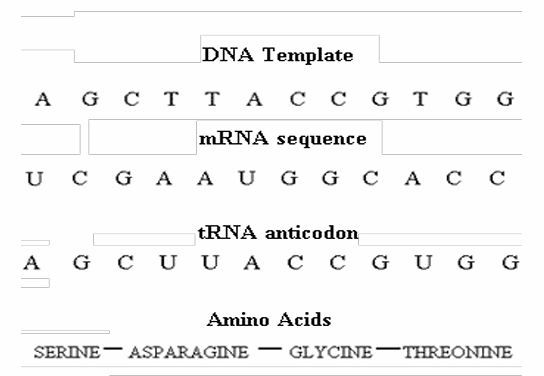
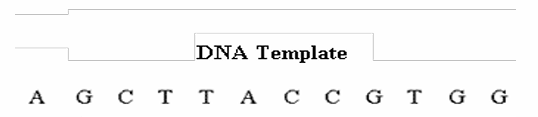
What is the mRNA sequence and tRNA anticodon of this DNA template?
Specificity
[CHARACTERISTICS OF THE GENETIC CODE]
specific codons always codes for the same amino acid
A. Specificity
B. Universality
C. Redundancy
D. Nonoverlapping and commaless
Universality
[CHARACTERISTICS OF THE GENETIC CODE]
the specificity of the genetic code has been conserved from the very early stages of evolution
A. Specificity
B. Universality
C. Redundancy
D. Nonoverlapping and commaless
Redundancy (degeneracy)
[CHARACTERISTICS OF THE GENETIC CODE]
a given amino acid may have more than one triplet coding for it
A. Specificity
B. Universality
C. Redundancy
D. Nonoverlapping and commaless
SILENT MUTATION
[CONSEQUENCES OF ALTERING THE NUCLEOTIDE SEQUENCE]
The codon containing the changed base may code for the same amino acid
A. SILENT MUTATION
B. MISSENSE MUTATION
C. NONSENSE MUTATION
SILENT MUTATION
[CONSEQUENCES OF ALTERING THE NUCLEOTIDE SEQUENCE]
UCA is for Ser, if the 3rd base is changed (to become UCU), it still codes for Ser
A. SILENT MUTATION
B. MISSENSE MUTATION
C. NONSENSE MUTATION
MISSENSE MUTATION
[CONSEQUENCES OF ALTERING THE NUCLEOTIDE SEQUENCE]
The codon containing the changed base may code for a different amino acid.
A. SILENT MUTATION
B. MISSENSE MUTATION
C. NONSENSE MUTATION
MISSENSE MUTATION
[CONSEQUENCES OF ALTERING THE NUCLEOTIDE SEQUENCE]
UCA for Ser, changing the 1st base to become CCA, it codes for Pro
A. SILENT MUTATION
B. MISSENSE MUTATION
C. NONSENSE MUTATION
NONSENSE MUTATION
[CONSEQUENCES OF ALTERING THE NUCLEOTIDE SEQUENCE]
The codon containing the changed base may become a termination codon/stop
A. SILENT MUTATION
B. MISSENSE MUTATION
C. NONSENSE MUTATION
NONSENSE MUTATION
[CONSEQUENCES OF ALTERING THE NUCLEOTIDE SEQUENCE]
UCA for Ser is given a different base (to become, UAA), the new codon is a stop codon
A. SILENT MUTATION
B. MISSENSE MUTATION
C. NONSENSE MUTATION
Codon and anticodon
bind in opposite directions (antiparallel)
3’→5’ direction
mRNA codon reads 5’→3’, while the anticodon pairs in the flipped __ → __ direction.
Wobble hypothesis
One tRNA anticodon can pair with multiple codons for the same amino acid
Wobble hypothesis
Arginine codons AGA and AGG both bind to anticodon UCU
Wobble hypothesis
Glycine codons GGU, GGC, and GGA can pair with one anticodon containing inosine (CCI).
GTP
provides energy for the FORMATION OF THE INITIATION COMPLEX
Prokaryotes
[Prokaryotes/Eukaryotes]
Use 3 initiation factors (IF-1, IF-2, IF-3).
Eukaryotes
[Prokaryotes/Eukaryotes]
Have at least 10 initiation factors (eIFs).
1. Ribosome splits into 40s and 60s subunits.
2. A complex of met-tRNA, GTP, and eIF-2 binds the 40s subunit (preinitiation complex).
3. mRNA binds this complex, forming the 43s initiation complex.
4. The 60s subunit joins to form the full 80s initiation complex.
Eukaryotic initiation has 4 steps:
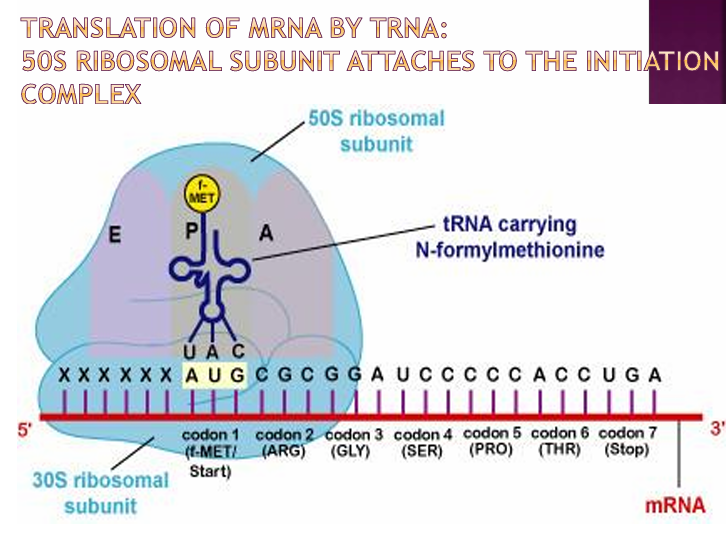
D) The initiation complex
What does the 50S ribosomal subunit attach to in the initiation phase of translation?
A) The tRNA
B) The 30S ribosomal subunit
C) The mRNA
D) The initiation complex
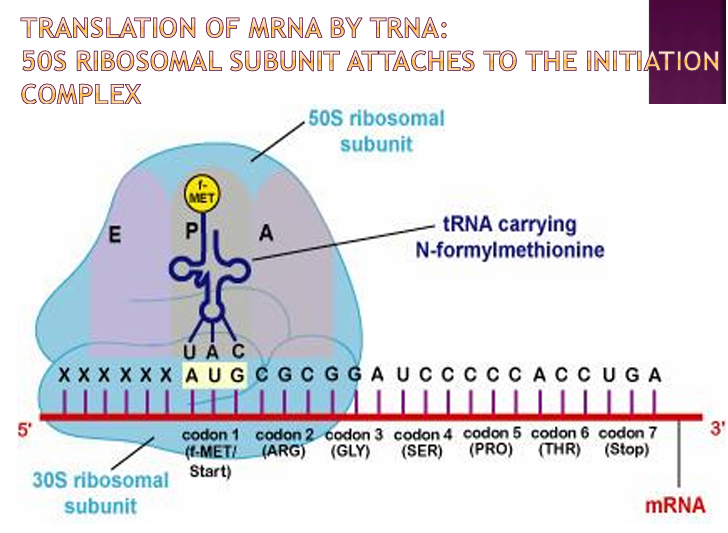
A) Methionine (f-MET)
What is the first amino acid attached to the tRNA in the translation process?
A) Methionine (f-MET)
B) Arginine (ARG)
C) Glycine (GLY)
D) Serine (SER)
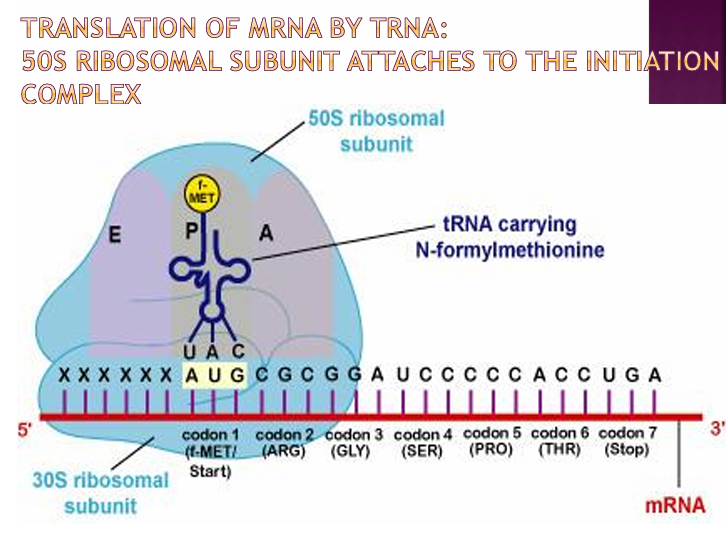
B) In the A site
Where does the tRNA with the amino acid bind in the ribosome?
A) In the P site
B) In the A site
C) In the E site
D) In the start codon
A site
[ELONGATIION]
Aminoacyl-tRNA binds to the [A/P/E site] with the help of EF1A and GTP.
Peptidyltransferase
[ELONGATIION]
____ enzyme forms the peptide bond between amino acids.
E site
[ELONGATIION]
The empty tRNA moves to the [A/P/E site] and leaves the ribosome.
B) Transcription and translation
What are the two main stages of protein synthesis?
A) Replication and mutation
B) Transcription and translation
C) Duplication and division
D) Transformation and transcription
C) Nucleus
Where does transcription occur in a eukaryotic cell?
A) Ribosome
B) Cytoplasm
C) Nucleus
D) Endoplasmic reticulum
C) Transcription
What is the first step of protein synthesis?
A) Translation
B) Replication
C) Transcription
D) Mutation
B) Messenger RNA (mRNA)
During transcription, what is copied from the DNA?
A) Protein
B) Messenger RNA (mRNA)
C) Transfer RNA (tRNA)
D) Ribosomal RNA (rRNA)
B) It unwinds
What happens to the DNA double helix during transcription?
A) It remains tightly coiled
B) It unwinds
C) It breaks apart permanently
D) It leaves the nucleus
B) RNA polymerase
What enzyme reads the DNA strand during transcription?
A) DNA polymerase
B) RNA polymerase
C) Ligase
D) Helicase
B) It builds a complementary mRNA molecule
What does RNA polymerase do?
A) It unwinds the DNA
B) It builds a complementary mRNA molecule
C) It carries amino acids
D) It splits the ribosome
C) Single-stranded
What kind of molecule is mRNA?
A) Double-stranded
B) Triple-stranded
C) Single-stranded
D) Circular
transcription
[transcription/translation]
produce a complementary mRNA molecule
B) Genetic code from the DNA
What does mRNA carry?
A) Amino acids
B) Genetic code from the DNA
C) Enzymes
D) Ribosomes
B) Ribosome in the cytoplasm
Where does translation occur in the cell?
A) Nucleus
B) Ribosome in the cytoplasm
C) Mitochondria
D) Golgi apparatus
C) It leaves the nucleus and travels to the ribosome
What happens to the mRNA after transcription?
A) It stays in the nucleus
B) It is destroyed
C) It leaves the nucleus and travels to the ribosome
D) It turns into DNA
C) To translate mRNA into a protein
What is the main purpose of translation?
A) To copy DNA
B) To make mRNA
C) To translate mRNA into a protein
D) To break down amino acids
B) Three-letter segments called codons
What does the ribosome read on the mRNA during translation?
A) Letters one by one
B) Three-letter segments called codons
C) Two-letter codes
D) Whole sentences of code
C) A specific amino acid
What does each codon on the mRNA correspond to?
A) A sugar molecule
B) A gene
C) A specific amino acid
D) A nucleotide
C) Transfer RNA (tRNA)
What type of RNA carries amino acids to the ribosome during translation?
A) Messenger RNA (mRNA)
B) Ribosomal RNA (rRNA)
C) Transfer RNA (tRNA)
D) Small nuclear RNA (snRNA)
C) Polypeptide chain (a protein)
What is the chain of amino acids produced during translation called?
A) DNA strand
B) Codon chain
C) Polypeptide chain (a protein)
D) mRNA molecule
B) Links them together in a chain
What does the ribosome do with the amino acids brought by tRNA during translation?
A) Stores them for later use
B) Links them together in a chain
C) Converts them into mRNA
D) Breaks them down
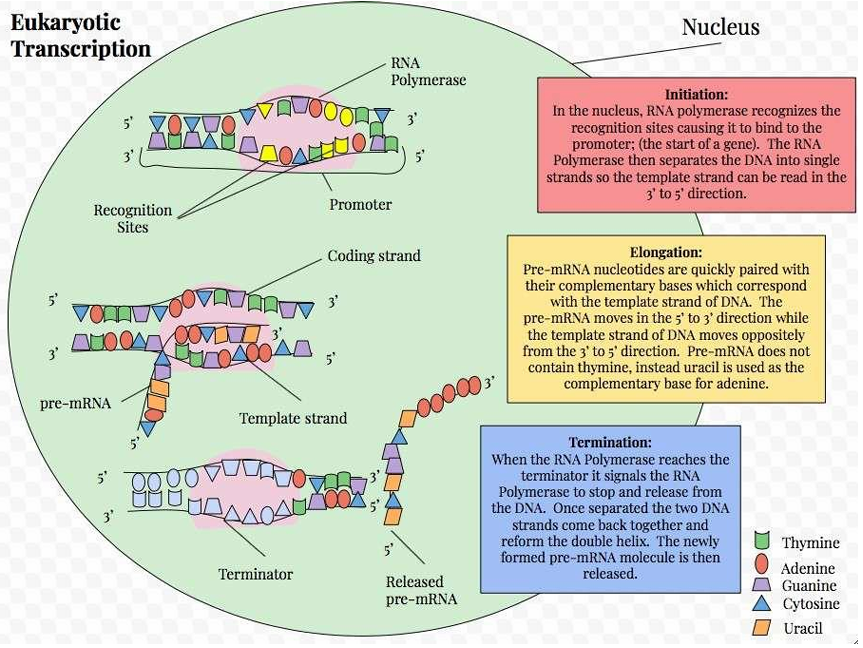
INITIATION
[Transcription]
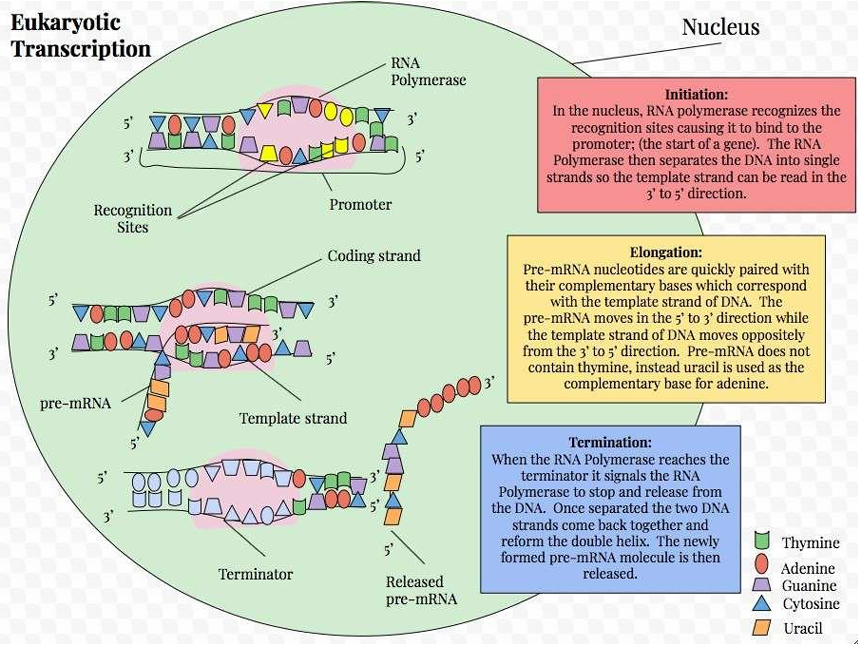
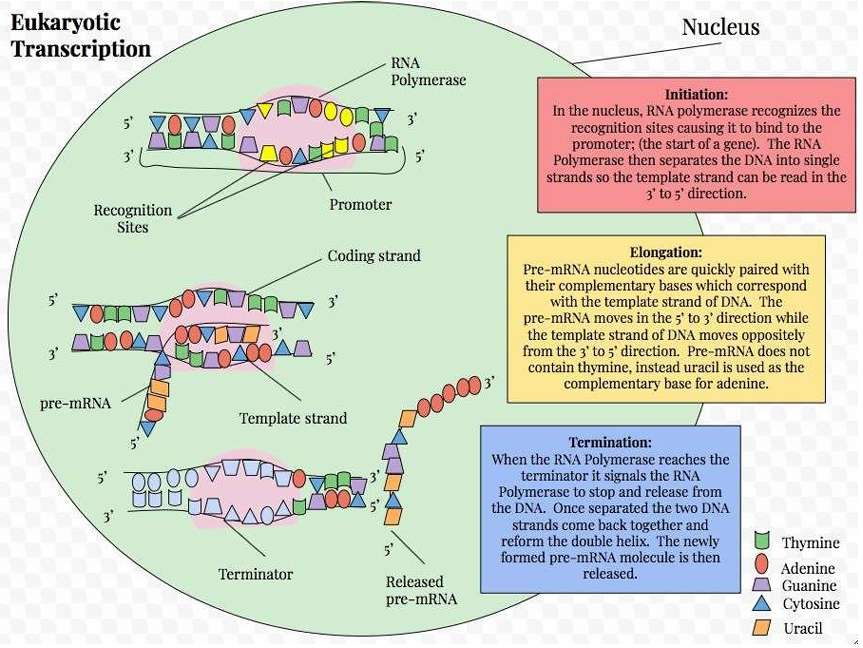
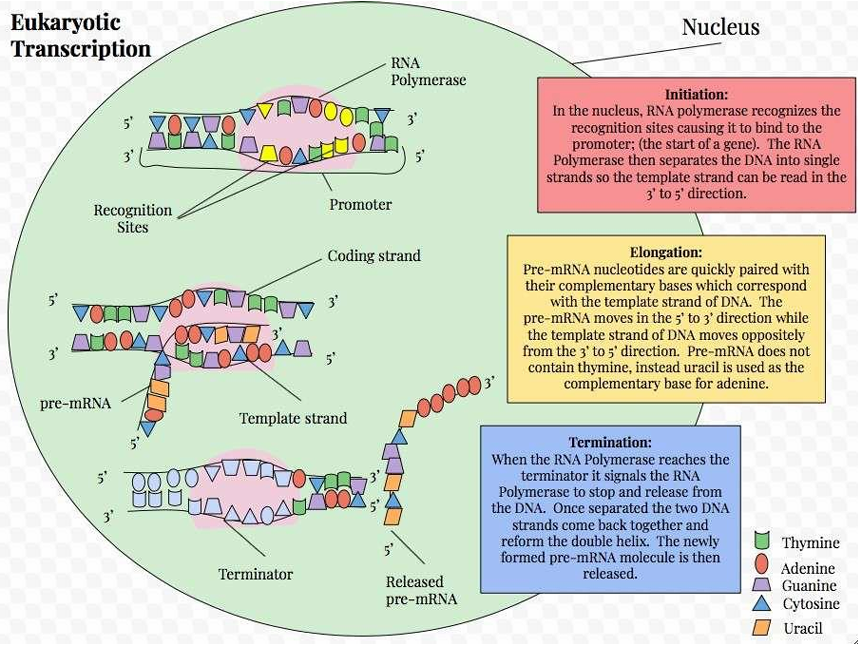
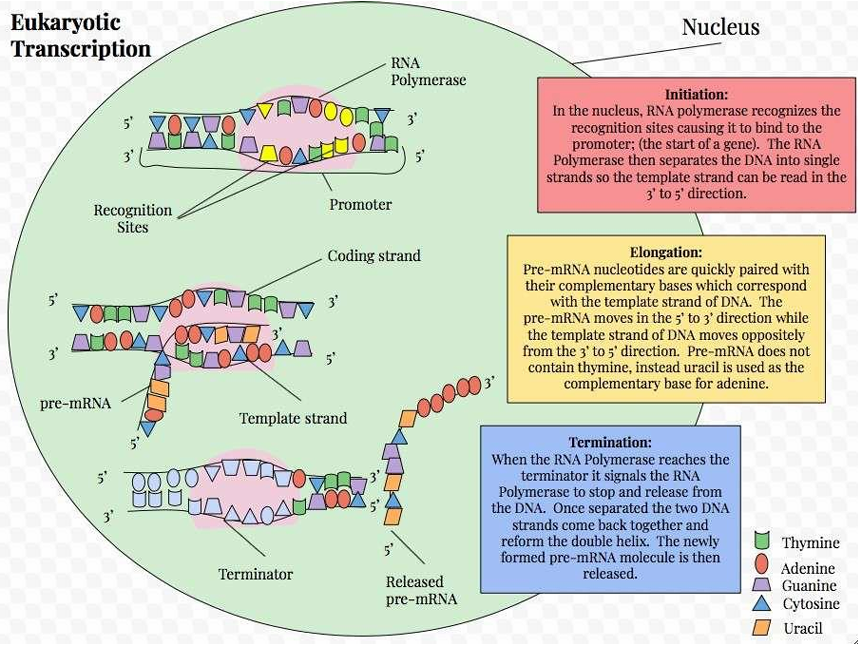
In the nucleus, RNA polymerase recognizes the recognition sites causing it to bind to the promoter; (the start of a gene).
A. INITIATION
B. ELONGATION
C. TERMINATION
INITIATION
[Transcription]
The RNA Polymerase then separates the DNA into single strands so the template strand can be read in the 3' to 5' direction.
A. INITIATION
B. ELONGATION
C. TERMINATION
ELONGATION
[Transcription]
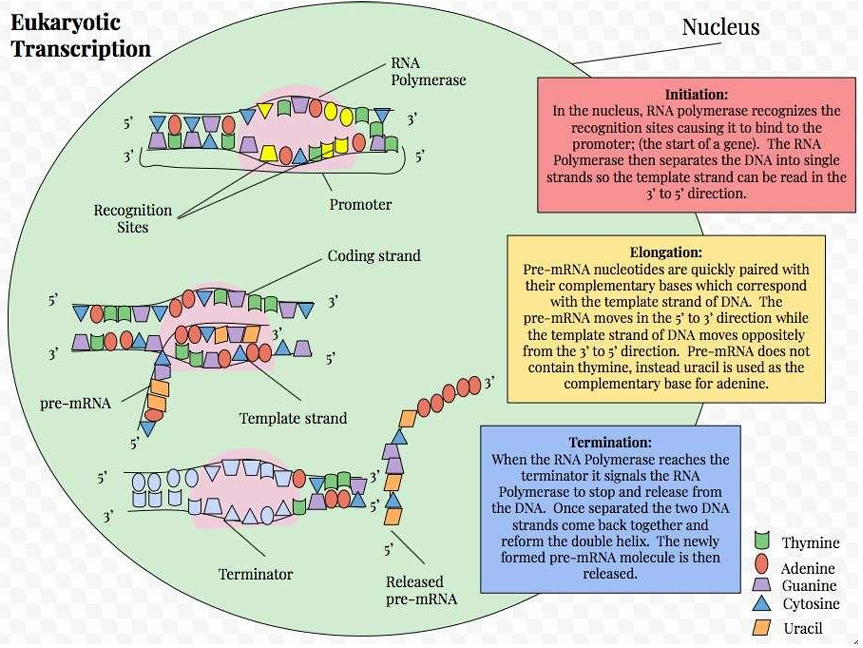
Pre-mRNA nucleotides are quickly paired with their complementary bases which correspond with the template strand of DNA.
A. INITIATION
B. ELONGATION
C. TERMINATION
ELONGATION
[Transcription]
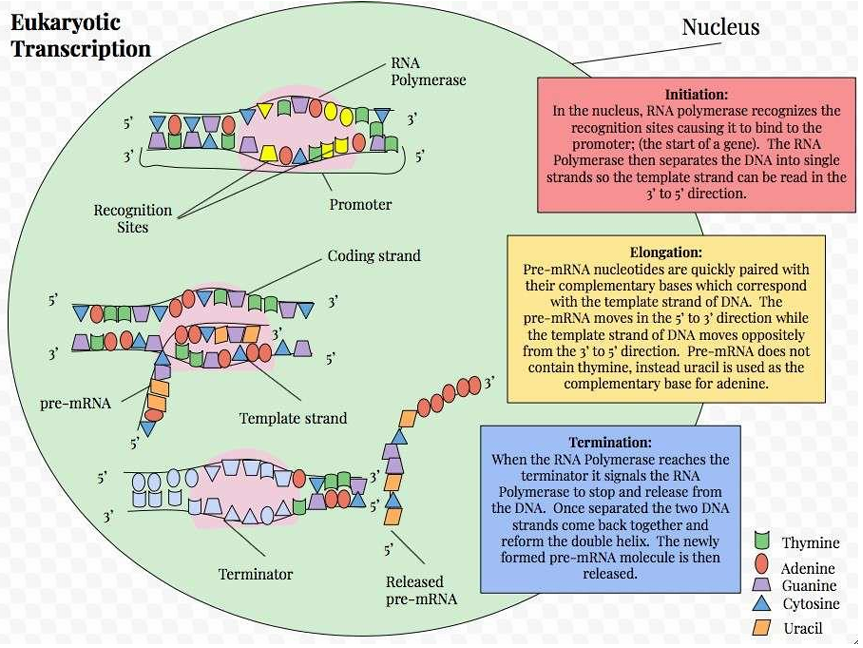
The pre-mRNA moves in the 5' to 3' direction while the template strand of DNA moves oppositely from the 3' to 5' direction.
A. INITIATION
B. ELONGATION
C. TERMINATION
ELONGATION
[Transcription]
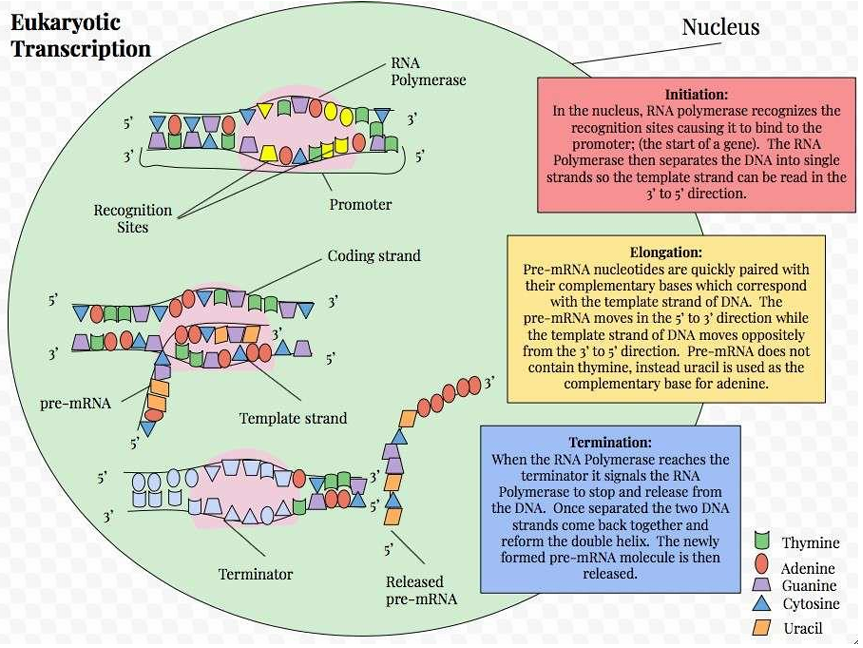
Pre-mRNA does not contain thymine, instead uracil is used as the complementary base for adenine.
A. INITIATION
B. ELONGATION
C. TERMINATION
TERMINATION
[Transcription]
When the RNA Polymerase reaches the terminator it signals the RNA
Polymerase to stop and release from the DNA.
A. INITIATION
B. ELONGATION
C. TERMINATION
TERMINATION
[Transcription]
Once separated the two DNA strands come back together and reform the double helix.
A. INITIATION
B. ELONGATION
C. TERMINATION
TERMINATION
[Transcription]
The newly formed pre-mRNA molecule is then released.
A. INITIATION
B. ELONGATION
C. TERMINATION