Vertebrae Homeostasis and Negative Feedback
 Call Kai
 Learn
Learn Practice Test
 Spaced Repetition
 Match
Match Flashcards
 Knowt Play
1/33

There's no tags or description
Looks like no tags are added yet.
Name | Mastery | Learn | Test | Matching | Spaced | Call with Kai | Chat |
|---|
No analytics yet
Send a link to your students to track their progress
34 Terms
Nervous System
Brain, spinal cord and peripheral nerves.
Communication b/w cells of the body through electrical signals and release neurotransmitters into small gaps
Skeletal Muscle
Skeletal muscle, bones, tendons and ligaments.
Support the body voluntary movement, and facial expressions
Cardiovascular System
Heart, blood vessels and blood.
Transport molecules thru body thru blood.
Respiratory System
Lungs, pharyx, trachea, bronchi
Bring oxygen into body and CO2 out
Renal System
Kidneys, ureters, bladder, urethra.
filter blood to regulate acidity, blood volume, and ion conc. and eliminate waste.
Physiology
The study of chemical and physical processes that control the function of living organisms.
Homeostasis
Process of maintaining stable internal environment compatible for life in the face of a changing external environments.
Most organ systems contribute to systemic homeostasis (except reproductive)
What is homeostatiscally regulated?
Glucose conc.
O2/ CO2 conc.
Metabolic waste conc.
pH
Water/ion conc.
Fluid Vol/ BP
Temp
Negative Feedback Control
Primary mechanism for homeostasis.
External change → triggers change in regulated variable in internal env. → triggers rxn to oppose the change and return regulated variable toward normal.
Set point
Desired level of regulated variable
Sensors
Detect level of regulated variable and provide input to integrating center. (thermoreceptors central and peripheral)
Integrating center
Compares set point to actual level of regulated variable.
It sends output to effectors(sweat glands, blood vessels, in skin and skeletal muscles) to return regulated variable toward set point. (hypothalmus)
Error signal
Difference b/w actual level and set point
Negative feedback loop example
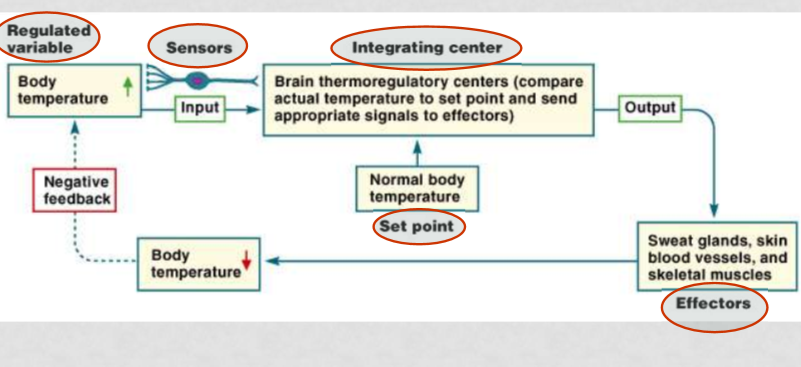
Thermoregulation
Homeothermic animals- have a set body temp, need to regulate it (mammals and birds)
Poikilothermic animals- no set temp, can survive in wide range of temp. (fish, amphibians, reptiles, and most invertebrates)
Radiation
thermal energy as electromagnetic waves (radiator)
Conduction
thermal energy through contact
Evaportatio
heat loss thru evaporation of water (sweating or insensible water loss)
Convection
heat transfer by movement of fluid/ air