2 - Fibre-reinforced plastics
 Call Kai
 Learn
Learn Practice Test
 Spaced Repetition
 Match
Match Flashcards
 Knowt Play
1/16

There's no tags or description
Looks like no tags are added yet.
Name | Mastery | Learn | Test | Matching | Spaced | Call with Kai | Chat |
|---|
No analytics yet
Send a link to your students to track their progress
17 Terms
Definition of composite material
What is it composed of?
What’s the purpose of each element?
Material that combines 2 distinct components to create a new material with superior performance
Fibers + matrix material
Fibers
→ provide the structural strength & stiffness, bear most of the load
matrix
→ usually a polymer that surrounds, protect & holds the fibres in place, distributes stress
What’s the most important advantage about composite materials?
→ combine strengths of their individual components
→ can withstand stresses that would break either component alone
Why do we use fibres?
light weight
Good tensile properties → excellent resistance to being pulled
Strengthen the material in specific directions
What’s the matrix in fibre-reinforced materials?
What are its purposes?
Material that surrounds & binds the fibres together
applies forces to the fibres
Reinforces bonding between fibres
stabilises / holds the fibres in place
Protects the fibres from environmental damage
What kind of plastics matrices can be made from? (their basis)
Thermosets (resins)
Thermoplastics
Name different types of fibres
Glass fibres
Aramid fibres
Carbon fibres
Natural fibres
Properties of glass fibres
(+ 1 application)
+ high tensile strength
+ good stiffness (E-modulus)
+ less expensive than others
+ good chemical resistance
+ good thermal resistance
→ used in communication with light signals
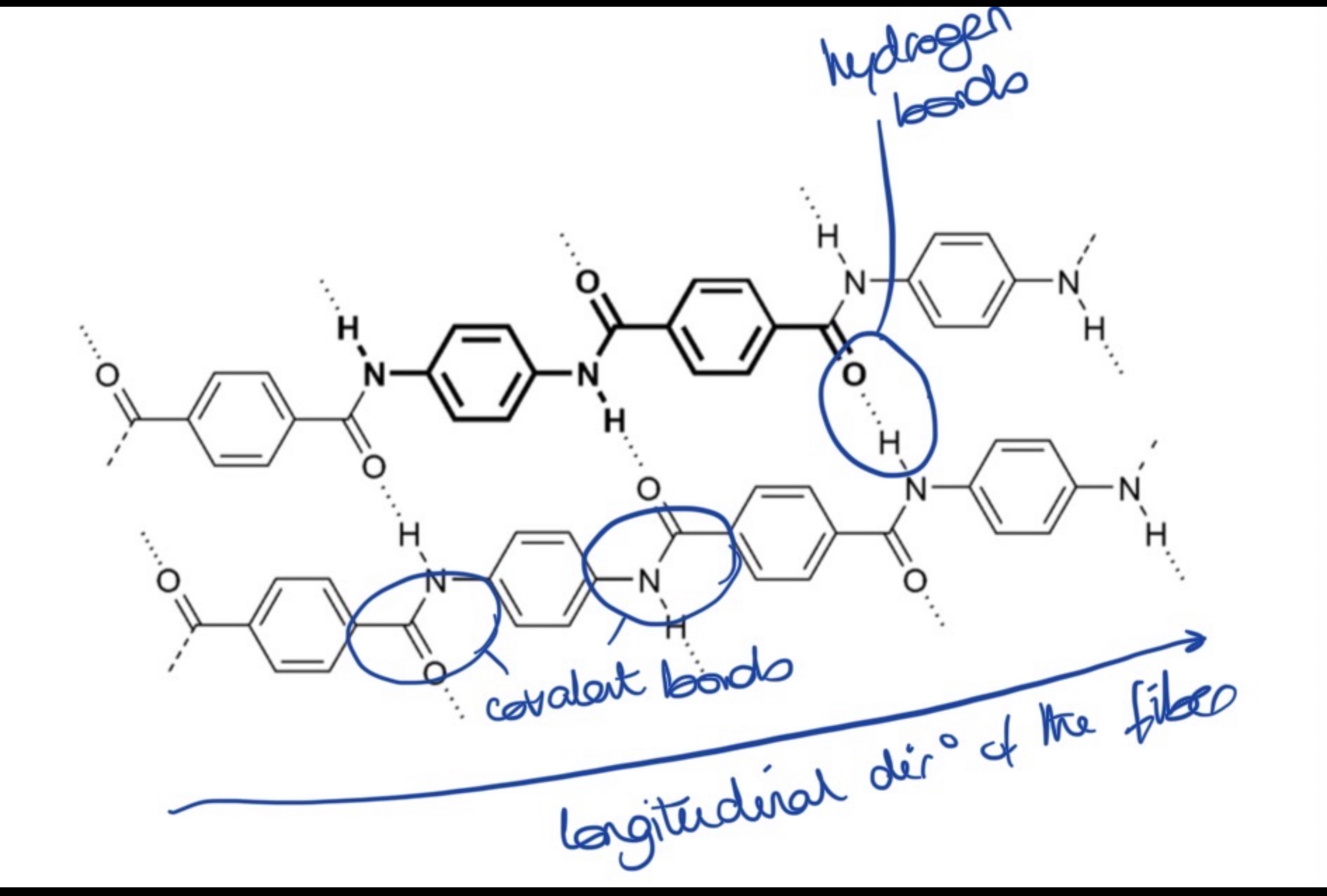
Properties of aramid fibres
(+ 1 application)
Explain why they’re strong in certain directions
→ aromatic polyamides
lightest reinforcing fibre (low density)
highly anisotropic (properties vary significantly with orientation of fibres)
UV-sensitive
very strong
→ used for bulletproof vests
→very strong in fibre direction (covalent bonds)
→ weaker perpendicular to the fibres (hydrogen bonds)
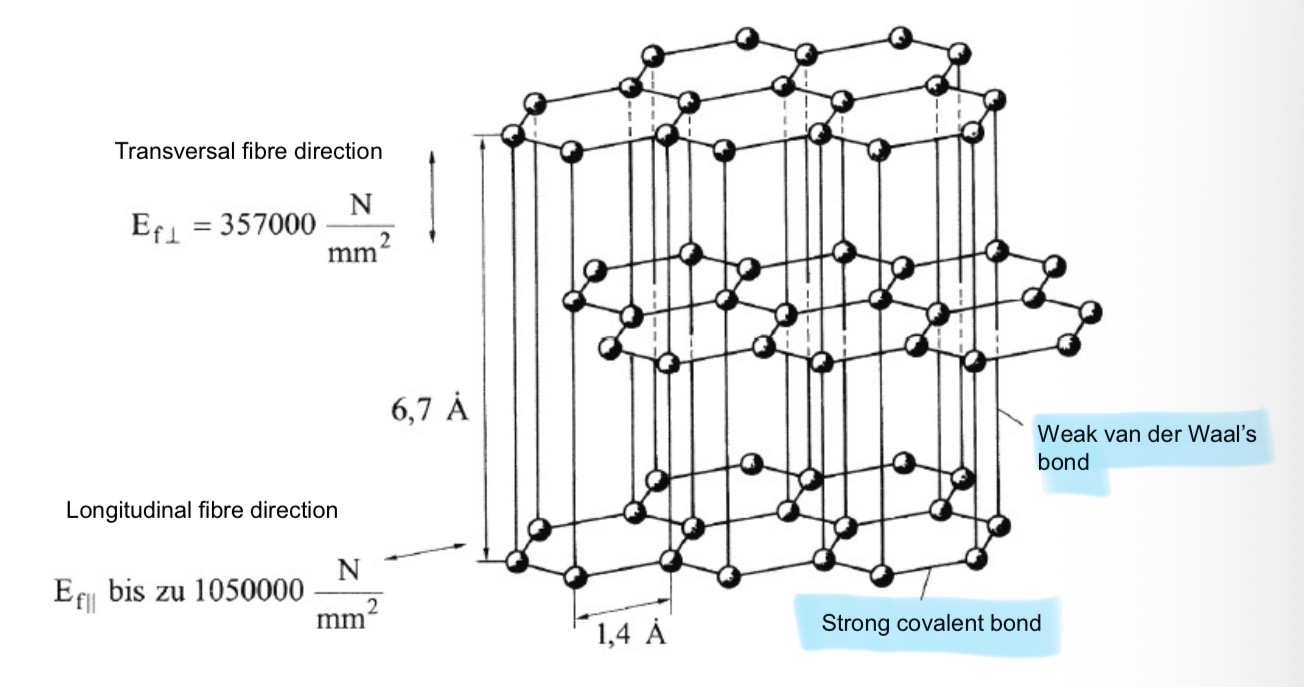
Properties of carbon fibres
Explain why they’re strong in certain directions
progressive stress-strain behaviour
→ deform gradually under stress, progressive increase in resistance as stress rises)
corrosion resistant
Highly anisotropic
Sensitive to bending (must have no sharp points)
→ strong in the fibre direction (longitudinal) because covalent bonds take place in this direction
→ very weak in the transversal fibre direction because van der Waal’s bonds take place in this direction
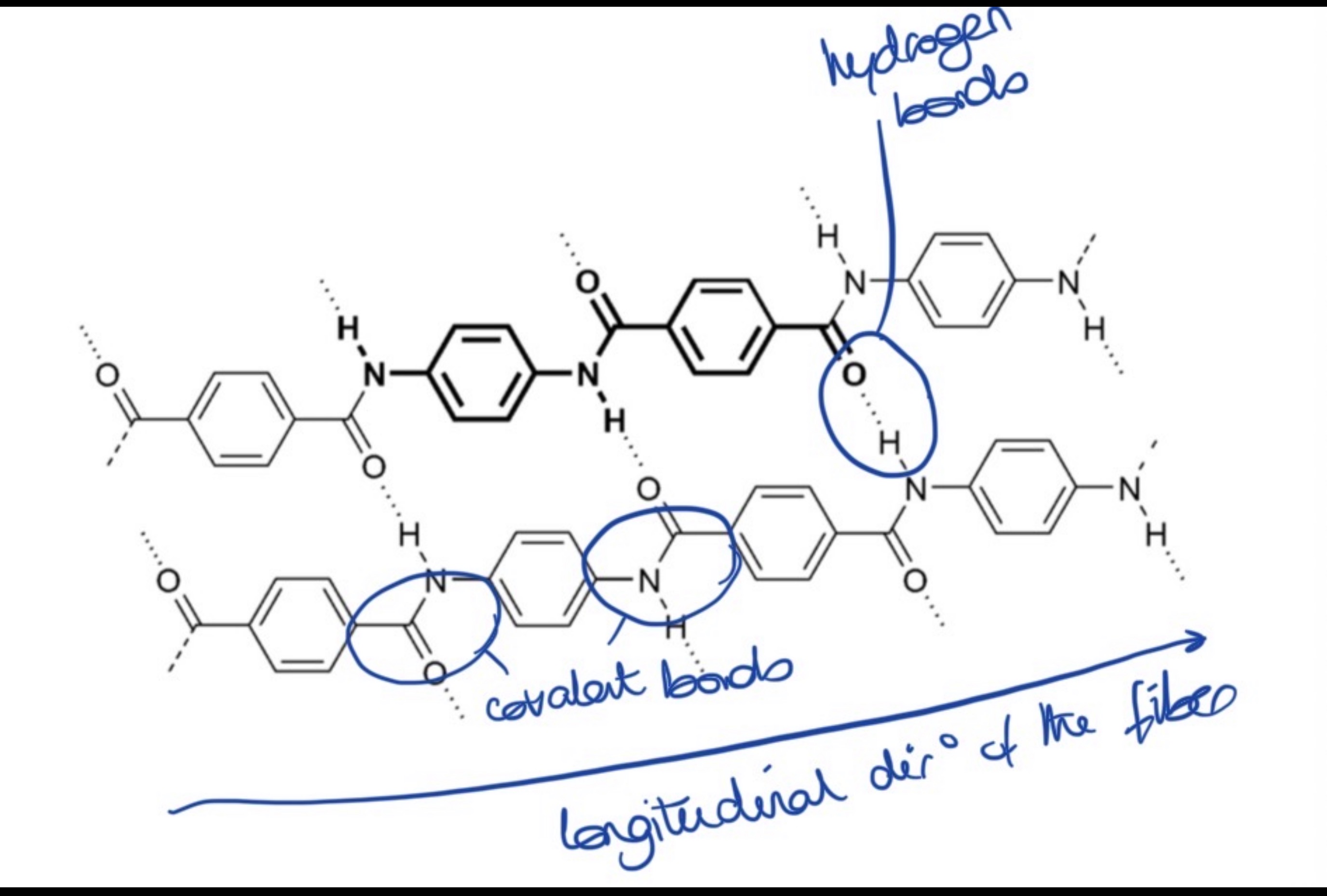
What’s the difference between isotropic & anisotropic?
Explain with the example of aramid fibres
isotropic
→ properties are constant in all directions
anisotropic
→ properties depend on the direction
Aramid fibres:
→ very strong in fibre direction (covalent bonds)
→ weaker perpendicular to the fibres (hydrogen bonds)
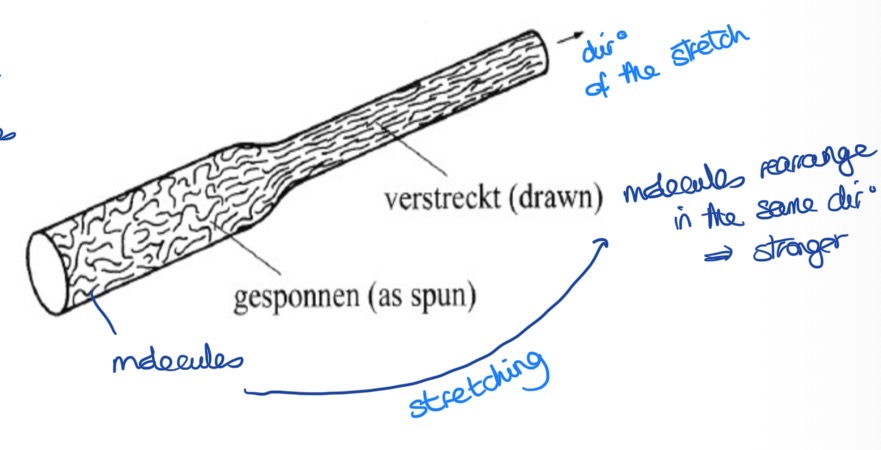
What happens to a polymer when being processed into a fibre?
→ initially the internal molecules are unaligned, tangled, & randomly oriented
→ the material is physically pulled / stretched
→ the molecules rearrange & reorient in the same direction as the pull → significantly increases the strength of the fibre along its length
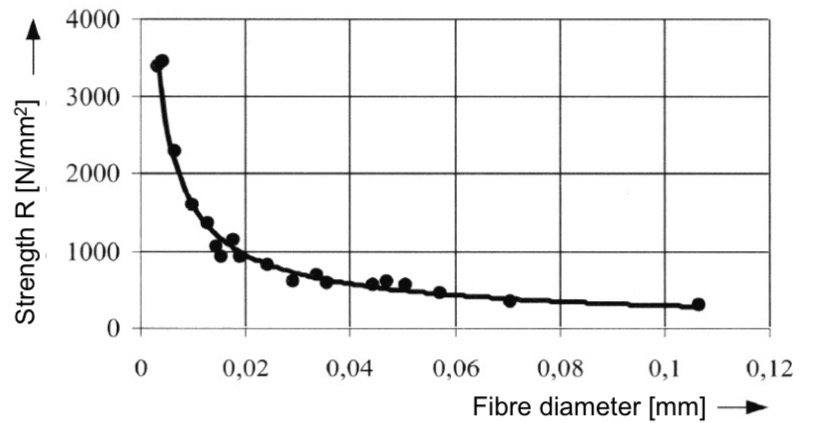
How does the diameter of a fibres affect its strength?
Why?
(Draw a graph, no values are needed)
Smaller diameter = stronger fibres
→ due to the orientation of the molecules
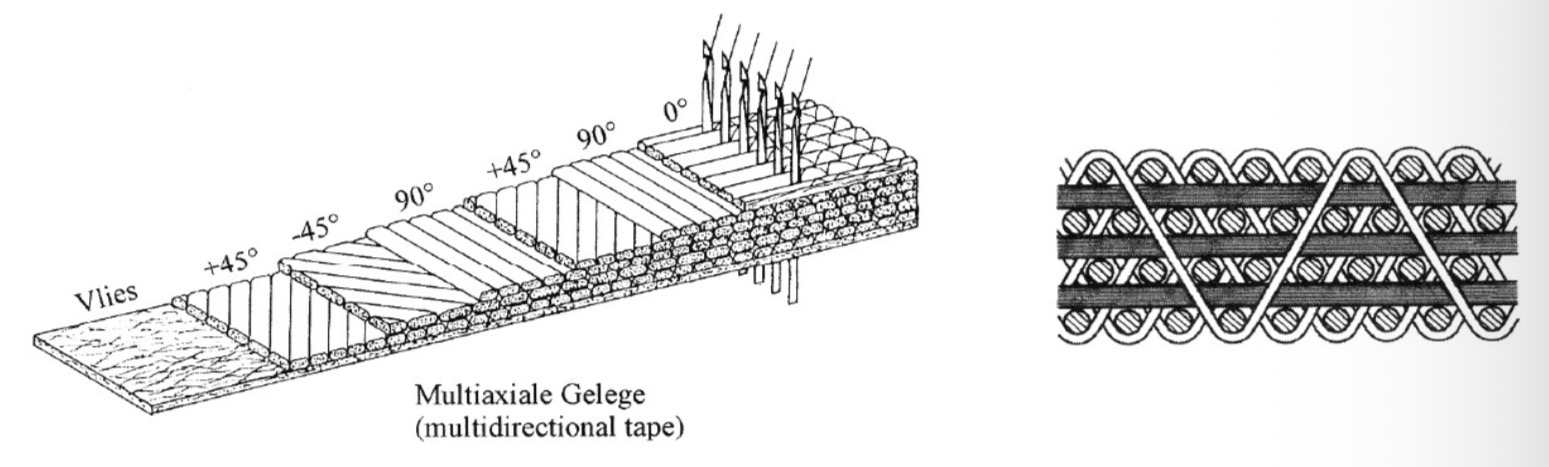
What’s the particularity about scrims (toiles)?
Fabric where fibres are arranged in multiple directions which provides good properties in all directions
What are the basic data required to determine characteristic values of composite materials?
type of fibres
Type of matrix
Fibre content (percentage of fibres in the composite)
Fibre alignement (orientation)
Manufacturing process
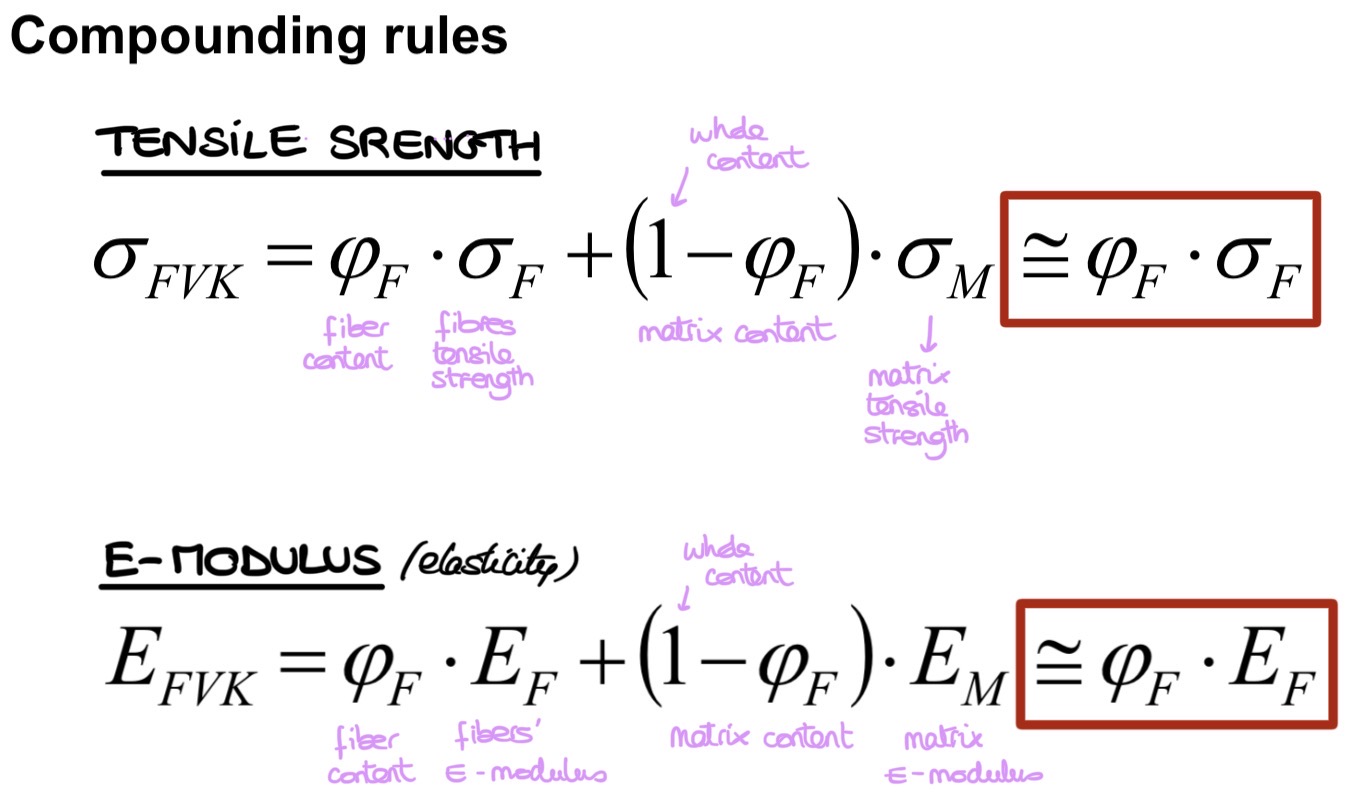
What are the formulas to calculate the properties of fibre-reinforced plastics in the fibre direction?
Tensile strength =
(Fibre content * fibre tensile strength) + (matrix content * matrix tensile strength)
E-modulus =
(Fibre content * fibre E-modulus) + (matrix content * matrix E-modulus)
Compare briefly the properties of carbon fibre VS glass fibre reinforced polymers
Carbon fibres
→ very high stiffness
→ very high strength
→ low elongation, brittle
Glass fibres
→ lower stiffness
→ Lower strength
→ higher elongation, less brittle
List some typical applications of fibre-reinforced plastics
aircraft constructions (wings, radars)
Boats (easy to bring it to a complex shape)
Vehicles
Sport equipment (bikes)
Plant construction (factories)
Architecture
Structures for constructions (bridges, reinforcement for concrete)