Avian Bio
 Call Kai
 Learn
Learn Practice Test
 Spaced Repetition
 Match
Match Flashcards
 Knowt Play
1/56

There's no tags or description
Looks like no tags are added yet.
Name | Mastery | Learn | Test | Matching | Spaced | Call with Kai | Chat |
|---|
No analytics yet
Send a link to your students to track their progress
57 Terms
Konrad Lorenz (Nobel 1973)
Study of animal behavior : instinctive behavior (imprinting), behavior is triggered by environment, importance of understanding context of behavior.
Niko Tinbergen (Nobel 1973)
Causation of behavior, rules of external stimuli for releasing innate behavior (bird silhouette), four questions of ecology.
Christiaan Eijkman (Nobel 1929)
Role of vitamin B (source of thiamine → glucose metabolism) from studies of chickens.
Peyton Rous (Nobel 1966)
Cancer is transmissible through viruses, from studies of chickens.
Dry cell
How much space the cell is taking. Larger genome = more space taken up in the cell = more room for mitochondria.
Bird genome
Most conserved genomes evolutionarily, studies using birds have shown a lot about which genes do what
Bmp4
Gene important for craniofacial development.
Avian paleontology
Birds as models for understanding dinosaurs/alligators (parental care)
Biomimickry
Mimicking biological organisms
Bioinspiration
Getting ideas from biological organisms
Avian engineering applications:
Used as models to observe flight mechanics, dynamic grasping and perching in arboreal environments (robotic application)
“Ecological barometers” (sensitive to environmental conditions)
Birds of prey are specifically susceptible to pollutants (weakens eggs)
Ex) canary in the coal mine.
Bio accumulation
Gradual build up of substances, such as toxic chemicals, inside a living organism over time.
Bio magnification
The process where the concentration of toxic substances increases in living tissue as the chemicals move up the food chain.
Avian ecosystem services
Consume insects, (carrion: scavenging dead animals), pest control, carcass dispose, seed dispersal, fertilizer, pollen nation.
Prum et al. (2015)
390 Kb of data (genomic) from 189 species
Case study: Morphology vs. Molecules
Can tell different stories about how groups are related, even biogeographic logic can mislead because it changes. Ex) evolution of ratites and flightlessness.
Archosaur
Group containing crocs, pterosaurs, dinos, and birds
Archosaur closet living relatives
Crocodiles and alligators
Archosaur extinct relatives
Other dinosaurs ← theropods, maniraptora
Avialae
Birds and bird-like theropods more closely related to birds than non-avian theropods. (Sister to Dienonychosauria, velociraptors and nonavian)
Crown group birds
Contains living present representatives and share a common ancestor
How are birds related to dinosaurs?
Nucleated red blood cells, scales on legs and face

Vane

Rachis

Calamus

Barbs

Barbules

Barb

Epidermal

Central rachis

Tail

Wing
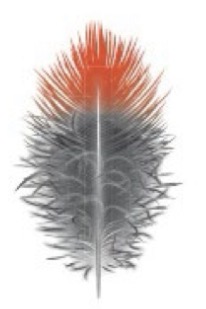
Semi-plume

Contour

Down

Filoplume

Briselle
Microstructure of feathers
B-keratin is primary structural protein (unique to birds) includes rachis, barbs, and hooklets
Plumulaceous barbs
Unstructured, soft, and fluffy. Lack hooklets and traps warm air next to birds body.
Pennaceous barbs
Flight feathers, vane with smooth, flat 2D surface. Have hooklets
Follicles
Epidermis-lined pits in skin. Double walled columns of epidermis with a dermal core
Progression of feather growth
Helical growth proceeds from epidermal collar and leads to formation of central rachis. Later sheath deteriorates and barbs unfurl
Functions of feathers
Social advertising, thermo regulation, camouflage, protection
Pterylae
Feather tracts (regions of follicles)
Apteria
Bare skin between feather tracts
Down feathers
Fluffy, lack a rachis. Used for insulation (loose barbs trap warm air)
Types of down feathers
Natal - nestlings
Body - adult
Powder - waterproofing
Contour feathers
Major outer feathers that cover a birds body helping to create its smooth shape. Rachis is longer than the barbs
Contour feather (streamlining)
Give the bird an aerodynamic shape to reduce drag
Contour feathers (thermoregulation)
Helps maintain a good body temperature by heating and cooling down
Contour feathers (waterproofing)
Spacing of barbs/barbules and natural waxy oils. Causes water drops to form
Flight feathers - Remiges
Wing feathers
Primaries: attached to manis (hand)
Secondaries: attached to ulna (arm bone)
Flight feathers - Rectrices
Tail feathers attached to pygostyle (tail bone)
Flight feathers - Semiplumes
Intermediate between contour and down feathers, help with insulation
Flight feathers - Filoplumes
Smallest types of feathers, bare rachis. Serve sensory functions to monitor movement of feather code.
Flight feathers - Bristles
Specialized sensory function and protection. Ex) Rictal (face) bristles of flycatchers protect their eyes