Surgery - GU / Renal
 Call Kai
 Learn
Learn Practice Test
 Spaced Repetition
 Match
Match Flashcards
 Knowt Play
1/51

There's no tags or description
Looks like no tags are added yet.
Name | Mastery | Learn | Test | Matching | Spaced | Call with Kai | Chat |
|---|
No analytics yet
Send a link to your students to track their progress
52 Terms
What is the minium post-op urine output goal
At least 0.5 ml/kg/hour
Ideally, when do we remove urine caths post-op
POD 1
What timeframe is given to assess if patient can properly void without a cath
6-8 hours post-op or post-cath removal
How does post-op low urine output typically occur
Kidneys have decreased blood flow
Activates the renin-angiotensin system
Preserve water
What are important questions to ask if a patient has low post-op urine output
Was the patient appropriately volume resuscitated?
Is the patient NPO?
What maintenance fluids? Rate?
Weight of the patient?
Fever / Increased metabolic issue?
What is the blood pressure / mean arterial pressure?
Treatment for Low Urine Output Post-OP
Assess for volume overload/heart failure issues
no signs of volume overload → bolus – 500-1,000 mL NSS
ncrease the maintenance fluid rate
Watch for signs of fluid overload
Signs of volume overload → Lasix
Risk Factors for POUR
Age over 40 years
Male gender
History of DM
Preexisting urinary retention
Neurologic disease
Type of surgery
Types of anesthesia
Prolonged surgical procedures
Certain medications
What neuro diseases have risk of causing POUR
cerebral palsy
neuropathy
MS
What anthesia types have risk for causing POUR
Epidural and spinal
POUR
Post-op urine retention
What medications can induce POUR
opioids
anticholingerics
beta-blockers
At what volume is post-void residual indicative for retention
Post-void residual >100 mL
Signs of Urine Retention / POUR
Inability to void despite feeling of full bladder
Suprapubic discomfort
Agitation
Palpable
Treatment for POUR
Encourage fluid intake
Intermittent catheterization to relieve bladder pressure
Temporary indwelling bladder catheter may be needed
alpha-adrenergic blocker → Tamsulosin
home performing clean intermittent catheterization (CIC)
What surgery types tend to cause POUR
Pelvic
Anorectal
Hernia repairs
Incontinence Surgery
What region of the prostate is affected by BPH
transitional zone of the prostate
Presentation of BPH
Nocturia,
frequency,
dysuria,
weak stream,
urinary retention
Treatment of BPH
Medical therapy - Alpha blockers + 5-alpha-reductase inhibitors
Surgery
Most procedures for BPH are performed
Transurethral
How long does a cath remain post-op TURP
1-7 days
Most Common Complication of TURP
UTI
Complications from TURP
UTIs
Reterograde ejaculation
Presentation of Nephrolithiasis
Severe colicky, flank (back) pain,
restlessness,
N/V
dx for Nephrolithiasis
Urinalysis demonstrates blood and/or stones
Abdominal CT (generally non-contrast)
Treatment for Nephrolithiasis
IV fluids,
analgesics,
watchful waiting
Surgery
Indications for Surgical Treatment of Nephrolithiasis
Intractable pain or infection
Progressive obstruction
Progressive renal damage
Solitary kidney
Stones with low probability of passing (size)
At what size are renal stones determined not to pass on own
6mm or more
Procedures for Nephrolithiasis
Extracorporeal shock wave lithotripsy (ESWL)
Ureteroscopy with stone extraction
Percutaneous nephrolithotomy (PCNL)
Open nephrolithotomy
Placement of stent past obstruction
Contraindications for ESWL
Pregnany
Bleeding diathesis
Stones several cm in size
Complications from ESWL
Bleeding
Infections
Most Common Complications from Ureteroscopy with stone extraction
Ureteral injury
Ureteral stricture
Percutaneous nephrolithotomy (PCNL)
removal of stone through skin
Complications from Percutaneous nephrolithotomy (PCNL)
Bleeding
kidney damage
Risks of Open nephrolithotomy
infection
longer recovery time
Complications from Ureter Stents
pain
infection
Most common type of bladder cancer
transitional cell carcinoma
Presentation of bladder cancer
painless hematuria
Pain usually with locally advanced or metastatic disease
Risk Factors for Bladder Cancer
Smoking
aniline dyes
Cyclophosphamide
dx for bladder cancer
Cystoscopy → initial procedure for diagnosis and management
Urinalysis
Treatment for Bladder Cancer
T1 tumor (No detrusor involvement) → Intravesical (BCG) or (TURBT)
If muscle wall invaded (T2 or higher) – need cystectomy with ileal conduit + chemotherapy + XRT
Complications of Bladder Surgery
Infection of the bladder
Bleeding
Lymphedema (legs) if lymphadenectomy done
Changes in urinary function
Types of Urinary Diversion
Ileal Conduit
Continent Cutanous Reservior
Orthotopic Neobladder
Most common tumor of the kidney
Renal cell carcinoma
hypernephroma
Renal cell carcinoma
Risk Factors for Renal cell carcinoma
smoking,
obesity,
hypertension,
chronic kidney disease
, genetic
What genetic syndrome is associated with renal cell carcinoma
(von Hippel-Lindau disease)
Presentation of renal cell carcinoma
flank pain,
mass,
hematuria,
unexplained weight loss,
fatigue,
night sweats,
persistent fever
with paraneoplastic syndromes
Test of Choice for renal cell carcinoma
CT
Most Common Mets Site for Renal Cell Carcinoma
Lung
How can renal cell carcinoma effect labs
HTN and elevated RBC due to high EPO
Treatment for renal cell carcinoma
radical nephrectomy with regional nodes, radiation, and chemotherapy
If less than 4cm → partial nephrectomy may be offered
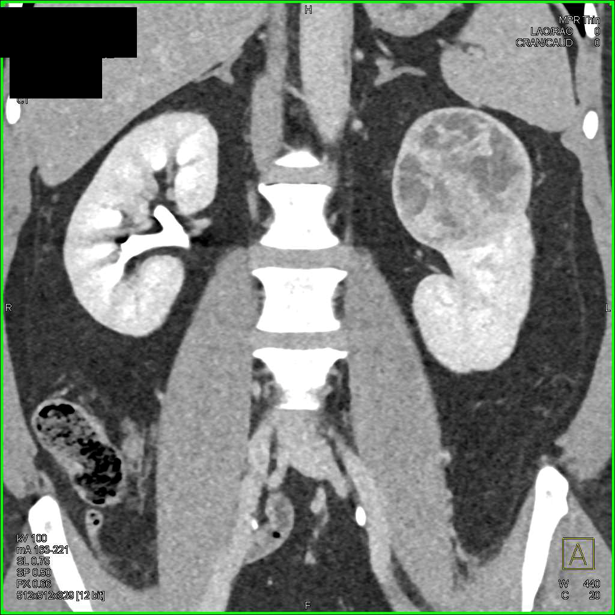
renal cell carcinoma