Biomedical Genomics Quiz 1
 Call Kai
 Learn
Learn Practice Test
 Spaced Repetition
 Match
Match Flashcards
 Knowt Play
1/51

There's no tags or description
Looks like no tags are added yet.
Name | Mastery | Learn | Test | Matching | Spaced | Call with Kai | Chat |
|---|
No analytics yet
Send a link to your students to track their progress
52 Terms

Pedigree Symbol
Unaffected male

Pedigree Symbol
Unaffected Female

Pedigree Symbol
Affected Male

Pedigree Symbol
Affected Female

Pedigree Symbol
Sibship
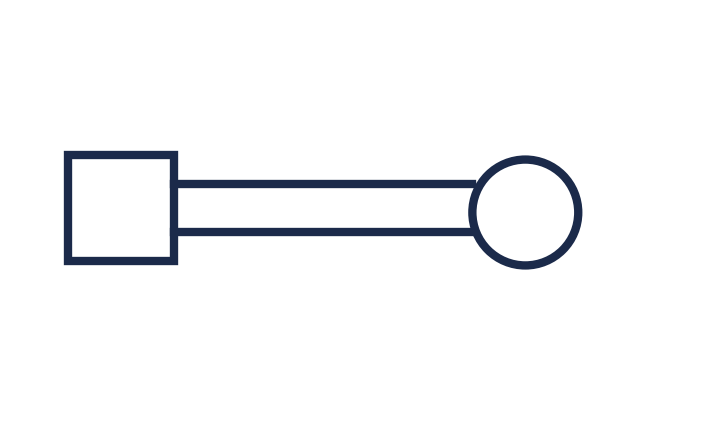
Pedigree Symbol
Consanguineous Mating

Pedigree Symbol
Proband

Pedigree Symbol
Autosomal Dominant

Pedigree Symbol
Autosomal Recessive
Consanguinity
A reproductive union between two individuals who are biological blood relatives.
Proband
Individual in a family who is first identified for having a genetic condition.
Modes of Inheritance
Autosomal Dominant, Autosomal Recessive, X-Linked Dominant, X-Linked Recessive, Mitochondrial
Autosomal Dominant Inheritance
Only one copy of the mutated gene from a single parent causes the condition
Vertical pattern
Appears in every generation
Autosomal Recessive Inheritance
Two copies of the mutated gene (one from each parent) are required for the condition to appear
Horizontal pattern
Often skip generations
X-Linked Inheritance
A genetic trait or inherited gene located on and passed down the X chromosome. Affects males more than females.
Mitochondrial Inheritance
Transmission of mitochondrial DNA (mtDNA) from mother to her offspring.
De Novo Inheritance
Genetic mutation occurs for the first time in an individual, not inherited from parents.
Common Variant types
SNPs, Indels, CNVs
SNPs
Single Nucleotide Polymorphisms, variations at a single nucleotide position in a DNA sequence
INDELs
Insertion or deletion of one or more nucleotides or base pairs
CNVs
Copy Number Variants, the number of copies of a segment of DNA differs between individuals. There are two copies (one inherited from each parent), a person may have one, three, or more copies of that same DNA segment.
Structural Variants
Large-scale genomic alterations: insertions, deletions, duplications, inversions
Somatic Mutations
Mutations occurring in somatic cells, not inherited, and can lead to cancer and other diseases.
Germline Mutations
Mutations occurring in germ cells, which are inherited and can be passed on to offspring.
Point Mutation
Affects only one nucleotide in a DNA sequence, classified as Transitions and Transversions
Transitions
A purine is replaced by a purine base, or a pyrimidine is replaced by a pyrimidine base
Transversions
A purine base is replaced by a pyrimidine base (or vice versa) in a DNA sequence
Purine Bases
Adenine (A) and Guanine (G)
Pyrimidine Bases
Cytosine (C), Thymine (T), and Uracil (U)
Inversions
A DNA segment is reversed in its orientation within a chromosome
Consequences of Point Mutations
Silent Mutations, Missense Mutations, Nonsense Mutations
Silent Mutations
Produce no change in amino acid sequence, does not affect protein function
Missense Mutations
Result in a different amino acid, affects protein function
Conserved = similar amino acid properties
Non-Conserved = dissimilar amino acid properties
Nonsense Mutations
Generates a stop codon, premature termination of translation.
Consequences of INDELs
Frameshift Mutations
Frameshift Mutations
Shifts reading frame of protein coding region, causes changes in amino acid sequence, may produce nonfunctional protein
Frameshift Mutation effect on Phenotype
Null Allele, Hypomorph, Hypermorph
Null Allele
No protein is made, or protein is non-functional, Loss of Function
Hypomorph
Protein has reduced function, Loss of Function
Hypermorph
Protein has increase function, or different function, Gain of Function
Polgenic Models
Models involving multiple genes that contribute to a specific trait or phenotype
Monogenic Models
Models involving a single gene that contributes to a specific trait or phenotype.
FASTQ
Raw, unaligned reads and quality scores
CIGAR Strings
(in BAM/SAM) shows how sequences align to a reference sequence, indicating matches, mismatches, insertions, and deletions.
BAM
Compressed, aligned sequencing reads
VCF
Table of called variants (chromosome, position, ref/alt allele, annotations)
Modes of Inheritance
Classic Mendelian, Incomplete Dominance, Codominance, Polygenic / Multifactorial
Classic Mendilian Inheritance
Follows Mendel’s laws, single-gene traits passed from parents to offspring
Incomplete Dominance
Heterozygous genotype results in phenotype that shows intermediate between dominant and recessive traits.
Codominance
Both alleles in heterozygous genotype express themselves equally in the phenotype.
Polygenic / Multifactorial Inheritance
Multiple genes influence a trait, resulting in a range of phenotypes, bell-shaped trait distributions (skin or height color)
Reference Genome
Used to align sequencing reads, not identical to any one individual, updated periodically to improve representation of diverse populations,