glaciated landscapes- SWITZERLAND DAM CASE STUDY (glaciated landscape)
 Call Kai
 Learn
Learn Practice Test
 Spaced Repetition
 Match
Match Flashcards
 Knowt Play
1/4

There's no tags or description
Looks like no tags are added yet.
Name | Mastery | Learn | Test | Matching | Spaced | Call with Kai | Chat |
|---|
No analytics yet
Send a link to your students to track their progress
5 Terms
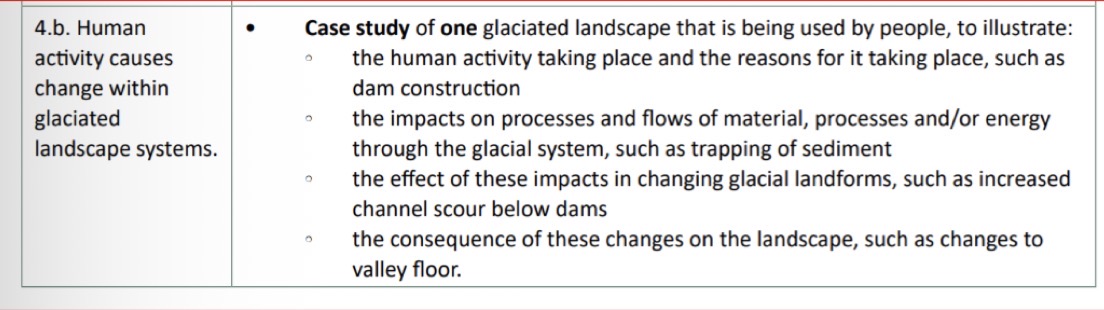
The human activity taking place and the reasons for it taking place such as dam construction
Grande Dixence Scheme-Val des Dix Switzerland
highest gravity dam in the world, constructed between 1950-61. Recent update 2010
Lengthy construction process due to inaccessibility of site and severe working conditions (glaciated landscape)- construction only took place in summer.
Cost 1600mil Swiss Francs (£1300mil)
Fed by 35 glaciers, fed by meltwater—> more in summer when there is greater ablation
Gravity holds dam to ground- stops sheer weight of water from pushing dam over
Stores over 400million m3 water a year
285m high
Construction materials for the dam obtained locally from moraine deposits in adjacent valleys
95% of Swiss energy comes from renewable energy
Water behind Grande Dixence dam drives turbines in 4 power stations
Enough energy to power 400,000 Swiss households
Stores glacial meltwater during summer- optimise water level, generates electricity during high demand winter
KE and GPE are energy involved
Impacts on processes and flows of material, processes and/or energy through glacial system such as trapping of sediment
Energy
water drives turbines in 4 power stations
GPE and KE
1/3 of Swiss energy comes from storage power stations
85% of water used for electricity generation
Trapping of sediment in dam- lake above dam is stagnant. Lots of sediment that doesn’t flow through. This is because there isn’t much energy behind the dam. Therefore we use the other 15% of the water to flush the sediment through so there isn’t a backlog of sediment.
Effect of impacts in changing glacial landforms such as increased channel scour below dams
environmental impact minimise- keep aesthetics of area for tourists.
Pumping stations + power plants built underground, well concealed to retain aesthetics
However reduced flow in Borgne River- tributary of the Rhone, below the dam has resulted in higher concentrations of pollutants at Les Haydee from agricultural and domestic sources
When sediment gets trapped upstream, leading to "hungry water" with more erosive power downstream, causing bed degradation and habitat loss
Impact on glacial system:
85% of water in the dam used for electricity generation.
15% used to deal with problems of sedimentation. When water is stored behind the dam the lack of flow means a loss in energy and the deposition of the sediment load behind the dam at rates of 20-40cm/yr. sediment concentrations are >300mg/l above the dam, <20mg/l downstream of the dam.
To solve problem, some water in reservoir used to purge sediment- flushing it out and moving it downstream. Water at these times has high levels of turbidity and sediment concentrations of up to 20,000mg/l
Channel scour (erosion)
no sediment downstream, water has lots of kinetic energy and lots of erosive potential, however not a lot of water supply in the long term and despite the fact that the river has a lot of energy, it can’t erode because there is so little water left below the dam. Channels dry up and constrict
Consequences of these changes on landscape such as changes to valley floor
Impact on river channels
trapping of sediment behind dam—> clear water returned into natural river channels below power stations
Excess energy, none used to transport sediments—> more channel erosion
But lack of discharge in below-dam rivers means some almost dry up in the summer. River channels also contract, scale of contraction increases with distance away from the dam
Amount of sediment eventually flowing into Lake Geneva halved since dam construction
Val d’Herens, risk of flooding when excess water stored must be released- hindered tourist use and development along valley floor
The future:
climate change producing more glacial melting in Swiss Alps- meltwater available to create hydropower increasing. Eventually glaciers will have shrunk to much that meltwater supply may diminish- altering sediment supply and transportation even more