Brain and Behavior CH. 9
 Studied by 0 people
 Call Kai
 Learn
Learn Practice Test
 Spaced Repetition
 Match
Match Flashcards
 Knowt Play
1/85

There's no tags or description
Looks like no tags are added yet.
Name | Mastery | Learn | Test | Matching | Spaced |
|---|
No study sessions yet.
86 Terms
basal metabolism
energy used to maintain a constant body temperature at rest
uses about 2/3 of our energy per day
TWICE as much energy is used for temperature regulations than all other activities combined
homeostasis
in mammals, temperature regulation, hunger and thirst, are NEARLY homeostatic and not EXACTLY homeostatic
negative feedback
processes that reduce discrepancies from the set point
allostasis
adaptive way in which the body changes in response to changes in life/environment
ectothermic (poikilothermic)
animals with body temperatures that match their environment
i.e. fish, lizards, cold bloodeds
endothermic (homothermic)
animals that can maintain body temperature of 37o C or 98o F
what brain region is critical for temperature control?
POA/AH
preoptic chasm
anterior hypothalamus (hypo cold)
we need POA/AH! (POWER)
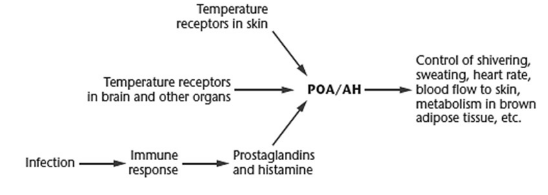
how does POA/AH work
monitors own temperature and receives input from temperature-sensitive skin and spinal cord receptors
also receives input from the immune system!
Suprachiasmatic N
circadian
Preoptic area
temperature control
Organum vasculosum laminae terminalis
osmotic pressure
Supraoptic and paraventricular N
release of vasopressin
Lateral preoptic area
drinking
Subfonical organ
stimulated by angiotensin II
drinking
Laternal N
increase eating
Ventrmedial N
decrease eating
Ventral noradrenergic bundle
decreasing eating (bundle)
Paraventricular N
decrease eating (para N)
fever initiation
bacteria and viruses trigger leukocytes to release cytokines
cytokines attack intruders but also stimulate the [vagus nerve], which stimulates the hypothalamus to produce fever
newborn rabbit immature hypothalamus
prefer a room warm enough to increase their body temperature in response to infection
it is behavioral!
when does fever get dangerous?
a fever above 39o C is bad
above 41o C is life threatening!!!!
immune system delivers what to cause shivering, increased metabolism and fever
prostaglandins and histamines
what does POA/AH control mainly
controls sweating or shivering
the concentrations of chemicals in water determines the rate of all chemical reactions in the body
true
how is water conserved in humans
excreting concentrated urine
decreasing sweat and other autonomic responses
when your body needs water, the ______ gland releases ______ also known as antidiuretic hormone (ADH)
posterior pituitary gland / vasopressin
what does vasopressin do (thirst)
raises blood pressure by constricting blood vessels
enables the kidneys to reabsorb water and secrete highly [concentrated urine]
osmotic pressure (why does osmotic thirst happen)
body maintains combined conc. of solutes at fixed level of 0.15 M
water tends to flow from low to high concentration
osmotic thirst
thirst due to increase in solute concentrations
triggered by change in osmotic pressure
hypovolemic thirst
thirst due to overall loss of volume
is based on blood volume becoming too low, so low that water and nutrients cannot enter body’s cells
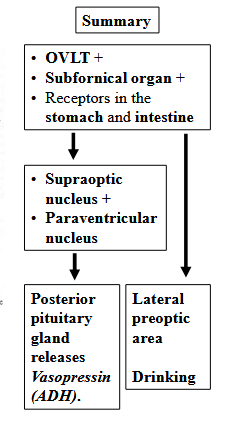
where do neurons detect osmotic pressure (osmotic thirst)
receptors around 3rd ventricle
Organum Vasculosum Laminae Terminalis (OVLT)
Subfornical organ: near 3rd ventricle
receptors in periphery: stomach, intestine (detect high sodium)
where are signals from osmotic pressure detectors relayed to
relayed to [supraoptic nucleus] and [paraventricular nucleus] of the hypothalamus that control the rate at which the posterior pituitary gland releases vasopressin (ADH)
also relayed to lateral preoptic area (drinking)
summary of osmotic thirst diagram
baroreceptors (real flesh and meat stuff)
receptors attached to large veins that determine the pressure of blood returning to the heart
baroreceptors trigger the release of what hormones?
vasopressin and angiotensin II
(hypovolemic thirst) when blood volume decreases, the kidneys release the hormone _____ which splits a portion off ______ (a large protein) to form ________ which is then turned into _______
renin / angiotensinogen / angiotensin I / angiotensin II
what does angiotensin II do?
constricts blood vessels in order to reverse loss of blood volume
stimulates subfornical organ (SFO) to increase drinking
what does angiotensin II stimulate?
stimulates neurons near the 3rd ventricle
it is also a neurotransmitter (released by hypothalamus)
animals with osmotic thirst prefer:
pure water
animals with hypovolemic thirst prefer:
slightly salty water
sodium-specific cravings
caused by release of [aldosterone] which causes the kidneys, salivary glands and sweat glands to conserve sodium and excrete more watery fluids than usual
develops automatically to restore solute levels in blood
due to bleeding or excessive sweating
big mac diagram
beef patty: protein, triglyceride, neutral fat
lettuce: cellulose
cheese: protein trigylceride
pickles: cellulose, starch
onions: cellulose, starch
bun: starch
25 g protein
28 g fat
47 g carbohydrates
540 calories in total!
the ______ tract provides the body with a continual supply of water electrolyte and nutrients
alimentary
what controls the alimentary tract
local, nervous, and hormonal systems
digestion
begins in mouth by saliva
esophagus => stomach, HCl and enzymes digest proteins
[pyloric sphincter] allows food to periodically enter intestines
enter small intestines (main site of nutrient absorption into bloodstream)
nutrients carried by blood to cells in body
large intestine absorbs water and minerals and lubricates remaining materials for excretion
why lactose intolerance happen
mammals lose ability to metabolize lactose due to decreased levels of lactase
sham feeding experiments
everything an animal eats leaks out of a tube connected to the stomach / esophagus do NOT produce [satiety]
main signal to stop eating
distention of the stomach
[vagus nerve] carries info to brain regarding stomach wall stretching, is a MAJOR basis for [satiety]
splanchnic nerves
convey info about nutrient contents of stomach
carries impulses between the spinal cord and digestive organs
duodenum and satiety
glucose produces satiety through receptors in the duodenum or by causing it to release hormones with satiating effect
cholecystokinin (CCK)
hormone released by duodenum to inhibit appetite by:
closing the sphincter muscle between stomach and duodenum and causing stomach to hold contents and fill faster
stimulating vagus nerve to send a message to hypothalamus that releases a similar chemical
insulin role in hunger
facilitates entry of glucose in bloodstream into body’s cells
glucagon
stimulates liver to convert stored glycogen into glucose
diabetics eat ____ food than usual but lose weight because their body’s cells are receiving ____ glucose due to poor insulin blood levels
more / little
obese people produce ___ insulin than people of normal weight
these levels of insulin cause more food than normal to be stored as fat, and causes quicker appetite return after a meal
more insulin
leptin
a peptide that signals the brain to increase or decrease eating
low leptin = HUNGRY
high leptin = do NOT necessarily decrease hunger, but increases physical and immune system activity
leptin and obese people
most people are obese because they are less sensitive to leptin
some people are obese because genetic inability to produce leptin
obesity due to constant overeating damages the endoplasmic reticulum in neurons of hypothalamus
leads to decreased leptin sensitivity
physical activity repairs endoplasmic reticulum
arcuate nucleus
part of the hypothalamus containing two sets of neurons
neurons sensitive to hunger signal
neurons sensitive to satiety signal
neurons of the arcuate nucleus specifically sensitive to hunger signals receive input from:
taste pathways
axons releasing neurotransmitter [ghrelin]
neurotransmitter in brain and hormone in stomach to trigger contractions
Prader-Willis syndrome
genetic condition marked by mental retardation, short stature, and obesity
Ghrelin is x5 higher than normal!
melanocortin
neuropeptide responsible for limiting food intake
people with mutated gene for the receptors melanocortin overeat and become obese
input to the satiety-sensitive cells of the [arcuate nucleus] include signals of both long-term and short-term satiety:
distention of intestine triggers neurons to release CCK
blood glucose and body fat increase blood levels of the hormone insulin
some neurons release a smaller peptide related to insulin as a transmitter
leptin provides additional input
output from the arcuate nucleus excites the ______ of the hypothalamus
excites paraventricular nucleus
paraventricular nucleus is part of the hypothalamus that _____ the lateral hypothalamus
inhibits latereal hypothalamus
lateral hypothalamus is important for feelings of what?
hunger and satiety
input from the hunger-sensitive neurons of the arcuate nucleus is _______ to both the paraventricular nucleus and the satiety-sensitive cells of the arcuate nucleus
inhibitory to both paraven, and satiety sens. cells
inhibitory transmitters
GABA, neuropeptide Y (NPY), and agouti-related peptide (AgRP)
NPY and AgRP are ___________ that block the satiety action of the paraventricular nucleus and provoke _______
inhibitory transmitters / overeating
output from the paraventricular nucleus acts on the _________
acts on the lateral hypothalamus
lateral hypothalamus controls what and alters what?
controls insulin secretion and alters taste responsiveness
orexin
secreted by lateral hypothalamus
increases persistence in seeking food
responds to incentives and reinforcement in general
what if an animal had damage to the lateral hypothalamus? why?
the animal would refuse food and starve unless force fed
axons to NTS => change taste sensation and increase salivation
axons to forebrain increase ingestion and swallowing
activate DA neurons => reinforce behaviors
axons to spinal cord, control digestive secretion
damage to the ventromedial hypothalamus leads to what? why?
leads to overeating and weight gain (no decrease in hunger because they consume bitter foods far less than normal)
eat normal sized but unusually frequent
increased stomach motility and secretions
lasting increase of insulin => store in fat
what happens when there is damage to the ventral noradrenergic bundle?
excess eating and increased body weight
paraventricular nucleus (PVN) rats
if damaged, rats eat larger meals rather than more frequent meals
is there a weak or strong relationship between depression and weight gain
weak relationship
a high-fat diet before birth can lead to offspring born with a ______ than average lateral hypothalamus
larger than average
when did obesity increase sharply in america?
in the 1970’s due to high use of fructose, large foods, etc
_________ has replace __________ and decreases meal sizes and binge eating by blocking reuptake of _______ and ________
sibutramine / fenfluramine
serotonin / norepinephrine
Orlistat
prevents intestines from absorbing fats
gastric bypass surgery
removal of part of the stomach
decreased stomach size allows greater distention of stomach to produce satiety
what percentage of adolescent females are bulimic
10%
obesity risks/symptoms
high blood pressure, high cholesterol
shortness of breath
eating in big bites with no pleasure
bulimia risks/symptoms
binging and purging
dry skin/hair
swollen glands from vomiting (chipmunk cheeks)
laxative addiction
stomach rupture
dental problems
anorexia nervosa risks/symptoms
dry cold skin, downy hair on skin
insomnia, hyperactivity
heart failure
kidney failure
low protein stores
digestive problems
electrolyte imbalance