Electronegativity, Bond Types, Water Properties, and Organic Isomers in Biology
 Call Kai
 Learn
Learn Practice Test
 Spaced Repetition
 Match
Match Flashcards
 Knowt Play
1/136

There's no tags or description
Looks like no tags are added yet.
Name | Mastery | Learn | Test | Matching | Spaced | Call with Kai | Chat |
|---|
No analytics yet
Send a link to your students to track their progress
137 Terms
what are the primary ions in electrolytes
sodium, potassium, calcium, magnesium, and chloride
Electronegativity
the pull an atom has on its electrons
How does electronegativity effect the sharing of electrons between 2 atoms: Higher electronegativity means?
stronger pull on electrons
How does electronegativity effect the sharing of electrons between 2 atoms: bigger difference in electronegtivity?
more unequal sharing between electrons
How does electronegativity "sets the stage" for hydrogen bonding between water molecules?
Electronegativity makes water polar. Oxygen pulls electrons closer, making O slightly negative and H slightly positive. The H of one water molecule is attracted to the O of another, forming a hydrogen bond.
Non-polar Covalent Bond
two atoms have the same or similar
electronegativity they will share the electrons equally
Polar Covalent Bond
big difference in electronegativity between the two atoms, one will have a much stronger pull on those shared
electrons and they will share unequally
Hydrogen Bond Defintion
intermolecular bond (between molecules)
Why do hydrogen bonds occur?
because a slightly positive hydrogen is attracted to a slightly negative atom nearby, like oxygen.
What is the role of electronegativity in hydrogen bonding between water molecules?
Electronegativity makes water polar. Oxygen is slightly negative and hydrogen is slightly positive, so they attract and form hydrogen bonds.
Properties of Water (8)?
-water has a high specific heat
-water has a high heat of vaporization
-cohesion
-adhesion
-solid water is less dense than liquid water
-water is an excellent solvent
-water organizes non-polar regions of molecules
-water dissociates into ions
Water has a high specific heat:
define:
example of why/how this property is significant in LIVING organisms
-needs a lot of energy to chage temperatures
-significant because it helps keep the weather more stable as well as humans body temperatures more stable
Water has a high heat of vaporization:
define:
example of why/how this property is significant in LIVING organisms
-boils (liquid to vapor)
-significant because of the process evaporate cooling which is sweating. Sweating is a process that helps cool us down.
cohesion:
define:
example of why/how this property is significant in LIVING organisms
-stick to other water molecules
-examples is forming water droplets and surface tension
Adhesion:
define:
example of why/how this property is significant in LIVING organisms
-stick to other molecules or surfaces
-examples: waters meniscus. plants uptake water, humans moving water through tissues
solid water is less dense than liquid water:
define:
example of why/how this property is significant in LIVING organisms
-basically ice floats
-freesing fixes hydrogen bonds in place which make its less dense
examples: icebergs, the top of water freezes for bodies of water (think of fish in pond and the insulation created)
Water is an excellent solvent:
define:
example of why/how this property is significant in LIVING organisms
-many molecules are able to dissolve in water
In humans: blood is mostly water, so it can carry nutrients, salts, oxygen, and wastes.
names of 3 terms for solvent
-solvent
-solute
-solution
Explan solvent
the liquid part of a solution
Explain Solute
what gets dissolved in the solvent
Explain Solution
the end result of solvent+solute
water organizes non-polar regions of molecules:
define:
example of why/how this property is significant in LIVING organisms
-some molecules are more polar while others are more non polar
-example on how soap works and phospholipid bilayer
Water dissociates into ions:
define:
example of why/how this property is significant in LIVING organisms
-H2O splits into OH- and H+
-OH- is hydroxide ion which increases the pH and is basic
-H+ is a hydrogen ion which decreases the pH and is acidic
Define the term polar
electrons are shared unequally, making one side slightly positive and the other side slightly negative.
define the term non polar
means electrons are shared equally, so there is no positive or negative side.
define the term hydrophobic
-nonpolar
-doesnt dissolve in water
-water "fearing"
define the term hydrophilic
-polar/ionic
-dissolves in water
-water "loving"
define the term phospholipid
a molecule that makes up the cell membrane. It has a water-loving head and water-fearing tails.
define the term micelle
Micelle = a little bubble that traps oily/nonpolar stuff inside.
-think of micellar water for makeup removal
define the term phospholipid bilayer
two layers of phospholipids that make up the cell membrane. The heads face water and the tails face inward.
pH Scale basic facts (number scale) (lower numbers are acidic or basic) (what is the neutral number)
-number scale: 1-14
-lower numbers are acidic
-higher numbers are basic
-neutral number= 7
what defines an acid?
-a substance that releases H⁺ ions in water.
-Acids have a pH below 7.
What defines a base?
a substance that accepts H⁺ ions or releases OH⁻ ions in water. Bases have a pH above 7.
Is HCI a strong acid or base
strong acid (pH 1-2)
Is NaOH a strong acid or base?
Strong base (pH 14)
What is the pH of blood?
7.35-7.45
What is a buffer?
-keep pH constant/stable
What is the role of buffers in the body?
help the body maintain a relatively constant pH
What is the general equation for the carbonic acid buffer system
H₂CO₃ ⇄ H⁺ + HCO₃⁻
How does the carbonic acid buffer system work?
more basic goes right
more acidic goes left
what is the point of the carbonic acid buffer
This system helps keep blood pH stable.
What are the different ways in which a carbon chain can differ?
-length
-branching
-rings
-double bonds
Define what an isomer is
-same chemical formula but different structure
what are the 3 types of isomers?
1) structural isomers
2) geometric isomers
3)enantiomers
Explain a structural isomer
differ in basic arrangements
Explain Geometric isomer
occur with double bond between carbons
Explan enantiomers
mirror image of each other
What is Natural Selection
survival of the fittest
Who founded natural selection
Charles Darwin
explain the pocket mouse video
-mutation for dark fur
-dark fur is due to natural selection
-camouflaged better from the predators
-lava flow turned terrian for light brown to black
explain the lactase video
-lactose -> came from a mutation
-livestock, famine, people who could digest lactose were more likely to survive and then passed the mutation down
what is the sickle cell example
Sickle cell can be harmful, but people with one sickle cell allele have some protection against malaria. In areas where malaria is common, this allele can stay in the population because it gives a survival advantage.
Describe Sexual selection
organisms have a preference in the mate they choose
describe gene flow
migration of a species so new alleles enters a new population which adds variation
describe genetic drift
Random changes in allele frequencies, especially in small populations.
bottleneck effect
populations size is significantly reduced by enviromental events or human activities
describe mutation
random changes to dna creating new alleles
describe artificial selection
what humans select as characeteristics they want
what are the main differences between prokaryotic cells and eukaryotic cells
Prokaryotic = no nucleus
Eukaryotic = has nucleus
which organisms are prokaryotes
bacteria
which organisms are eukaryotes
plant and animal cells
whats the hierarchy of biological classification
Dumb King Philip Came Over For Great Sandwiches
Dumb-
Domain
King-
Kingdom
Philip
Phyla
Came-
Class
Over-
Order-
For-
Family
Great-
Genus
Sandwiches-
Species
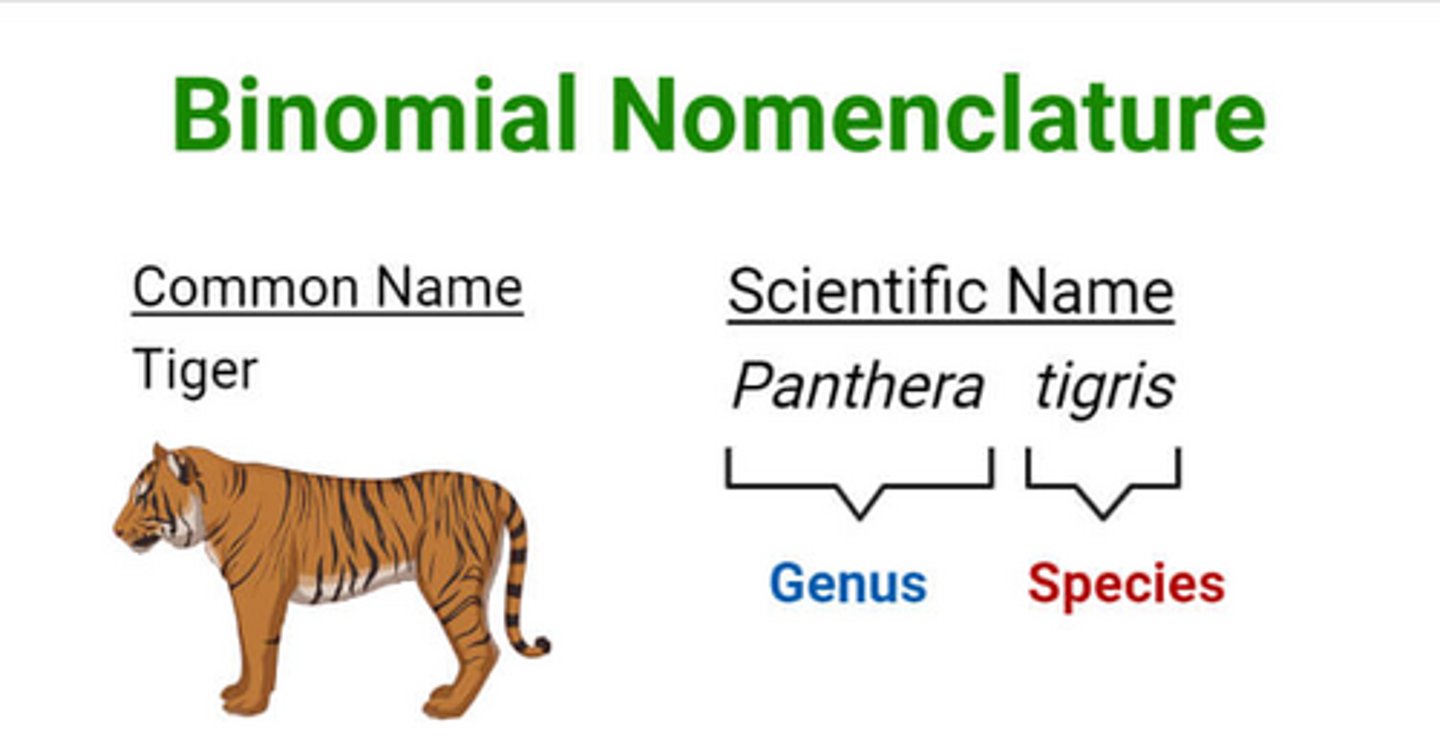
how are living organisms named (bionomial nomenclature)
Example: Homo sapiens
Rules: Genus is capitalized. species is lowercase. Both words are italicized.
explain what subatomic particles are
small particles that make up an atom
proton?
positive charge
makes up half the nucleus of an atom
electron?
negative charge
orbits around the nucleus
neutron?
no charge
makes up half the nucleus of an atom
how do you find the number of protons, neutrons, and electrons of an atom, pratice with a chemical
what is a valenece electron and what does it do?
-electrons in the outermost shell of an atom
-the determine the reactivity of the atom
what is the oclet rule
Atoms are most stable when they have 8 electrons in their valence shell.
what is the law of conservation of matter
What you start with in a reaction must equal what you end with.
what is a covalent bond. give the fun fact
2 atoms share electrons
-fact: they are the strongest bond and hard to break
types of covalent bonds
single, double and triple
what do covalent bonds only occur between
they only occur between nonmetals
what are the two types of covalnet bond
non polar and polar
what is an ion
number of protons doesnt equal the number of electrons
what causes ions to form
Ions form when atoms gain or lose electrons to become more stable.
what is an ionic bond
attraction of ions with opposite charge
what are ionic bonds between?
a metal and nonmetal
does the metal or nonmetal dominate everytime
nonmetal dominates everytime
how to determine the number of electrons in an ion
the atomic number
how to find the net charge of an ion
Protons − electrons = charge
what is a cation
positively charged and lost an electron
what is an anion
negatively charged and gained an electron
what are ions called in the human body
electrolytes
chemical symbol for sodium?
Na
chemical symbol for potassium?
K
chemical symbol of calcium?
Ca
Chemical symbol of carbon
C
Chemical symbol of hydrogen
H
Chemical symbol of oxygen
O
Chemical symbol of sulfur
S