Week 1: Intro, Chemical principles, and prokaryotes
 Call Kai
 Learn
Learn Practice Test
 Spaced Repetition
 Match
Match Flashcards
 Knowt Play
1/60

There's no tags or description
Looks like no tags are added yet.
Name | Mastery | Learn | Test | Matching | Spaced | Call with Kai | Chat |
|---|
No analytics yet
Send a link to your students to track their progress
61 Terms
Define Microbiology
the study of microorganisms (too small to be seen with naked eye)
What sorts of functions do microbes play?
Environmental (decomposers and generate O2)
Industrial (produce chemicals like vinegar)
Manufacturing (products)
Medical (hormones and proteins)
Food (fermentation)
How is microbial nomenclature expressed?
Genus. species (the specififc epithet)
What are the 4 types of microorganisms?
bacteria
fungi
viruses
protozoa
Who devised the 3 domain system?
Carl Woese
Who discovered that living things are composed of “little boxes” (cells) and marked the beginning of cell theory?
Robert Hooke
Define cell theory
all living things are composed of cells
Who observed the first microbes and termed them “animalcules”?
Anton van Leeuwenhoek
Define spontaneous generation
the hypothesis that life arises from nonliving matter; a “vital force” is necessary for life
Who was the first to challenge spontaneous generation by filling jars with meat?
Francesco redi
Who was the first to demonstrate that microbes are present in the air with his curved flask experiment?
Louis Pasteur
Name a few more discoveries of Pasteaur
Fermentation by microbes
Microbes spoil food and beverages
Bacteria that use oxygen turn wine to vinegar
Adding enough heat to kill organisms but not cook can make foods last longer
Define the germ theory of disease
the theory that disease was caused by microbes
What are koch’s postulates?
a set of four scientific rules to prove that a specific microbe causes a specific disease
Who was the first to start vaccinating people with cowpox to fight small pox?
Edward jenner
Define antibiotic
chemicals made by fungi or bacteria that kill microbes
define chemotherapy
treating disease with chemicals
Who accidentally discovered the first antibiotic (penicillin)
Alexander flemming
What are some problems that could arise from antimicrobial chemicals?
• Overuse leads to resistance
• Some drugs (like antivirals) are toxic
True or false: most microbes are pathogenic towards humans
false; pathogenic bacteria make up a small percent of all microbes
This macromolecule is used for cell structure and energy storage; most are isomers
carbohydrtes
Compare monosaccharides, disaccharides, and polysaccharides.
Monosaccharide = simple sugar w/ 3-7 carbon atoms
Disaccharides = two monosaccharides joined in a dehydration
synthesis
Polysaccharides consist of tens or hundreds of monosaccharides
joined through dehydration synthesis
This macromolecule is insoluble in water, makes up important biological membranes, and acts as energy storage
Lipids
What is the difference between saturated and unsaturated fatty acids?
saturated have no double bonds
unsaturated has atleast one double bond
What is the name of the complex lipid (composed of a glycerol, 2 fatty acids, and a phosphate group) that makes up cell membranes?
phospholipids
This macromolecule is essential in cell structure and function and is comprised of amino acids
proteins
What do amino acids contain?
Amino acids contain a carbon that has an attached
• Carboxyl group (-COOH)
• Amino group (-NH2)
• R group (side group)
What is a peptide bond and how is it formed?
Peptide bonds are between amino acids and are formed by removal of water (dehydration)
describe the four levels of protein structure
The Primary Structure is a polypeptide chain
The Secondary structure occurs when the amino acid chain folds and coils in a regular helix or pleats
The Tertiary structure is the three-dimensional structure of a protein.
The Quaternary structure is the relationship of several
folded polypeptide chains, forming a protein
This macromolecule is what comprises DNA and RNA
nucleic acids
Explain the difference between nucleotides and nucleosides
• Nucleotides consist of a pentose (deoxyribose or ribose), a phosphate group, and a nitrogen-containing (purine or pyrimidine) base
• Nucleosides consist of a pentose and a nitrogen-containing base

DNA (Deoxyribonucleic acid) contains four bases? What are they called and which of those bases always pair with each other?
• Adenine hydrogen bonds with Thymine
• Cytosine hydrogen bonds with Guanine
RNA (Ribonucleic acid) has a difference in bases compared to DNA, what are those differences?
RNA is single stranded, it contains ribose not deoxyribose, and it contains Uracil (which bonds with Adenine) instead of Thymine
What are the three main shapes of bacterial cells?
• Bacillus (rod-shaped)
• Coccus (spherical-shaped)
• Spiral (Vibrio, Spirillum, Spirochete)

Describe the different arrangements of bacterial cells
• Pairs: diplococci
• Clusters: staphylococci
• Chains: streptococci
• Groups of four: tetrads
• Cubelike groups of eight: sarcinae

What is the difference between gram positive and gram negative bacterial cells?
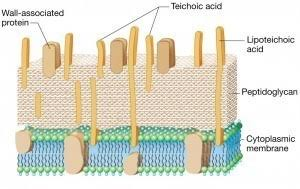
Gram-positive (monoderm) has only a single plasma membrane, a and a thick peptidoglycan layer (purple stain) with teichoic acids
Gram-negative (diderm) has an outer membrane enclosing a thinner peptidoglycan layer (pink stain), periplasmic space, and an inner membrane
What is a bacterial cell wall made of and what is its function?
It is made of peptidoglycan and it gives the cell shape/rigidity, prevents osmotic lysis, and acts of a point of anchorage for flagella
can also contribute to pathogenicity
What is the composition and characteristics of peptidoglycan?
• Polymer of a repeating disaccharide in rows:
• N-acetylglucosamine (NAG)
• N-acetylmuramic acid (NAM)
• Rows are linked by polypeptides
What do teichoic acids do in gram-positive bacteria?
Lipoteichoic acid links cell wall to plasma membrane
Wall teichoic acid links the peptidoglycan
Carry a negative charge
Regulate movement of cations
What is the outer membrane of gram negative bacteria made of?
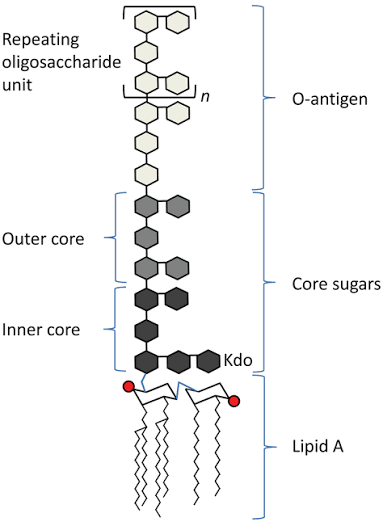
polysaccharides, lipoproteins, and phospholipids
What is a lipopolysaccharide (LPS)?
a large molecule made of a lipid and a polysaccharide that forms the outer membrane of Gram-negative bacteria
What is a porin?
proteins that form channels through the plasma membrane
What are the functions of the periplasm?
Digestion by hydrolytic enzymes
Transport by proteins
In summary, a gram-positive cell wall has…
• Thick peptidoglycan layer
• Peptidoglycan that contains teichoic acid
• No outer membrane around peptidoglycan
In summary, a gram-negative cell wall has…
• Thin peptidoglycan layer
• No teichoic acid
• Outer membrane around peptidoglycan with LPS
These atypical cell walls are made of a waxy lipid (mycolic acid) and are bound to mycobacterium (stained with carbolfuchsin)
acid fast cell walls
What is the name of the bacterium that has no cell wall?
Mycoplasma
____ hydrolyzes bonds in peptidoglycan
lysozome
_______ inhibits peptide bridges in peptidoglycan
penicillin
What is a gram-positive cell called when it loses its cell wall?
protoplast
What is a gram-negative cell called when it loses its cell wall?
spheroplast
true or false: protoplasts and spheroplasts are susceptible to osmotic lysis
true
What is the glycocalyx? What are the two types?
viscous and gelatinous secretion external to cell wall made of polysaccharides and/or polypeptides
• Capsule: neatly organized and firmly attached
• Slime layer: unorganized and loose

What are the main functions of the glycocalyx?
• Can contribute to virulence
• Capsules prevent phagocytosis
• Prevent dehydration
• Aids in adhesion
• Is a source of nutrients
• Extracellular polymeric substance helps form biofilms
What is a biofilm?
• Microbes attach to solid surfaces and grow into masses
• They will grow on rocks, pipes, teeth, other organisms
• Biofilms are often resistant to antibiotics or other stressors
Define a flagella
Filamentous appendages external of the cell used to propel bacteria (made of flagellin)
Name the five types of flagella (or lack of)
Monotrichous: A single flagellum attached to one end (pole) of the cell.
Amphitrichous: A single flagellum (or a tuft of flagella) located at both opposite ends of the cell.
Lophotrichous: A cluster or tuft of multiple flagella emerging from one or both poles.
Peritrichous: Multiple flagella distributed evenly all over the entire surface of the cell.
Atrichous: Bacterium without a flagellum

What are the three parts of a flagella?
Filament: outermost region
Hook: attaches to the filament
Basal body: consists of rod and pairs of rings; anchors flagellum to the cell wall and membrane

How do bacteria use flagella to move? What is the process called and how does it work?
Run and Tumble:
Run: flagella rotate counterclockwise to propel bacterium
Tumble” flagellum switch directions to clockwise motion to change direction

Axial filaments are found in _______ and move in a ______ fashion
spirochetes; corkscrew
Compare and contrast: fimbrae and pili
Fimbrae are short hair-like appendages that are thinner than flagella, hundred per cell, and function in adhesion
Pili are longer than fimbrae, only a few per cell, function by grabbing and retracting to pull cell
both are found only on gram-negative bacteria and made of protein called pilin
