Computer Vision L1-L4
 Call Kai
 Learn
Learn Practice Test
 Spaced Repetition
 Match
Match Flashcards
 Knowt Play
1/58

There's no tags or description
Looks like no tags are added yet.
Name | Mastery | Learn | Test | Matching | Spaced | Call with Kai | Chat |
|---|
No analytics yet
Send a link to your students to track their progress
59 Terms
Computer Vision Definition
Automatic understanding of images and video
Measurement
Perception and Interpretation
Search and Organization
Visual Generation
Vision for Measurement
computing properties of the 3D world from visual data
Examples: real-time stereo, structure from motion, tracking
Vision for Perception and Interpretation
algorithms and representations to allow a machine to recognize objects, people, scenes, and activities.
Example: recognizing objects in a photo
Visual Search and Organization
algorithms to mine, search, and interact with visual data
Example: social media algorithms
Visual Generation
algorithms for manipulation or creation of image or video content
Examples: photo filters, ai generated images/video
Computer Vision Uses
Optical character recognition (OCR)
Face Detection
Face Recognition
Biometrics (fingerprint scanner, Face ID, iris patterns)
Visual Effects (CGI, de-aging)
Sports Overlays for Live
Robotics
Smart and Self Driving Cars
Games (Kinect)
Medical Imaging
Why is Computer Vision difficult
Ill-posed problem: real world much more complex than what we can measure in images (3D to 2D)
Impossible to “invert” image formation process
Challenges in Computer Vision
viewpoint variation
scale
illumination
intra-class variation (same object that looks different; cars)
motion
background clutter
occlusion (object partially hidden
local ambiguity (blurry images that have similar looking shapes but are different objects)
How far are we?
Current models are very good at the “easy” things
Humans are still better at the “hard” things
Deep learning keeps moving the line between the two
Geometric Primitives in 2D and 3D
points, lines, and planes
2D Lines
L = ax + by + c
2D Linear Transformations
only 2D linear transformations can be represented by a 2×2 matrix
Combinations of
scaling
rotation
shear
reflection/mirror
Scaling
multiplying each of its components by a scalar
uniform means scalar is same for all components
non-uniform means different scalars per component
2D Equation
x’ = ax
y’ = by

Rotation
2D Equation
x’ = x cos θ - y sin θ
y’ = x sin θ + y cos θ

Shear
slant or skew shape by one side parallel
2D Equation
x’ = x + (shx * y)
y’ = (x * shy) + y

Reflection/Mirror
2D Equation
For X-axis: y’ = -y
For Y-axis: x’ = -x
For origin: x’ = -x, y’ = -y
Translation
2D Equation
x’ = x + tx
y’ = y + ty
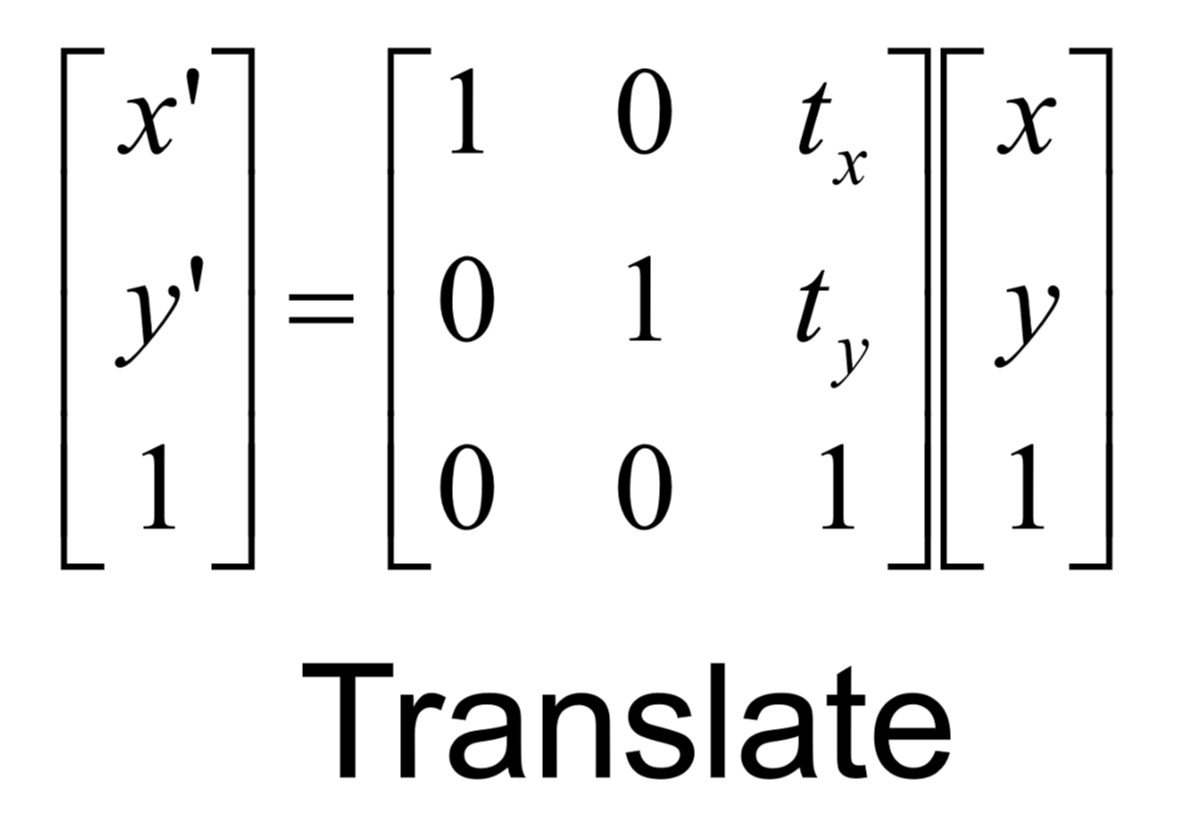
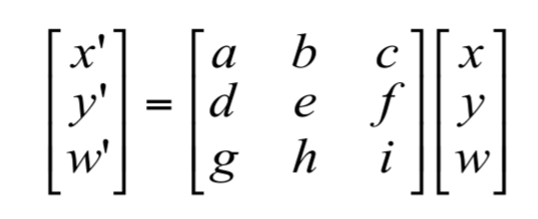
Homogeneous Coordinates
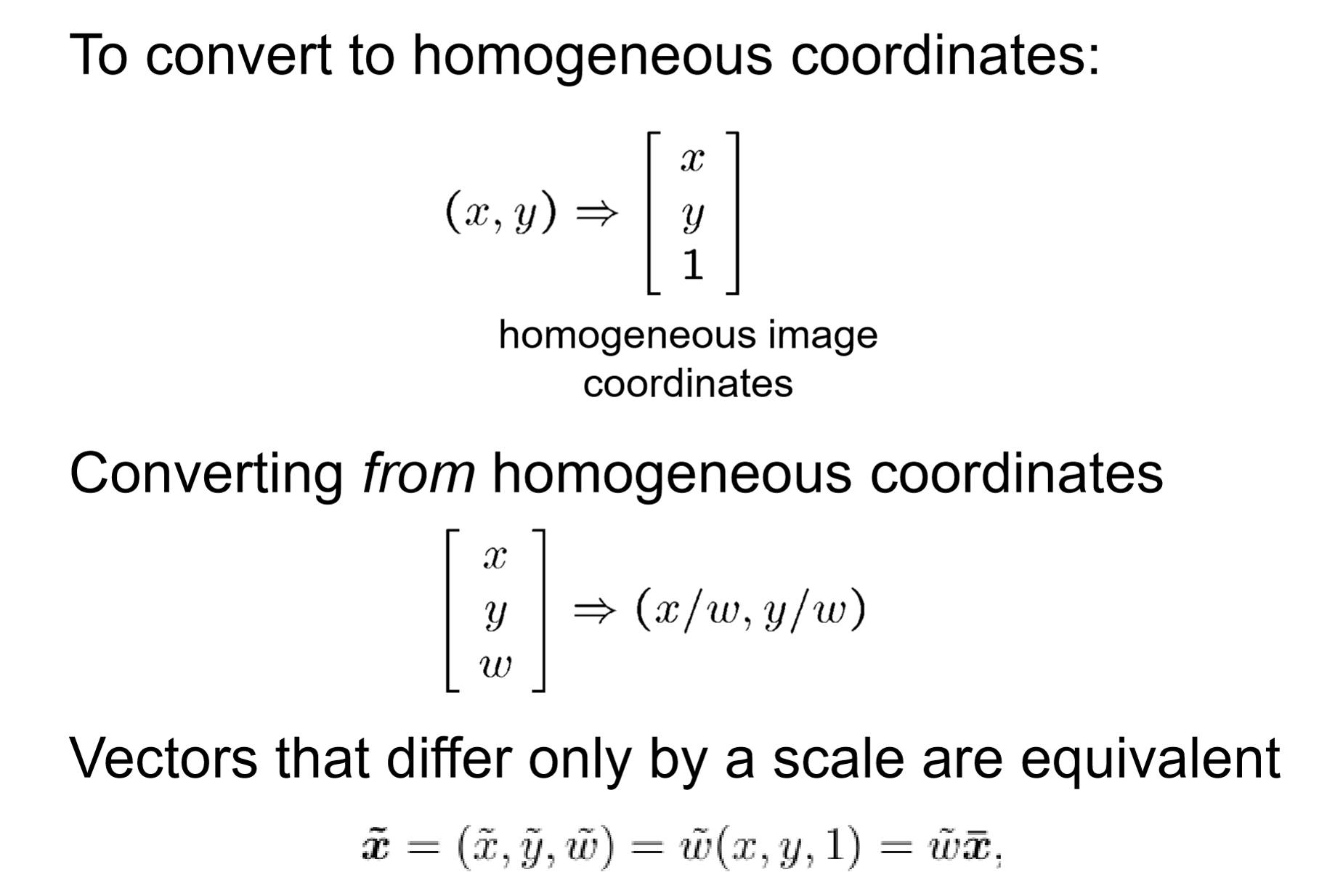
Matrix Composition - what, why, note
transformations can by combined by matrix multiplication
efficiency is main point of composition
multiplication order does matter
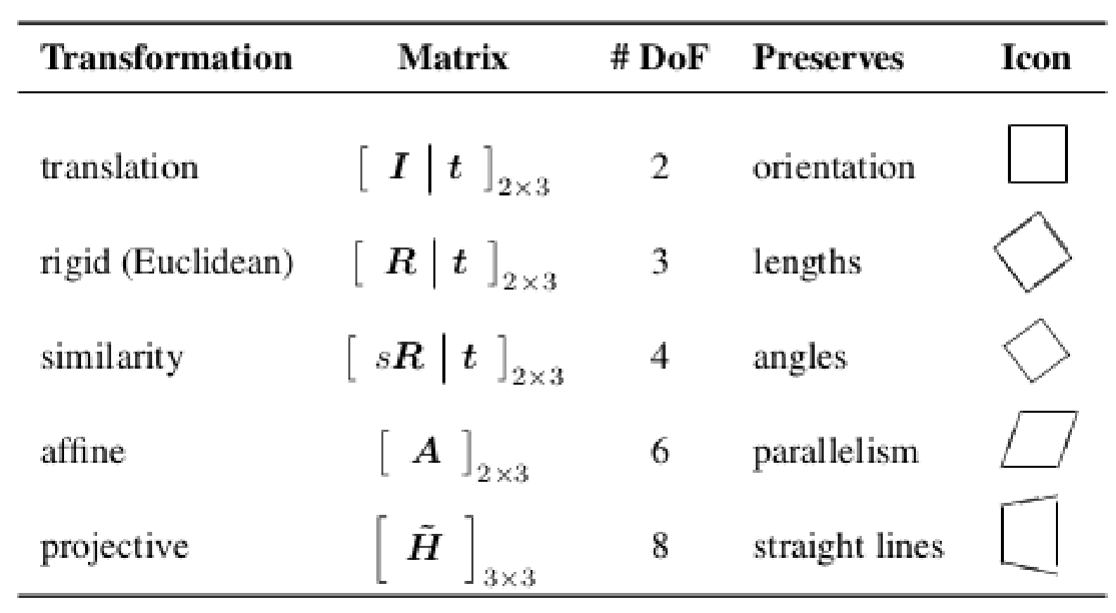
2D Affine Transformations
combinations of linear transformations and translations
note: parallel lines remain parallel

2D Projective Transformations
combinations of affine transformations and projective warps
only lines remain lines
Classification of 2D Transformations
each variable in the matrix accounts for one degree of freedom
Classification of 3D Transformations

Focal Length
distance from center of camera to image plance
Bare - Sensor Images
results in blurry image because all light rays are collected for image plane
Pinhole camera
blocks most rays so image can form
flipped image plane as side effect

Vanishing Point
in images, parallel lines on the same plane lead to collinear vanishing points (horizon)
was a great way to identify ai generated images, but is being fixed in recently
Perspective Projection
size of object in image plane is inversely proportional to distance
closer the object to camera center, it appears larger in the image
far objects appear smaller than close ones
the larger the focal length, the bigger the image
From 3D space to 2D point
Perspective Projection Math
f is focal length and z is length of object to camera center
Points Defined in camera coordinate system
P = [ x y z ] projects to 2D image point P’ = [ x’ y ] where
x’ = f’ ( x/z )
y’ - f’ ( y/z )
P = [ x y z 1 ] projects to 2D image point [ x’ y’ 1 ] where P’ = CP
![<ul><li><p>f is focal length and z is length of object to camera center </p></li></ul><ul><li><p>Points Defined in camera coordinate system </p></li><li><p>P = [ x y z ] projects to 2D image point P’ = [ x’ y ] where</p><ul><li><p>x’ = f’ ( x/z )</p></li><li><p>y’ - f’ ( y/z ) </p></li></ul></li><li><p>P = [ x y z 1 ] projects to 2D image point [ x’ y’ 1 ] where P’ = CP</p></li><li><p></p></li></ul><p></p>](https://assets.knowt.com/user-attachments/0755e941-d027-46bd-b8d6-8640417915fa.png)
Perspective Projection Calibration Matrixes
sensor and pinhole aligned
shifted sensor
non square pixels and skewed sensor

Projective Camera Complete Matrix
calibration, projection, extrinsics
11 degrees of freedom

What does projection lose?
depth
length
angles
What does projection preserve?
straight lines
Weak Perspective
x’ = m x
y’ = m y
m = f’ / z0
Orthographic Projection
1 to 1 projection of 3D object to 2D
x’ = x
y’ = y
Types of Projection
perspective
weak perspective
orthographic
application and situation determine use case
Three Parts of Photometric image formation
lighting
reflectance and shading
optics
Lighting
2 kinds; point or area
shadows can help determine if image is ai generated
Reflectance and shading
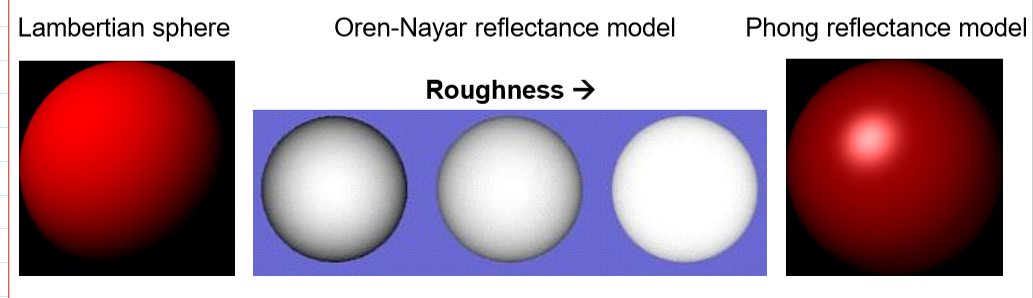
surface reflection depends on both the viewing and illumination direction with Bidirectional Reflection Distribution Function
also a good way to tell if image is ai generated
Specular Reflection
incident light rays are reflected in a direction that is rotated by 180 around the surface normal
Diffuse Reflection
Light scatters in all directions
Lambertian
Oren-Nayar
Phong
Fully general: BRDF or Bidirectional Reflection Distribution Function
Optics
light source reflects off of object and hits camera sensors to determine color and bightness
Pinhole Aperture/ Size
large lets too much light in so blurry
small lets to little light in so fuzzy
Lens
lens focuses light onto the film
rays passing through the center are not deviated
all parallel lines converge to one point on a plane located at the focal length f
if half pinhole covered it is a blurry image because not enough light went through. with a lens, all light goes through so focused full image
Thin lens model
zi = distance from image plane to lens, adjustable
zo = distance from lens to object/light source
1/zo + 1/zi = 1/f
must ensure that zi does not equal f, focus at infinity
when zi > f, brings back focal plane from infinity

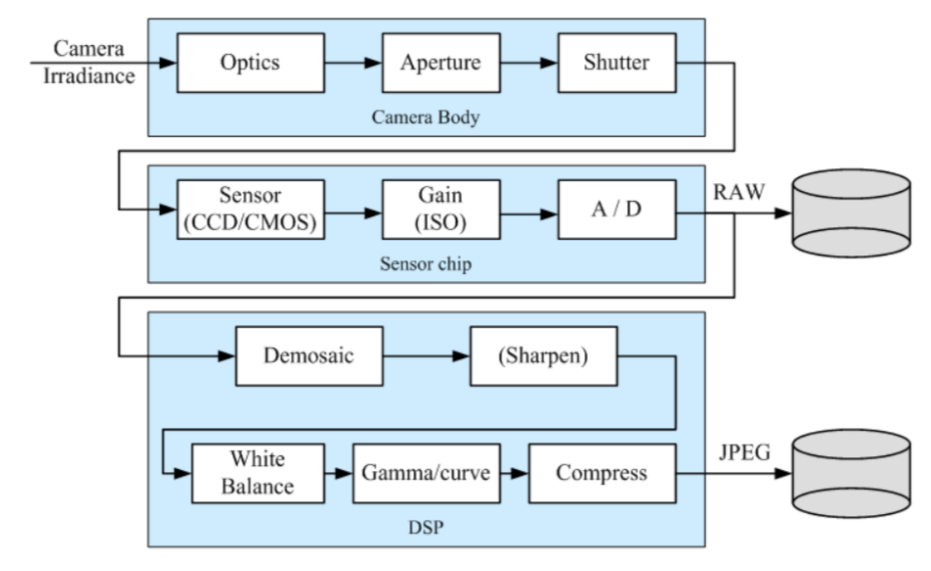
Digital Camera
replaces film with sensor array
each cell in array is a light sensitive diode that converts photons to electrons
energy efficient and good quality
two types:
charge coupled device (CCD)
CMOs
Sensing Pipeline
Sampling to prevent Aliasing
sampling frequency needs to be twice as high as highest signal or there will me artifacts
fs >= 2 fmax
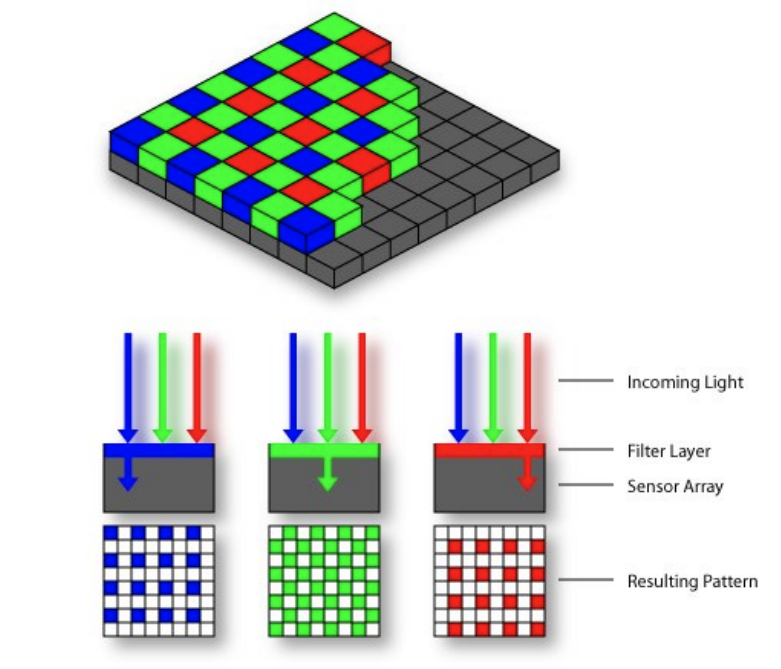
Bayer Grid
sensors are color blind, we add filters to detect color. one filter per pixel
effects
could lose some color information
sampling at lower resolution
put higher resolution in green because human perception is more sensitive to it
Images in Python
represented as matrix
NxM RGM image called im
im(0,0,0) = top left pixel value in R channel
im (y, x, b) = y pixels down, x pixels to the right in bth channel
im(N-1, M-1, 2) = bottom right pixel in B channel
Color Spaces
RGB
HSV
YCbCr
L*a*b
most information in intensity of light not color
RGB
red, green, blue
default color space
drawbacks:
strongly correlated channels
non perceptual
HSV
Hue, Saturation, Value
intuitive color space
YCbCr
fast to compute
good for compression
used by TV
L*a*b
perceptually uniform color space
Types of Image Transformations
warping - changes domain of image function, changes location
filtering - changes range of image function, changes color
Types of Filtering
point operation - single pixel input
neighborhood operation - multiple pixel input
Point Processing Examples
Image result = I’(X,Y)
contrast = a I(X,Y), a
brightness I(X,Y) + b,b
histogram equalization = h(I(X,Y))
arithmetic (example image 1 - image 2)
composting
F = image
a = alpha map
aF = foreground
aF + (1 - a)B = changing background
Human Vision
eye is pinhole camera
iris - colored annulus with radial muscles
pupil - hole whose size is controlled by iris
retina - back of eye with contains the photoreceptor cells (rods and cones)
cones - less sensitive, operate in high light, color vision
rods - highly sensitive, operate in low light, gray-scale vision