Stem Cells
 Call Kai
 Learn
Learn Practice Test
 Spaced Repetition
 Match
Match Flashcards
 Knowt Play
1/18

There's no tags or description
Looks like no tags are added yet.
Name | Mastery | Learn | Test | Matching | Spaced | Call with Kai | Chat |
|---|
No analytics yet
Send a link to your students to track their progress
19 Terms
Features of Stem Cells
Unspecialised
Able to self-renew (cell div)
Able to differentiate
Behaviour is regulated by stem cell niche
Totipotency
Have the capacity to differentiate into all cell types including extraembryonic tissues (placenta), can form an organism
EG fertilised egg (zygote)
Pluripotency
Have the potential to differentiate into almost any cell type, but lacks self-organising ability to form an organism
EG embryonic stem cells (from inner cell mass of blastocyst)
Multipotency
Capable of differentiating into several related cell types for the tissue they reside in
EG Lymphoid, myeloid stem cells
Function of stem cells
Self-renew to ensure a constant pool of stem cells
Support growth and development
Repair by replenishing cells that are damaged
Embryonic Stem Cells
found from inner cell mass of blastocyst
can differentiate into any cell except trophoblast
Structure of germ layers (EEM)
Ectoderm: generates outer layer of embryo, produces skin, brain and nervous system
Endoderm: becomes innermost layer of embryo, produces epithelium of digestive tube and organs
Mesoderm: sandwiched between above 2, generates the rest of the important organs (heart, lungs, kidney etc)
Blood Stem Cells
Lymphoid progenitor cells —> B cells, T cells
Myeloid progenitor cells —> basophils, eosinophils, platelets, neutrophils, erythrocytes, monocytes
Bioethics
Respect for autonomy
Nonmaleficence
Beneficence
Justice
Respect for autonomy
allows individuals to make informed decisions for themselves without interference
Nonmaleficence
Avoid causing harm intentionally, minimise harm
Beneficence
Work to the best interests of individuals
Justice
ensure fairness and equity of resources
FOR embryonic stem cells
embryos are not equivalent to human life as it only starts at heartbeat
embryonic stem cells can treat a wide range of diseases due to its range of differentiation
there are surplus embryos created from IVF that would otherwise be destroyed
AGAINST embryonic stem cells
embryo is human as it has potential
disrespect to life to treat it as a tool
unforeseen consequences (eg tumours)
expensive
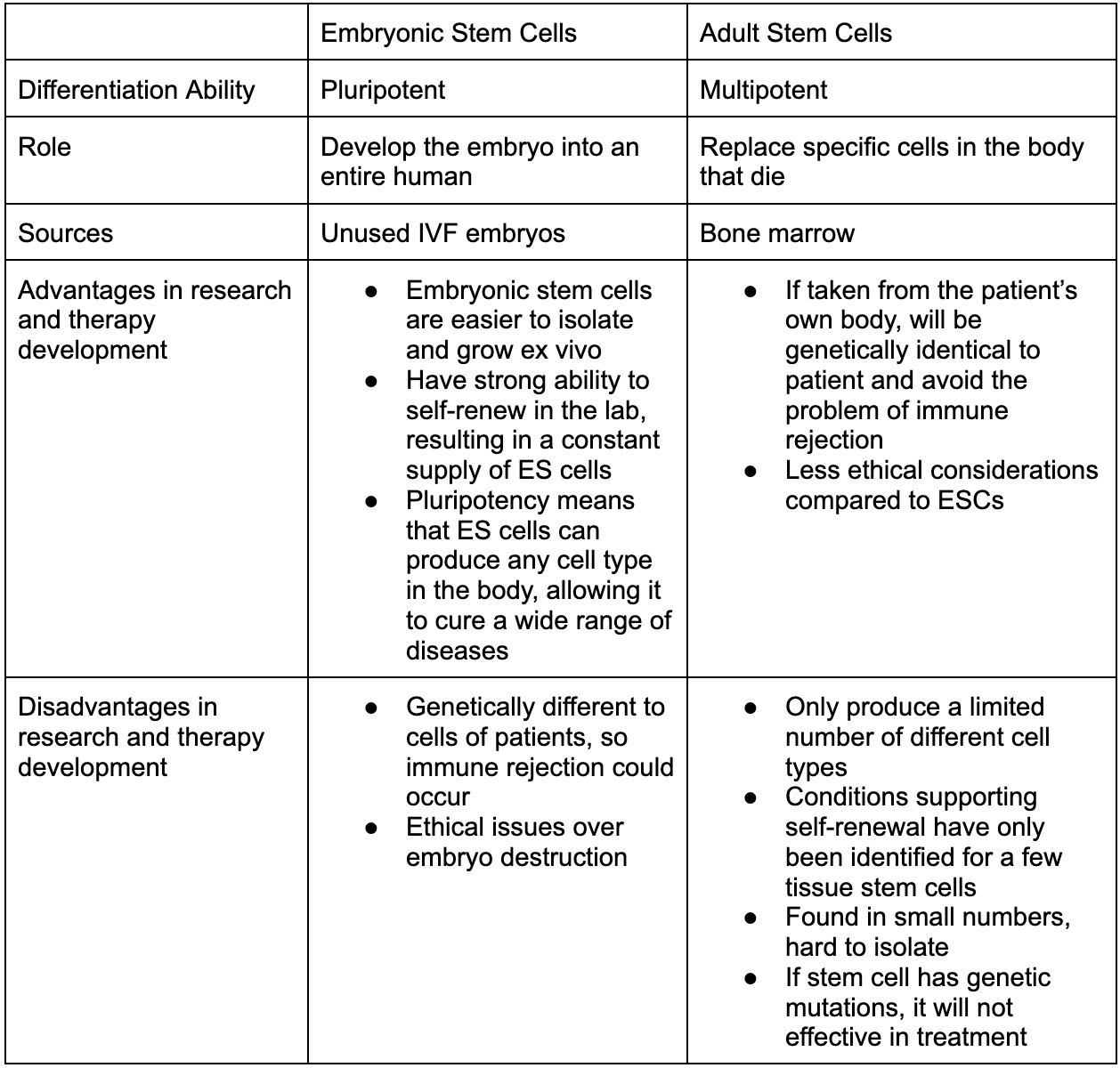
embryonic VS adult stem cells
Induced Pluripotent Stem Cells (iPSCs)
normal adult cells that are reprogrammed to embryonic stem cell-like state
erasing and remodelling epigenetic marks like DNA methylation to reverse potency level
Advantages of iPSCs
can be obtained from adult tissue, hence no embryos destroyed
can be obtained easily from donor
derived from patient, less chance of immune rejection
Problems w iPSCs
low efficiency: conversion rate is very slow
genetic modification may result in cancer