bio 2.0 unit 2 exam
 Call Kai
 Learn
Learn Practice Test
 Spaced Repetition
 Match
Match Flashcards
 Knowt Play
1/147

There's no tags or description
Looks like no tags are added yet.
Name | Mastery | Learn | Test | Matching | Spaced | Call with Kai | Chat |
|---|
No analytics yet
Send a link to your students to track their progress
148 Terms
why do leaves appear green?
because chlorophyll is poor at absorbing green light
is chlorophyll free to move about the chloroplast?
no, it is attached to integral membrane proteins, and when put together, this is a photosystem
___ chlorophylls allow the photosynthetic ETC to operate efficiently
antenna
___ molecules of ATP and ___ molecules of NADPH are required for every ONE molecule of CO2
3, 2
____ provides most of the energy incorporated into the bonds of the glucose molecules produced by Calvin cycle
NADPH
Photosynthesis involves redox reactions, in which Water is ____and
Carbon dioxide is____, and it is an ____reaction
oxidized, reduced, endergonic
true or false:
water is the final electron acceptor in a photosynthetic reaction.
false - it’s oxygen
the photosynthetic electron transport chain-based photosystems and protein complexes are in ____
thylakoid membrane
Photosystem II (PS II) light-harvesting chlorophyll molecules absorb
photons and pass the energy to nearby chlorophyll molecules until it
reaches the reaction center (pair of Chlorophyll a) which ____electron and gets ____.
donates, oxidized
the light capture reaction phase of photosynthesis uses (reactants) to produce (products).
reactants: light, water; products: ATP, NADPH, oxygen
during light capture reaction, proton electrochemical gradient is formed because of ____
water splitting
pumping of protons from stroma into thylakoid lumen
Photosynthesis:
During the light capture rxn, ATP synthesis occurs due to:
protons flowing from thylakoid lumen into stroma through ATP synthase
Which Photosystem I is involved in exacting electrons from water (or oxidizing water), resulting in oxygen formation?
photosystem II
Which photosystem is involved in the electron transfer to form the reducing power NADPH?
PS I
under excessive light, which photosystem is involved in maintaining the balance of ATP and NADPH in plant cells?
photosystem I
during ATP synthesis via chemiosmosis (proton flow through ATP synthase), the pH of the stroma is ____ and the pH of the thylakoid lumen is ____
(THINK: where are the H+?)
basic, acidic
Which products of light capture or light-dependent reactions are used in the Calvin cycle to form carbohydrates?
ATP, NADPH
in excessive light conditions, plant cells can combat the negative impact of reactive oxygen species using the following components:
xanthophylls/accessory pigments
antioxidants
What is the correct order of electron flow in photosynthesis?
water, PSII, PS I, NADPH, triose phosphate
the carbon fixation or Calvin cycle occurs in ____
the stroma
select the right order of reactions that occur during the Calvin cycle:
carboxylation, reduction, regeneration
during the Calvin cycle, 1-C (CO2) combines with 5-C (RuBP) using the enzyme ____
Rubisco
the ____ phase of Calvin cycle utilizes ATP and NADPH (reducing power) to form the product ____
reduction; triose phosphates
how many times must the Calvin cycle run to form ONE molecule of glucose?
6
Cellular respiration and Photosynthesis are both energy-related processes. Which part of these processes shows the most similarity?
ATP synthesis via chemiosmosis
Which phase of Calvin cycle would be impacted first by the absence of light energy?
reduction of 3-phosphoglycerate
Chlorophyll molecules in chloroplasts normally only fluoresce a very small amount compared to chlorophyll that has been extracted into a solvent solution.
in chloroplasts, the molecules are held close together and oriented to allow the transfer of excitation energy between molecules
When light is absorbed by chlorophyll that has been extracted into a solvent solution, it _______ releases the energy in the form of _______.
rapidly, heat and light
The photosynthetic reaction center becomes ______ when it passes its ______ to the ______, which is thus ______.
oxidized, excited electron, electron acceptor, reduced
When chlorophyll in solution returns to its ground state via energy release, it is ready to absorb another photon
in the chloroplast, the reaction center chlorophyll must obtain a replacement electron
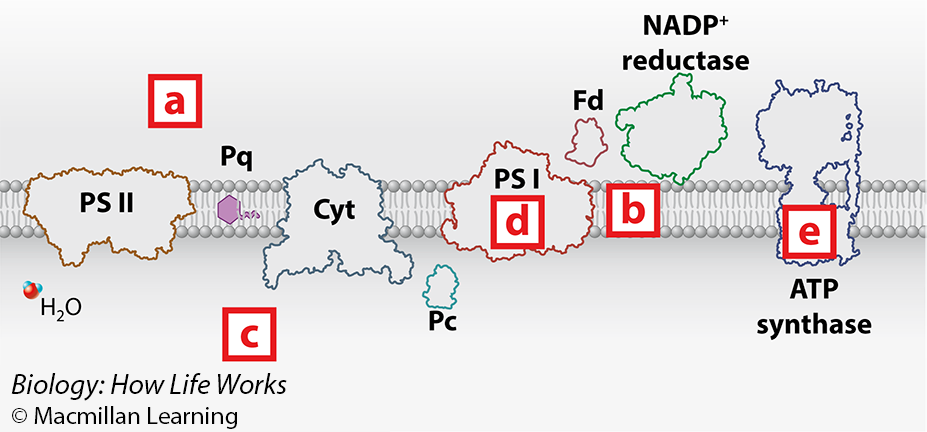
Which is the thylakoid lumen and which is the stroma?
c, a
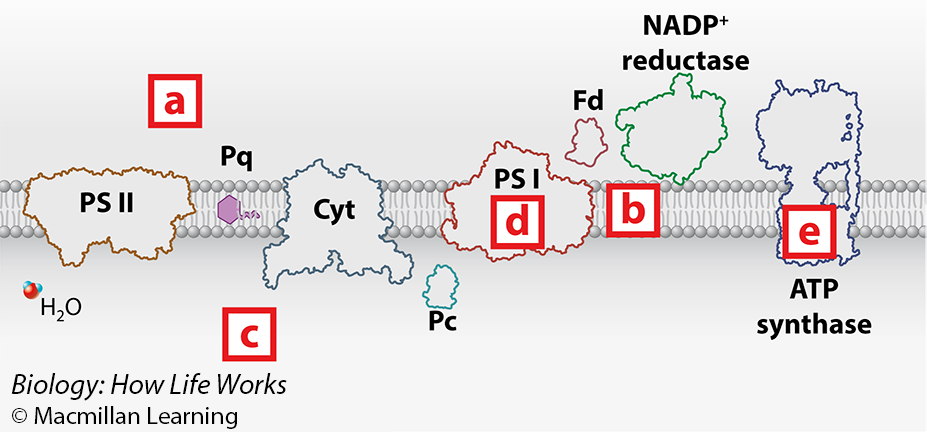
In the figure, during photosynthesis, where does the concentration of protons increase? Select from the boxed red letters.
c
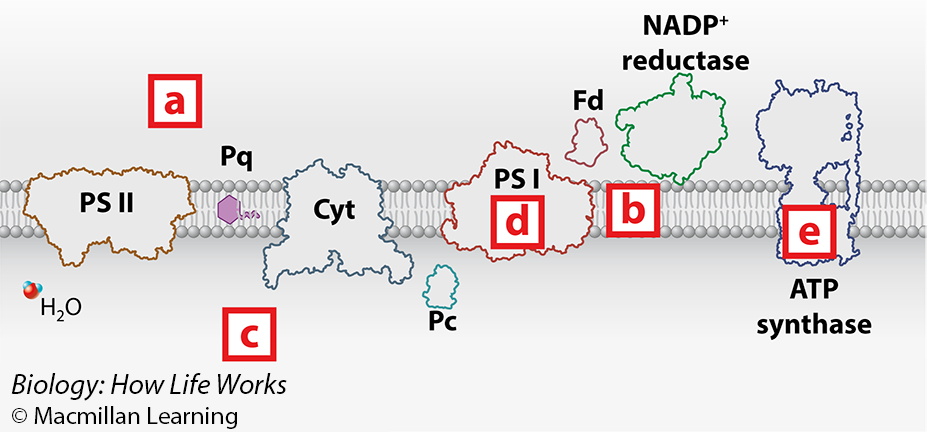
In the figure, which area would you predict to have the lowest pH during daylight? Select from the boxed red letters.
c
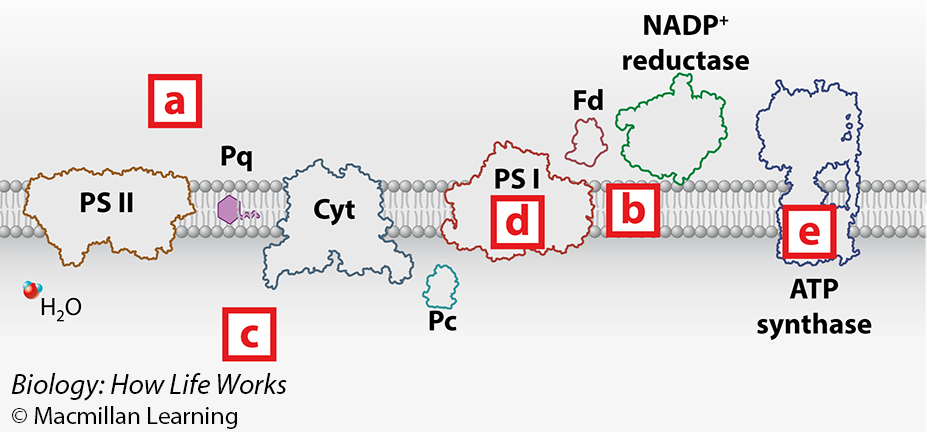
Which arrow in this figure best depicts the proton pumping that is driven by the electron transport chain of photosynthesis?
arrow b
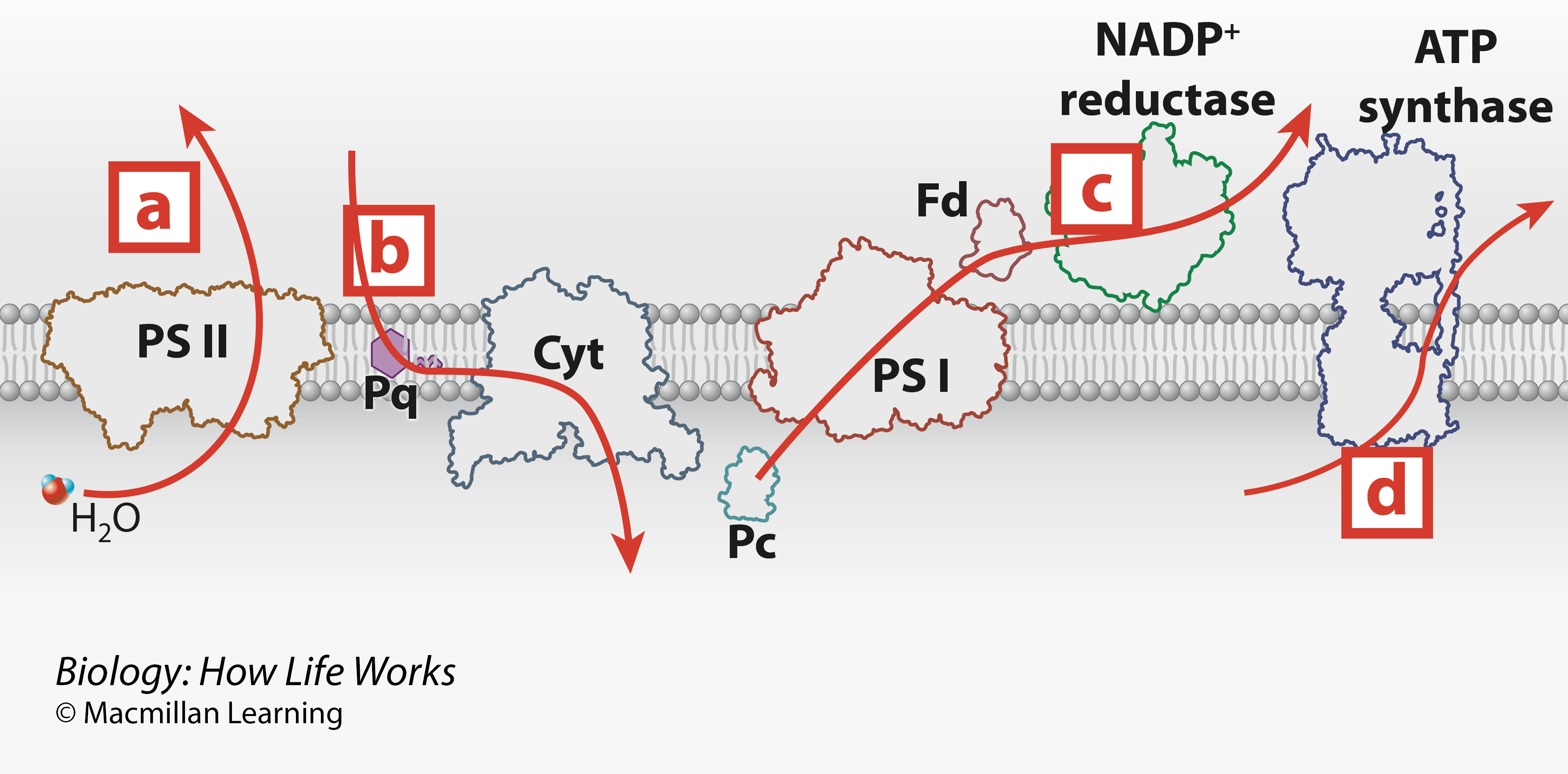
Which arrow in the figure best depicts the flow of protons in powering the formation of ATP?
arrow d
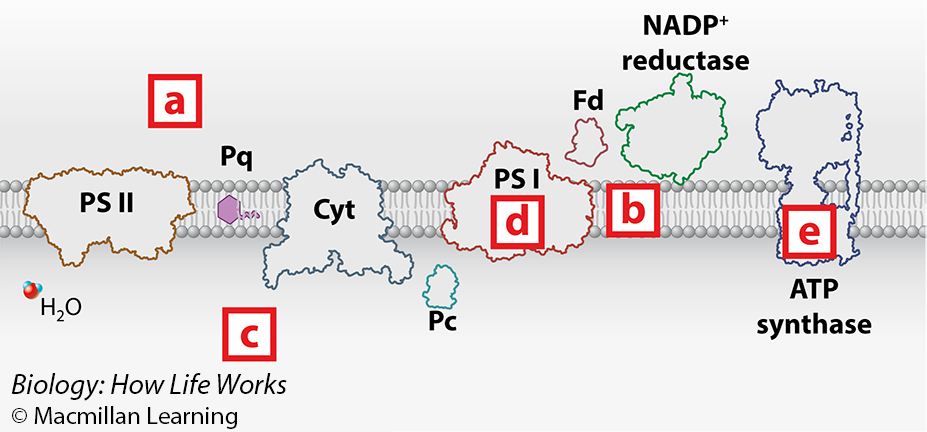
Which component in the diagram does not participate in the flow of electrons?
e, ATP synthase
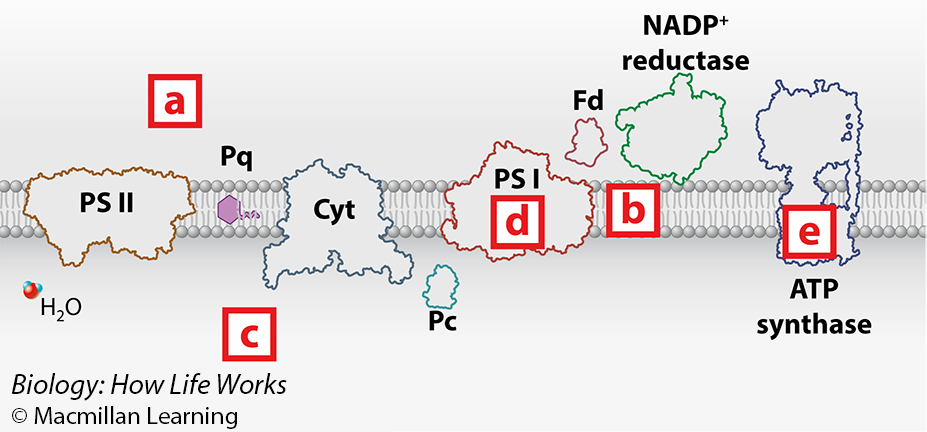
The electron donor that replenishes the PS II reaction center is ______ and for the PS I reaction center is _______.
H2O, Pc
Where does carbohydrate synthesis take place in eukaryotes?
stroma
Which phases of the Calvin cycle use ATP?
reduction, regeneration
Which of the answer choices is true when comparing the Calvin cycle and light-harvesting reactions of photosynthesis?
they take place in different compartments of the same organelle
Where is the photosynthetic electron transport chain located in plant cells?
in the thylakoid membranes of the chloroplast
Which of the answer choices are produced directly as a result of the movement of electrons through the photosynthetic electron transport chain?
ATP and NADPH
During photosynthesis in plants and algae, _____ is oxidized and _____ is reduced.
H2O, CO2
In the overall process of photosynthesis, light energy drives the transfer of electrons from _____ to _____.
H2O, sugar
What happens to the NADPH molecules that are generated in the photosynthetic electron transport chain?
they provide energy to the Calvin cycle
What are the three phases of the Calvin cycle?
carboxylation, reduction, regeneration
Suppose a plant is exposed to a toxin that causes the thylakoid membranes to become much more permeable to protons than normal. Which of the answer choices would be true?
the reduction and regeneration phases of the Calvin cycle would slow down and eventually stop
Why is the regeneration phase of the Calvin cycle essential?
because a 5-carbon molecule is necessary for the carboxylation phase
What is the role of Rubisco in the Calvin cycle?
Rubisco incorporates CO2 from the atmosphere into an organic molecule
Is the pH of the thylakoid lumen higher, lower, or the same as the pH of the stroma prior to the synthesis of ATP in chloroplasts?
lower
Chemicals called uncouplers can make membranes permeable to small molecules and ions. What effect might uncouplers have on photosynthesis?
decreased ATP production because the proton gradient would decrease
The splitting of water to extract electrons, resulting in molecular oxygen as a byproduct, is associated with which photosystem(s)?
photosystem II
As electrons flow between the two photosystems, the amount of energy present in the electrons decreases. How is energy lost by the electrons put to use?
the energy is used to create and maintain a proton gradient
Photosynthesis in green plants is comprised of the _____, in which H2O is oxidized, and _____, in which CO2 is reduced.
photosynthetic ETC, the Calvin cycle
What is cellular respiration?
the breakdown of glucose to ATP via redox reactions
_____ cellular respiration consumes organic molecules in the presence of oxygen and yields ATP, O2, and H2O
aerobic
the partial degradation of sugars ANAEROBICALLY in yeast and bacteria
fermentation
Where does glycolysis occur?
in the cytoplasm
What are the FOUR steps of pyruvate oxidation?
pyruvate is transported to mitochondrial matrix
pyruvate is oxidized to form carbon dioxide
electrons are donated to NAD+, resulting in the formation of NADH
acetyl group is transferred to coenzyme A
due to the pumping action of the electron transport chain, protons have a high concentration in the _____ and a low concentration in the _____
intermembrane space, mitochondrial matrix
Which molecule is the most oxidized form of cellular respiration products?
CO2, H2O, NADH, FADH, Pyruvate, Acetyl CoA
CO2
What are the electron carriers that capture energy released from glucose breakdown?
NAD+, FAD
true or false:
More ATP is produced by substrate-level phosphorylation than oxidative phosphorylation.
FALSE
Which stage of cellular respiration is common to both bacteria and plants?
glycolysis
Write down the location and outputs (products) for each of the
following stages of cellular respiration involving one molecule of
Glucose oxidation?
a. Glycolysis
Cytoplasm; 2 Pyruvate, 2 NADH, net 2 ATP
Write down the location and outputs (products) for each of the
following stages of cellular respiration involving one molecule of
Glucose oxidation?
b. Pyruvate oxidation
Mitochondria matrix; 2 Acetyl CoA, 2 NADH, 2 CO2
Write down the location and outputs (products) for each of the
following stages of cellular respiration involving one molecule of
Glucose oxidation?
c. Citric acid cycle
Mitochondria matrix; 6 NADH, 2 FADH2, 4 CO2, 2 ATP, GTP
Write down the location and outputs (products) for each of the
following stages of cellular respiration involving one molecule of
Glucose oxidation?
d. Oxidative phosphorylation
Mitochondria inner membrane; H2O and ~28 ATP
Which stages of cellular respiration produce ATP using substrate-level phosphorylation?
glycolysis, citric acid cycle
Which molecule stores the most potential energy:
NADH
FADH2
ATP
NAD+
NADH
true or false:
in cellular respiration, glucose is REDUCED and acts as a REDUCING agent to CARBON DIOXIDE forming WATER
false- glucose is oxidized, and it acts as a reducing agent to oxygen
Which molecule is the final electron acceptor in aerobic C.R.?
O2
Cellular Respiration
true or false:
chemiosmosis through proton gradient motive force drives ATP synthesis using ATP synthase in the last stage of C.R.
true
Where are the ETC and ATP synthase located?
mitochondrial inner membrane
the electrons stored in glucose through stepwise catabolic stages move through electron carriers (NADH, FADH2), ETC, and reach O2 to form the product ____
water/H2O
Which of the following apply to glycolysis?
a. involves endergonic and exergonic reactions
b. occurs in absence of oxygen
c. net gain of 2 ATP and 2 NADH
d. Products formed are 2 molecules of Pyruvate
e. all are true
e. all are true
In the CITRIC ACID CYCLE, redox reactions result in the production of NADH, FADH2. Which are the REDUCED ELECTRON CARRIERS that are produced along with CO2?
a. NADH
b. FADH2
c. both
a. NADH
Citric acid cycle starts with Acetyl coA (2-carbon compound)
reacting with oxaloacetate (4-carbon compound) to form Citrate (6-
carbon compound), which of these is regenerated in the cycle?
oxaloacetate
Which stage of C.R. results in complete oxidation of glucose to form CO2?
citric acid cycle
How many citric acid cycles need to occur in order to completely oxidize one molecule of glucose?
2 cycles
Cellular Respiration:
electron transfer in the ETC results in the pumping of H+ from ____ to _____.
mitochondrial matrix to intermembrane space
cellular respiration:
As a result of Chemiosmosis, H+ (Proton) electrochemical gradient
across mitochondrial inner membrane results in flow of protons from
___to through ___enzyme
intermembrane space, mitochondrial matrix, ATP synthase
select all that apply to fermentation process:
a. occurs in absence of oxygen
b. pyruvate is reduced using NADH
c. NAD+ is regenerated
d. glycolysis stage is common to fermentation and aerobic cellular respiration
e. fermentation involves partial breakdown of glucose
f. all of the given options are correct
g. none are correct
f. all are correct
the stored form of glucose in plants is ___ but is ____ in animals
starch, glycogen
Which are the two parts of C.R. that produce CO2?
pyruvate oxidation and citric acid cycle
Which molecule(s) is reduced alongside the release of carbon dioxide during the citric acid cycle in eukaryotes?
NAD+
Which stages of cellular respiration only takes place in the presence of oxygen?
pyruvate oxidation
citric acid cycle
oxidative phosphorylation
during the metabolism of glucose by the process of aerobic cellular respiration, glucose is (oxidized/reduced) to CO2 via _____ reactions
oxidized, redox
During glycolysis, pyruvate oxidation, and the citric acid cycle, the chemical energy in glucose is transferred to:
electron carriers and ATP
What is the equation for AEROBIC cellular respiration?
C6H12O6 + 6O2 → 6CO2 + 6H2O + energy
the energy in organic molecules is released in a series of steps, rather than a single step, because:
the amount of energy released would be too much to capture in one reaction
When you exhale, there is more CO2 than was present in the air that you inhaled. This CO2 comes from…
pyruvate oxidation and the citric acid cycle
Once they have been processed through the citric acid cycle, acetyl CoA molecules from a single glucose molecule produce:
2 ATP, 6 NADH, 4 CO2, 2 FADH2
Best describe how ATP synthase converts the potential energy of the proton gradient to the chemical energy of ATP.
Kinetic energy from the flow of protons is converted to the kinetic energy of rotation of the F0 subunit; the rotation of the F0 subunit leads to rotation of the F1 subunit, which can then catalyze ATP synthesis.
Due to the pumping action of the electron transport chain, protons have a high concentration in the _____ and a low concentration in the _____.
intermembrane space, mitochondrial matrix
Proteins can be broken down to extract energy. They are typically broken down into amino acids, which then enter cellular respiration via:
glycolysis or the citric acid cycle
The conversion of the potential energy of a proton gradient to a form more useful to the cell is achieved by coupling the movement of protons down their electrochemical gradient with the synthesis of ATP. This coupling is made possible by:
ATP synthase
What happens during the citric acid cycle?
ATP synthesized by substrate-level phosphorylation
Cellular Respiration:
What is the IMMEDIATE source of electrons for the ETC?
NADH, FADH2
During the action of ATP synthase, the _____ energy of the proton gradient is transformed into _____ energy of the F1 subunit, and this is converted into _____ energy of chemical bonds in ATP.
potential, kinetic, potential