Quiz 1 Flash Cards
 Call Kai
 Learn
Learn Practice Test
 Spaced Repetition
 Match
Match Flashcards
 Knowt Play
1/54

There's no tags or description
Looks like no tags are added yet.
Name | Mastery | Learn | Test | Matching | Spaced | Call with Kai | Chat |
|---|
No analytics yet
Send a link to your students to track their progress
55 Terms
Aseptic Technique
The collective methods of obtaining and maintaining a pure culture.
Pure Culture
A culture containing only one species of microorganism.
Contaminant
Any other introduced microorganism introduced to the pure culture.
Contaminated/Mixed Culture
Pure culture + the contaminant.
Media
Substance where the microorganism is grown and maintained,
Media Examples
Agar Plate
Agar Deep Tube
Broth
Agar Slant
Sterilization
Goal to wipe out everything.
Disinfection
Goal is reducing a broad range of microbes.
Sanitization
Goal is reducing bacteria specifically.
Thermal Death Time
Length of time required to kill all the microorganisms in a liquid suspension at a designated temperature.
Thermal Death Point
Lowest temperature at which all of the microorganisms in a liquid suspension are killed within ten minutes.
Autoclaving
Steam Heat under Pressure to prevent boiling of heat sensitive liquids
Tyndallization
Successive boiling to heating
Tube Disposal: Solid
Cap off tube upside down.
Tube Disposal: Liquid, Screw Cap
Cap off, remain upright
Tube Disposal: Liquid, No Screw Cap
Cap on, remain upright
Growth Factors: Physical
Temperature
Incubation
Growth Factor: Chemical
pH
Minerals
Energy Source
Amino acids
Vitamins
Minerals
Water
Fastidious Organisms
Requires a complex set of chemical factors
The more complex the more fastidious
Heat Fixing
Kill the bacteria, stick it to the slide.
Gram-Stain:
Purple: Positive
Pink: Negative
Why use Agar?
Easily melts and solidifies
Can manipulate the hardness
Autoclavable
Acts as check for contamination
Allows for creation of homogenous cultures
Why slants over plates?
Less contamination risk
Faster dehydration rate
Less media consumption
Agar Deeps
Anaerobic conditions
can change the density of media to test motility
Types of Broth Growth
Turbid
Pellicle
Sediment
Button
Flocculent
Pellet/Myocorrhizal
Type of Broth Growth/Definitions
Pellicle – mat-like growth at the air – liquid interface
Sediment – loose clumpy growth at bottom of broth
Button – Hard, resistant growth at bottom of tube
Flocculent – Evenly distributed clumping
Pellet/Mycorrhizal – Usually fungal clumped
Turbid - cloudy/milky look to broth
Gram Positive
Thicker cell wall due to greater number of peptidoglycans
Purple
Gram Negative
Thinner Cell Wall
Extra membrane; a lipid bilayer
Pink
Gram Staining Techniques: Fluids (in order)
Crystal Violet
Iodine
Ethanol
Basic Fuchsin
Gram Staining: Crystal Violet
Primary Stain
60 seconds’
Dyes the bacteria purple
G+: Purple
G-: Purple
Gram Staining: Iodine
Mordant (Binds to crystal violet)
60s
G+: Purple
G-: Purple
Gram Staining: Ethanol
Decolorizer
30 seconds
G+: Purple
G-: Clear
Gram Staining: Fuschin
Counter stain
60 s
G+: Purple
G-: Pink
Dyes everything pink, shows only on G-/
Slants vs. Deeps
Slants: Most often used for growth and storage of pure cultures
Deeps: used too measure motility, oxygen dependency, and metabolic end products
Terms of Growth
Pellicle
Turbid
Sediment
Mycelia
Pellicle
Cells grown on surface of broth
Turbid
Cloudiness/opaqueness
Sediment
Growth settled on the bottom of the tube
Mycelia
Clumps of cells floating in the broth
Range of Colonies on Plate
30-300
Why do we T-streak?
To isolate colonies
True or False: It is okay to use controls on a different slide from your unknown culture if you are careful
False
Motility
Movement caused by action of flagella
Positive chemotaxis
Motility towards a favorable environment
Negative Chemotaxis
Motility away from a less favorable or harmful environment
Flagella
Hollow tubes made of the protein flagellin
Polar flagellation
Cells with flagella inserted only in the ends of the cell.
Peritrichous Flagellation
Cells with flagella inserted all over the cell

Name?
Peritrichous
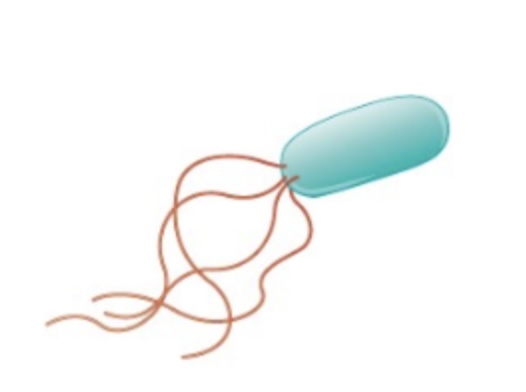
Name?
Lophotrichous
Endospore
Structure formed on the inside of the cell
Vegetative Cells
Cells lacking endospores
Sporangium
the rest of the cell surrounding the mature endospore

Name?
Monotrichous
Bacterial Endospores
Most G+ rods
central or terminal location
absence does not equal incapability
spore formation helps in identification
resistant to environmental stressors
resist staining due to keratin