Book 13B - Costs of trade flows, labour flows
 Call Kai
 Learn
Learn Practice Test
 Spaced Repetition
 Match
Match Flashcards
 Knowt Play
1/9

There's no tags or description
Looks like no tags are added yet.
Name | Mastery | Learn | Test | Matching | Spaced | Call with Kai | Chat |
|---|
No analytics yet
Send a link to your students to track their progress
10 Terms
Explain how trade flows can lead to non-inclusive growth in developed countries
Globalisation leads to economic restructuring
Countries specialise in the production of the good in which they have comparative advantage and engage in free trade to promote economic growth and development AND free trade leads to the import of low-skilled labour-intensive products (demand for LSW fall) -> change in demand for different types of FOP and skills mismatch -> sunrise and sunset industry thing -> S-UN -> income inequality
Explain how trade flows can lead to vulnerability to External demand and supply shocks
(X-M) will take up larger proportion of AD
As capital flower increase -> greater reliance on FDI -> FDI take up larger proportion of country’s I
Explain how trade flows can lead to -ve EG IF foreign firms undergo unfair competition
Foreign firms may engage in unfair competition practises such as dumping to establish a monopoly in the domestic market
Dumping: foreign producers sell exports at prices below MCOP -> foreign imports cheaper than domestic (with help of foreign government subsidies)
Domestic firms that cannot match lower prices will shut down -> If consumers switch from goods produced by domestic firms to imported goods, domestic consumption expenditure C falls -> AD falls
When foreign firms obtained monopoly power in the future -> foreign firms will raise prices back up to profit maximising levels -> prices increase
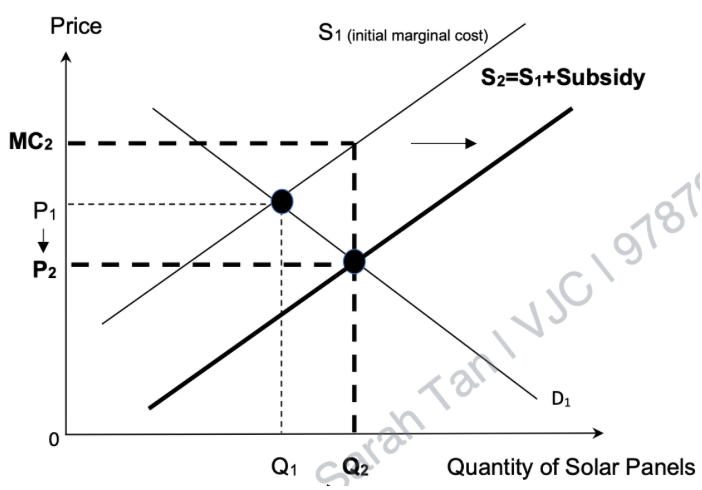
Explain how subsidies allow firms to dump solar panels in the EU
Define dumping -> describe subsides (SS increase -> surplus -> P decrease and Q increase) -> true price that producers would have to receive to produce this quantity is MC2
HENCE, the subsidies allows firms to sell their exports at P2 is lower than their initial MCOP of MC2 -> allowing them to dump in the EU
Draw subsidy causing dumping graph
State costs of trade flows
Non-inclusive growth (Developed countries)
Vulnerability to External demand and supply shocks
-ve EG and Greater UN IF foreign firms undergo unfair competition
Describe the benefit of labour flows for developed countries
PEG and price stability (increase quantity of labour)
Eased labour shortages
“Brain gain”
Counter slowing down in growth due to problem of shrinking and ageing labour force
Describe the benefits of labour flows for developing countries
Foreign income from remittances sent back to home country
Decrease in UN-rate
Acquisition of new skills and knowledge by migrants who may eventually return
Reduce pressure on social welfare system
When citizens migrate to work elsewhere, they are no longer drawing directly on the social welfare provisions of their home country
Describe costs of labour flows for developed countries
Non-inclusive growth and inequity
Great labor inflow concentrated in low-skill labour markets -> SS workers increase -> surplus -> WR falls
Describe costs of labour flows for developing countries + eval
-ve EG
As labour leaves a developing economy to seek higher wages or better SOL in developed countries -> quantity of labour falls
If workers are HSW -> quality of labours falls (brain drain)
Eval: If these migrants return to their home countries, the returning migrants bring back foreign knowledge and experience -> facilitate the transfer of foreign technologies that expands PC