PHARM 312 - MIDTERM
 Call Kai
 Learn
Learn Practice Test
 Spaced Repetition
 Match
Match Flashcards
 Knowt Play
1/100

There's no tags or description
Looks like no tags are added yet.
Name | Mastery | Learn | Test | Matching | Spaced | Call with Kai | Chat |
|---|
No analytics yet
Send a link to your students to track their progress
101 Terms
What does BASE stand for?
Behavioural
Administrative
Social
Evidence-based
Rank the following sources of law from the highest and lowest in paramountcy:
Legislation and Regulations (Health Professions Act, Freedom of Information and Protection of Privacy Act, Health Information Act)
Constitution and Canadian Charter of Rights and Freedoms
Common law
Constitution and Canadian Charter of Rights and Freedoms
Legislation and Regulations
Common law
What is a common law?
judge-made cases, interpretation of legislation → what we expect the court to do in future similar situations

Organize these from lowest to highest in authority:
Alberta Court of Appeal
Alberta Court of Justice
Court of King’s Bench
Supreme Court of Canada
Alberta Court of Justice, Court of King’s Bench, Alberta Court of Appeal, Supreme Court of Canada
——- law deals with (often intentional harm committed against certain individuals, but are also considered offenses against the public. (i.e. punish and deter ppl from committing crimes)
——- law deal with disputes among private parties. Punishment is not the primary concern, rather compensation of the victim or validation of rights. (e.g. pt sues HCP for negligence)
——- law deals with the delegation of power (by government) to administrative bodies to carry-out the establishments of laws, implementation of laws, and decision-making. (e.g. Legislature of Alberta → Health Professions Act and Regulations → ACP)
criminal, civil, adminstrative
Which type of law would this fall under?
A pharmacist is accused of stealing medications for personal use.
a) criminal
b) civil
c) administrative
a
Which type of law would this fall under?
A patient sues the pharmacist for dispensing a higher dose of medication than prescribed by her physician causing an adverse health reaction.
a) criminal
b) civil
c) administrative
b
Which type of law would this fall under?
A complaint is made by the patient to the Alberta College of Pharmacy for professional misconduct as the pharmacist failed to adhere to the ACP’s Standards of Practice and Code of Ethics.
a) criminal
b) civil
c) administrative
c
A —— is what the patient or bystander remembers, what the chart says (or does not), or what the caregiver admits.
An ——- is what the “experts” say in their reports and how it holds up in court.
A —— —— of proof must show proof of it being true over a 50% probability threshold.
A ——- ——- of proof is one that is beyond a reasonable doubt (that it’s true).
fact, opinion, civil standard, criminal standard

KNOW THIS
KNOW THIS
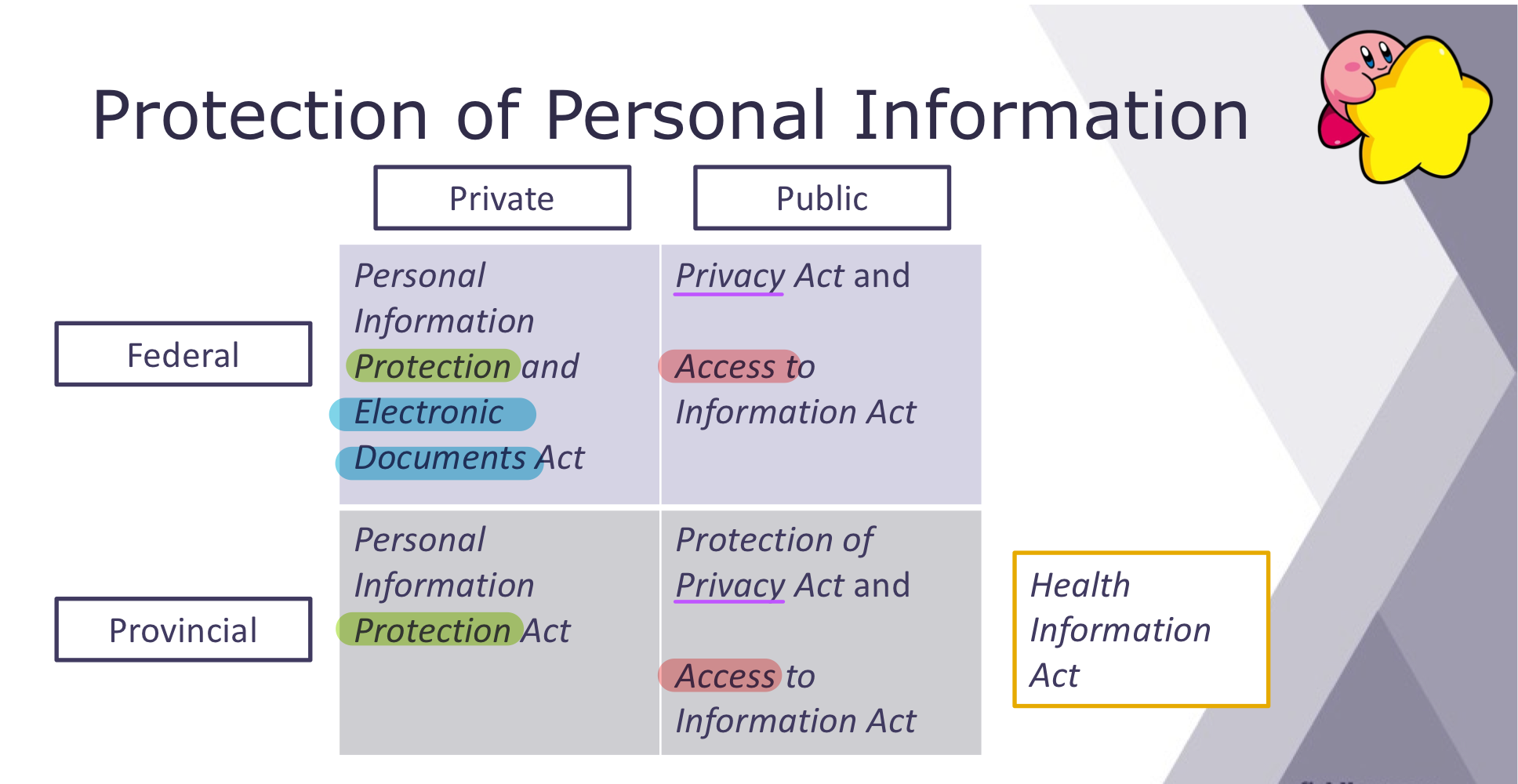
Which Act would the following be classified under?
The University of Alberta collects high school examination results of prospective students to award scholarships and bursaries.
a) Personal Information Protection + Electronic Documents Act
b) Personal Information Protection Act
c) Privacy Act + Access of Information Act
d) Protection of Privacy + Access to Information Act
e) Health Information Act
d

Which Act would the following be classified under?
Alberta Health Services collects a patient’s medical history to complete triage within an emergency department.
a) Personal Information Protection + Electronic Documents Act
b) Personal Information Protection Act
c) Privacy Act + Access of Information Act
d) Protection of Privacy + Access to Information Act
e) Health Information Act
e
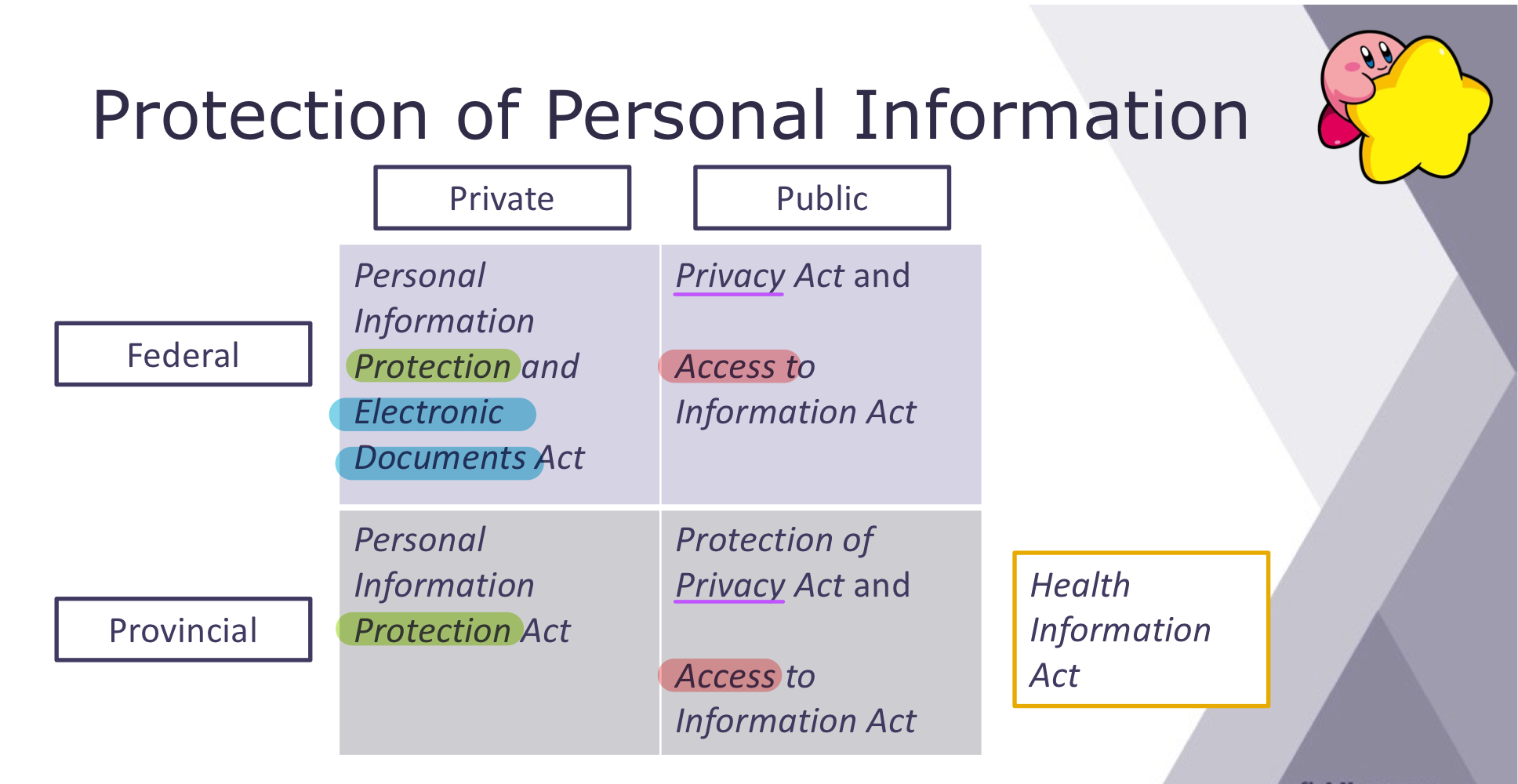
Which Act would the following be classified under?
London Drugs collects customer addresses to administer it’s customer loyalty benefits program.
a) Personal Information Protection + Electronic Documents Act
b) Personal Information Protection Act
c) Privacy Act + Access of Information Act
d) Protection of Privacy + Access to Information Act
e) Health Information Act
b
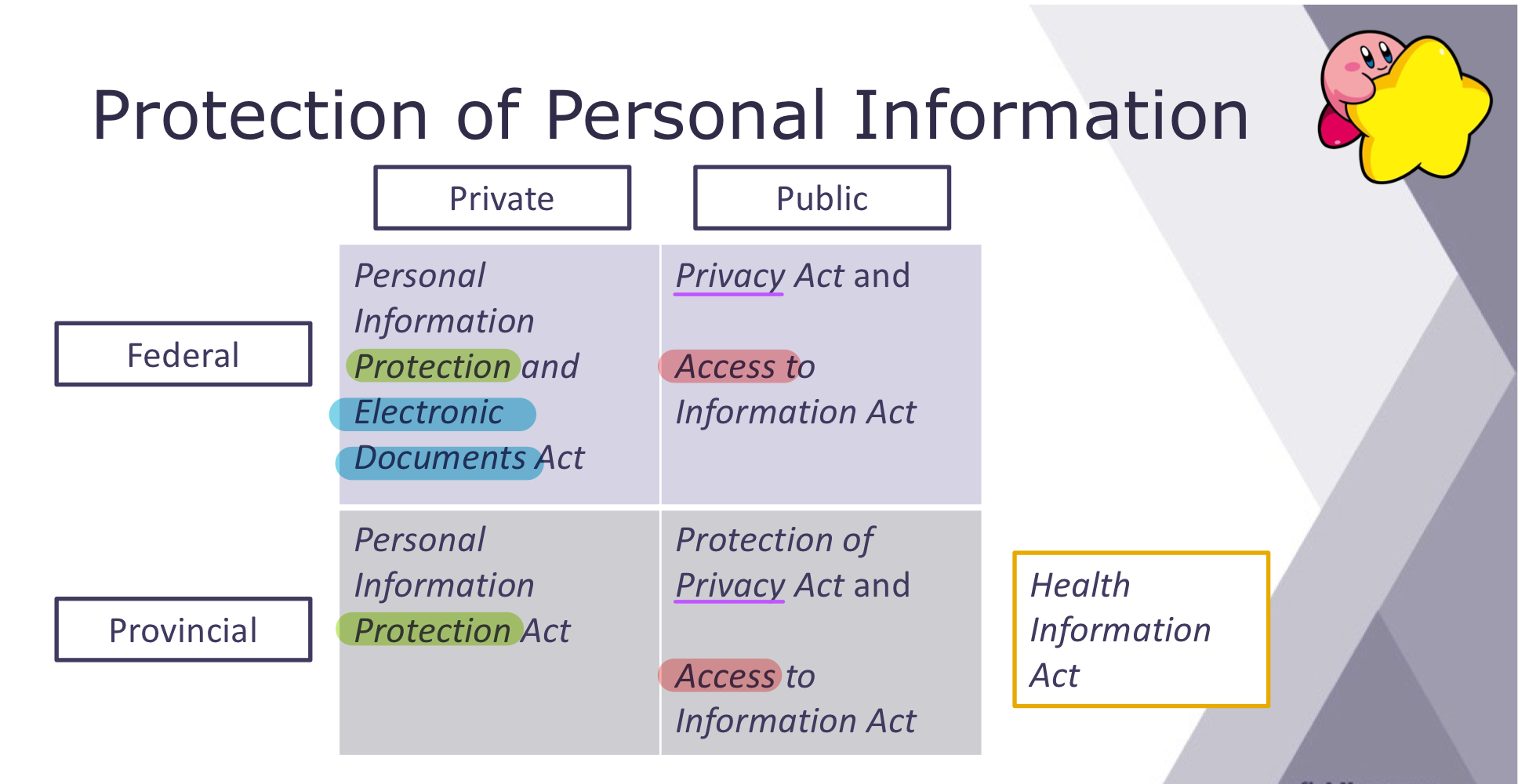
Which Act would the following be classified under?
Alberta Health Services is collecting employee information for the purposes of administering employee benefits (i.e. life insurance).
a) Personal Information Protection + Electronic Documents Act
b) Personal Information Protection Act
c) Privacy Act + Access of Information Act
d) Protection of Privacy + Access to Information Act
e) Health Information Act
d
POPA controls the manner in which a —— body may collect, use, and disclose personal information from individuals.
This may include a department or office of the Government of Alberta, municipalities, police services, school boards, regional health authorities, and universities/public colleges/technical institutes.
public
—— information is information about an identifiable individual (i.e. any information used to identify an individual)
Examples: name, home or business address, race or ethnic origin, age, sex, marital status, identifying number assigned to the individual, medical history and employment history
personal
Under POPA, collection of information should be directly from the individual to whom the information belongs to and ——- of purpose of collection is required (e.g. footer at the end of the form citing POPA and the specific section that gives authority to collect your info, signs that notify of video recording)
notification
Under POPA Use and Disclosure, a public body may use and disclose personal information for the purposes for which it was collected. T/F
T
PIPA governs the collection, use and disclosure of personal information by ——- organizations. Consent is also required for use and disclosure, and notification needs to be provided upon collection.
private
The Health Information Act governs the collection, use, and disclosure of —— information by “——-” and “———”.
health, custodians, affiliates
What is the difference between custodians vs. affiliates in the Health Information Act?
custodians = ppl who are acc responsible for policies/procedures of health information for the organization (often management roles)
affiliates = use health information to provide health services
Which of the following can be considered health information? (multi-select)
a) physical and mental health of individual
b) health service provided to an individual
c) amount paid for health service
d) demographic info
e) residence info
g) billing info
all of the above
Collection of health information should come directly from the subject individual unless exception applies. T/F
T
What are appropriate uses for health information? (multi-select)
A. A pharmacist reviews a patient’s medication history to diagnose a health problem and recommend treatment.
B. A regulatory body reviews a pharmacist’s records during an investigation into a complaint or potential misconduct.
C. A pharmacy uses patient information to check and improve the quality of its services, such as reviewing medication errors.
D. A health program reviews a patient’s information to determine whether they qualify for a specific healthcare benefit or service.
E. A regulator conducts a practice visit/audit to assess whether a pharmacy is meeting professional standards.
F. A pharmacist looks at a patient’s health information out of personal curiosity, even though it is unrelated to providing care.
A, B, C, D, E
In which situations can a patient’s health information be disclosed WITHOUT the patient’s consent? Select ALL that apply.
A. A pharmacist shares a patient’s treatment information with another healthcare custodian who needs it to provide care.
B. A healthcare provider shares relevant information with the patient’s family member, when the patient has not expressly objected and the required conditions are met.
C. A pharmacy uses patient information as part of a quality assurance review, such as investigating a medication error.
D. A healthcare provider discloses relevant information because it is required for court proceedings.
E. A pharmacist sends a patient’s health information to a friend who is curious about the patient’s condition.
F. A pharmacist posts a patient’s diagnosis in a private social media group to ask for advice.
A, B, C, D
Under HIA, mandatory reporting of breaches to the ——— ——- ——- ——- (OIPC) is required when there is a loss of or unauthorized access to personal information that is in the custody or control of the custodian.
This is known as a ——- ——-.
Office of the Information and Privacy Commissioner, Breach Notification
What are some factors to considering when assessing “risk of harm” from a breach of personal information?
whether info has been accessed or disclosed by/to a person
info has been misused or will be misused
info may be used for identity theft or to commit fraud
cause embarrassment of physical, mental, financial harm, or damage to reputation (e.g. results for STD test)
was info encrypted or secured (can we shut down access to that device?)
What are examples of info that the Commissioner has determined as highly sensitive?
social insurance numbers, DOB, driver’s license number → can be used to commit fraud or identity theft
credit card numbers → can be used to make fraudulent purchases
certain medical info (e.g. psychiatric or addiction counselling notes), employee info (e.g. poor performance or termination info) → ability to cause humiliation and harm to reputation
Who must be notified in case of a breach?
Office of the Information and Privacy Commissioner
Ministry
individual to whom the info belongs to

What is the #1 health privacy breach?
snooping
An individual who believes their health information has been collected, used, or disclosed in contravention of the HIA may ask the Office of the Information and Privacy Commissioner for a review.
May proceed to a ——- or an ——- before the Commissioner.
aka this is not a form to get financial compensation from bruh
mediation, inquiry
The Commissioner may only conduct an investigation regarding compliance when there is a complaint reported. T/F
F - the Commissioner can conduct investigation to ensure compliance with any provision of the HIA (e.g. attempt to gain access to info in contravention of HIA, obstruct investigation, fail to report breach)
——- controls the manner in which a public body may collect, use, and disclose personal information from individuals.
——- governs the collection, use, and disclosure of personal information by private organizations.
——- governs the collection, use, and disclosure of health information by “custodians” and “affiliates”.
FOIPPA, PIPA, HIA
What are some potential problems with using AI and privacy?
violation of collection limitation principal
increased risk of frequency and scope of privacy breaches
lack of proper consenting/use inconsistent with original purpose for collection
Which of the following statements about an individual’s right to access health information under the HIA are TRUE? Select ALL that apply.
A. An individual has the right to access records containing their health information that are in the custody or control of a custodian.
B. A custodian must generally provide access within 30 days of receiving the request.
C. The 30-day deadline can never be extended, regardless of the circumstances.
D. The OIPC may allow a custodian to disregard a request if it is frivolous, vexatious, or an abuse of the right to make an access request.
E. An individual can ask the OIPC to review a decision made about their access request.
F. Access may be refused if providing the information could reasonably be expected to cause immediate and grave harm to the applicant’s physical or mental health or safety, another person’s safety, or public safety.
G. Access may be refused if it would reveal a standardized diagnostic test or assessment and disclosure would prejudice the use or effectiveness of that test or assessment.
H. An individual automatically has access to every record held by a custodian, even if it does not contain their health information.
A, B, D, E, F, G
An individual may seek correction of his/her personal health information if the individual believes that there is an error or omission in the health information. What is something that can’t be corrected under this?
can’t request for change of a professional opinion or diagnosis
Intrusion upon seclusion (i.e. someone intentionally invades your private life without permission, even if they don't share the information with anyone else) and public disclosure of private facts (i.e. someone shares someone else's private information publicly, in a way that a reasonable person would find highly offensive) are examples of —— —— → which falls under civil law (can claim compensation for invasion of privacy).
privacy torts
A pharmacist posts on social media that a patient has HIV, identifying the patient.
What is this an example of?
public disclosure of private facts
A pharmacy employee accesses a patient’s medication profile just because they are curious, even though they are not involved in the patient’s care.
What is this an example of?
intrusion upon seclusion
What is the following an example of: narcotics and KCl
a) Accreditation - Medication Management
b) Good Catch Reporting
c) High Alert Medication (HAM)
d) Hazardous Medication Handling
e) Tall Man Lettering
c
What is the following an example of: catch error before it leaves the pharmacy → review to see what can be improved to mitigate this in the future
a) Accreditation - Medication Management
b) Good Catch Reporting
c) High Alert Medication (HAM)
d) Hazardous Medication Handling
e) Tall Man Lettering
b
What is the following an example of: cytotoxic meds handling
a) Accreditation - Medication Management
b) Good Catch Reporting
c) High Alert Medication (HAM)
d) Hazardous Medication Handling
e) Tall Man Lettering
d
What is the following an example of: morphine vs. HYDROmorphone
a) Accreditation - Medication Management
b) Good Catch Reporting
c) High Alert Medication (HAM)
d) Hazardous Medication Handling
e) Tall Man Lettering
c
What does FR stand for?
Formulary Restricted
What is the purpose of a formulary in clinical pharmacy?
help guide usage so that we stock what’s actually used, mitigate waste
What are the 3 areas/steps of medication reconciliation?
Admission, Transfer, Discharge
What does the Admission step of a med rec entale?
obtain BPMH (note: do not just go off of Netcare, speak to the pt/family)
What does medication “reconciliation” mean?
does the medication need to be discontinued, continued, or hold?
What is a MAR?
Medication Administration Record - tells nurse what to give and when, they will document administration on MAR (can be paper or electronic)
What does CPOE stand for?
Computerized Physician Order Entry - prescribers will enter the orders directly into the computer system and pharmacist will verify the orders (e.g. Connect Care/Epic)
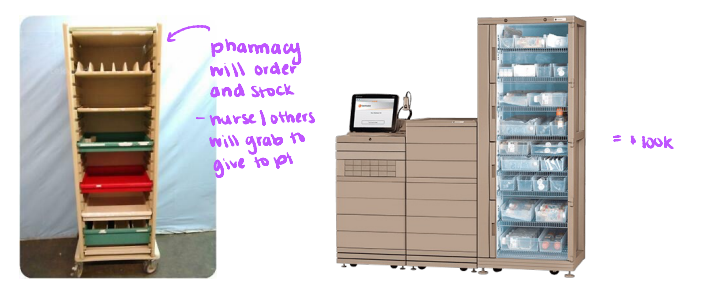
What is this an example of?
ward-stock systems (aka unit stock or cupboard stock)W
What is the difference between profiled vs. non-profiled cabinets in an ADC (Automated Dispensing Cabinet)?
profiled - cabinet contains wardstock but the machine is connected to the MAR, users can only remove medications that have been verified by pharmacy for that patient; has override but only for certain medications
non-profiled - can access whatever once an authorized user is logged in
What is the typical supply sent to a ward-stock?
24-hour supply

What is this an example of?
oral dose solid bulk tablet repackaging machine
According to the WHO, providing patient education for a group is an essential practice for all HCPs, especially in relation to patients with ——- diseases.
chronic
Which of the following is true about group educations? (multi-select)
a) It’s education for two or more patients about medication and/or issues related to use of medications.
b) The content is tailored to the needs of the group.
c) It’s predominantly formal programs that are highly structured and delivered as a predetermined curriculum.
d) It’s predominantly informal programs that allow for discussions and flexibility in learning.
e) It is separate from individual patient education provided at the time the patient receives the medication.
a, b, c, e
What are some patients need that can be met with group education?
behavioural - medication adherence, changes to daily routine
cognitive - knowledge regarding medication treatment
cognitive, affective - expectations for outcomes of medication therapy
affective - accepting reality of a chronic condition, making meaning of a situation
What are some possible changes of facilitating group education?
balancing group needs vs. individual needs
developing education that is both general and specific
dealing with patient’s emotions, especially anger
managing group dynamics
What would be the main focus for group education in a cardiac rehabilitation setting?
a) make changes in daily life
b) support making sense of diagnosis, improve adherence with medications
c) explain expectations for medication outcomes
a
What would be the main focus for group education for young adults who were newly diagnosed with mental illness?
a) make changes in daily life
b) support making sense of diagnosis, improve adherence with medications
c) explain expectations for medication outcomes
b
An ——- ——- is a systematic way to plan education so that learner needs, objectives, activities, assessment, and evaluation fit together.
instructional design
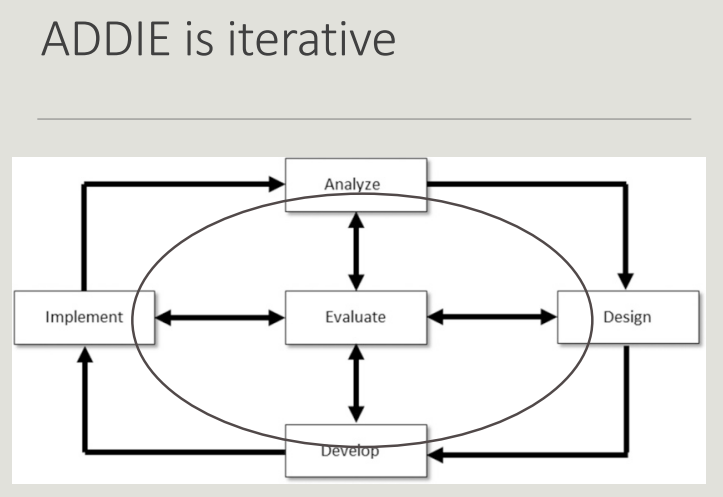
ADDIE gives you a process to develop a group teaching plan. what does ADDIE stand for?
Analysis - Who are the learners and what do they need?
Design - What should they learn? How will they learn it? How will you assess it?
Development - What needs to be created/prepared?
Implementation - How will it be delivered?
Evaluation - Did it work and how can it improve?
Analysis should change your design. Describe the difference between educational need vs. content - using insulin as an example.
Weak analysis: “The topic is insulin.”
Better analysis: “Patients need to be able to administer insulin, recognize signs of hypoglycemia, know what to do if it occurs, and feel confident monitoring and managing common day-to-day situations.”
Once we understand the learner and their needs, we can design the education. What are the main areas to look at when designing?
objectives - what needs to be learned?
learning activities - how will it be taught/learned?
assessment - what was learned? how will you know if it was learned? how can it launch into more learning?
What are the 5 ideal characteristics of a good objective?
specific, measurable, attainable, relevant, time bound
What are the 3 kinds of learning?
behavioural/psychomotor, cognitive, affective
Learning that includes physical movement, coordination, motor skills are example of which kind of learning?
a) behavioural/psychomotor
b) cognitive
c) affective
a
Learning that includes remembering, understanding, explaining, and applying?
a) behavioural/psychomotor
b) cognitive
c) affective
b
Learning that includes values, feelings, motivations, and attitudes?
a) behavioural/psychomotor
b) cognitive
c) affective
c
What does alignment mean in group learning?
when the objective, learning activities, and assessment makes sense together (with the audience, environment, purpose and content)
Why should we learn and apply learning theory?
helps us to choose activities and assessments that fit the kind of learning we want
Behavioural learning means…
a) developing knowledge and understanding
b) building meaning from prior knowledge and experience
c) demonstrating or changing an observable behaviour/skill
The educator might…
a) explain, organize information, ask learners to apply or explain
b) facilitate discussion, problem-solving, reflection and peer learning
c) demonstrate, provide practice, feedback and reinforcement
a, c
Cognitive learning means…
a) developing knowledge and understanding
b) building meaning from prior knowledge and experience
c) demonstrating or changing an observable behaviour/skill
The educator might…
a) explain, organize information, ask learners to apply or explain
b) facilitate discussion, problem-solving, reflection and peer learning
c) demonstrate, provide practice, feedback and reinforcement
c, a
Constructive learning means…
a) developing knowledge and understanding
b) building meaning from prior knowledge and experience
c) demonstrating or changing an observable behaviour/skill
The educator might…
a) explain, organize information, ask learners to apply or explain
b) facilitate discussion, problem-solving, reflection and peer learning
c) demonstrate, provide practice, feedback and reinforcement
b, b
What type of theory does this activity demonstrate?
Understand a drug mechanism
cognitive
What type of theory does this activity demonstrate?
Inject insulin
behavioural
What type of theory does this activity demonstrate?
choose between therapeutic alternative
cognitive, constructivist
What type of theory does this activity demonstrate?
discuss experiences managing medications
constructivist

The ——- of ——- ——- is the gap between what a learner can do and what they can’t do. We want to ideally be in this zone when designing group education → what they can do with support.
zone of proximal development
What is the difference between formative vs. summative assessment?
when do they occur, how do they measure improvement/achievement, feedback vs. objective, opportunity to adjust
formative:
occurs during learning
supports improvement
feedback is central
opportunity to adjust
summative:
occurs after learning
judges achievement
determines whether objective was achieved
usually end-point
What are the types of assessment used for behavioural objectives?
a) observation/demonstration
b) quiz, explanation, case question
c) explanation of reasoning, discussion, reflection, case reflection
a
What are the types of assessment used for cognitive objectives?
a) observation/demonstration
b) quiz, explanation, case question
c) explanation of reasoning, discussion, reflection, case reflection
b
What are the types of assessment used for behavioural objectives?
a) observation/demonstration
b) quiz, explanation, case question
c) explanation of reasoning, discussion, reflection, case reflection
What are the types of assessment used for constructivist objectives?
a) observation/demonstration
b) quiz, explanation, case question
c) explanation of reasoning, discussion, reflection, case reflection
c
What does the Evaluation step involve?
assess effectiveness of the education plan i.e. did the education plan work?
——- gives you the planning process.
——- ——- helps you decide how learning might occur.
——- ensures the objective, activity, and assessment fit together.
——- tells you whether learners learned.
——- tells you whether the education worked.
ADDIE, learning theory, alignment, assessment, evaluation
Which of the following is true regarding narcotics and control drugs? T/F
a) Narcotics and controlled drugs are governed by federal legislations.
b) They must be stored in locked, secure areas in both the pharmacy and patient care areas and kept separate from other medications.
c) They can be put with other medications.
d) They require perpetual inventory + regular inventory counts.
e) They require a signature at all stages (signature count).
f) At the end of each shift, narcotics must be counted and the balance reconciled, including all administrations and wastes.
a, b, d, e, f
Which of the following are considered sterile compounding?
a) intravitreal preparations
b) intrapleural preparations
c) preparations including hazardous drugs (e.g. cytoxic)
d) parenteral nutrition (PN)
e) gene therapy products
a, b, c, d, e
Sterile compounding are almost always prepared for a specific patient and sent directly to the care unit, typically as a 24-hour supply. T/F
T

What is a new technology that supports sterile compounding checking?
i.e. help check to make sure that the right drugs were added in the preparation
taking pictures of each drug that was added
![<p>Barcodes are a sequence of vertical bars and spaces that represent alphanumeric information [0-9, aA-zZ] and other symbols. A barcode consists of 5 parts including…</p>](https://assets.knowt.com/user-attachments/d1a8379a-14ae-4184-b4e0-8a6363c58214.png)
Barcodes are a sequence of vertical bars and spaces that represent alphanumeric information [0-9, aA-zZ] and other symbols. A barcode consists of 5 parts including…
quiet zone, start character, data characters (including optional check characters), stop character, another quiet zone
——- is the process of encoding data into a symbol to allow for accurate and rapid collection of data in real-time.
barcoding
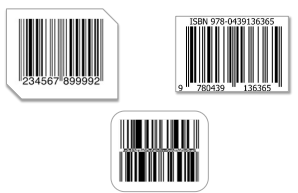
Which of the following are considered 1D or linear barcodes?
a) UPC
b) ISBN
c) Code 128
d) GS1 databar
e) QR code
f) datamatrix
g) Aztec
a, b, c, d

Which of the following are considered 2D barcodes?
a) UPC
b) ISBN
c) Code 128
d) GS1 databar
e) QR code
f) datamatrix
g) Aztec
e, f, g
What are the advantages vs. disadvantages of 1D barcodes?
pros:
common
cons:
can only store limited data, requires a lengthy bar code to encode more info
any damage to the lines will result in error
not suited for curved surfaces (i.e. pill bottles)
What are the advantages vs. disadvantages of 2D barcodes?
pros:
can store more data for unit area than 1D barcodes
if damage, more likely to scan than damage to 1D
cons:
not suited for curved surfaces
Canada currently has a national medication barcode mandate requiring all medications to have standardized barcodes on their packaging, including vaccines, with vaccine barcodes containing a GTIN and lot number. T/F
F - Canada has no national medication barcode mandate
However, since 2014–2015, Canadian vaccine products have been moving toward GS1 standards using GTINs (Global Trade Identification Number)
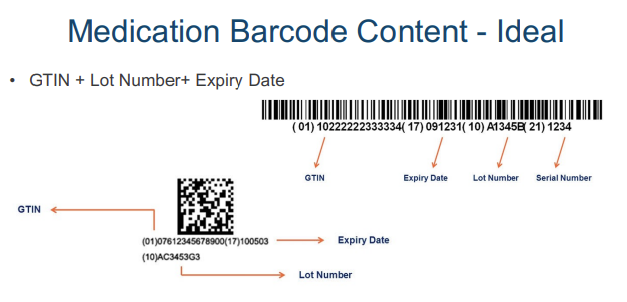
According to the Barcode Standard for Vaccine Products in Canada (2014-2015), the primary package of vaccine products (single or multidose vials, pre-filled syringes or sprayers of vaccine products) should have a barcode containing the ——- and —— —— and ——- ——.
GTIN, lot number, expiry date

Which of the following contributes to the most medication errors?
a) clinician ordering
b) transcription and verification
c) dispensing
d) administration
a, d
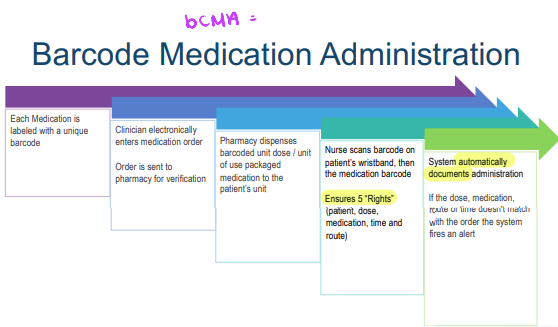
To reduce medication errors, healthcare systems use multiple safety checks throughout the medication-use process.
Clinician ordering can be improved through:
——- ——- ——- ——- (CPOE) where clinicians enter their prescription into a computer program (with options more meds and dosages, etc.) rather than hand-writing prescriptions
Clinical Decision Support such as allergy and drug interaction alerts
Medication ——- at admission, transfer, and discharge
Transcription and verification are improved through:
integrated electronic order entry
standardized medication catalogs
and pharmacist verification queues
Medication dispensing can be made safer using:
automated dispensing systems (ADS) such as ——-
with dispense queues
preparation and checking processes
and unit-dose packaging
Finally, medication administration can be improved through
——- ——- ——- = scan pt wristband and the med to see if they match
Electronic Medication Administration Record (eMAR)
barcoded medication administration (BCMA) = ensure the correct medication is given to the correct patient
Computerized Provider Order Entry, reconciliation, Pyxis, Barcode Patient Identification
What are the 5 “Rights” during the administration process?
right patient, dose, medication, time, route