Biochem Tophat Exam 4 / drugs cumulative
 Studied by 0 people
 Call Kai
 Learn
Learn Practice Test
 Spaced Repetition
 Match
Match Flashcards
 Knowt Play
1/30

There's no tags or description
Looks like no tags are added yet.
Name | Mastery | Learn | Test | Matching | Spaced |
|---|
No study sessions yet.
31 Terms
b) Trypsin converts more trypsinogen into active trypsin, which leads to a rapid activation of the remaining zymogens
Enteropeptidase initiates the activation of pancreatic zymogens by converting trypsinogen into trypsin. What happens next?
a) Trypsin converts chymotrypsinogen into chymotrypsin. Chymotrypsin then converts procarboxy-peptidase into carboxy-peptidase. Lastly, carboxy-peptidase converts prolipase into lipase
b) Trypsin converts more trypsinogen into active trypsin, which leads to a rapid activation of the remaining zymogens
c) Trypsin is a glycosyltransferase, which adds carbohydrates onto the other pancreatic enzymes, stabilizing their active forms
d) Trypsin is a kinase, which phosphorylates and activates the other pancreatic enzymes into their active forms
a) Peptidases break down peptides into amino acids, which are then adsorbed.
Proteolysis of proteins occurs in its final steps in the intestines. Which of the following statements best describes what happens during proteolysis in the intestine?
a) Peptidases break down peptides into amino acids, which are then adsorbed
b) Peptidases break down disulfide bonds, which allows denatured proteins to be adsorbed
c) Exonucleases break down phosphodiester bonds into amino acids, which are then adsorbed
d) Peptidases join (ligate) amino acids to form new proteins, which are then adsorbed
a) Homocysteine levels increase
Cysteine is synthesized from homocysteine in two enzymatic steps. The first step, Cystathionine β-synthase, requires PLP, the coenzyme form of vitamin B6. What happens to the levels of homocysteine in a person deficient in vitamin B6?
a) Homocysteine levels increase
b) Homocysteine levels decrease
c) Homocysteine levels do not change
D) Cystathionine beta-synthase is the enzyme. Pyridoxyl phosphate (PLP) is the cofactor
Which enzyme consumes homocysteine as a substrate, and which cofactor does that enzyme require in the reaction with homocysteine?
A) Alanine amino transferase is the enzyme. Pyridoxyl phosphate (PLP) is the cofactor
B) Cystathionine beta-synthase is the enzyme. Nicotinamide (NADH) is the cofactor
C) Alanine amino transferase is the enzyme. Nicotinamide (NADH) is the cofactor
D) Cystathionine beta-synthase is the enzyme. Pyridoxyl phosphate (PLP) is the cofactor
b) High concentration of a downstream product of a pathway can allosterically inhibit the first step in that pathway
Which of the following statements is true regarding feedback inhibition of a biosynthetic pathway?
a) High concentration of a downstream product of a pathway can competitively inhibit the first step in that pathway
b) High concentration of a downstream product of a pathway can allosterically inhibit the first step in that pathway
c) Low concentration of the initiating substrate of a pathway can competitively inhibit the last step in that pathway
d) Low concentration of a downstream product of a pathway can allosterically inhibit the last step in that pathway
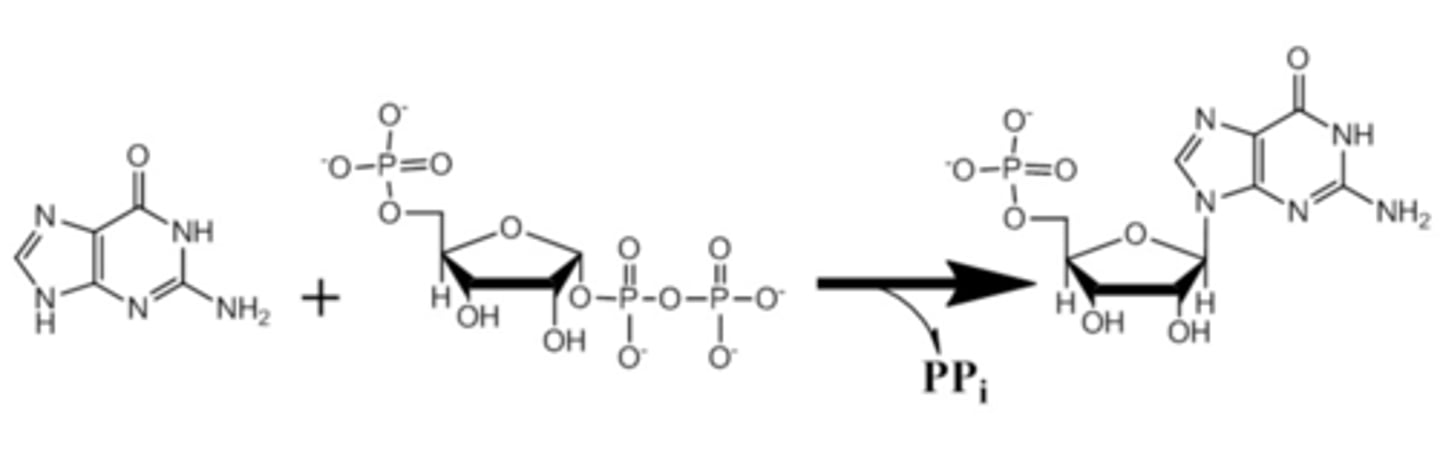
b) Guanine increases and GMP decreases
If hypoxanthine/guanine phosphoribosyl transferase (HGPRT) activity is deficient, which of the following occurs to the levels of guanine and GMP?
a) GMP increases and guanine decreases
b) Guanine increases and GMP decreases
c) Guanine increases and GMP increases
d) Guanine decreases and GMP decreases
e) Guanine and GMP levels are unaffected
d) High levels of AMP inhibit the conversion of IMP to adenylosuccinate. High levels of GMP inhibit the conversion of IMP to XMP.
In a key branch point in purine synthesis, IMP is either converted into adenylosuccinate or XMP. Which statement best describes the allosteric regulation of these conversions?
a) High levels of hypoxanthine inhibit the conversion of IMP to xanthine. High levels of xanthine inhibit the conversion of IMP to hypoxanthine
b) High levels of AMP inhibit the conversion of IMP to hypoxanthine. High levels of GMP inhibit the conversion of IMP to xanthine
c) High levels of AMP inhibit the conversion of IMP to UMP. High levels of GMP inhibit the conversion of IMP to CMP
d) High levels of AMP inhibit the conversion of IMP to adenylosuccinate. High levels of GMP inhibit the conversion of IMP to XMP
b) high levels of dATP inhibits Ribonucleotide Reductase (RNR)
What statement describes the biochemical defect that connects to the cellular phenotype in adenosine deaminase (ADA) deficient patients?
a) low levels of dATP inhibits Ribonucleotide Reductase (RNR)
b) high levels of dATP inhibits Ribonucleotide Reductase (RNR)
c) high levels of dATP activates Ribonucleotide Reductase (RNR)
d) high levels of dATP inhibits phosphofructokinase
c) 5' to 3'
In which direction does RNA synthesis occur on the newly synthesized strand?
a) 3' to 3'
b) 3' to 5'
c) 5' to 3'
d) N to C
e) C to N
a) PRPP
Amidotransferases are inhibited by the antibiotic azaserine, which is an analog of glutamine. Which metabolite would accumulate in cells treated with azaserine?
a) PRPP
b) IMP
c) TMP
d) GMP
b) TMP levels decrease
If dihydrofolate reductase is inhibited by methotrexate, what happens to the levels of TMP?
a) TMP levels increase
b) TMP levels decrease
c) TMP levels are unaffected
D) Leptin is a hormone secreted by adipocytes in response to increased triacylglycerol stores
How does the hormone leptin help regulate long term control over caloric homeostasis?
A) Leptin is a hormone secreted by the liver in response to lower triacylglycerol stores
B) Leptin is a hormone secreted by the liver in response to lower glycogen stores
C) Leptin is a hormone secreted by adipocytes in response to increased glycogen stores
D) Leptin is a hormone secreted by adipocytes in response to increased triacylglycerol stores
c) Missing OH groups replaced with hydrogens on the sugar ring
How is Stavudine (d4T) modified from a natural nucleoside?
a) Thymine instead of threonine
b) Missing OH groups on the pyrimidine ring replaced with carbonyls
c) Missing OH groups replaced with hydrogens on the sugar ring
d) glucose instead of ribose
c) reverse transcriptase
Lamivudine (picture from lecture showed a S on the 3' position) inhibits what?
a) xanthine oxidase
b) IMP dehydrogenase
c) reverse transcriptase
d) thymidylate synthase
D) Cystathionine beta-synthase is the enzyme. Pyridoxyl phosphate (PLP) is the cofactor
Which enzyme consumes homocysteine as a substrate, and which cofactor does that enzyme require in the reaction with homocysteine?
A) Alanine amino transferase is the enzyme. Pyridoxyl phosphate (PLP) is the cofactor.
B) Cystathionine beta-synthase is the enzyme. Nicotinamide (NADH) is the cofactor.
C) Alanine amino transferase is the enzyme. Nicotinamide (NADH) is the cofactor.
D) Cystathionine beta-synthase is the enzyme. Pyridoxyl phosphate (PLP) is the cofactor.
-Anticancer
-Antagonist that blocks estrogen receptor signaling
Tamoxifen
-Hormone
-Agonist that promotes estrogen receptor signaling
Estradiol
-Antibiotic
-Competitive inhibitor of PABA → blocks folate synthesis
Sulfanilamide
-Antibiotic
-Suicide inhibitor of transpeptidase → blocks peptidoglycan
Penicillin
-Anticancer
-Suicide inhibits thymidylate synthase (TS)
5-Fluorouracil
(Capecitabine, prodrug of 5-FU)
-Anticancer
-Inhibits BCR-Abl kinase
Imatinib
-Vitamin (B2)
-Component of FAD (redox)
Riboflavin (B2)
-Vitamin (B5)
-Component of CoA (acyl-transfer)
Pantothenic acid (B5)
-Vitamin (B3)
-Component of NAD⁺ (redox)
Nicotinic acid (niacin) (B3)
-Vitamin (B1)
-Component of TPP (aldehyde transfer)
Thiamine
-Vitamin (B6)
-Component of PLP (aminotransferase reactions)
Pyridoxine
-Vitamin (B9)
-Component of THF (one-carbon transfers)
Folic acid
-Vitamin
-Component of adenosyl-cobalamin (methyl + rearrangements)
B12
-Antidote
-Oral chelator of heavy metals
Succimer (DMSA, dimercaptosuccinic acid)
-Antidote
-Restores glutathione levels
N-Acetylcystenine
- Antihyperlipidemic
- Inhibits HMG-CoA reductase
Atorvastatin (lipitor) &
Rosuvastatin (Crestor)