Thoracic Limb - Bones
 Call Kai
 Learn
Learn Practice Test
 Spaced Repetition
 Match
Match Flashcards
 Knowt Play
1/42

There's no tags or description
Looks like no tags are added yet.
Name | Mastery | Learn | Test | Matching | Spaced | Call with Kai | Chat |
|---|
No analytics yet
Send a link to your students to track their progress
43 Terms
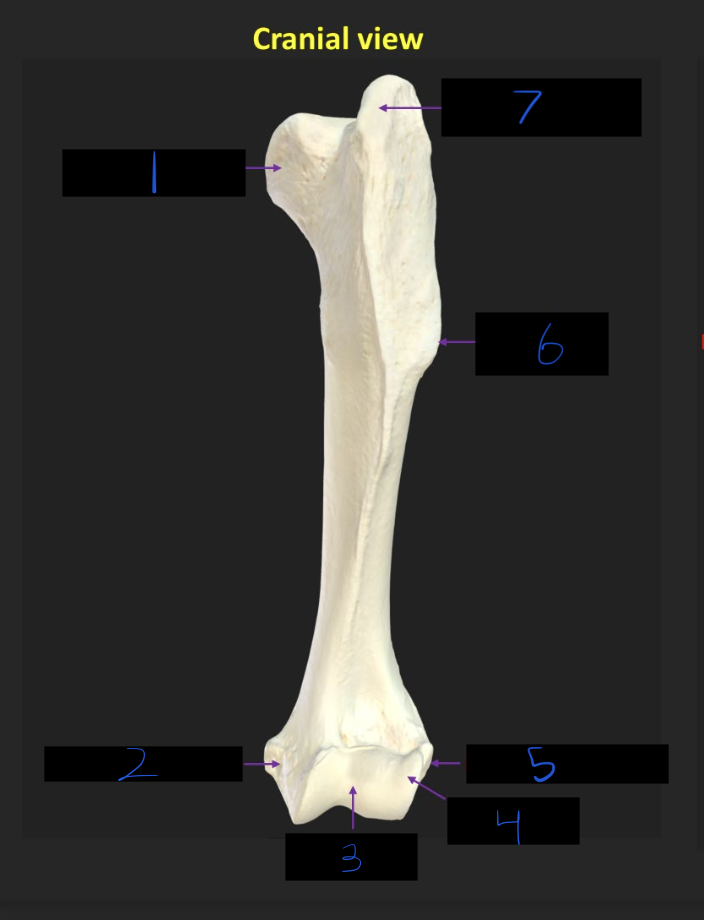
Name these parts of the humerus
lesser tubercle 2. medial epicondyle 3. trochlea 4. capitulum 5. lateral epicondyle 6. deltoid tuberosity 7. greater tubercle
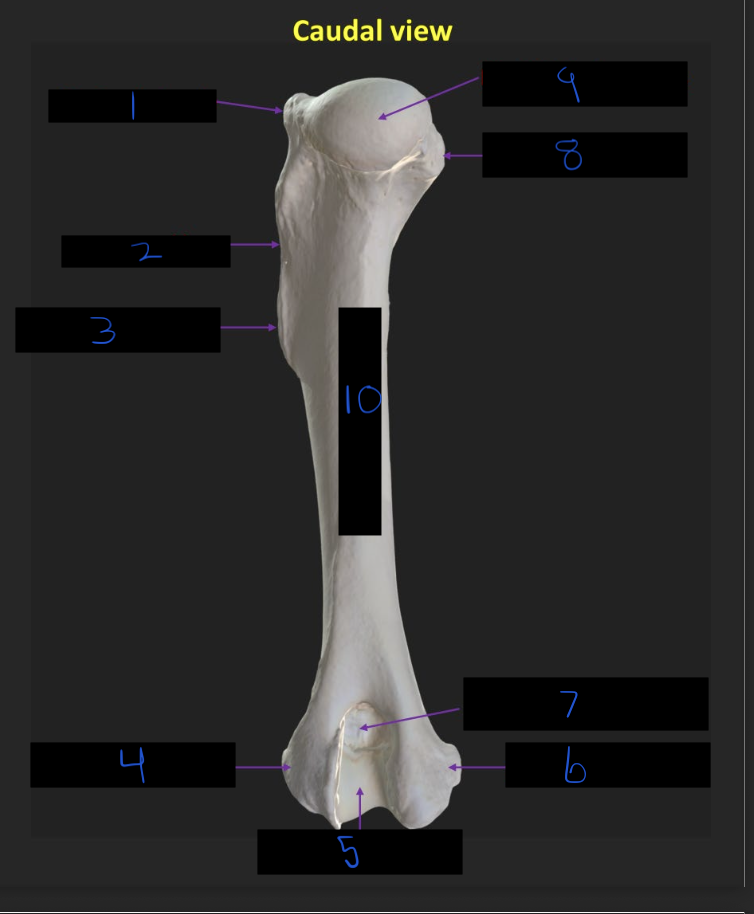
Name these parts of the humerus
greater tubercle 2. tricipital line 3. deltoid tuberosity 4. lateral epicondyle 5. olecranon fossa 6. medial epicondyle 7. supratrochlear foramen 8. lesser tubercle 9. head 10. body of humerus
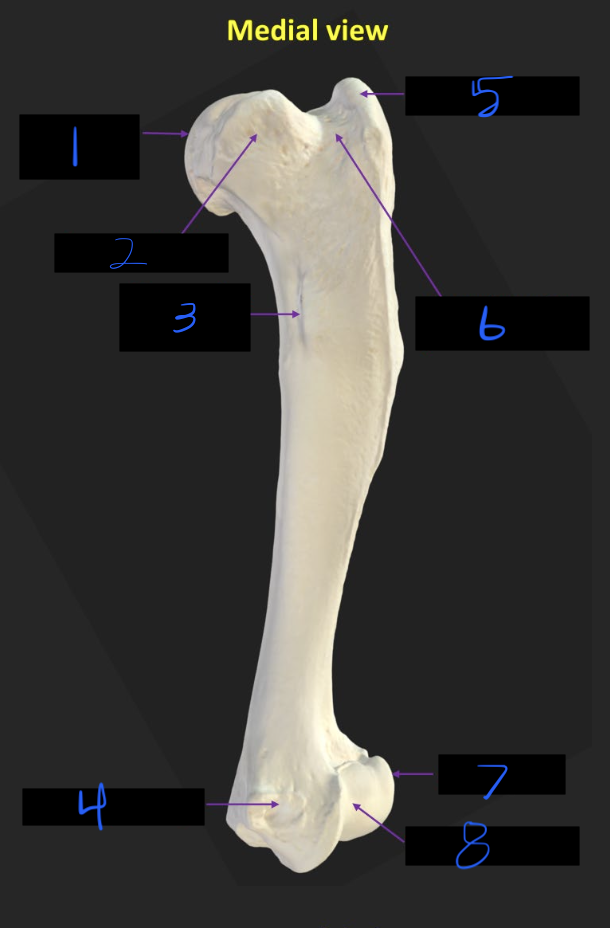
Name these parts of the humerus
head 2. lesser tubercle 3. teres major tuberosity 4. medial epicondyle 5. greater tubercle 6. intertubercular groove 7. capitulum 8. trochlea

name these parts of the humerus
greater tubercle 2. head 3. tricipital line 4. deltoid tuberosity 5. body 6. brachial groove 7. radial fossa 8. lateral supracondylar crest 9. lateral epicondyle
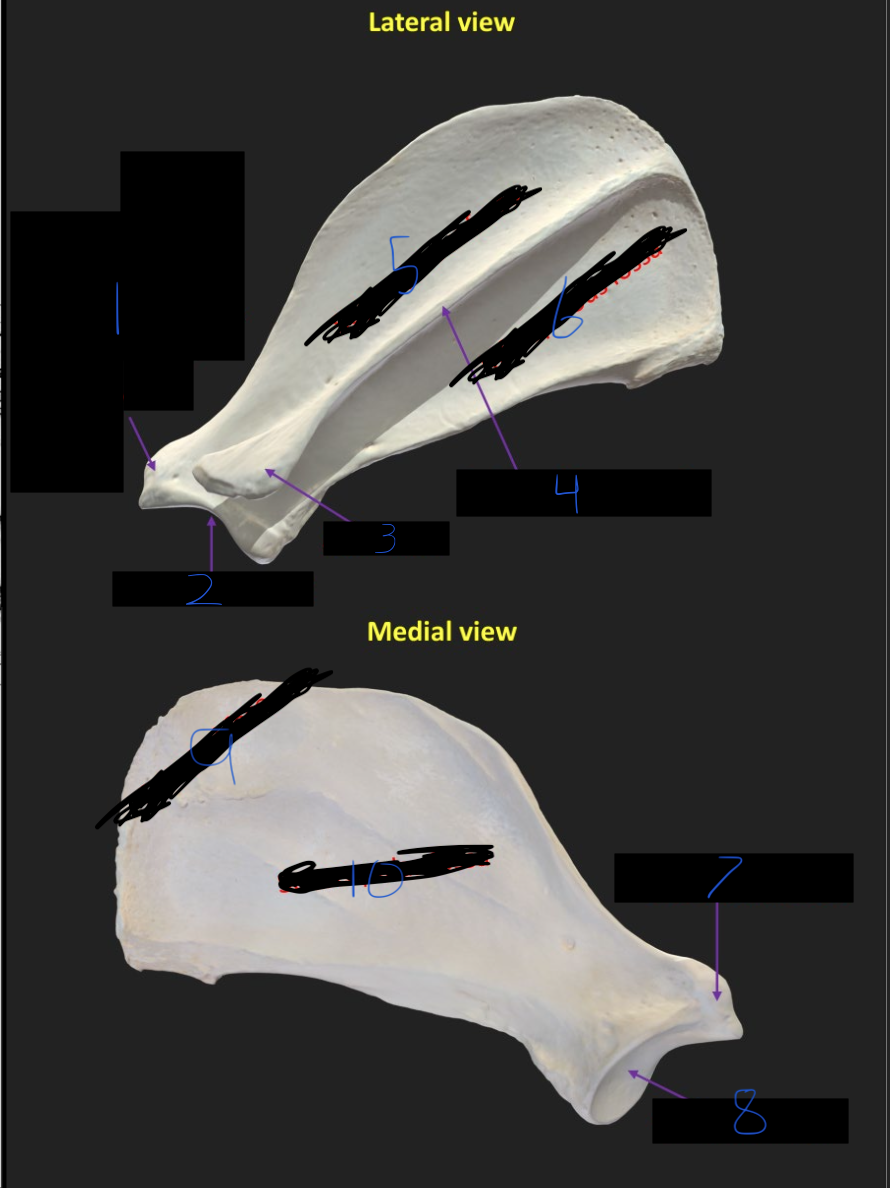
Name these parts of the scapula
supraglenoid tubercle 2. glenoid cavity 3. acromion 4. spine 5. supraspinous fossa 6. infraspinous fossa 7. coracoid process 8. glenoid cavity 9. serrated face 10. subscapular fossa

Name these parts of the ulna
anconeal process 2. trochlear notch 3. medial coronoid process 4. lateral styloid process 5. olecranon 6. tuber olecrani
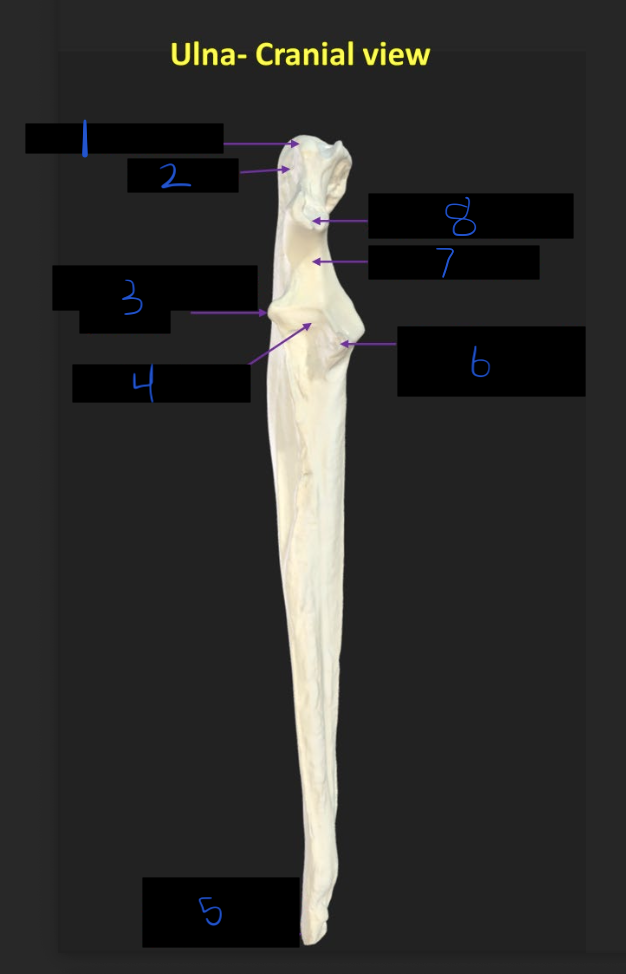
Name these parts of the ulna
tuber olecrani 2. olecranon 3. lateral coronoid process 4. radial notch 5. lateral styloid process 6. medial coronoid process 7. trochlear notch 8. anconeal process
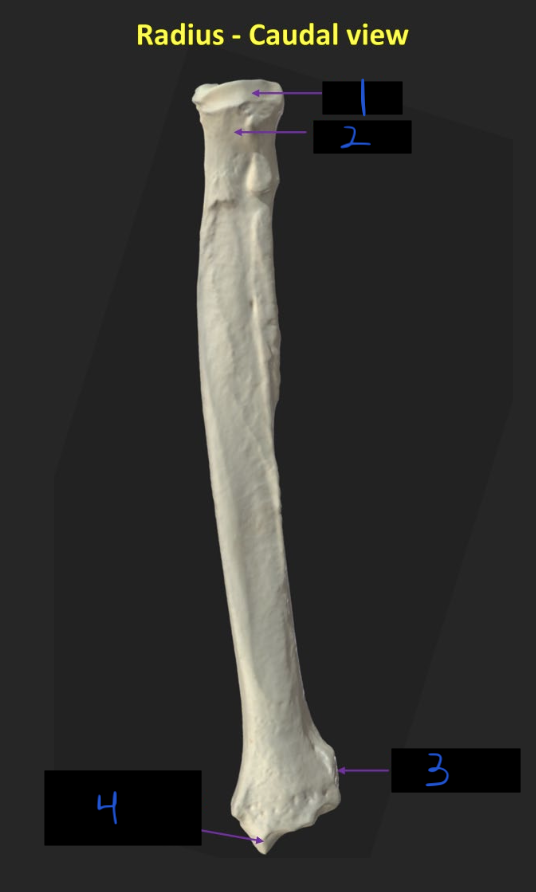
Name these parts of the radius
head 2. neck 3. ulnar notch 4. medial styloid process
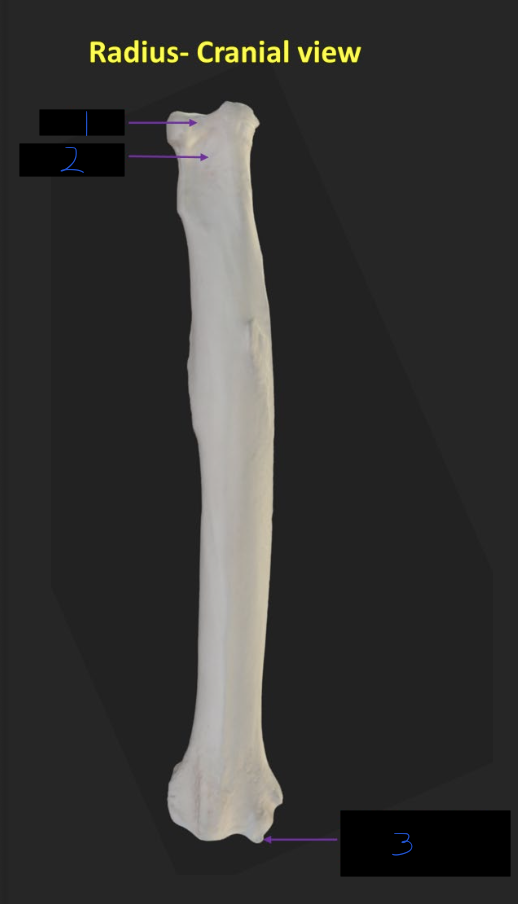
Name these parts of the radius
head 2. neck 3. medial styloid process

Name these parts of the manus
radius 2. ulna 3. intermedioradial carpal 4. ulnar carpal 5. distal phalanges 6. proximal phalanges 7. middle phalanges

Name these parts of the manu
radius 2. intermedioradial carpal 3. ulna 4. accessory carpal 5. ulnar carpal
What is a useful landmark for arthrocentesis of the shoulder joint and detection of shoulder luxations?
The acromion
What is special about the clavicle of cats?
it is more developed and palpable
What is special about the acromion in cats?
it exhibits both a hamate (distal) and suprahamate (proximal) process
What is unique about the scapula in cats?
the dorsal border normally projects above the spinous processes of the thoracic vertebrae
what is special about the coracoid process in cats?
it is well developed
What is a common site of osteochondritis dissecans lesions and flexion of the shoulder joint?
The caudal aspect of the humeral head.
These diseases are painful
the greater tubercle is preferred for collection of bone marrow for samples/grafts
what is a common site for articular fractures?
the humeral condyle
Do cats have a supratrochlear foramen?
No, they have a supracondylar foramen.
the brachial a. (not v.) and median n. travel through this
these are vulnerable to injury in distal humeral fractures and must be considered in humeral repair
What on the ulna is prone to avulsion fractures?
the olecranon, due to its attachment to the triceps.
What happens during elbow luxation?
the palpable olecranon is displaced laterally to the lateral epicondyle (also palpable).
what is the important of the anconeal process in immature dogs?
it’s a separate ossification center. If not fused in time, ununited anconeal process (UAP) develops, leading to degenerative joint disease (arthritis) of the elbow
What else can lead to degenerative joint disease in dogs?
Fragmentation of the medial coronoid process. Pressure over the medial aspect of the elbow elicits pain in this condition.
what is a landmark during declawing?
The ungual crest. Failure to remove it completely will result in regrowth of the claw.
What does cats have on their distal phalanx?
Dorsal elastic ligaments, which keep the claw in a retracted state.
in retraction, the distal phalanx lies lateral to the middle phalanx
upon flexion of the deep digital flexor muscle/tendon, the claw is exposed
arrangement of the distal phalanx is important during declaws
what is the carpal organ?
In cats, they have specialized sensory elevation in the skin on the caudal forearm. This area has stiff whiskers connected to pressure receptors. Not to be confused with a tumor/lesion.
what are the 4 regions of the forelimb?
shoulder
brachium
antebrachium
manus
what is the difference in forelimbs between a cat and a dog?
The bumps, holes, and depressions are more prominent in dogs. Cat bones are usually straighter
does the shoulder articulate with the trunk?
no, extrinsic muscles attach the forelimb to the bodyw
what other animals have a suprahamate process?
elephants and rabbits
what runs through the supratrochlear foramen in dogs?
nothing
What is OCD?
Osteochondritis Dissecans
The term osteochondrosis refers is an abnormal development of the cartilage on the end of a bone in the joint.
OCD occurs when the diseased cartilage separates from the underlying bone. It most commonly affects the shoulder joint, but the elbow, hip, or knee (stifle) may also be affected.
what percent of weight do the radius and ulna support?
radius - 80% ulna - 20%
at what ages. do more fractures occur in dogs?
when they’re immature
What can result from forces transmitted through the limb?
it can break off the lateral aspect of the humeral condyle
what do the radius/ulna allow for?
pronation/supination
ulna starts medially and ends up laterally
a fracture of one likely means a fracture to both
what is a physis?
a growth plate
describe the guillotine declaw method. is it optimal?
Have to control hemostasis – tourniquets (possible radial n. damage if left on too long)
Pressure bandages for several days
Often get part of pad – disfigured/pain
Leave behind bone (P3) – possibility of claw regrowing/pain
Higher incidence of chronic lameness
not optimal
describe the scalpel declaw method
surgical removal w/ scalpel blade
Have to control hemostasis – tourniquets
Pressure bandages for several days
More precise removal of P3/no bone left over
Little to no regrowth
Lower incidence of chronic pain/lameness
describe the laser declaw method
Similar to scalpel technique, just use laser
Usually little bleeding – no tourniquet
Need to prevent burning
More precise removal of P3/no bone left over
Little to no regrowth
Lower incidence of chronic pain/lameness
Expensive piece of equipment/training
do muscles act on bones or joints?
joints. muscles must cross over the act on it
what is the appendicular skeleton?
includes the limbs and girdles that attach them to the axial skeleton
what is the axial skeleton?
forms the body axis and protects vital organs