Leukocytes Development, Kinetics and Functions
 Call Kai
 Learn
Learn Practice Test
 Spaced Repetition
 Match
Match Flashcards
 Knowt Play
1/84

There's no tags or description
Looks like no tags are added yet.
Name | Mastery | Learn | Test | Matching | Spaced | Call with Kai | Chat |
|---|
No analytics yet
Send a link to your students to track their progress
85 Terms
Granulocyte Maturation
Myeloblast
Premyelocyte
Myelocyte
Metamyelocyte
Band Form
Mature Granulocyte
Myeloblast - Nucleus
Round to oval
Centrally located
Homogenous with delicate euchromatin with 2-4 visible nucleoli
Myeloblast - Cytoplasm
slightly basophilic
Type I: no visible granules
Type II: up to 20 azurophilic granules
Myeloblast Cell Division and Bone Marrow Population
Capable of cell division
1 - 2% Bone Marrow population
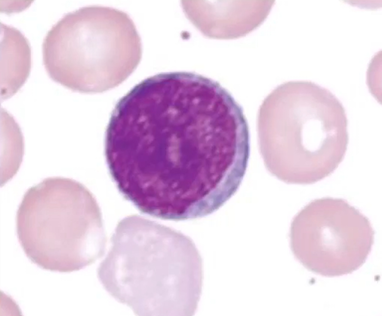
Type I Myeloblast

Type II Myeloblast
Promyelocyte - Nucleus
Round to oval
Eccentric Location
Chromatin Clumping becomes visible, but nucleoli may still be seen
Promyelocyte - Cytoplasm
Evenly basophilic
Full of primary azurophilic granules
Promyelocyte Cell Division & Bone Marrow Population
Capable of Cell division
1 - 6% bone Marrow Population

Promyelocyte
Myelocyte - Nucleus
Nucleoli are difficult to observe using light microscope
Myelocyte - Cytoplasm
End of primary (azurophilic) granule production
Start of secondary (specific) granule production
“Dawn of Neutrophilia”
Myelocyte Cell Division & Bone Marrow Population
Final stage where cell division occurs
6 - 17% Bone Marrow Population

Myelocyte
Metamyelocyte - Nucleus
Increasingly clumped chromatin
Nuclear indentation (<1/2 of the nuclear diameter)
Metamyelocyte - Cytoplasm
Start of tertiary granule synthesis
Little to no basophilia
Metamyelocyte Cell Division & Bone Marrow Population
No longer capable of Cell Division
20 - 30% Bone Marrow Population
Granules appear neutrophilic (attracts both acids and basophilic stain)
Metamyelocyte

Metamyelocyte
Band or Stab Form Nucleus
Highly clumped chromatin
Nuclear Indentation (>1/2 of the nuclear diameter)
Band or Stab Form - Cytoplasm
Start of secretory granule formation
All evidence of cytoplasmic basophilia are absent
Band or Stab Form Cell Division & Bone Marrow Population
No longer capable of Cell Division
9 - 32% of the population
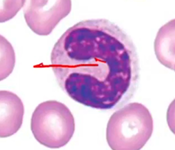
Band or Stab Form
Mature Neutrophil - Nucleus
3-4 nuclear segments connected by thread-like filaments
Barr bodies
Mature Neutrophil - Cytoplasm
Secretory granules continue to be formed
Mature Neutrophil Cell Division & Bone Marrow Population
No longer capable of cell division
7 - 30% of Bone Marrow Population

Mature Neutrophil
Primary Neutrophil Granules
Myeloperoxidase
Acid Beta-glycerophosphates
Cathepsins
Defensins
Elastase
Proteinase - 3
In-charge of turning Chloride to hypochlorous acid (that engulf microorganism)
Myeloperoxidase
Secondary Neutrophil Granules
Beta2 - microglobulin
Collagenase
Gelatinase
Lactoferrin
Neutrophil gelatinase-associated lipocalin
Sequests Iron
Lactoferrin
Tertiary Neutrophil Granules
Gelatinase
Collagenase
Lysozyme
Acetyltransferase
ß2-microgIobulin
Secretory Neutrophil Granules
CD 10, 13, 14, 16
CD 11b/CD18
Cytochrome b558
ALP
Vesicle-associated membrane-2
Complement Iq receptor
CRI
Neutrophil Functions
Phagocytosis
Formation of neutrophil extracellular traps
Secretion of transcobalamin 1 or R binder protein
Process of engulfing and destroying foreign particles by phagocytic cells
Phagocytosis
Phases of phagocytosis
Initiation or recognition
Chemotaxis
Engulfment
Digestion
Phagocyte receptors recognize and bind to certain foreign molecular patterns and opsonin
Surface receptors
Phagocytosis - Initiation
Cellular movement towards or away from a chemical stimulus
Chemotaxins/Chemotactic Factors/Chemoattractants
Phagocytosis - Chemotaxis
Pseudopods are extended around the foreign particle and enclose it within a phagosome
Phagocytosis - Engulfment
Specialized vesicle formed inside a cell, acting as a temporary stomach to break down engulfed materials
Phagosome
Destroying foreign particles via O2 - dependent (ROS) and O2 - independent (primary and secondary granules)
Phagocytosis - Digestion
Neutrophil Extracellular Traps
Generated upon neutrophil death as a result of antibacterial activity.
Extracellular thread-like structure that represent chains of nucleosomes from unfolded nuclear chromatin materials
Cytoplasmic enzymes attach to the Cathepsin G chromatin threads so that bacteria are digested in the external environment.
Eosinophils
1-5% of circulating leukocytes.
Nucleus has only two segmentation.
Cytoplasm is full of eosinophilic secondary granules.
Eosinophil Functions
Destroys tissue-invading parasites through secretion of MBP, ECP, and ROS
Play an important role in immune regulation.
Regulate mast cell function through the release of MBP that causes the mast cells to degranulate.
Hallmark of allergic disorders.
Basophils
Least numerous white blood cell (0.2% - 1.5%)
Lobulated nucleus obscured by large basophilic granules
Involved in allergic responses.
Regulates Th2 responses and induce lgE production.
Basophil Granules
Histamine
Platelet Activating Factor
Leukotriene C4
Ineterleukin-4 and -13
Vascular Endothelial Growth Factor (A and B)
Chondroitin Sulfates
Pro-inflammatory Substances
Histamine
Leukotriene C4
Mast Cells
Found in tissues.
Precursors also arise from GMP
Involved in allergic responses
Also has anti-inflammatory and immunosuppressive actions
Inactive Macrophages with no peroxidase
Monocyte
Monocyte Maturation
Monoblast
Promonocyte
Monocyte
Promonocyte - Nucleus
Slightly Folded or Indented
Delicate chromatin pattern
Promonocyte Cytoplasm
Blue with scattered azure granules
Monocyte - Nucleus
Deeply Indented (“Horseshoe” or “Kidney bean” shaped)
Lace-like or stringy chromatin Pattern
Monocyte - Cytoplasm
Blue-gray with fine azure granules (“ground glass” appearance)

Monoblast

Promonocyte

Monocyte
Macrophage
Oval nucleus with net-like chromatin pattern
Vacuolated cytoplasm
Macrophage Function
Phagocytosis
Antigen presentation
Macrophages of the Brain
Microglia
Macrophages in the Tissues
Histiocytes
Liver Macrophages
Kupffer cells
Lung Macrophages
Alveolar Macrophage
Bone Macrophage
Osteoclasts
Spleen Macrophage
Splenic Macrophages
Macrophage of the skin
Langerhans cells
Macrophages of placenta
Hofbauer Cells
Lymphocyte Maturation
Lymphoblast
Prolymphocyte
Lymphocyte
Lymphoblast - Nucleus
Round to oval
Coarse Chromatin
1-2 nucleoli
Lymphoblast Cytoplasm
Moderate to deep blue
Prolymphocyte Nucleus
Round to oval
Slightly indented
Clumped chromatin
1-2 nucleoli
Prolymphocyte Cytoplasm
Moderate to deep blue to occasional azurophilic granules

Lymphoblast

Prolymphocyte

Lymphocyte
B - cell
10 - 15% of circulating lymphocytes
Homogenous chromatin material
Extremely scanty cytoplasm
Adaptive humoral immunity
Produces antibodies
T - cell
85% of circulating lymphocytes
Morphologically indistinguishable from B cells in the PBS
Helper T-cell
Commands cytokines
CD4+ cell
Cytotoxic T - cell
kills virus infected cell/tumor cell
CD8+ T - cell
antigen - specific/ antigen dependent
Regulatory T - cells
T - suppressor cells
Natural Killer Cell
2% of circulating lymphocytes
Large and granular
Innate defense against intracellular pathogens
antigen - independent
non - specific
Subsets of CD16+ and CD56+
NK Cell
CD4+ surface marker
Helper T - cell
CD8+ surface marker
Cytotoxic T - cell
Emit Robin Egg Blue
Lymphocyte