Kidneys and acid base
 Call Kai
 Learn
Learn Practice Test
 Spaced Repetition
 Match
Match Flashcards
 Knowt Play
1/58

There's no tags or description
Looks like no tags are added yet.
Name | Mastery | Learn | Test | Matching | Spaced | Call with Kai | Chat |
|---|
No analytics yet
Send a link to your students to track their progress
59 Terms
why does the concentration of H+ need to be controlled in the body
H+ is highly reactive and reacts very easil ywith proteins, despite its comparatively low concentration compared to other electrolytes
how do the lungs aid with H+ homeostasis
alveolar ventilation removes CO2 - involved in H+ buffering
what 3 organs are involved in H+ concentration
liver
lungs
kidneys
why do the kidneys need to be involved in H+ homeostasis
non volatile lipids and proteins are made and cant be exhaled
how does the body deal with non-volatile proteins and lipids produced that contain H+
secretion in the kidney
how are H+ secreted in the urine
bound to filtered buffers as it cant be excreted freely
what buffers are used to excrete urine
ammonium
phosphate
which metabolite of H+ buffering must be reabsorbed into the blood during excretion and why
HCO3-
if it’s not reabsorbed it’s the same as adding H+ to the plasma
what metabolites does the liver produce to aid with H+ secretion
NH4+
once the liver has produced NH4+, how is the proton accessed for excretion?
NH4+ + CO2 → HCO3- and H+
HCO3 is titrated, H+ is then excreted through methods back as NH4+
describe the cycle of H+ synthesis and secretion
NH4+ produced in the liver from metabolism
HCO3- and H+ are produced from a reaction with CO2
H+ and HCO3- go through process in the kidney
H+ is excreted bound to NH3 → NH4+ or with PO43- as HPO3,2-
what are the 3 lines of defence for pH control?
buffers
respiratory system
kidneys
How does acid secretion take place in the kidney?
glutamine is converted to alpha-ketoglutarate
this becomes NH4+, glucose and HCO3-
NH4+ is secreted into tubular lumen (H+ secretion)
glucose is metabolised
HCO3- is reabsorbed

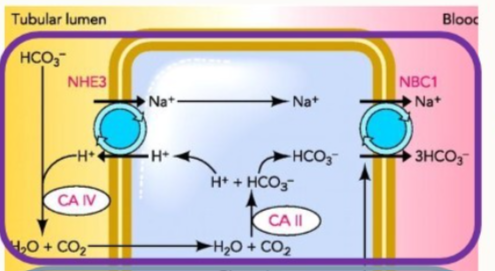
How does bicarbonate reclamation take place in the kidney?
H2O and CO2 react together → H+ and HCO3-
bicarbonate is reabsorbed
protons are pumped out into the tubular lumen via co-transport of Na+ (uses the concentration gradient to power this)
H+ binds with HCO3- in the tubular lumen via the action of carbonic anhydrase → H2O and CO2 (cycle repeats again
HCO3- is reabsorbed into the blood via 3Na+ : HCO3- co-transporter
what are 4 factors that control bicarbonate reabsorption
luminal HCO3- concentration
luminal flow rate
arterial pCO2
angiotensin II
which hormone contributes to bicarbonate reabsorption, how?
PTH - it increases cAMP and decreases bicarbonate reabsorption
which 2 places in the nephron does acidification take place
PCT
DCT
how does acidification in the DCT compare to that in the PCT/
uses H+-ATPase due to lack of Na+ reabsorption rather than Na+/H+ co-transport
describe acidification in the distal tubule
H+ is secreted in cortical medullary collecting tubule by active secretion via H+-ATPase
H+ combine with phosphate buffers
where in the nephron does excretion of H+ take place with:
NH4+
PO43-?
PCT
DCT
how does the pKa of the bicarbonate system compare to the phosphate system, what does this mean in terms of acidification at the initial filtrate pH of 7.4?
bicarbonate - 6.8
phosphate - 6.1
more bicarbonate base than phosphate base as buffer

What does this infographic tell us?
acidification and excretion along the nephron affects each other and itsn’t an isolated process
ammonium is essential along the tubule for the removal of H+
how does increased PCO2 affect H excretion
tubular cells respond directly to its increase in the blood by increasing the rate of H+ secretion
how does ECF level affect hydrogen secretion?
if ECF volume decreases, Na+ reabsorption is stimulated, increasing H+ secretion and HCO3- reabsorption
increased Angiotensin II directly stimulates the Na+/H+ exchanger
increased aldosterone stimulate H+ secretion by cortical collecting tubules
what tends to occur after H+ secretion is affected by decreasing extracellular fluid levels?
alkalosis due to excess H+ secretion and HCO3- reabsorption
how does plasma potassium affect h+ excretion?
when high
when low
hypokalaemia stimulates H+ secretion in PCT
hyperkalaemia inhibits H+ secretion in PCT
what effect does a decreased plasma K conc have on H+ concentration?
increases H+ concentration in renal tubular cells
this stimulates H+ secretion and HCO3- reabsorption → alkalosis
how does incresaed K+ affect H+ secretion?
hyperkalaemia descreases H+ secretion and HCO3- reabsorption → acidosis
how does hypochloraemia affect H+ excretion?
it causes secretion and HCO3- reabsorption
Na+ must be absorbed in exchange for H+/K+ secretion
causes paradoxical aciduria
state 6 factors that cause increased H+ secretion and HCO3- reabsorption
increased pCO2
increased [H+'], decreased [HCO3-]
decreased ECF volume
increased angiotensin
increased aldosterone
hypokalaemia
state 6 factors that cause a decreased H+ secretion and HCO3- reabsorption
decreased pCO2
decreased [H+], increased [HCO3-]
increased ECF volume
decreased angiotensin
decreased aldosterone
hyperkalaemia
what measure can we take during surgery to help us determine how well the kidneys/lungs/liver are secreting H+
arterial or venous blood gas
what is arterial blood gas useful to measure?
assessing respiratory stats
what won’t arterial blood gas help detect?
changes in the periphery
what is venous blood gas useful for?
measuring metabolic scenarios
how will venous blood gas differ from arterial?
lower pH and higher CO2
what may peripheral blood gas not be accurate in?
in low flow states
what do we want blood pH to be?
around 7.4
what is the typical range of pCO2 mmHg?
40 (range of 31-49 but want in the 40 area)
what do we want HCO3- to measure in blood gas?
18-29 mmol/l
what do we want pO2 mmHg to be
arterial
venous
90-100
24-48
if a patient presents with pO2mmHg at 90, which is in range, should we just presume this is fine?
NO - need to look at patient entirely and see if they amy need additional O2 support
what blood gas marker hsould we always look at first?
O2
where do we take an arterial sample from for blood gas?
dorsal metatarsal
facial
transverse facial
femoral
auricular
what needle to we use for arterial sample collection?
heparinised
how do we set up a blood gas reader?
insert cartridge needed for calibration
attach syrings and inject sample smoothly
interpret results
if arterial pH is decreased what do we call this?
acidaemia
if arterial pH is elevated, what do we call this?
alkalaemia
what are the 2 additional blood gas markers which correlate to acidaemia?
elevated paCO2
reduced HCO3-
what type of acidaemia is it for the following markers:
elevated paCO2
reduced HCO3-
respiratory acidosis
metabolic acidosis
what are the 2 additional markers of alkaelimia in a blood gas sample?
decreased PaCO2
increased HCO3-
what do the following tell us about the type of alkalaemia?
decreased PaCO2
increased HCO3-
respiratory alkalosis
metabolic alkalosis
if both PaCO2 and HCO3- are changed in a blood gas sample, how do we determine whether the patient is in respiratory or metabolic distress?
which one of the markers is worse - use this initially and go from there
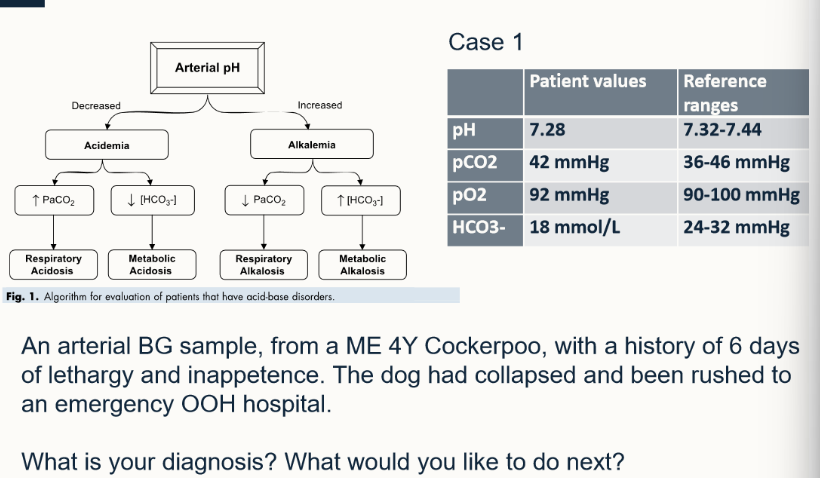
What is our dignosis?
look at O2 first - well saturated
pH is low, therefore acidosis
pCO2 is within range but HCO3- is low, therefore metabolic acidosis

Interpret
Oxygen is LOW - needs immediate oxygen support!
pH is low = acidosis
paCo2 is elevated
HCO3- is also elevated
paCO2 elevated most therefore respiratory acidosis
what does an anion gap tell us?
the grreater the anion gap, the more we can assume other acid is being added from another body system contributing to acidosis
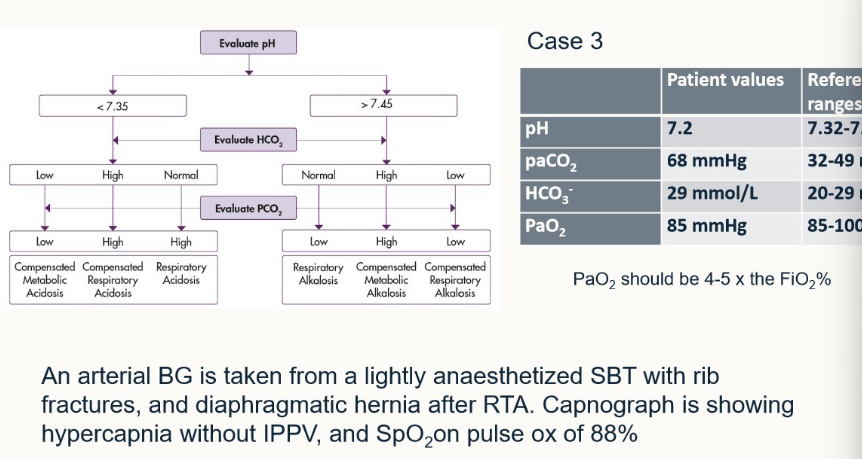
Interpret
oxygen is lower end of acceptable range - as pet has been in an RTA - GIVE O2 ANYWAY
pH is low
PaCo2 is elevated
HCO3- is within range
respirtaory acidosis duet o RDA