Pain Management in the Cancer Patient
 Call Kai
 Learn
Learn Practice Test
 Spaced Repetition
 Match
Match Flashcards
 Knowt Play
1/65

There's no tags or description
Looks like no tags are added yet.
Name | Mastery | Learn | Test | Matching | Spaced | Call with Kai | Chat |
|---|
No analytics yet
Send a link to your students to track their progress
66 Terms
How Pain Develops
When something in the body is not working properly, the body's nerve cells sense pain at the site of the damage or injury and send a signal to the brain, which triggers a response
Pain
Pain is one of the most feared consequences of cancer.
All pain is real regardless of cause, and most pain is caused by a combination of physiologic and psychogenic factors.
Pain assessment has several purposes:
Determine baseline for treatment and intervention
Determine which intervention is best for patient
Enable the evaluation of intervention
Cancer Patient’s Pain
33%-88% of all cancer patients experience pain.
45% of adult oncology patients have moderate to severe pain daily
Pain during radiation therapy does not follow a standard pattern
Pain as a result of XRT begins towards the end of treatment and resolves withing a few weeks after, but is unpredictable
Staff attitude towards pain plays a role in the assessment and treatment of CA patient pain
Pain Transmission: Includes several body structures
Nerve endings
Nerve fibers
The Brain
Pain is caused by various stimuli
The three types are:
Mechanical
Physical forces such as pressure, stretch, or cutting. They are often activated by excess pressure or mechanical deformation of tissues.
Thermal
Detect noxious heat or cold. They are sensitive to temperatures that can damage tissue, such as a hot stove or extreme cold.
Chemical
Respond to substances released during injury, inflammation, or disease.
Pain - Acute
It is new, can be sudden, usually transient
may come from diagnostic or surgical procedures, or trauma
may be accompanied by anxiety or emotional distress.
for the most part, results from disease, inflammation, or injury to tissues.
the cause of acute pain can usually be diagnosed and treated, and the pain is self-limiting, that is, it is confined to a given period of time and severity.
When new pain is related to growth or impact of a tumor, it is considered an emergency
in some rare instances, it can become chronic.
Pain - Chronic
is widely believed to represent disease itself.
it can be made much worse by environmental and psychological factors.
pain that persists over a longer period of time than acute pain (usually 3 months or more)
is resistant to most medical treatments. It can—and often does—cause severe problems for patients.
In a cancer patient, sources can be the result of the tumor invading bone, soft tissue, viscera, blood and nerves
Other sources of chronic pain can be the result of surgeries, chemotherapy and radiation treatments
Types of Pain
Pain that is caused by organic disease and disorders is known as: Somatogenic pain
Somatogenic pain, or organic pain, arises from somatogenic lesions resulting from trauma, infection, or other external factors.
Somatogenic pain is divided into two main categories:
Nociceptive pain
Neuropathic pain
Nociplastic (also called Mixed)
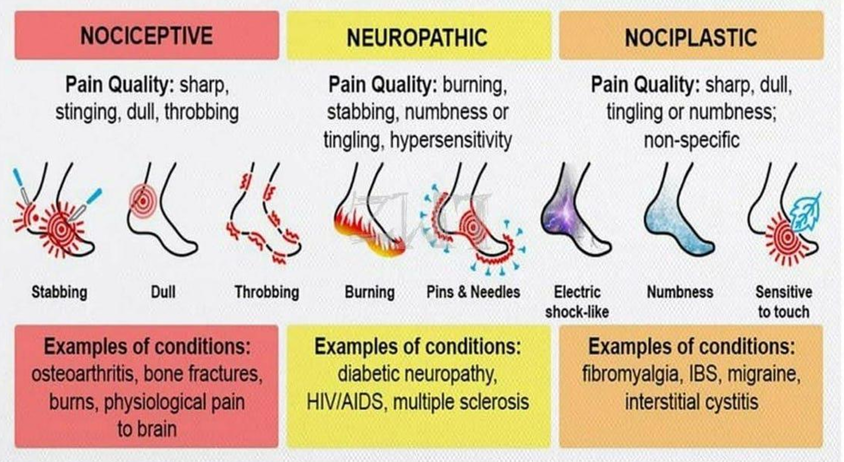
Nociceptive Pain
Pain quality: sharp, stinging, dull, throbbing
ex. osteoarthirits, bone fractures, burns, physiological pain to brain

Neuropathic Pain
Paint quality: burning, stabbing, numbness or tingling, hypersensitivity
ex. diabetic neuropathy, HIV/AIDS, multiple sclerosis
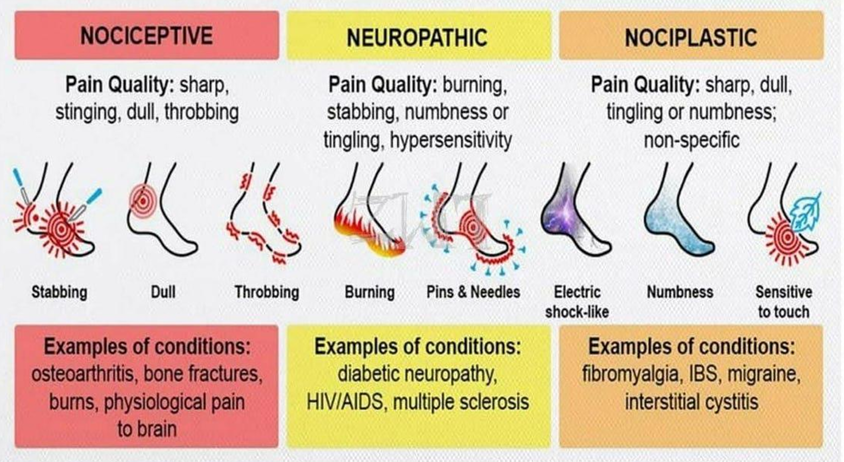
Nociplastic Pain
Pain quality: sharp, dull, tingling or numbness; non-specific
ex. fibromyalia, IBS, migraine, interstitual cystitis
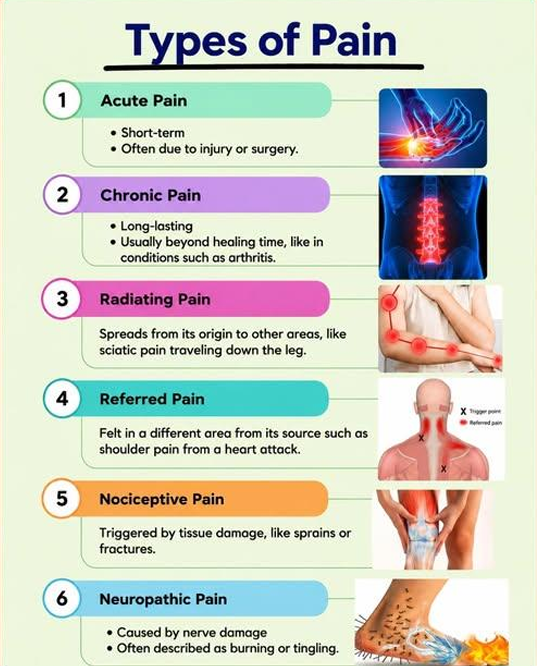
Types of Pain
Psychogenic pain
Psychogenic pain is not an official diagnostic term. It is used to describe a pain disorder attributed to psychological factors. Such things as beliefs, fears, and strong emotions can cause, increase, or prolong pain.
It often does not have an organic explanation
Somatic Pain
Pain experienced in the skin, muscles, bones and joints
Visceral Pain
The pain of organs, in the thoracic or abdominal cavities
Both somatic and visceral pain can be _____ or _____. The two classification systems have full overlap.
Nociceptive
Neuropathic
Types of Pain (Based on Duration, Source/Origin, Location)

Specifics on Cancer Pain
Is a legitimate pain
Can be acute or chronic
There may be several etiologies
Pain unrelated to cancer
*Combination of these exists
Common Sites of Cancer Pain
Bones: long bones, vertebrae, pelvic
Lymph nodes
pleura
skin
liver
bowel
*more than one site
Skeletal Related Events that Cause Pain
radiation to bone
fractures
bone surgery
spinal cord compression
Pain associated with Cancer Treatment
Radiation therapy can cause pain
(Wells: Supportive Care, Table 9.1, pg 163; and Table 9.2, pg 165)
Where?
Skin, H&N, Chest, Abdomen, Pelvis
Pneumonitis and fibrosis
Myelopathy (Dz of spinal cord)
Lhermitte’s sign (shock-like feeling down spinal column)
Factors Affecting Responses to Pain
Depression
Anxiety
Meaning of pain
Past experience with pain
Culture
Religion
Gender
Genetic
Staff – training and attitude
Patient barriers to effective pain management
Fear of addiction
Don’t want family to know
Fear of side effects
Fear nothing available when pain gets bad
Don’t want to distract MD
Fear disease worsening
Punishment for past indiscretions
health care provider and health care system barriers
HC Providers -
Fear of legal repercussions
Inadequate knowledge
Poor pain assessment
Fear of patient addiction
Concern about drug tolerance
Fear of masking symptoms
Patient’s pain report is not believed
HC Systems
Pain relief not valued
Limited access to care (i.e. pain medications)
Insurance issues
Insufficient pain care providers
Limited formulary
Pain relief plan
Set goal intensity with the patient and the family
Purposes of pain assessment
Establishes a baseline for treatment and intervention
Helps Clinical Teams focus on which interventions are best for the patient.
Enables the evaluations of the interventions
Six dimensions to consider when assessing pain
Physiologic: Organic cause of pain
Sensory: Intensity, location, and quality
Affective: Depression and anxiety
Cognitive: Influence on thought processes
Behavioral: Observable behavior (verbal, nonverbal, moans, grimaces, complaints)
Sociocultural: Factor that influences response to pain
Three types of pain in cancer patients
Pain associated with direct tumor involvement
Pain associated with cancer therapy
Pain unrelated to the tumor or its treatment
Two factors related to the cause of pain
Duration—refers to whether pain is acute or chronic
Pattern of pain—three separate patterns
Sensory Dimension
Consists of pain location, intensity, and quality
Location—ask patient where pain is or ask patient to point to area of pain
Intensity—goal is to translate pain into description of numbers or words to provide objective description
Quality—how it actually feels (e.g., hot, burning, aching, throbbing, sharp, tender, stabbing, heavy, shooting, gnawing, splitting)
Affective
anxiety and depression are factors that affect a patient’s response to pain and ability to tolerate and cope with pain
Cognitive
pain influences thought processes and/or the way people view themselves
Behavioral
Factors such as physical exercise, time spent in bed, and ability to do chores have been used to measure pain behavior; the Karnofsky
Performance Status is used for this
Sociocultural factors that influence pain are
ethnic; cultural; demographic; spiritual; and related factors such as age, gender, and race
Tools to assess pain must be simple, short, and relevant for the patient.
Tools include the McGill Pain Questionnaire, Brief Pain Inventory, and Memorial Pain Assessment Card.
Pain assessment should be
systematic
organized
ongoing
When evaluating a cancer patient’s pain
Believe the patient’s complaint of pain
Take a careful history of the patient’s pain complaint
Evaluate the patient’s psychological state
Perform a careful medical and neurologic examination
Order and review appropriate diagnostic studies
Treat the pain to facilitate the appropriate workup
Reassess the patient’s response to therapy
Individualize the diagnostic and therapeutic approaches.
When to assess pain
on admission
regularly
after pain interventions
before and after procedures
with new pain
When to Assess: continued
It is very important to assess for pain in a patient not only while they are lying still in bed or sitting in a chair, but with activity!!!
Remember: pain is cyclical, not linear and not static!
Also, pain often intensifies at night (nothing to distract patient)
There are two ways of measuring pain:
physical
functional
(both types of assessment are carried out by a physician based on what the patient reports)
Pain Assessment Tools
Reading – Oncology Nursing Secrets: Pain Management pg. 391-395 Washington, pg 45-50
Pain intensity rating scales
Facial expression scale
Pain map
Pain diary
Patients at Risk for Under-treatment of Pain
Infants
Children
Elderly
Confused (including psych pts)
Mental status changes
Non-verbal
Non-English speaking
Prior addicts
Neuro patients
How do we treat pain?
Two groups
Non-opioids (non-narcotic)
opioids (narcotic)
Non-Opioid Analgesics
Tylenol (side effect: Liver failure)
NOTE: this is an acetaminophen this is not an NSAID
NSAID’s (Non-steroidal anti-inflammatory drug)
Ibuprofen: Motrin, Advil
Naproxen: Aleve
Topicals (Zostrix)
*Often given in combination with opioids
Major side effects of NSAIDs (Non steroidal anti-inflammatory drug)
Decreased platelet aggregation*
GI bleeding*
Renal failure
Have a ceiling effect
Maximum dose: 4-6 grams in 24 hours
*Concern in pts with low platelets
Opioids
multiple formulations
avoid term “narcotics”
pure forms relatively inexpensive
Demerol (opioid)
acute pain only
short duration of action (2-3 hours)
SE; seizures
this should not be used for cancer pain
morphine (opioid)
Gold standard for cancer pain-
Many formulations
Easy to titrate
Cheap
Potential SE: renal toxicity
i.e. opioids
Oxycodone
Hydrocodone
Hydromorphone
Codeine
Propoxyphene
Opioids - Routes of administration
By mouth
IV
IM (intramuscular)
Topical-
Epidural
Transdermal
Transmucosal
Nebulized
Intrathecal
Opioid Side Effects
Constipation
May lead to obstruction and impaction
Sedation (confusion)
Itching (Pruritus)
N and V (nausea and vomiting)
Urinary retention
Dry mouth
Respiratory depression
Addiction definitions
Psychological dependence on the use of substances for their psychic effects…characterized by compulsive use despite harm.”
FSMB Model Guidelines for the Use of Controlled Substances 1998.
“…a primary, chronic, neurobiologic disease, with genetic, psychosocial, and environmental factors influencing its development and manifestations. It is characterized by behaviors that include one or more of the following: impaired control over drug use, compulsive use, continued use despite harm and craving…”
AAPM, APS, and ASAM, Feb 2002.
5 C’s of addiction
Chronic
Impaired Control over drug use
Compulsive use
Continued use despite harm
Craving
Pseudoaddiction
Drug-seeking behavior due to unrelieved pain; actually pain-relief seeing behavior
Due to underprescribing by MD’s or overestimation of drug efficacy by RN
*>50% of chronic pain pts found it necessary to change MDs in their quest for pain relief
Physical Dependence:
“Physiologic state of neuroadaptation which is characterized by the emergence of a withdrawal syndrome if the drug is stopped or decreased abruptly or if an antagonist is administered.” FSMB
“Physical dependence is an expected result of opioid use [and] does not equate with addiction.”
Opioid Withdrawal
Symptoms are usually experienced shortly before the time of the next scheduled dose
Although unpleasant, withdrawal from narcotics is rarely life threatening.
Addicted comparison
Addicted
Chemically dependent persons (addicts) use drugs to escape or avoid reality
Do not have pain
QOL declines
Take drugs even though they are harmful
Not Addicted
Persons with pain us drugs to participate in reality
QOL improves
Drug are not causing them harm
Drug Tolerance
Addicts virtually always evidence tolerance (chronic opioid users also)
Tolerance is unpredictable and can persist months to years after abstinence
Shortened duration and a decrease intensity of analgesia, euphoria and sedation, which creates the need to consume progressively larger doses to attain the desired effect.
Definition
A state of adaptation in which exposure to a drug induces changes that result in a diminution of one or more of the drug’s effects over time.
Adjuvants
These are drugs whose original use was not analgesic
Antidepressants
Anticonvulsants
Stimulants (Ritalin)
Corticosteroids
Local anesthetics
Bone pain
Radiopharmaceeuticals can be used
Metastatic osteoblastic bone lesions
Palliation of bone pain
Specific criteria for use
Strontium-89
IV over 2 minutes by radiation oncologist
SE: bone marrow depression
Pain from Bone Metastasis
what is Zometa (zoledronic acid) (May be used for pain from bone melts)
Biphosphanate (Rx hypercalcemia)
Bone specific, not tumor specific
Inhibits bone resorption (regardless of tumor type)
Preserves bone architecture and strength
Reduces number and size of bone mets in tumor-induced osteolysis
Anti-androgenic and anti-pain effects (UNK reasons)
Non-Pharmacological: Mechanical Strategies
Alternatives to conventional treatments-
What are they and do they work?
Non-Pharmacological, Mechanical Strategies include
Massage*
Heat and cold
Therapeutic touch
Acupressure*
Acupuncture*
Hyperbaric oxygen treatment (HBO)
*Not with low platelets
** No chiropractic strategies
Behavioral Interventions include:
Relaxation techniques
Distraction
Imagery/Visualization
Music
Humor
Prayer
Biofeedback
Hypnosis
Treating cancer pain with radiatoin therapy
Curative treatment
Palliative treatment
Relieve pain
Control symptoms
Delay tumor growth
How does XRT relieve cancer pain?
Cytotoxic effect of XRT on normal bone cell
inhibits the release of chemical mediators of pain, such as prostaglandins. This effects explains the fact that some patients get rapid pain relief, often within 24 hours of the first treatment.
The Cytotoxic effect of XRT on abnormal cells
prevents any further bond destruction, reduces the size of the tumor and enables re-absorption of bone to take place. This effect explains the pain relief achieved between 2 and 8 weeks after radiotherapy.
Common uses of XRT for pain
Bone metastasis
Spinal cord and brachial plexus involvement
Liver and pancreatic pain – but XRT not used this way very often anymore
Responses to XRT for pain
Pain from direct invasion
Pain relief within 24-48 hours
Pain from indirect stimulus (edema, compressed or obstructed organs)
Pain relief 2-3 months
XRT dose and frequency controversial
More Invasive Techniques
Nerve blocks
Neurosurgical procedures
Deep brain stimulation
Chemical or surgical ablation
Joint injections
Vertebroplasty