ORGANIC CHEMISTRY i
 Call Kai
 Learn
Learn Practice Test
 Spaced Repetition
 Match
Match Flashcards
 Knowt Play
1/20

There's no tags or description
Looks like no tags are added yet.
Name | Mastery | Learn | Test | Matching | Spaced | Call with Kai | Chat |
|---|
No analytics yet
Send a link to your students to track their progress
21 Terms
Basics you need to know about carbon
Here you should know that a carbon electronic configuration is as shown in the pic and how the sp3 hybride is formed

Model of a sp3 carbon
It is tetrahedral means it's like aV perpendicular to V

What property of carbon let it makes a large no. Of compounds in nature
It's the catenation property this property let the carbon atoms to form bond with itself means self linking property and let it form different types of chains which are cylic open branched or unbranched
C C bond and C H bond is strong
No leaving tendency
Basic idea of organic chemistry I mean about what things do we actually study in organic chemistry
We study mainly about either hydrocarbon ( compounds made up of only hydrogen and carbon) or hydrocarbon derivatives ( compounds which are made up of carbon and hydrogen but also N O P S and halogens F Cl Br and I
Note organic chemistry is not the study of all the compounds found in nature
What is vital force theory
Berzelius proposed vital force theory in 1815to explain that the organic compounds can only be formed when a special force is present must be existing in a living organism
This special force was called as vital force
Who was the scientist to disprove berzelius theory of vital force
Fredrich wholer accidently form urea in his lab actually he was making ammonium cyanate by reacting ammonium sulphate and potassium cyanate but due to optical isomerism it turn into ures
Hence he disprove the vital force theory
About some more scientists
Kolbe →→ acetic acid Berthelot ′→→→
Different ways to represent organic compounf
Organic compounds ko chaar main tarah se represent kar sakte hain: (1) Molecular formula— elements aur unke total atoms batata hai. Structure nahi batata. (2) Complete structural formula— atoms aur unke bonds fully show karta hai. Atoms ka kis tarah connected hain dikhata hai. (3) Condensed structural formula— short form, functional groups ka idea milta hai. Branches dikhane ke liye parentheses use ho sakte hain. (4) Bond-line ya skeletal formula—carbon skeleton lines mein, carbon aur unke attached hydrogens usually nahi likhte. Heteroatoms (O, N, S, P, etc.) ko show kar dete hain. One-line trick: Molecular atoms ki count batata hai; structural connections dikhata hai; condensed same cheez ka short version hai; bond-line minimum writing with carbon skeleton
Types of carbon atoms and types of hydrogen atoms
Carbons atoms are of 4 types depending upon how many carbon atoms are attached to it
If one two three or four and it will be called respectively as primary secondary tertiary and quaternary
Hydrogen atoms are also of 4 types depending on which carbon thet are attached to
If primary then primary ………
No. Of pie and sigma bonds
Single bond then 1 sigma bonds
Double bond then 1 sigma bonds and one pie b9nf
Triple bond then 1 sigma bonds and 2pie bond
Hybridization
Steric no. = No. Of sigma bonds plus no. Of localised loan pair

Functional groups
Functional group is the part of a molecule that determines its chemical properties and typical reactions." Short note: "functional group = reactive center deciding properties and reactions."
Made up of group of atoms or a single atoms
Can be carbon containing or non carbon containing
Can be terminal or non terminal
May be monovalent or polyvalent
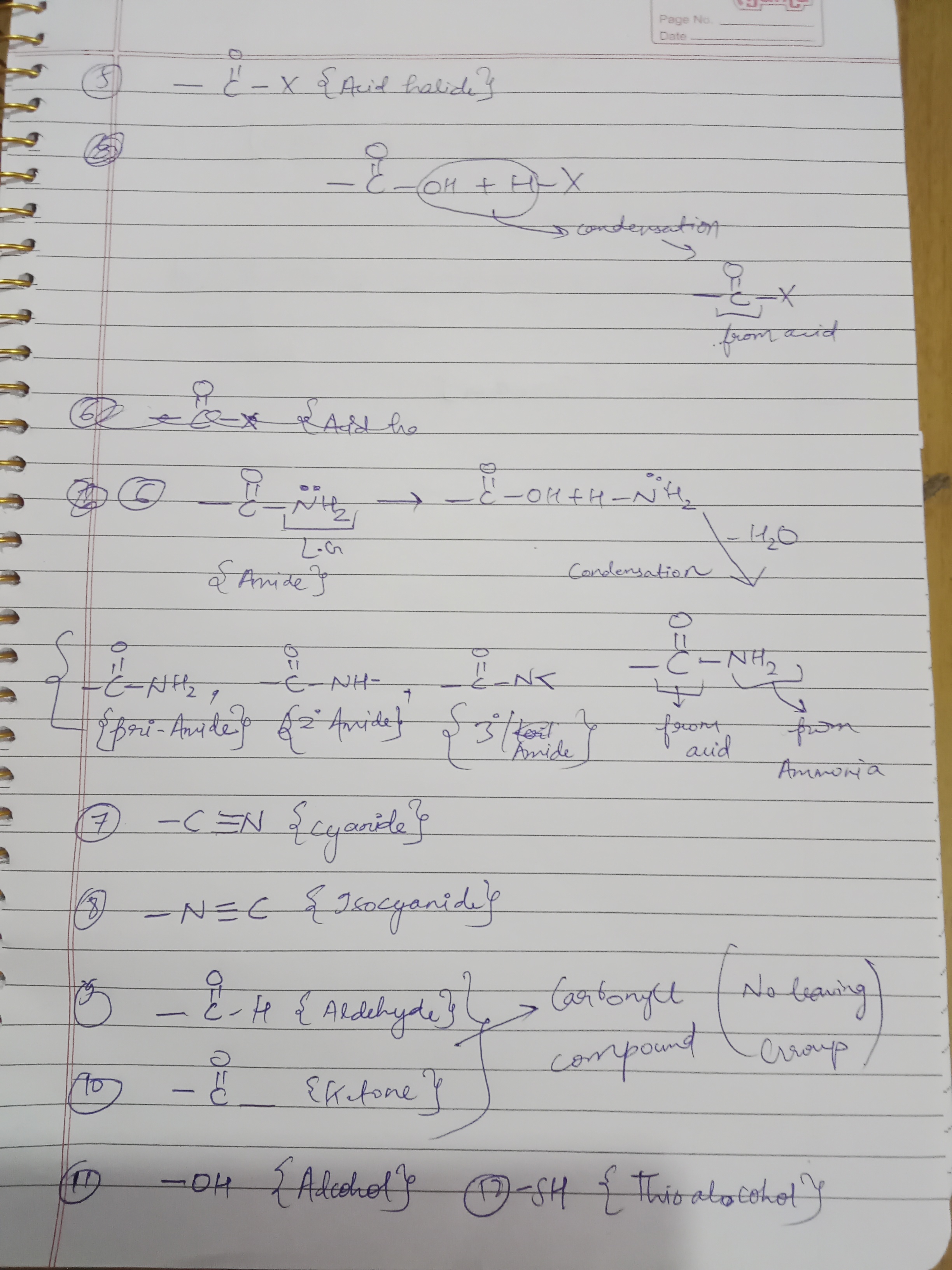
KEY POINTS AND IMPORTANT POINTS

Active hydrogen
Whe. Hydrogen bonds to a highly electronegative atom (3 or more than it ) the bond becomes polar
H carries a partial positive charge
Can participate in hydrogen bonding
Acd base reaction
Polar protic solvent
Polar hydrogen term is more precise to describe charge distribution
Polar →polarity
Active →reactivity
F 4
O 3.5
N 3.0
Degree of unsaturation
Degree of unsaturation (DU/DBE/IHD): 1 ring equals 1 DU, 1 double bond (C=C) equals 1 DU, 1 triple bond (C≡C) equals 2 DU. So, DU equals total rings plus pi bonds. Heteroatoms: nitrogen is "+N" in the formula (conceptually 1 N equivalent to 1 H); oxygen and sulfur are ignored; halogens are "-X" (each halogen equals 1 H). Formula: DU = (2C+2+N-H-X)/2. Unsaturation means a compound has a double or triple bond. Double bond = olefinic, triple bond = acetylenic.
Homologous series
Homologous Series: Same general formula, same functional group, similar chemical properties, gradual change in physical properties; consecutive members differ by –CH2, i.e. 14u in molecular mass. Members generally have the same degree of unsaturation (DU). Example: CH4, C2H6, C3H8, C4H10; each consecutive member differs by CH2 (14u).
General formula of organic compound
Alkane: CnH2n+2; Alkene: CnH2n; Alkyne: CnH2n–2; Aldehyde/Ketone: CnH2nO; Alcohol: CnH2n+2O; Carboxylic acid & Ester: CnH2nO2.
Different radical of organic chemistry
(1) CH₄ → methane, CH₃• → methyl, CH₂ → methylene, CH → methylidyne/methine, depending on nomenclature
(2) C₂H₆ ethane; एक H हटाओ → C₂H₅• ethyl radical। अब दो H हटाने के दो तरीके हैं। एक, अगर दोनों अलग-अलग carbon से हटे तो Cl-CH₂–CH₂–Cl, ये कहलाता है vicinal dichloride, क्योंकि दोनों पड़ोसी carbons पर हैं। और अगर दोनों एक ही carbon पर लगा दो तो CH₃–CHCl₂, ये होता है geminal dichloride (gem-dichloride)। याद रखने की trick: vicinal मतलब पड़ोसी carbons, geminal मतलब same carbon पर groups
(3) "Vinyl vs Allyl"। Vinyl group double bond carbon से directly attached होता है। Example: CH₂=CH–Cl, vinyl chloride. Allyl group double bond के adjacent carbon से attached होता है। Example: CH₂=CH–CH₂–Cl, allyl chloride। याद रखने की बात ये है कि vinyl में attachment सीधे double bond carbon पर है, और allyl में double bond के next carbon पर
(4) "Phenyl and Aryl Group." Benzene से एक H हटाओ, C₆H₅– phenyl group मिलता है (Ph–)। कुछ books में इसे phi भी लिखते हैं। Aryl (Ar–) मतलब कोई भी aromatic substituent जो aromatic hydrocarbon से H हटाने पर बनता है। Phenyl aryl का specific example है। अगर Cl लगा दो phenyl पर C₆H₅–Cl, chlorobenzene जो aryl halide है। याद रखने की लाइन: "Phenyl is specific; aryl is general
Different radical of organic compound
so a normal radical is generally understood as a straight chain hydrocarbon minus one hydrogen atom। So, which creates one free valency. And the “n-” stands for normal, indicating that the chain is unbranched or straight. So, the main idea is straight chain hydrocarbon minus one hydrogen, and that forms the n-alkyl radical।
so a iso radical is generally understood as a straight chain hydrocarbon minus one hydrogen atomfrom send carbons frome the end or from the start of the chain So, which creates one free valency. And the “ iso “ stands for isomer , indicating the presence of structural isomerism So, the main idea is straight chain hydrocarbon minus a hydrogen from second last carbon add a methyl group and then done here we have a iso alkyl
Ne9 is just like iso radical but here we just have to add two methyl group instead of one and we are done to have a neo radical or to have a neo alkyl It represents a structure with a quaternary carbon
Secondary radical
Free valency is on a secondary carbon
Tertiary radical
Free valency is on a tertiary carbon
SEC AND TERT JUST TELLS US WHERE THE FREE VALENCY IS
Classification of organic compound
