Atomic structure
 Call Kai
 Learn
Learn Practice Test
 Spaced Repetition
 Match
Match Flashcards
 Knowt Play
1/69

Earn XP
Description and Tags
Name | Mastery | Learn | Test | Matching | Spaced | Call with Kai | Chat |
|---|
No analytics yet
Send a link to your students to track their progress
70 Terms
Where is most of the mass of the atom contained?
In the nucleus.
Give the relative charge of:
a) a proton
b) a neutron
c) an electron
a) +1
b) 0
c) -1
Give the relative mass of:
a) a proton
b) a neutron
c) an electron
a) 1
b) 1
c) 1/1840
Describe the structure of an atom.
Neutrons and protons are together forming the central nucleus of the atom. Electrons orbit the nucleus in energy levels/shells.
What does the mass number of an element tell us about subatomic particles?
It tells us the number of protons and neutrons in the nucleus of the atom.
What does the atomic number of an element tell us about subatomic particles?
It tell us the number of protons in the nucleus of the atom.
True or false? Atoms are neutral so the number of protons = the number of electrons.
True.
Why are ions charged?
Because they don’t have an equal number of protons and electrons.
How do ions gain their charge?
By losing or gaining a given number of electrons.
What are isotopes?
Atoms of the same element that have the same number of protons and electrons but a different number of neutrons each, so they each have a different mass.
True or false? Isotopes have the same physical properties but different chemical properties.
False. ISOTOPES HAVE THE SAME CHEMICAL PROPERTIES BUT DIFFERENT PHYSICAL PROPERTIES.
Describe the first model of the atom (1803).
Atoms are spheres.
Describe the plum pudding model of the atom.
The atom is a positively charged sphere with negatively charged particles embedded in it.
Describe the third model of the atom (1909).
An atom consists of a very small, positively charged nucleus surrounded by mostly empty space that is a negatively charged cloud.
Talk me through how Rutherford proved the existence of the nucleus.
1) Fired (positively charged) alpha particles at a thin sheet of gold leaf.
2) The majority of the alpha particles passed through as they did not hit any small, positively charged nuclei in the gold atoms (the atom is mostly empty space).
3) A few alpha particles were deflected off the gold sheet as they hit (positively charged) gold nuclei that repelled them (the nuclei are positively charged and very small).
Describe the fourth model of the atom (1913).
The atom consists of a positively charged nucleus orbited by electrons in different, fixed energy levels.
Talk me through how Bohr proved the existence of energy levels in the atom.
1) EM radiation fired towards atoms.
2) This EM radiation is absorbed by electrons, causing them to go up in energy levels.
3) When the electrons move back down to lower energy levels, they emit this EM radiation.
Name the five stages of TOF mass spectrometry.
1) Vaporisation.
2) Ionisation.
3) Acceleration.
4) Ion drift.
5) Detection.
Talk me through an explain vaporisation in TOF mass spectrometry.
The sample is vaporised, this allows the sample to travel through the TOF mass spectrometer.
Name the two methods used for the ionisation step in TOF mass spectrometry.
Electron impact.
Electrospray ionisation.
Talk me through the process of electrospray ionisation.
1) The sample is dissolved in a volatile solvent.
2) The sample is pushed through a fine, hollow needle.
3) The needle is connected to the positive terminal of a high voltage supply, this causes each atom in the sample to gain a proton and produce positively charged ions in droplets.
4) The solvent in the droplets evaporates, releasing ions into the vacuum.
5) The droplets get smaller and smaller until they contain a single ion.
Give an equation to represent electrospray ionisation.
X (g) + H+ → XH+ (g)
Talk me through how electron impact works.
1) An electron gun fires high energy electrons at the gaseous sample.
2) This usually knocks off one electron from each atom, leaving a positively charged ion.
What is the electron gun made of in electron impact?
A hot wire filament with a current running through it.
Give an equation showing electron impact.
X (g) + e- → X+ (g) + 2e- (what actually happens)
(simplified to) X (g) → X+ (g) + e-
Talk me through what happens in acceleration in TOF mass spectrometry.
The positively charged ions are passed through an electric field (negatively charged plates) that accelerates them all to the same kinetic energy.
True or false? Ions with a lower m/z ratio with accelerate quicker.
True.
True or false? In TOF mass spectrometry, in ion drift, ions with a greater m/z ratio travel faster (at a greater speed).
False. IN ION DRIFT, IONS WITH A LOWER M/Z RATIO TRAVEL FASTER.
Talk me through what happens in ion drift in TOF mass spectrometry.
1) The ions pass through a hole in the negatively charged plate, forming a beam of ions.
2) The ions travel along the flight tube at a constant speed (constant velocity) and kinetic energy towards a negatively charged plate at the end of the flight tube.
Talk me through what happens in detection in TOF mass spectrometry.
1) The ions hit the negatively charged plate at the end of the flight tube.
2) The positively charged ions pick up one electron each from the negatively charged plate, generating a current.
How is m/z ratio determined in TOF mass spectrometry?
Through the time taken for the positively charged ion to reach the negatively charged plate at the end of the flight tube.
How is relative abundance determined in TOF mass spectrometry?
The size of the current generated at the negatively charged plate at the end of the flight tube is proportional to the abundance of that substance.
Define relative atomic mass (Ar).
The average mass of one atom of an element when measured on a scale where 1/12 the mass of a carbon-12 atom is exactly 1 (relative to the mass of 1/12 of a carbon-12 atom).
Define relative isotopic mass.
The mass of one atom of an isotope of an element measured on a scale where 1/12 the mass of a carbon-12 atom is exactly 1 (relative to the mass of 1/12 of a carbon-12 atom).
Define relative molecular mass (Mr).
The average mass of a molecule when measured on a scale where 1/12 the mass of a carbon-12 atom equals exactly 1 (relative to the mass of 1/12 of a carbon-12 atom).
How is the m/z ratio of an ion found?
By dividing the relative mass of the ion by the charge of the ion.
Why is the m/z ratio of an ion usually the same as the mass of the ion?
Because the ion has a charge of +1, the mass of the ion divided by 1 gives the exact same value.
Give a formula for working out relative atomic mass (Ar) from a mass spectrum.

What will the value of total abundance be if percentage abundance is used?
100
Why is electrospray ionisation preferred over electron impact when ionising larger molecules?
Electrospray ionisation reduces fragmentation of the larger molecule, fragmentation would cause various smaller peaks to appear on the mass spectrum produced from analysing the larger molecule.
What is the molecular ion peak on a mass spectrum of a molecule?
The largest, final peak on the spectrum of a molecule that gives the relative molecular mass of the molecule, it is the M+1 peak.
How do you work out the relative molecular mass when you have the m/z ratio of the molecular ion peak from electrospray ionisation?
Value of m/z ratio - 1
How many electrons can a single orbital hold?
Two electrons.
How many orbitals are in the s subshell? So, how many electrons can the s subshell hold?
1 orbital, 2 electrons.
How many orbitals are in the p subshell? So, how many electrons can the p subshell hold?
3 orbitals, 6 electrons.
How many orbitals are in the d subshell? So, how many electrons can the d subshell hold?
5 orbitals, 10 electrons.
How many orbitals are in the f subshell? So, how many electrons can it hold?
7 orbitals, 14 electrons.
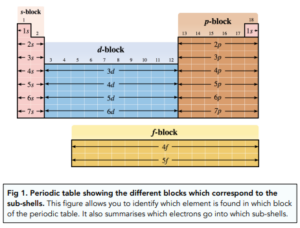
Label the different blocks on the periodic table.
What three things does this electron configuration tell you?

In the first shell/energy level.
In the s subshell.
There are two electrons in the s subshell.
True or false? Orbitals are filled up singly before electron pairing starts.
True.
True or false? Electrons in the same orbital are attracted to one another.
False. ELECTRONS IN THE SAME ORBITAL REPEL ONE ANOTHER.
True or false? Electrons are removed from the highest energy level first.
True.
Give two transition metals with unusual electron configurations.
Chromium.
Copper.
What is unusual about the electron configuration of chromium? Why does it do this?
Instead of the 4s subshell being full, one electron goes to the 3d subshell giving - 3d5, 4s1 NOT -3d4, 4s2
It does this to form a more stable half-full 3d subshell.
What is unusual about the electron configuration of copper? Why does it do this?
Instead of the 4s subshell being full, on electron goes to the 3d subshell.
It does this as it forms a more stable, full 3d subshell.
True or false? In transition metals, the 4s subshell is emptied first when forming ions.
True.
True or false? The 3d subshell has a lower energy than the 4s subshell.
False. THE 4s SUBSHELL HAS A SLIGHTLY LOWER ENERGY THAN THE 3d SUBSHELL.
Define first ionisation energy.
The energy required to remove one mole of electrons from one mole of atoms in the gaseous state.
Give the general equation for first ionisation.
X (g) → X+ (g) + e-
True or false? All ionisation energies are endothermic.
True.
Describe and explain how shielding affects ionisation energy.
Increased shielding decreases ionisation energy. Increased shielding decreases the attraction between the electron being removed and the positively charged nucleus, this attraction requires less energy to overcome.
Describe and explain how atomic radius affects ionisation energy.
Increasing atomic radius decreases ionisation energy. As atomic radius increases, the distance between the electron that will be removed and the nucleus increases the two attraction between the two decreases. Less energy is required to overcome this attraction.
True or false? As the number of the ionisation energy increases (1st, 2nd, 3rd…) the ionisation energy decreases.
False. AS THE NUMBER OF THE IONISATION ENERGY INCREASES, THE IONISATION ENERGY INCREASES.
Describe and explain how nuclear charge affects ionisation energy.
As nuclear charge increases, ionisation energy increases. As nuclear charge increases the attraction between the positively charged nucleus and the electron that will be removed increases. This attraction requires more energy to overcome.
What is successive ionisation?
The removal of more than one electron from the same atom.
What do jumps in successive ionisation energies suggest?
That electrons are now being removed from an energy level/shell that is closer to the nucleus.
Why does aluminium have a dropped first ionisation energy in period 3?
The outer electron of aluminium is in 3p which is slightly higher energy and further from the nucleus than the last electrons in magnesium, so it requires less energy to remove.
Why does sulfur have a dropped first ionisation energy in period 3?
There is a pair of electrons in the 3p orbital (3p4) that repel each other so require less energy to remove one.
Define mass number of an atom.
The number of neutrons + the number of protons in the nucleus of an atom.
Give two reasons why samples must be ionised in TOF mass spectrometry.
To form positively charged ions that will be accelerated by an electric field.
To generate a current at the negatively charged plate (when the positively charged ions gain an electron each).