Lecture 4: Uptake, Metabolism and Elimination of Pollutants
 Call Kai
 Learn
Learn Practice Test
 Spaced Repetition
 Match
Match Flashcards
 Knowt Play
1/47

There's no tags or description
Looks like no tags are added yet.
Name | Mastery | Learn | Test | Matching | Spaced | Call with Kai | Chat |
|---|
No analytics yet
Send a link to your students to track their progress
48 Terms
What feature in toxicology is most important?
Most chemicals must enter the organism to exert a toxic effect
What is ADME?
Absorption
Distribution
Metabolism
Excretion
What are the exposure routes?
Inhalation
Dermal contact
Ingestion
Injection
Absorption vs adsorption
Absorption occurs where molecules are drawn into the bulk of the phase and penetrate/distribute into the material
Adsorption occurs when molecules adhere to the surface of the phase
Absorption
Transfer of chemical from exposure site to system circulation
Usually (but not always) through the bloodstream (systemic circulation)
Factors affecting absorption rate:
Route of exposure
Dosage of concentration
Physicochemical properties of chemicals
Physiological factors
To enter an organism
A chemical must cross a cell membrane no matter what the route of entry (ingestion, inhalation, gills, skin). A cell membrane consists of a bilayer of lipids.
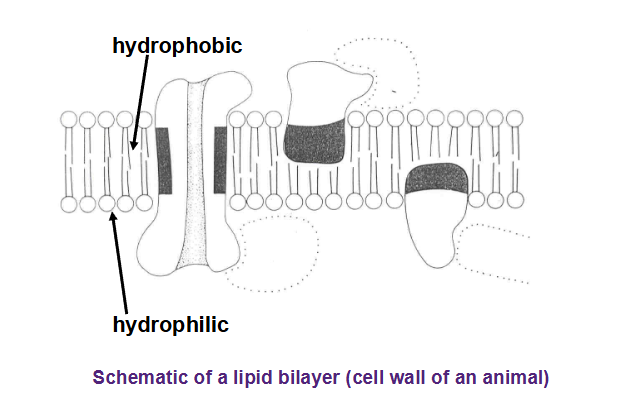
What are the four ways in which chemicals can pass through lipid bilayers?
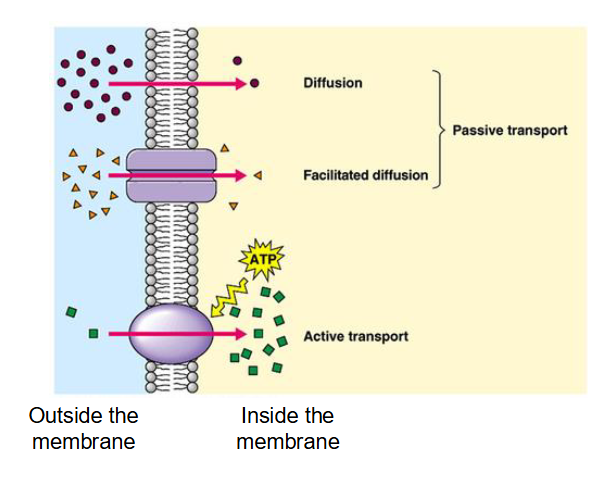
Diffusion
Facilitated diffusion
Active transport
Endocytosis
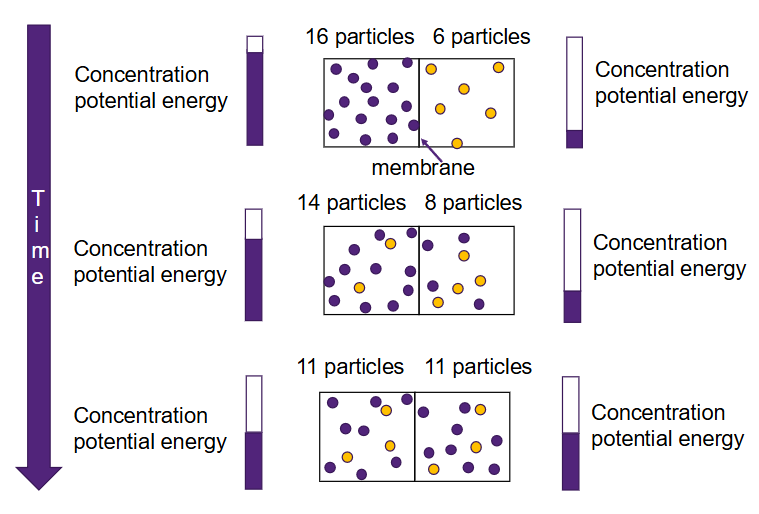
Diffusion
The movement of a chemical molecule from a place of higher concentration to a place of lower concentration (along concentration gradient). This process does not require much energy. This process also never stops; net movement is what stops.
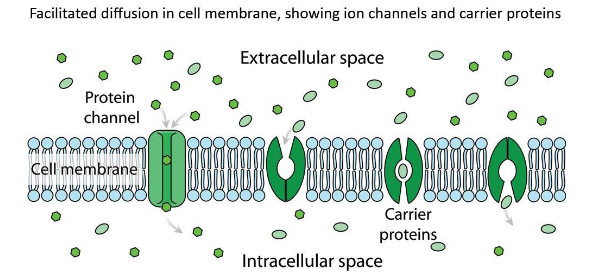
Facilitated diffusion
A form of diffusion that is aided by transmembrane proteins (channel protein and carrier proteins), that cross the membrane. It does not travel through these bilayer lipids
Channel proteins demonstrate weak selectivity of molecules based on size and charge status. Carrier proteins are more selective (only allows one type of protein to pass through).
Chemicals that use facilitated diffusion function
Glucose (sugar) is absorbed through these carrier proteins. It does not go through the bilayer lipids because the molecules are too large and too polar (water loving).
Active transport
Active transport acts against the concentration gradient. It transports molecules from where concentration is lower to places of higher concentration. This process requires energy.
Endocytosis
A general process by which cells absorb external material by engulfing it within the cell membrane. The two types of endocytosis are:
Phagocytosis
a cellular process for ingesting and eliminating solid particles larger than 0.5 μm in diameter, including microorganisms and foreign substances
Pinocytosis
a cellular process for ingesting and eliminating liquids and dissolved substances
Chemicals that use active transport
Sodium ions
How do pollutants cross membranes?
As long as there is a favourable concentration gradient, any chemical can cross over
Proteins allow chemicals to cross over when they get tricked:
Only chemicals with a similar size, volume and favourable concentration gradient can cross by facilitated diffusion
Only chemicals with a very similar size, volume or 3D shape can cross by active transport
e.g. ionic radius of cadmium (Cd2+ = 95 pm) and calcium (Ca2+ = 100 pm) are very similar, so Cd2+ can bind to proteins that transport Ca2+ across membranes
Do all chemicals cross the membrane equally?
Physicochemical properties control entry:
Ionic state
neutral molecules (not charged) cross membranes better than charged molecules (because they are nonpolar and oil loving)
Molecular size
smaller molecules cross membranes more easily (lower effort)
Lipophilicity
increased lipophilicity increases the ability to cross membranes
Viscosity
increased viscosity decreases the ability to cross membranes (lower effort)
Concentration
increased conc increases the ability to cross membranes
The Gastrointestinal tract (GIT)
This route of entry applies to pollutants in food, solids or liquids that are swallowed.
Parts of the body involved in the ingestion of a pollutant
Mouth and teeth
to chew and break food in smaller pieces thus increasing surface area to volume ratio
small amounts of food also absorbed in mouth
Oesophagus
conduit from the mouth to the stomach
Stomach
receptacle for chewed foods
acid and enzyme excretion which breakdown the structure of the food particles
food leaves the stomach and enters the small intestine
Small and large intestine
the principal organs that absorb food substances and pollutant into the organism’s body
The intestines as a route of absorption
Intestines are designed to maximise absorption
small intestine is ~2.7 to 5 m long in adults
large intestine is ~1.5 m long in adults
intestines have three sets of ridges (plicae circulares→ villi → microvilli) to increase their surface area (which increases absorption of food including toxicants)
Respiratory system (land animals)
This route of entry applies to pollutants in air, particles or vapour that is inhaled
Parts of the body involved in the inhalation of a pollutant
Trachea
Bronchi (primary and secondary)
Bronchioles
Alveolar duct
Aleveoli
The aleveoli as a route of absorption
Gas exchange occurs between alveoli and capillaries
Gases can dissolve and diffuse between the lungs and the circulatory system
oxygen diffuses into red blood cells
carbon dioxide diffuses into alveolus
Lungs maximise gas exchange by increasing surface area (adult lung area is ~50 - 70 m2)
Defences of the respiratory system
Nose has nasal hairs (act as crude filter) and mucosa cells that line the nose and secrete mucus (trap particles)
Medium sized particles will hit the larynx and will not go further than the mouth
Lung structure and air velocity
our airway will double 23 times which helps with particle removal (area increases)
Bernoulli’s principle suggests that high velocity keeps small and large particles suspended, whereas lower velocity causes larger particles to strike mucus covered surfaces
The mucociliary escalator is made of Goblet cells that line the respiratory system (mouth, nose to bronchioles) and secrete mucus (phlegm, sputum or spit)
mucus layer is 5 to 10 µm thick
other cells lining the respiratory system are called ciliated cells which have cilia (tiny hairlike projections)
Coughing and sneezing
Particles sizes and penetration into the respiratory system
10 µm (coarse)
mass = 1
particle no. = 1
surface area per particle = 1
total surface area per mass = 1
filtered in proximal airways
may irritate skin and mucosa
2.5 µm (fine)
mass = 1
particle no. = 64
surface area per particle = 0.0625
total surface area per mass = 4
reached peripheral airways
cannot enter systemic circulation
0.1 µm (ultrafine)
mass = 1
particle no. = 1,000,000
surface area per particle = 0.0001
total surface area per mass = 100
higher adsorbed toxic material on surface
may enter systemic circulation
COVID and respiratory system
When coronavirus infects cells in the respiratory system, they cut off cilia and stop their cleaning function
Respiratory system (aquatic organisms)
Gills in aquatic organisms perform the same function as lungs in terrestrial organisms (exchange gases and bring O2 into the organism). They are the main route of entry for pollutants in aquatic organisms.
Skin
The skin is a selective barrier some substances can penetrate and others can not
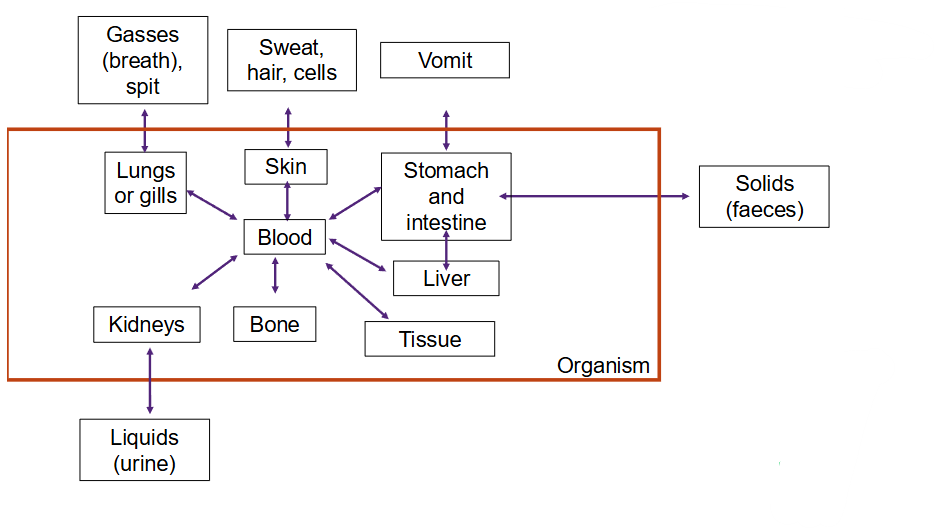
Distribution within the organism
Partitioning within the blood to kidneys and liver, bone and tissues.
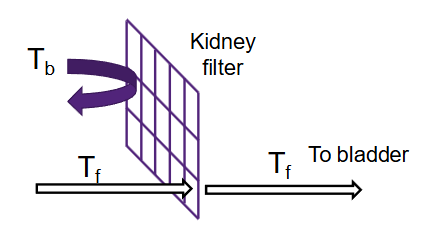
Tf + biomolecule → Tb
Tf the free fraction of biologically active and can cause toxic effects
Tb the bound fraction is not biologically active and does not cause toxic effects
Blood phases
Blood has three main phases:
Water
Lipids
Protein
Examples of partitioning in blood
DDT
log KOW = 6.2
aqueous solubility (mg/L) = 0.003
% free = 0.1
% bound = 99.9
Parathion
log KOW = 3.8
aqueous solubility (mg/L) = 6.5
% free = 1.3
% bound = 98.7
Nicotine
log KOW = 1.3
aqueous solubility (mg/L) = very soluble
% free = 75.0
% bound = 25.0
Persistent Organic Pollutants (POPs such as DDT) are preferably stored in fat cells. What do you think would happen to blood concentrations of POPs if a person lost weight?
We would expect POP concentrations in blood to increase.
Do you think that organisms with a higher fat content would be able to tolerate more or less of a fat-soluble pollutant?
We would expect organisms with a higher fat content would be able to tolerate higher concentrations of a fat-soluble pollutant.
Metabolism and biotransformation
Many foreign chemicals (xenobiotics) enter the body. Organisms have developed defences against these chemicals. Decreasing order of important for biotransformation:
Liver
Kidney
Lungs
Intestine
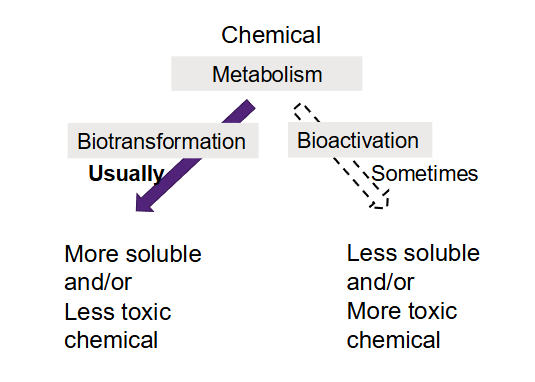
Metabolism (biotransformation vs bioactivation)
Biotransformation reactions are catalysed by enzymes
Enzymes are proteins that facilitate particular biochemical reactions to occur
Phase 1 reactions of biotransformation
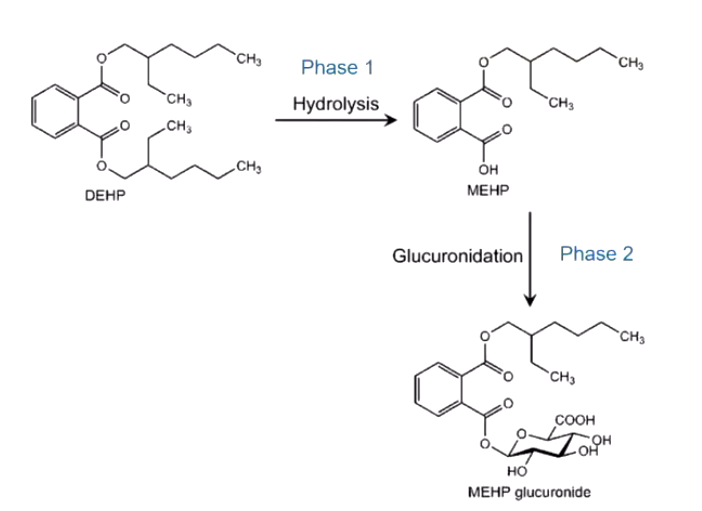
Phase 1 reactions involve oxidation, reduction and hydrolysis of the chemical
Phase 1 enzymes are cytochrome P450 system and mixed function oxygenase
These reactions add or expose:
Hydroxyl groups (OH-)
Amino groups (NH2)
Thiol groups (SH)
Carboxyl groups (COOH)
these increase the chemicals’ polarity, aqueous solubility and make it more susceptible to Phase 2 reaction
Phase 2 reactions of biotransformation
These are called biosynthetic reactions or conjugate reactions, and they require energy to occur
Conjugation process involves adding endogenous molecules to the foreign molecules that have already been hydrolysed in Phase 1 metabolism
e.g. glucuronic acid and sulfate will attach these molecules to the Phase 1 metabolite to become more water soluble and available for excretion (pee)
Example of Phase 2 reactions
Di(2-ethylhexyl) phthalate (DEHP) is a commonly used plasticiser. Polymers when first produced as plastics are useless so plasticisers are added to make the product malleable. The issue is that these plastics are binded to the material and easily leached. So it is likely everyone has DEHP in their body — however it can be metabolised and excreted easily.
Interesting feature of biotransformation
Most enzymes are highly specific — they catalyse one specific chemical reaction
but enzymes in metabolism (biotransformation and bioactivation) are not
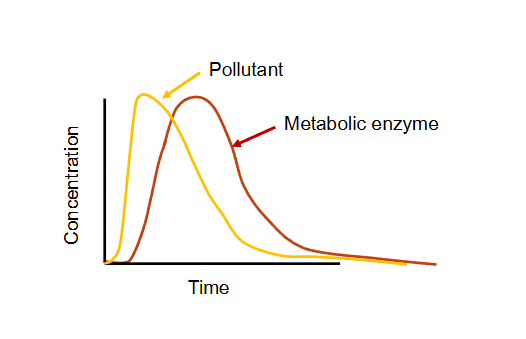
Animals and humans are not born with a full complement of metabolic enzymes
chemical concentrations in infants and kids are much higher than adults
Elimination of pollutants
The main routes of excretion are:
Urine
Faeces
Respiratory system
pee and poo are generally the most important but it depends on the physicochemical properties of pollutant
Urinary system
The kidney is a filter of water-soluble material
Tf can bypass to bladder whereas Tb cannot bypass due to larger molecule weight
Faecal system
Mainly excrete molecules with a larger weight
When we lose fat where do they go?
85% leaves via our lungs as CO2 and the rest as water through urine and sweat etc.
Respiratory system elimination (lungs)
The lungs only eliminate gases or volatile pollutants. e.g. carbon dioxide, alcohol
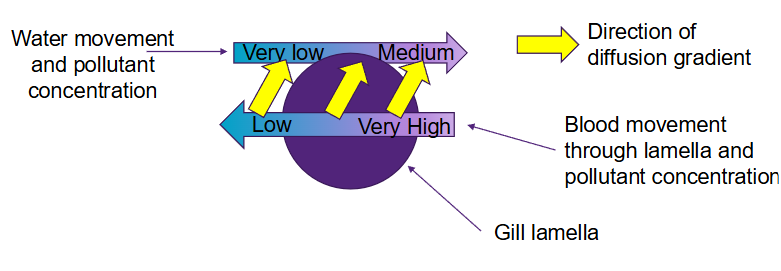
Respiratory system elimination (gills)
Fastest for chemical with low lipophilicity (log KOW < 3) and/or high polarity
Slow for non-polar chemicals
Driven by diffusion — must be a favourable gradient (higher internal conc and lower external conc)
Elimination by other organisms
Fish lay fat rich eggs
Crustaceans and insects moult their exoskeleton
Birds incorporate metals into their feathers
Many aquatic organisms secrete metals into granules
Elimination by plants
They have a range of different elimination routes compared to humans and mammals:
Transformation (equivalent to animals)
Leaching
Evaporation from leaves (equivalent to animals’ lungs or gills)
Dying and falling leaves (equivalent to animals’ hair, nails etc)
Exudation from roots
Herbivore grazing
Biomagnification
When toxins stored in fat cells increase in their concentration as they move along the food chain. (e.g. diotoxins from burning plastics → settle in pastures → consumed by cattle → eaten by humans → accumulate in from mother to infant)
Breast milk
Numerous studies have shown that mothers milk contains a range of organic chemicals e.g. POPS
Overall picture of distribution and excretion