A&P: Ch 2: Chemistry
 Call Kai
 Learn
Learn Practice Test
 Spaced Repetition
 Match
Match Flashcards
 Knowt Play
1/18

There's no tags or description
Looks like no tags are added yet.
Name | Mastery | Learn | Test | Matching | Spaced | Call with Kai | Chat |
|---|
No analytics yet
Send a link to your students to track their progress
19 Terms
Matter
anything that has mass and occupies space
Solid
definite shape and volume
liquid
changeable shape; definite volume
gas
changeable shape and volume
Kinetic
energy in action
Potential
stored (inactive) energy
elements
Four elements make up 96% of body:
• Carbon, oxygen, hydrogen, and nitrogen
• 9 elements make up 3.9% of body
• 11 elements make up <0.01%
Covalent Bonds
two atoms that share one or more pairs of electrons
Why they are important: they share pairs of electrons to hold atoms together and create the stable molecules needed for life

Ionic bond
a strong chemical link formed when one atom gives up one or more electrons to another atom
Why they are important: creating oppositely charged ions that stick together through electrostatic attraction

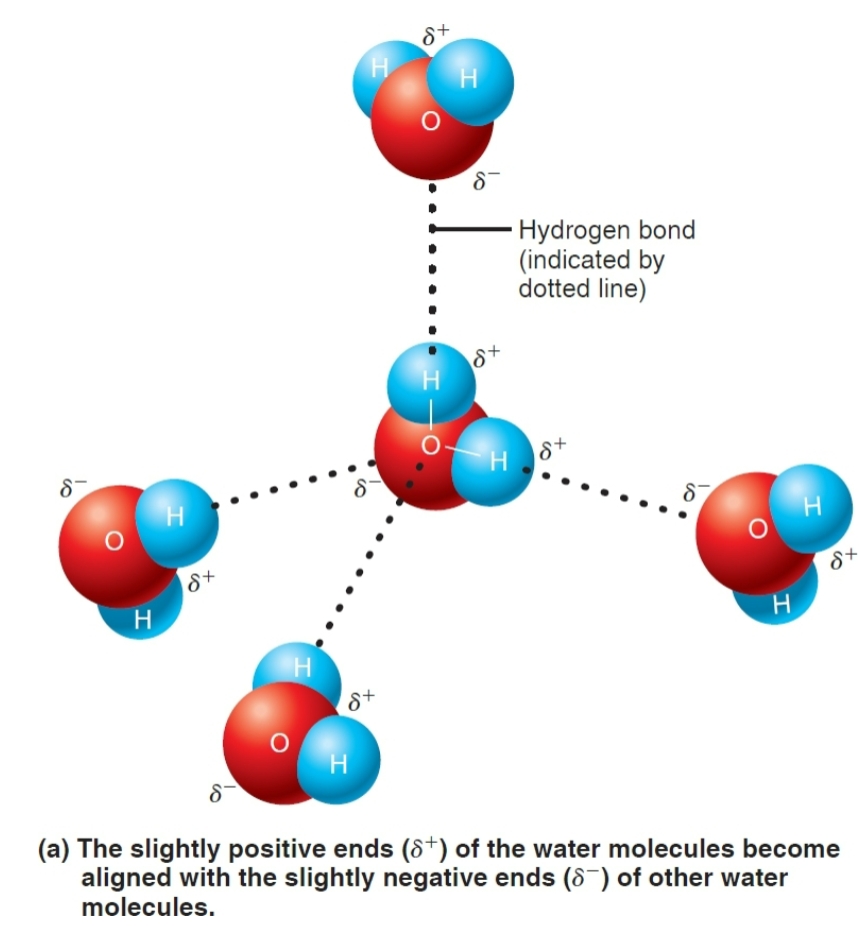
Hydrogen bond
weak type of attractive interaction that forms when a hydrogen atom covalently bonded to a strongly electronegative atom (like oxygen, nitrogen, or fluorine) experiences an electrostatic attraction to another nearby electronegative atom
Why are they important:
Water properties: They give water a high boiling point and make it liquid at room temperature.
Polar covalent bond
Unequal sharing: One atom pulls the shared electrons closer to itself.
Charge distribution: Creates partial charges—a slightly negative charge on the stronger atom and a slightly positive charge on the weaker atom.
Nonpolar convalent bond
Equal sharing: Atoms share their electrons equally.
Charge distribution: There are no positive or negative poles.
Ex. carbon dioxide
electrolytes and ionic bonds
Electrolytes form when ionic compounds dissolve in water and their ionic bonds break apart into free moving, charged ions
Carbohydrates
Building blocks: Simple sugars or monosaccharides (like glucose).
Main job: Provide fast, easy energy for your cells and brain.
Lipids
Building blocks: Glycerol and fatty acids.
Main job: Store long-term energy, protect organs, insulate the body, and build cell membranes
Proteins
Building blocks: Amino acids.
Main job: Build and fix tissues (like muscles), speed up chemical reactions as enzymes, and support the immune system.
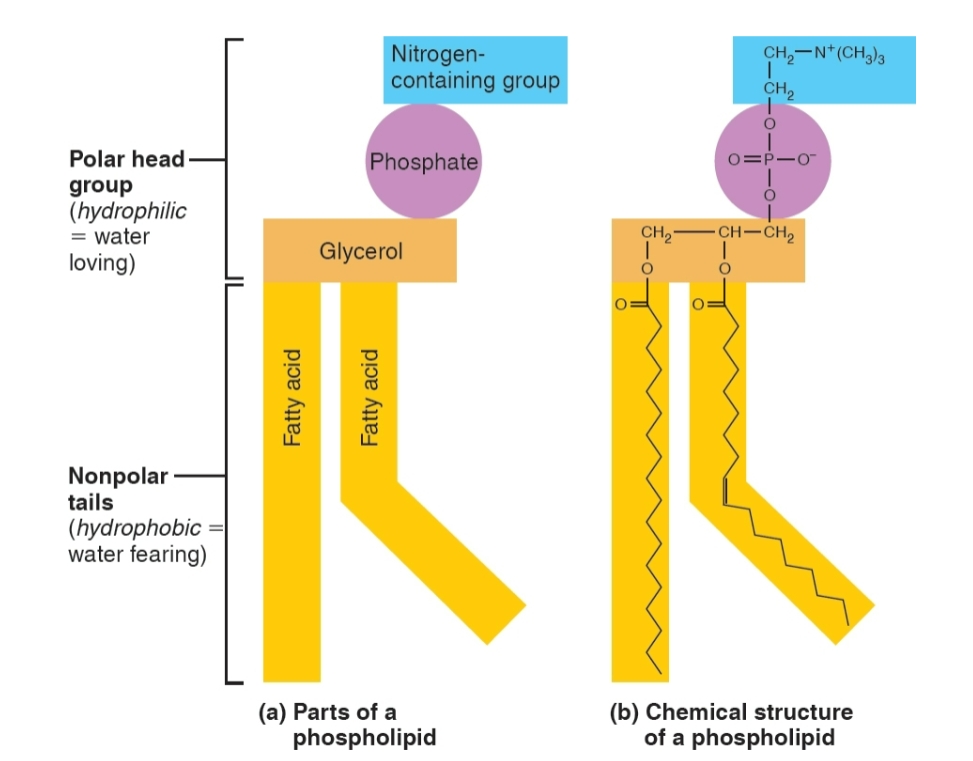
phospholipid
a fat-like molecule with a water-loving (hydrophilic) head and two water-fearing tails (hydrophobic)
naturally line up in two rows to make a lipid bilayer.
The inner core stops large or charged items from crossing easily.
Bent or straight tails keep the membrane flexible so the cell can move and change.
host proteins and cholesterol to help the cell communicate and function
Acids
proton donors, they release hydrogen ions (H+), less than 7
bases
more than 7, Substances that accept hydrogen ions or release hydroxide ions (OH⁻) into a liquid. They often taste bitter, feel slippery, and turn red litmus paper blue. Examples include soap and baking soda