CH 02 - Chemical components of cells
 Call Kai
 Learn
Learn Practice Test
 Spaced Repetition
 Match
Match Flashcards
 Knowt Play
1/24

Earn XP
Description and Tags
EXAM 1: homework problems
Name | Mastery | Learn | Test | Matching | Spaced | Call with Kai | Chat |
|---|
No analytics yet
Send a link to your students to track their progress
25 Terms
The chemical reactions that take place in a cell, as compared to the chemistry in nonliving matter, primarily occur
BETWEEN CARBON BASED MOLECULES
The chemistry of living things follows all the same chemical and physical laws of the chemistry that occurs in the nonliving world. The difference is that the chemical compounds of life are mostly carbon-based polymers that undergo complex reactions in an aqueous environment.
Two atoms held together solely by ionic bonds are referred to as a(n)
SALT
Atoms are the simplest form of an element that still retain the properties of that element. When multiple atoms come together, it is called a molecule, but when those bonds are solely ionic bonds, it is often called a salt.

Given the periodic table below, how many electrons does an oxygen atom have?
8
The atomic number is the number of protons in the nucleus of an atom. For an atom to remain electrically neutral, the number of electrons is equal to the number of protons. Thus oxygen, with an atomic number of 8, has 8 electrons.
Glucose has a molecular weight of 180 grams per mole. To prepare 1 liter of a 100 mM solution, how many grams of glucose would you dissolve in water for a total volume of 1 liter?
18
Glucose has a molecular weight of 180 g/mole, which means that dissolving this mass of glucose in a liter would give a 1 M solution. Because 100 mM is 0.1 M, it is 1/10 of the concentration. Using 1/10 of the molecular weight (18 g) in the same volume would give a 1/10 concentration, thus a 0.1 M or 100 mM solution.
How many bonds are made by a carbon atom?
4
Carbon has four electrons in its outer shell and it needs eight to fill it. To fill its outer shell, carbon can share electrons with four different atoms, forming four bonds.
A molecule with a lot of polar covalent bonds is likely to be
HIGHLY SOLUBLE IN WATER
Polar covalent bonds are formed when two atoms unequally share an electron, forming partial positive and partial negative charges at either end of the bond. Water also has partial positive and negative charges, and thus will easily interact with other molecules’ partial charges, thus making it soluble.
Which of the following is UNLIKELY to be hydrophilic?
MOLECULE W PRIMARILY NONPOLAR COVALENT BONDS
Hydrophilic molecules carry positive or negative charges, allowing them to interact with the partial charges on water molecules. Polar covalent bonds form partial charges, whereas nonpolar covalent bonds do not.
A base is a molecule that will ___________ a proton in water
ACCEPT
Bases accept protons in water, removing a proton from a water molecule, forming OH2_ ions. If the hydrogen atoms in water are more attracted to the electronegative atom of a base, they can be stripped off as a proton.
Ionic bonds are ___________ than covalent bonds and are ___________ common in cells.
WEAKER, LESS
Ionic bonds are weak bonds commonly found in salts that form ions in aqueous solution. Because the cell environment is primarily aqueous, ionic bonds are dissociated by interaction with water.
Which of the following occurs by bringing nonpolar surfaces together to exclude water?
HYDROPHOBIC FORCES
Surfaces with nonpolar bonds cannot favorably interact with water. These hydrophobic surfaces prefer to come together to exclude water. This is referred to as hydrophobic force.
Which of the following is an inorganic compound?
TABLE SALT (NaCl)
Organic compounds are made up of carbon atoms linked together, frequently along with other atoms and chemical groups. Inorganic compounds do not contain multiple linked carbon atoms.
Which of the following chemical groups could confer nonpolar/hydrophobic characteristics on the region of a molecule in which it is found?
METHYL GROUP (CH3)
Bonds between carbon and hydrogen are nonpolar and molecules with mostly nonpolar bonds are hydrophobic. Bonds between H and electronegative atoms like O and N are polar and tend to impart hydrophilic characteristics.
Long polymers are made from single subunits in cells using a ___________ reaction, which ___________ water.
CONDENSATION, RELEASES
A condensation reaction joins two monomers together, releasing water. A hydrolysis reaction uses water to split the bond that joins two subunits of a polymer.
Which of the following is a role that sugars can play outside of their role in energy production and storage?
FORMATION OF SUPPORT STRUCTURES
Sugars play many roles outside of being an energy source that is stored and/or harvested for powering cellular processes. Sugars also form support structures like cell walls, exoskeletons, or adherent structures on the cell surface.
What is the name used for a molecule in which two carbons of glycerol are attached to fatty acid chains, and the third carbon is attached to a phosphate group?
PHOSPHOLIPID
Glycerol molecules have three carbons attached to −OH groups that can be linked to fatty acids or other molecules. When two fatty acids and a phosphate are attached to glycerol, it is called a phospholipid. If three fatty acids are attached, it is called a triacylglycerol.
Which way do the fatty acid tails of a phospholipid face in a cell membrane?
BOTH DIRECTIONS
To form cell membranes, phospholipids form a bilayer, with the fatty acid tails facing each other. Thus, one layer has the fatty acid tails facing inward and the other layer has the fatty acid tails facing outward.

The following image shows two triacylglycerol molecules with different fatty acid chains. If these fatty acids were in a phospholipid molecule, which of the two would form the most fluid membrane?
UNSATURATED
Unsaturated fatty acids have double bonds in their hydrocarbon chains, and so have kinks in them; these keep them further apart. Thus, membranes made from unsaturated fatty acids are more fluid because they cannot pack as closely together as saturated fatty acids, which have no double bonds and are straighter.
All amino acids have which of the following chemical groups in common?
CARBOXYL GROUP
All amino acids have an amino group (NH2) and a carboxyl group (−COOH) attached to a central carbon. They differ in which side groups are attached to the central carbon, such as a methyl group or aromatic rings, for example.
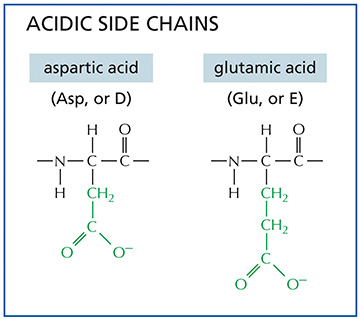
Amino acids with side chains that contain −COOH groups, like those shown below, would be ___________ in the aqueous environment of a cell.
ACIDIC
Amino acids like glutamic acid and aspartic acid have side chains that terminate in carboxylic acid groups (−COOH). This group loses a proton in water and is acidic in nature.
A nucleotide is different from a nucleoside because a nucleotide has a
PHOSPHATE GROUP
A nucleotide is a sugar (either ribose or deoxyribose), attached to a nitrogen-containing base, and one or more phosphate groups. A nucleoside simply lacks any phosphate groups.
What is one of the main differences between DNA and RNA?
RNA - TWO SUGARS
DNA - ONE SUGAR
RNA uses the sugar ribose, which has a 2′ and a 3′ −OH, whereas DNA uses the sugar deoxyribose, which only has a 2′ −OH. This leads to fundamental differences in the self-replication and stability of these molecules.
A readily available source of energy that cells use to drive reactions is stored in the ___________ bond.
PHOSPHOANHYDRIDE
Nucleotide triphosphates, notably ATP, have three phosphoanhydride which can be hydrolyzed easily to release energy.
Covalent bonds in macromolecules are primarily important for
LINKING TOGETHER MONOMERS
Covalent bonds are strong and are used within molecules to form the linkages between monomers that form the polymer. Noncovalent bonds are more important for the three-dimensional conformation and for interactions with other molecules.
Strong and specific associations between macromolecules or between an enzyme and its substrate are due to
MANY WEAK NONCOVALENT BONDS
Two macromolecules in a cell come together in a very specific way through many weak noncovalent associations between them. This allows more specificity, but also easier reversibility, as molecular interactions often must be relatively short lived in cells.
The technique that scientists used to determine that hemoglobin was a single large macromolecule rather than a loose conglomeration of small organic molecules was
ULTRACENTRIFUGATION
Scientists at first did not believe that molecules could be as large as hemoglobin, and thought they were a lot of smaller molecules held together in close association. Separating molecules by size in ultracentrifugation allowed scientists to see if macromolecules were just one molecule of a large size, or many small molecules.