PCOL 406- Exam 1
 Call Kai
 Learn
Learn Practice Test
 Spaced Repetition
 Match
Match Flashcards
 Knowt Play
1/111

There's no tags or description
Looks like no tags are added yet.
Name | Mastery | Learn | Test | Matching | Spaced | Call with Kai | Chat |
|---|
No analytics yet
Send a link to your students to track their progress
112 Terms
Pharmacology
The study of drugs and their effects on living organisms.
The goal of Pharmacology
The goal of pharmacology is to understand the mechanisms by which drugs interact with biologic systems to enable the rational use of effective agents in the diagnosis, prevention, and treatment of disease.
Drug
Can be defined as a natural product, chemical substance, or pharmaceutical preparation intended for administration to a human or animal to diagnose or treat a disease
Drugs may be hormones, neurotransmitters, or peptides produced by the body either systemic or natural
Xenobiotic Drugs
Produced outside the body, either synthetic or natural
Poison
A drug that can kill. Most drugs are poisons since they can be lethal at a certain dose. Even water is a poison (ex. Water intoxication leading to death)
There are also some poisons that aren’t drugs (ex. Ricin, Polonium, Ethylene Glycol)
Toxin
A drug that can kill and is produced by a living organism. Some toxins are drugs (ex. Artemisinin, Taxol, Opium)
Natural Drugs
Often plant compounds called alkaloids (nitrogen containing), examples include morphine, cocaine, atropine, and quinine. Antibiotics isolated from microorganisms. Hormones from animals, and minerals (lithium)
Synthetic Drugs
Only became available with the development of modern chemistry, started with modifying or producing natural drugs (aspirin, barbiturates, procaine, oxycodone).
Led to screening compounds for activity, has evolved to structure activity modeling for rational design now aided by AI
4 Types of Drug Preparations
Natural Drug Source (Ex., Opium poppy, Marijuana, Tobacco, Psilocybin Mushrooms, Peyote)
Crude Drug Preparations (Ex., Raw opium, coffee, tea)
Pure Drug Extract (Ex., Morphine, Insulin)
Pharmaceutical formulation (Ex. Morphine tablet, capsules, IV)
Pharmaceutical Preparations Purpose
Drugs are refined to make manufacturing pharmaceutical preparations that are suitable for administration of a particular dose to the patient.
Refined drugs can be prepared for enteral (lozenge, pill, suppository), inhalation, transdermal (aerosol, lotion, patches), or parenteral (IM, IV, intrathecal, subcutaneous injection).
Refined drugs let us know the DOSE!!! Compare to a tea made from Jimson weed (You don’t know the dose!!!)
Drug Names
A chemical name (Ex., Acetylsalicylic acid).
A nonproprietary/generic name (Ex., Aspirin, Ibuprofen, Morphine)
A proprietary name or a trade/brand name (Ex., Disprin).
Pharmacodynamics
What the drug does to the body
Provides a scientific basis for the selection and use of drugs to counteract specific pathologic changes caused by disease, trauma, or genetic anomalies
Pharmacokinetics
What the body does to the drug
The study of drug disposition (what happens after the drug enters the body) and focuses on the changes in drug plasma concentration.
The plasma concentration of the drug rises and falls according to the rates of 4 processes: Absorption, Distribution, Metabolism, Excretion (ADME)
Drug Absorption
Refers to the passage of drug molecules from the site of administration into the circulation. This requires that drugs cross one or more layers of cells and cell membranes.
Injections bypass the first epithelial layer of the gut, but drug must still get into target tissue through multiple membranes (first the blood vessel cells, then (often) the membrane of the target cell – this depends on were the drugs “receptor” is located)
Oral vs. Parenteral Administration
In the gut, lungs, and skin drugs must first be absorbed through a layer of epithelial cells that have tight junctions.
For this reason, drugs face a greater barrier to absorption after oral administration than after parenteral (not gut) administration
Passive Diffusion
Most drugs are absorbed by passive diffusion into circulation (No ATP and transporter required)
Absorption rate is proportional to the drug concentration gradient across the barrier and surface area of absorption (Fick’s law).
Drugs absorbed passively through cells by lipid or SOMETIMES aqueous diffusion
Lipid & Aqueous Diffusion
Lipid diffusion is a passive diffusion process by which drugs dissolve in lipid components of cell membrane; main route of diffusion for most drugs.
Aqueous diffusion occurs by passage through aqueous pores in cell membranes but many drugs are too large for this process.
Ionization and Absorption
Many drugs are weak acids or bases that exist in both ionized and non ionized forms.
Only the nonionized form of these drugs can to cross cell membranes.
The ratio of ionized/nonionized forms at a particular site influences the rate of absorption.
pH and pKa
At a pH equal to the pKa, equal amounts of the protonated and non-protonated forms are present.
If the pH is less than the pKa, the protonated form predominates (for an acid this means lipophilic = faster absorption and for a base this mean charged = slow absorption.) Gains proton (H+)
If the pH is greater than the pKa, the non-protonated form predominate
Absorption based on Weak Acids or Bases
Absorption across a membrane depends on whether the drug is a weak acid or base.
For example, weak acids are more readily absorbed in the stomach (low pH keeps the H+ stuck on them and makes them uncharged = lipophilic)
Weak bases are more readily absorbed by the intestines than the stomach. The massive surface area of the intestines allows absorption of even weak acids though (weak acids can give away their H+ as the pH increases after the stomach, but remember it’s not all or nothing, and some weak acids will still have their proton even momentarily and cross the gut membrane)
ABC Transporters/Efflux Pumps
Opposing the distribution of drugs are a number of ATP-driven efflux pumps known as ABC transporters. This is what promotes the M and E in ADME
The most studied of these proteins is P-glycoprotein (Pgp – “P” for permeability)
P-glycoprotein (Pgp)
Excretes various xenobiotics (usually plant products) back out of enterocytes (the cell) into the intestinal tract
Serving as a detoxifying mechanism that prevents absorption and also serves to exclude drugs from the brain as part of the blood brain barrier.
Why does the body care so much about keeping xenobiotics out of the brain? Xenobiotics are foreign substances that may toxic/harmful.
Drug Metabolism
Drug metabolism (biotransformation) is the enzyme-catalyzed (mostly done by “CYPs”) conversion of drugs to their metabolites.
Most drug-metabolizing (both Phase I and Phase II) takes place in the liver but drug-metabolizing enzymes are found in other tissues including the gut (enterocytes), kidneys, brain, lungs, and skin. This is because these tissues are the sites of exposure and thus absorption!
Metabolism can lead to either drug activation or deactivation. Recall the examples of exceptions: diazepam (valium) which must be metabolized to become active, and morphine who’s gluranide conjugate is actually more potent.
Role of drug-metabolizing enzyme
The fundamental role of drug-metabolizing enzymes is to make xenobiotics less lipophilic so they can be excreted. They usually inactivate and detoxify xenobiotics (drugs) that enter the body.
These enzymes do not recognize whether they are bioactivating or inactivating, hence why valium and morphine are bioactivated.
First Pass Effect
Drugs/xenobiotics absorbed from the gut go directly to the liver via the hepatic portal vein – FIRST PASS EFFECT.
Many drugs are converted to inactive metabolites during their first pass through the gut wall (where there are CYPs) and liver (Where most of the CYPs are) and have low bioavailability after oral administration.
This is called the first-pass effect – we have to increase the dose given to compensate for the first pass effect
Drug Biotransformation Phases (I & II)
Drug biotransformation can be divided into two phases with a unique set of metabolic enzymes.
Phase I biotransformation typically creates or unmasks a chemical group (usually a –OH group, the “handle”) required for a phase II conjugation.
Phase I includes oxidative, hydrolytic, and reductive reactions, for our purposes think of it as putting a chemical handle onto the xenobiotic.
Phase II biotransformation includes conjugation reactions with an endogenous substrate such as acetate, glucuronide, sulfate, and others: the body is adding a large, bulky, polar/ionizable = charged molecule to the xenobiotic
Phase II - Why it works
Most conjugated drug metabolites (“big, bulky, charged”) are pharmacologically inactive by changing the drug’s shape (recall how even small changes to a molecule can dramatically affect the effects in the body).
In addition, the Phase II conjugated metabolites are more water soluble (less lipophilic, less likely to cross membranes = now the body can out the metabolite somewhere and it can’t just passively diffuse back into the body, the most important ”somewhere” is the urine) making it more easily excreted by the kidneys.
Phase I metabolism is not always required prior to Phase II biotransformation – many drugs already have the “handles” needed for Phase II conjugation to occur
Excretion
Its the removal of the drug from body fluids via urine, bile, sweat, saliva, tears, feces, breast milk, and exhaled air.
Most drugs are excreted in the urine once they have been made charged and can no longer diffuse across membranes, and are handled by the kidneys in the same manner as are endogenous substances
First-Order Kinetics
Most drugs exhibit first-order kinetics, in which the rate of drug elimination (amount of drug eliminated per unit time) is proportional to the plasma drug concentration and follows an exponential decay function.
The amount of drug eliminated per unit time changes with the concentration of drug in the blood – if you double the dose, you double the amount metabolized per unit of time
Zero-Order Kinetics
A few drugs (e.g., ethanol) exhibit zero-order kinetics, in which the rate of drug elimination is constant and independent of plasma drug concentration.
If you double the dose, you don’t double the amount metabolized per unit of time. The drug's elimination half-life is proportional to the plasma drug concentration.
This is important because a small increase in dosage can produce a disproportionate increase in the plasma drug concentration and greatly increase the amount of time the drug stays at toxic concentration.
THINK OVERDOSE!!! You have saturated the elimination pathways.
Which drugs exhibit first order kinetics and which zero-order?
This is the wrong question, most drugs will be first-order until the dose gets too high and then switch to zero-order kinetics!!!
Drugs exhibit zero-order elimination when high doses (or overdose) are administered
For example, with aspirin, alcohol, and the anticonvulsant phenytoin, or when a hepatic or renal disease has impaired the drug elimination processes

Zero order: Half-life varies by drug concentration. More
drug = more elimination
First order: Half-life is constant. More drug = elimination
already Max’ed out
Elimination Half-Life (t1/2)
This is the time required to reduce the plasma drug concentration by 50%.
Note that in first-order kinetics, if you double the dose (and don’t saturate the metabolism enzymes (the CYPs)) you will double the amount metabolized per unit of time.
In Zero-order kinetics, the CYPs and other elimination mechanisms are already working as fast as possible – they’re saturated, if you double the dose, you just pile up more drug waiting to be metabolized (think of the cars at a checkpoint analogy) and the half-life time will increase – again, if the drug is at a toxic level already, and the half-life increases, you will spend more time in a toxic dose range
Types of Receptors
4 Types:
Hormone/Neurotransmitter
Enzymes
Membrane transport proteins
Others (macromolecules, nucleic acids, DNA)
G protein-coupled receptors (GPCRs)
G-proteins can be stimulatory, inhibitory on multiple signaling pathways (IP3, cAMP, cGMP) that alter cell behavior and gene expression (ex: mu-opioid receptors).
There are >800 GPCRs in the human genome. As receptors, GPCRs have two interlinked jobs: they receive the external signal (the ligand binding) and ‘report’ it to the inside of the cell.
Upon activation, ligands cause a conformation change which activates the bound G protein on the intracellular-side of the membrane. Ligands can cause different effects in different parts of the body depending on different GPCRs and G-Proteins being expressed.
Agonist
Is a ligand that binds to receptors and activates them, causing a response.
Agonists have both affinity, which means they bind to the receptor (put the key in the lock), and intrinsic efficacy, which means they change the receptor's activity to produce a response (open the lock)
Antagonist
Is a ligand that binds to receptors and doesn't activate them, preventing a response. Antagonists have affinity but no intrinsic efficacy.
Types of Antagonists
Competitive: Binds to receptor at the normal ligand binding site (orthosteric) key is in the lock, but does not open it
Noncompetitive: Binds to a different site (allosteric) on the enzyme and alters the shape of the molecule, reducing its activity (changes the lock to prevent it from opening)
Positive Allosteric Modulator
Binds to an allosteric site and increases function when an agonist ligand binds
Receptor Types of Bonds
Drugs can bind to receptors through hydrogen bonding, ionic bonds, and hydrophobic bonds (covalent can be possible, but only in a few cases with specific receptors)
Weak Bond Importance
Weak bonds are reversible and enable the drug to dissociate from the receptor as the tissue concentration of the drug declines – thus as we metabolize and excrete the drug, the effect wears of

Dose-Response Curve
Sigmoid curve shown above that indicates the relationship between the drug dose and the magnitude of the pharmacological effect
Dissociation constant (KD)
Ratio of k2 to k1, drug concentration required to occupy 50% of its receptors
The lower the KD, the greater the drug's affinity for the receptor as it takes less drug to occupy 50% of its receptor

Potency vs Efficacy
Potency denotes the amount of drug needed to produce a given effect (median effective dose or ED50).
Receptor affinity is the primary determinant of drug potency (Key point: a drug can be very potent, but not very efficacious! We call that an antagonist)
Efficacy
Refers to the relative ability of a drug-receptor complex to initiate a cellular effect (not directly related to receptor affinity/potency)
Affinity
The ability of the drug to bind with its receptor or target (via the weak interactions on the last page

Comparison of Drugs using Dose-Response Curves
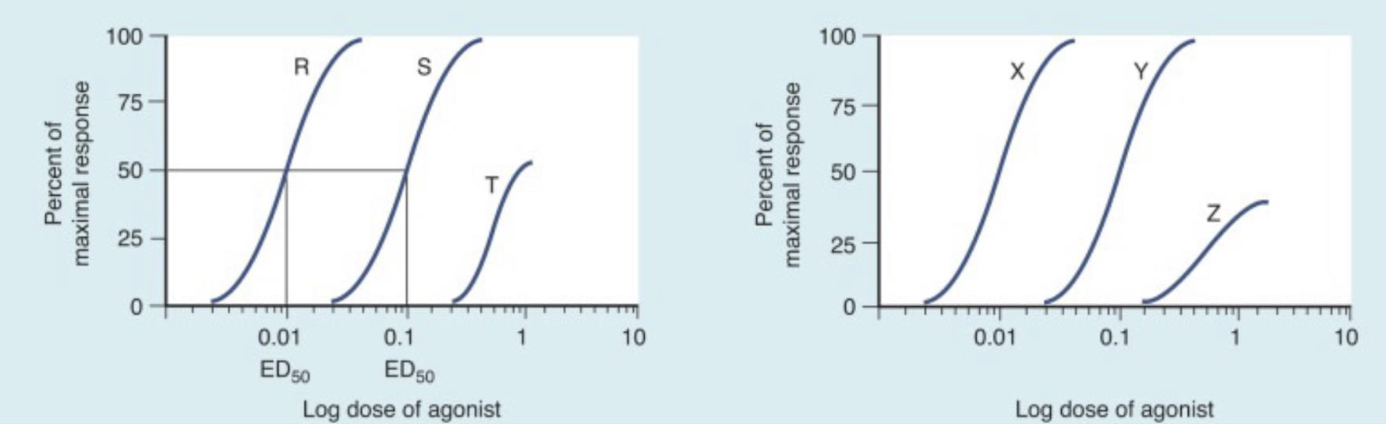
The graph on the left compares the dose-response curve of three different drugs R, S, and T.
Drugs R and S are full agonists and both have maximal efficacy. Drug T is a partial agonist and does not have maximal efficacy, no matter how much you add!
Drug R is more potent than drug S which is more potent than drug T
The graph on the right compares the dose-response curve of the same drug in the presence of:
Drugs Y is a competitive antagonist, now it takes more of Drug X to get full efficacy because it must compete for binding (orthosteric).
Drug Z is a non-competitive inhibitor (allosteric binding) that changes the shape of the receptor and makes it less able to respond when drug X binds. Note that the dose response curve of drug X has a change in slope and no matter how much we use, we no longer can get full efficacy
Comparison of Drugs using Dose-Response Curves (Cont.)
Although a noncompetitive antagonist shifts the agonist’s dose-response curve to the right (like a competitive antagonist does), it also binds to the receptor in a way that reduces the ability of the agonist to elicit a response.
This affects the efficacy, potency, and slope of the dose-response curve as seen in drug Z above. The effects of a noncompetitive antagonist cannot be overcome by higher doses of agonist, while the effects of a competitive antagonist can be overcome by increasing agonist concentration.
Therapeutic Index
Provides a general indication of the margin of safety for a drug

Toxicity (How it varies)
Toxicity varies considerably with the route and duration of exposure (ADME!).
Acute dermal exposure usually does not cause serious toxicity if the poison is rapidly and thoroughly removed from the skin to prevent absorption.
In contrast, accidental or intentional ingestion of herbicides can cause serious, irreversible, and life-threatening toxicity. Inhalation of herbicide vapors tends to cause an intermediate degree of toxicity
Herbicide- Paraquat
Converted to free radicals that induce oxidative damage to plant and human cells
Herbicide- 2,4-D
Ingredient in Agent Orange, mimics the plant hormone auxin to kill plants with 2 embryonic leaves, not grasses
Pesticide- Rotenone
Interferes with the electron transport chain in mitochondria – no ATP! Toxic to insects (and fish), but less so humans – gut enzymes provide protection and its is not well absorbed.
What about fish? They “breath” water and its easily absorbed, same for insect trachea.
Pesticide- DDT
Opens voltage-sensitive sodium ion channels at insect neurons but not mammals, causing them to fire spontaneously leading to paralysis. Makes raptor eggs too fragile. Still used today in some cases despite international ban (Malaria is much worse than DDT poisoning).
Pesticide- Pyrethroids
Delays the closure of voltage-gated sodium channels (Action Potential!) in the nerve cells of insects, leading to paralysis
Pesticide- Neonicotinoids
Blocks insect nicotinic acetylcholine receptors (ligand gated sodium channels – Action Potentials, and also mammalian receptors, nicotine is toxic to mammals so why don’t humans die that smoke or vape? DOSE DOSE DOSE!!!)
Pesticide- Organophosphates
Examples include sarin nerve gas, Malathion (pesticide), Carbaryl. Inhibit acetylcholinesterase in both insects and mammals - causes excessive acetylcholine receptor stimulation and subsequent neurotoxic effects of the parasympathetic nervous system
Treatment for Organophosphates
Treatment includes decontamination and the administration of atropine (mAchR antagonist!) and/or pralidoxime (prevents “Aging” of the covalent bond to cholinesterase).
Malathion and Carbaryl are toxic to insects, but detoxified and eliminated rapidly in vertebrates due to carboxyesterases (could a massive overdose overwhelm the esterases that toxify in mammals? Yes!). Not so for Sarin gas – it doesn’t have an ester bond.
Organophosphate Aging - chemical stabilization of the phosphate bond to AChE occurs over time, Pralidoxime (2-PAM) prevents aging & thus AChE (acetylcholinesterase) can regenerate slowly (hence atropine).
Atropine is a competitive, reversible antagonist of the muscarinic acetylcholine receptors – can prevent the effects of excessive acetylcholine caused by loss of acetylcholinesterase activity by organophosphates/sarin gas.
The Autonomic Nervous System
Sympathetic (fight or flight): Norepinephrine (adrenaline)/Epinephrine
Parasympathetic (rest, digest, read, reproduce, SLUDD, low heart/bp): Acetylcholine
SNS and PNS Relationship
The SNS and PNS antagonize each other!
Parasympathetic neurons innervate and inhibit neurotransmitter release from sympathetic neurons, and vice versa via pre-synaptic receptors.
Craniosacral outflow is parasympathetic while thoracolumbar outflow is sympathetic, physically separating the parasympathetic and sympathetic nervous systems

Explain this image!!!
All parasympathetic neuro-effector junction effects (at the organ) are mediated by muscarinic acetylcholine GPCR receptors.
Nicotinic receptors (ligand gated sodium channels!) are used at ganglionic junctions of both the SNS and PNS, and the somatic nervous system (voluntary movement) nerve-muscle (neuro-effector junction) interface.
Pre- and post-ganglionic fibers: Why have short-long in the SNS and long-short in the PNS? Because of the neurotransmitters: PNS is ACh all the way so it’s ok if the acetylcholine from the ganglionic nerve transmission spills over to the neuro-effector junction, SNS is ACh to Norepinephrine and Epinephrine – need to keep the acetylcholine away from the neuro-effector junction or it will work against the the SNS signaling!
Parasympathetic Effects
Open the vasculature so you can get the fluid to make secretions, squeeze the glands (smooth muscle contraction) to cause secretion: tears, milk, mucus. Relax the sphincters, but squeeze the contents (urination, defecation) <- different second messengers on the muscarinic receptor subtypes.
SLUDD: S: Sexual arousal, L: Lacrimation (making tears), U: Urination, D: Digestion, D: defecation.
Muscarinic Receptor Agonists Effects
Respiratory Tract Effects: Stimulation of muscarinic receptors increases bronchial muscle contraction (opposite of the vasculature elsewhere: e.g. the penis – recall how this is accomplished by differing mAChR receptor expression: peripheral endothelial cells bind acetylcholine and produce NO which diffuses and signals smooth muscle relaxation, whereas in the lung acetylcholine acts directly on smooth muscle cell receptors and causes contraction) and causes an increase in the secretion of mucus throughout the respiratory tract. Muscarinic receptor agonists can cause bronchoconstriction – careful in asthmatics!
Cardiac Effects: Muscarinic receptor agonists slow the heart rate and contractile strength – lowers blood pressure in addition to relaxing vasculature.
Eye: Muscarinic receptor agonists cause the pupil to shrink (miosis – focus to read the book) and the fluid of the eye to drain (lower ocular pressure – treat glaucoma)
GI: increase secretion of mucus, open the sphincters, squeeze the contents out – (urination, defecation).

Acetylcholine
Acetylcholine, note ester bond that is the target of acetylcholinesterase
Cholinergic Agonists
Can activate muscarinic or nicotinic receptors, or both
Choline esters
Include acetylcholine and synthetic acetylcholine analogs, such as bethanechol and carbachol - Not distributed to the CNS (Central Nervous System) due to charge (ADME!).
Carbachol activates both muscarinic and nicotinic receptors (not great), but can be used in ophthalmic surgery to constrict the pupil and lower fluid pressure in the eye

Bethanechol
Selectively activates muscarinic receptors, stimulates bladder or gastrointestinal muscle. Used for postoperative urinary retention.

Cevimeline
A synthetic muscarine analog, selectively activates M3 receptors: Treat dry mouth (radiation therapy, Sjögren syndrome). Adverse effects include increased sweating (recall sweat glands are innervated by sympathetic neurons, but the synapse uses acetylcholine so cholinergic drugs activate sweating even though it’s controlled by the sympathetic nervous system), nausea, and visual disturbances caused by drug-induced miosis (small pupils).
Do these side effects make sense? Would they also apply to IV (why would it need to be IV? Charged!) administered bethanecol, carbachol? YES

Pilocarpine
A plant derived muscarinic alkaloid from the plant Pilocarpus. The drug is well absorbed after topical ocular and oral administration. Greater affinity for muscarinic receptors than for nicotinic receptors, used to treat glaucoma (high eye pressure which damages the optic nerve).

Varenicline
A partial agonist at the nicotinic receptor subtype, reduces the reinforcing effects of nicotine in smoke

Cholinergic Agonists: Cholinesterase inhibitors
They act by decreasing acetylcholine degradation by cholinesterase
Short-acting: Reversible cholinesterase Inhibitors- Edrophonium
Around ~10 min
Reversibly binds to cholinesterase, but it is not a substrate
Reverses the effects of neuromuscular blockade (if we have given a nicotinic receptor antagonist to cause paralysis during surgery, we can reverse the effect by increasing the agonist acetylcholine by inhibiting its degradation by cholinesterase!)
Long-acting: quasi-reversible cholinesterase inhibitors. “Stigmines”- Physostigmine
Plant alkaloid, penetrates the BBB. Treat glaucoma, and as an antidote to atropine, scopolamine, hyoscyamine – closely related muscarinic antagonists
Long-acting: quasi-reversible cholinesterase inhibitors. “Stigmines”- Neostigmine and Pyridostigmine
Synthetic drugs, positively charged compounds at physiologic pH.
Do not cross the blood-brain barrier. Treat myasthenia gravis (auto-immune attack of nicotinic receptors. Eeek!).
If excessive doses are used, muscle weakness can increase as a result of constant depolarization resulting from excessive levels of acetylcholine
Agonists and Antagonists on Paralysis
Paralysis can occur from too much agonism or antagonism!!! Think of the depolarizing muscle relaxer succinylcholine! Why is this? Because too little acetylcholine can make you paralyzed (no signaling to the muscles), but too much causes seizing followed by paralysis.
Homeostasis
We keep running into the need for a balance (homeostasis) here
E.g. atropine can be the drug that saves you from a cholinesterase inhibitor, or conversely a cholinesterase inhibitor can save you from an atropine overdose
Erectile Dysfunction
Sildenafil and tadalafil used to treat erectile dysfunction
Acetylcholine activates muscarinic M3 receptors on vascular endothelial cells, increasing production of nitric oxide, which diffuses to the smooth muscle and causes relaxation and thus vasodilation mediated by cGMP.
PGE5 degrades cGMP and Sildenafil and tadalafil inhibit PGE5, producing erection (and effects on other vaculature – don’t overdose!)
Cholinergic antagonist
The acetylcholine receptor antagonists are drugs that selectively block either muscarinic or nicotinic receptors.
The nicotinic receptor antagonists primarily consist of neuromuscular blocking agents used to relax skeletal muscle during surgery
Muscarinic Receptor Antagonist
Belladonna Alkaloids (Jimson weed)
Muscarinic Receptor Antagonist- Atropine
Racemic mixture of d,l-Hyoscyamine, used to prevent organophosphate poisoning or overdose with the agonists above
Atropine can be used to treat bradycardia after heart attacks
Muscarinic Receptor Antagonist- Scopolamine
Used for motion sickness – transdermal patch, effects mediated by M1 receptors in the brain, drowsiness side effect
What happens at high doses of antagonists
The opposite of SLUDD
Better (than atropine) bladder drugs M3 specific
Oxybutynin, tolterodine, darifenacin, solifenacin, and trospium are used to reduce the fourmajor symptoms of overactive bladder
Better (than atropine) Respiratory drugs
Ipratropium (Atrovent) and tiotropium (Spiriva), quaternary amine derivatives of atropine (No systemic absorption), can treat asthma, emphysema, and chronic bronchitis – opens airways AND reduces mucus secretion.
Nicotinic Receptor Antagonist- Ganglionic Blocking Agents (NN)
Lack of selectivity for sympathetic or parasympathetic ganglia (both use acetylcholine!) - Only mecamylamine remains on the market as a ganglionic blocker for treating malignant hypertension.
But we have better drugs now (sympatholytics).
Nicotinic Receptor Antagonist- Neuromuscular Blocking Agents (NM)
Bind to the muscle subtype of nicotinic acetylcholine receptor and inhibit neurotransmission at skeletal neuromuscular junctions, causing muscle weakness and paralysis
These agents (NN & NM) can be divided into two groups
Nondepolarizing blockers, which are competitive antagonists at the neuromuscular junction. These are the Curare drugs (rocuronium) used for muscle relaxation and intubation during surgery.
Depolarizing blocker succinylcholine (acetylcholine fused back to back - more stable agonist – doesn’t get degraded by acetylcholinesterase as quickly).
Dangers of Neuromuscular Blocking Agents
Neuromuscular blocking agents are extremely dangerous compounds, because they can produce complete respiratory failure in a patient lacking external ventilatory support.
We can reverse the steroid-based Curare drugs (rocuronium) using sugammadex which binds the drugs up and reverses paralysis after surgery.
No antidote for Succinylcholine! Why? It causes constant depolarization, drugs that could reverse it would only make the side effects worse!
Adrenoceptors Classifications
Adrenoceptors are classified as ⍺ -adrenoceptors or β-adrenoceptors
⍺-adrenoceptors
⍺1 = Contracts SMOOTH MUSCLE, exocrine gland secretion, neuronal excitation
⍺2 = CNS depression

β-adrenoceptors
β1 = HEART increase in heart rate, contractility, and conduction
β2 = Relaxes SMOOTH MUSCLE bronchodilation, glycogenolysis (except the heart! Where it’s like beta-1)

Baroreceptor reflex
Body’s rapid blood pressure compensation (↑BP → reflex bradycardia; ↓BP → reflex tachycardia)
Catechols vs Non‑catechols
Catechols = phenyl ring + two OH groups + ethylamine tail. Non‑catechols lack OH groups → longer‑acting, oral, BBB‑penetrating
Catecholamine Synthesis Pathway
Tyrosine → DOPA → Dopamine → Norepinephrine → Epinephrine.
High dopamine doses act like NE/E because it’s the precursor.
Catechol Metabolism (MAO/COMT)
MAO and COMT results in low bioavailability and short half-lives (if a drug is 120 mg/L in the plasma, how many half lives till it is 15 mg/L? Three!) so given parenterally = these are IV drugs for the ER/ambulance/battlefield to keep your heart beating and your blood pressure
Direct Acting- Norepinephrine (α1, α2, β1)
Primarily α1-adrenoceptors: vasoconstriction increases peripheral resistance, which increases the systolic and diastolic blood pressure.
Causes reflex bradycardia (see baroreceptor reflex) Used for septic and cardiogenic shock.
Use when you want lower heart rate/work but higher blood pressure.
Note: you need actual blood volume for any of these drugs to work – IV fluid and blood transfusions in cases of blood loss!
Direct Acting- Epinephrine (α1, α2, β1, β2)
Increases the heart rate (Beta-1 and Beta-2!!) and contractility which increase systolic blood pressure. ⍺1 and β2 effects on diastolic pressure (peripheral vessels) depend on dose since they’re opposites, at low dose β2 dominates, high-dose a1 dominates increasing systolic even more as well as diastolic. Anaphylactic shock and Cardiac arrest. Use when you want higher heart rate/work with less effect on periphery
Direct Acting- Dobutamine (β1 > β2)
B1 effects increase cardiac output while B2 effects lower vascular resistance = lower blood pressure resistance. Used in heart failure
Direct Acting- Phenylephrine (α1‑selective)
Smooth muscle contraction produces vasoconstriction and raises blood pressure. Ocular administration contracts iris dilator muscle (mydriasis, compare to miosis by carbachol and atropine). Used for runny nose and eyes due to colds and allergies – but not orally!
Because of MAO and COMT! (the cholinesterases of the catechols. If you want oral efficacy, you need to buy pseudoephedrine – but you’ll have to sign for it since it’s so easy to make (meth)amphetamine from it.
Remember big Nyquil giving us Phenylephrine which is not orally available :( Blame the smurfs
Direct Acting- Albuterol (β2‑specific)
Used for asthma and COPD by inhalation, beta-2 relaxes the airways and we don’t get sysmtemic absorption. Cool!
Clonidine/Precedex (I can’t pronounce the proper drug name) - a2-specific – suppresses sympathetic outflow from the CNS: effects used for sedation of
pediatrics, drug withdrawal, hypertension, intubated patients