Lecture 23: Diagnostic Procedures & Tx Options in Equine Neurology
 Call Kai
 Learn
Learn Practice Test
 Spaced Repetition
 Match
Match Flashcards
 Knowt Play
1/28

There's no tags or description
Looks like no tags are added yet.
Name | Mastery | Learn | Test | Matching | Spaced | Call with Kai | Chat |
|---|
No analytics yet
Send a link to your students to track their progress
29 Terms
What bloodwork should be performed in a neuro case?
CBC: inflammation, dehydration, other disease
Biochemistry: metabolic disorders, electrolyte abnormalities, enzymes, ammonia, vitamin E
Serology, ELISA, PCR
What are the three methods of CSF collection?
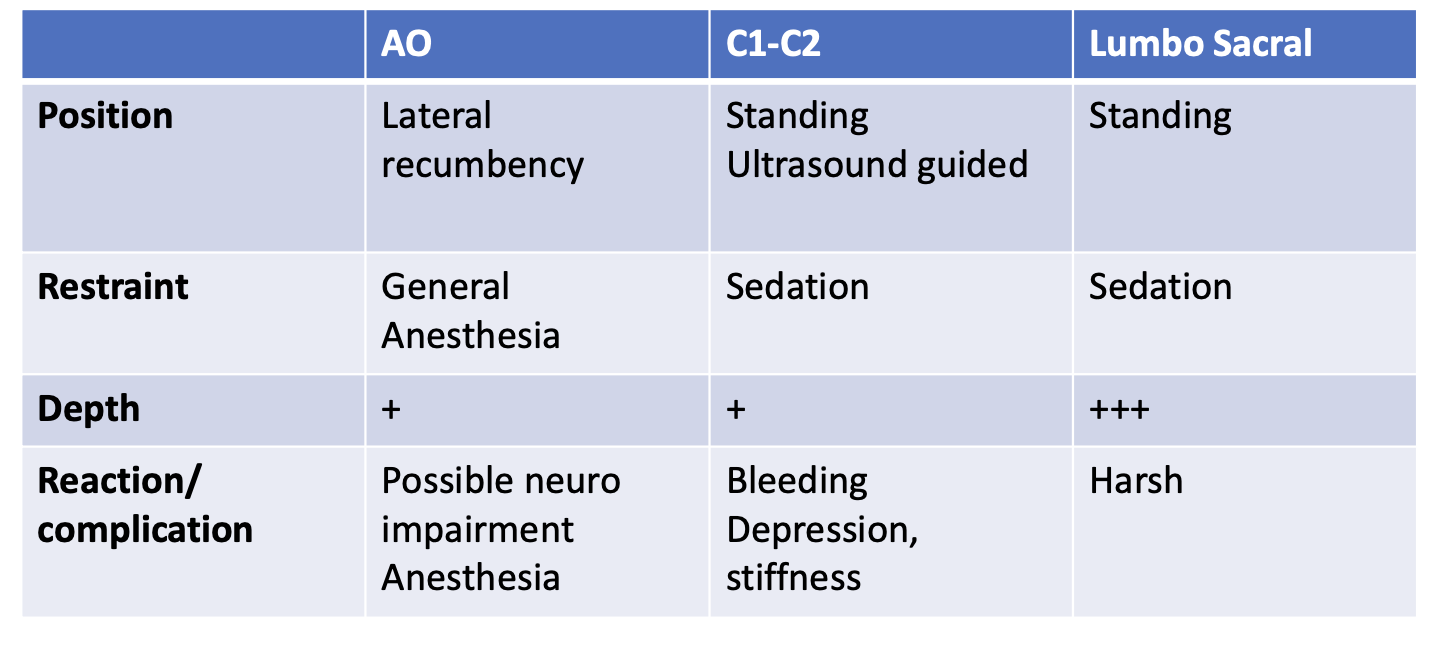
How is CSF analyzed?
GROSS
• Pressure
• Appearance (color, turbidity)
• Xanthochromia
LAB ANALYSIS
• TP
• TCC
• Cytology
• Enzymes
• Immune testing for specific diseases
Why is a nasal swab performed during a neuro exam?
EHV1
What are the possible complications of myelograms?
Complications possible
- Seizure, blindness
- Fever
- Neck pain
- Horse cannot rise
Recovery of neuro horse from general anesthesia is difficult
What are the neuroelectrodiagnostics?
• Electromyography - EMG
• Nerve conduction studies -NCS
• Brainstem auditory evoked response - BAER
• Electroencephalography
What is the difference between EMG and NCS and what do they evaluate?
• EMG: electrical activity by muscle
• NCS: electrical conduction by nerve
• Evaluate LMN: Positive sharp waves, Fibrillation potential
What are the human concerns when caring for the neurologic horse?
Always consider rabies ➔ gloves, contact tracing
Careful handling
Exit strategy, buddy strategy
Always be able to exit the stall
Do not examine the horse by yourself
Prevent falls, kicks etc.
Steady horse by tail if standing
Be nowhere close to the legs
Even a horse in a sling may not be safe…
What are the horse concerns when caring for the neurologic horse?
a. Protect from self-injury
b. Provide nutrition & support
c. Avoid secondary injuries & loss of function
When does recumbency decrease prognosis significantly in a neurologic horse?
if > 48-72 hours
What are the injury and secondary issues risked with recumbency?

How can you protect a neurologic horse from self-injury?
• Head: helmet
• Eyes: ointment, helmet
• Legs: bandage, support
• Adapt bedding: Absorbent, nonabrasive, comfortable, Good footing
• Padded stall
How should hydration and nutrition be altered for a neurologic horse?
Hydration:
• Easy access to water
• Nasogastric intubation
• IV fluids
Nutrition:
• No additional support
• Pellet gruel
• Liquid diet
• Parenteral nutrition
What in the GI tract and urinary tract needs to be evaluated in a neurologic horse?
GI:
• Can the horse defecate? Rectal exam
• Empty rectum regularly
• Monitor fecal output & GI sounds
• Complications: impaction, ileus
Urinary:
• Can the horse urinate? Rectal exam
• Empty bladder regularly
• Consider catheter
• Complications: cystitis
What are the concerns with the lungs and the eyes in a neurologic horse?
Lung:
• Is the horse dysphagic? Prevent aspiration
• Positioning: up > sternal > lateral
• Broad spectrum antimicrobials
• Complication: pneumonia
Eyes:
• Protection: padding, helmet, bandage
• Lubrication: eye ointment
• Daily exam
• Complication: ulcers, keratitis
What physiotherapy should be considered in a neurologic horse?
• Some horses are smarter than others
• Encourage movement
• Controlled exercise (standing horse)
• Sling (even if for brief periods)
• Recumbent horse: manipulate limb: passive flexion, extension, Massage, Therapeutic ultrasound
What are the benefits of using slings in a neurologic horse?
➔ Better assessment, diagnosis, prognosis
➔ Improved supportive care for horse
➔ Physiotherapy
• Supervision
• Not every horse tolerates the sling
• Not every condition is amenable for a sling
What are the different types of slings?
• Simple: Breast piece and body part, ! can slide out backwards (i.e. EquiSling)
• Advanced: Tail piece around hind quarters, adjustable straps (i.e. Liftex sling)
• Complex and smart slings: Anderson Sling
How should a neurologic horse be transported?
Protect from self-injury
a. Empty trailer without supporting bars
b. Wide door (i.e. stock trailer)
c. Consider heavy sedation or anesthesia
Bandage head and limbs
Padding or deep bedding
Call ahead
What drugs are used for seizure control in horses?
diazepam
midazolam
phenobarbital
potassium bromide
sodium bromide
What drugs are used to control seizures if diazepam or phenobarbital NOT available?
xylazine
detomidine
butorphanol
pentobarbital
What NSAIDs are commonly used for a neurologic horse?
phenylbutazone
flunixin meglumine
ketoprofen
firocoxib
What steroids are used for neurologic horses?
dexmethasone
dexmethasone SP
methyprednisolone sodium succinate
prenisolone
What are the common complications of steroids in neuro cases?
use controversial
laminitis
infection
What antioxidants are used for neurologic horses?
DMSO: controversial but cheap
Vitamin E
Thiamine
coenzyme 10
What is used to treat neuro head trauma?
hypertonic saline
mannitol
thiamine
What antimicrobial drugs are used for neuro horses?
• Trimetoprim-sulfamethoxazole
• Penicillin, 3rd generation cephalosporins
• Gentamycin
What are 3 FDA approved EPM treatments?
1. Sulfadiazine – Pyrimethamine
2. Ponazuril
3. Diclazuril
What are the risk based vaccines in horses?
botulism
EHV1, but no EHM protection