Botany 110 Week 2 (Stems, Leaves, Flowers and Seeds)
 Call Kai
 Learn
Learn Practice Test
 Spaced Repetition
 Match
Match Flashcards
1/32

There's no tags or description
Looks like no tags are added yet.
Name | Mastery | Learn | Test | Matching | Spaced | Call with Kai | Chat |
|---|

33 Terms
Function of Stems
Support
Transport
Producing Food
Producing more stems
Apical Meristem
Contributes to an increase in stem length, is dormant before the growing season.

Leaf Primordia
Tiny embryonic leaves that develop into mature leaves
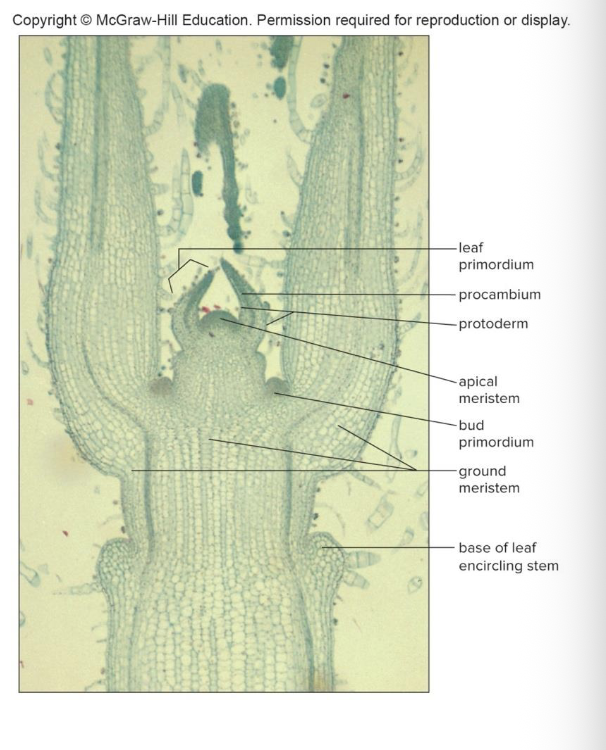
Vascular Cambium (Cambium, Vascular Bundle)
Narrow bands of cells between the primary xylem and primary phloem may become vascular cambium. Cells produced by VC become components of secondary phloem and xylem.
Deciduous
Lose all leaves annually. Have dormant axillary buds with leaf scars bellow

Cotyledons
Seed leaves attached t embryonic stems. (Store food for seedling)
Dicotyledons (Dicots)
Flower plants that develop from seeds having two cotyledons. (Beans)
Monocotyledons (Monocots)
Flower plants that develop from seeds with a single cotyledon (Corn)
Herbaceous Dicots
Have discrete vascular bundles arranged in a cylinder
Woody Dicots
Secondary xylem, one year’s growth is of xylem = annual ring
Monocotyledonous Stems
No vascular cambium, xylem, or phloem is present throughout the stem.
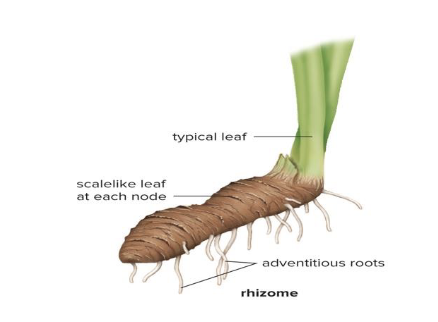
Rhizomes (Stem)
Horizontal stems that grow below-ground and have long to short internodes (Irises, Ferns and Grasses)
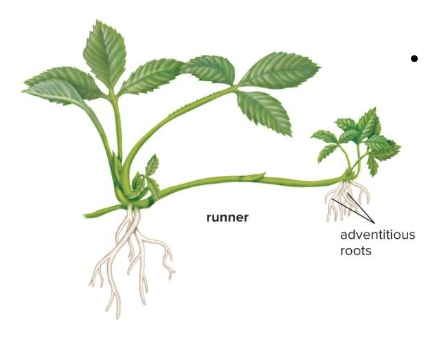
Runners (Stem)
Horizontal stems that grow above the ground and have long internodes. (Strawberry)
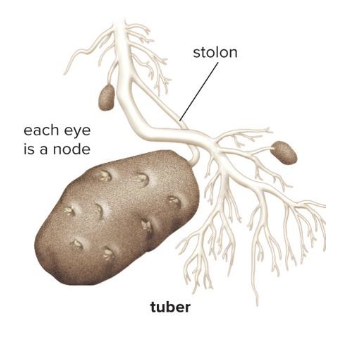
Stolons (Stem)
Produced beneath the surface of the ground and tend to grow in different directions. (Irish Potato)

Tubers (Stem)
Swollen, Fleshy, underground stem that stores food. (Irish potatoes eyes of potato are nodes)
Bulbs (Stem)
Large buds surrounded by numerous flashy leaves, with a small stem at the lower end. Store food. (Onions, lilies, Tulips)
Corms (Stems)
Resemble bulbs, but composed almost entirely of stem tissue with papery leaves. Store food. (Gladiolus and Crocus)
Cladophyll (Stem)
Flattened, leaf-like stems (Prickly pear cactus and some orchids)
Function of the leaf
Photosynthesis
Storage
Transpiration
Photosynthesis
Trapping and storing of energy in sugar molecules that are constructed from water and carbon dioxide
Stomata
Tiny pores on the lower surface of leaves (carbon dioxide enters through here, water vapor and oxygen diffuse out)
Guard Cells
Control water loss by opening or closing pore of stomatal apparatus
Simple Leaves
Leaves with a single blade.

Compound Leaves
Arrangement of veins in a leaf that is divided into multiple leaflets that attach to a single petiole.

Pinnately Veined Leaves (Compound Leaves)
Main mid-vein included within enlarged midrib.

Palmately Veined Leaves (Compound Leaves)
Several primary veins fan out from base of blade

Monocot Leaf Venation
Primary veins parallel (Parallel Venation)

Diocot Leaf Venation
Primary veins diverge in various ways. (Netted)

Phyllotaxy
Arrangement of leaves on the stem.
Alternate- one leaf per node
Opposite- Two leaves per node
Whorled- Three or more leaves at a node
Epidermis
A single layer of cells covers the entire surface of the leaf. Devoid of chloroplasts, coated with cuticles.
Storage Leaves
Succulent leaves are modified to store water. These leaves are often fleshy to store carbohydrates. Have parenchyma cells with large vacuoles.
Reproductive leaves
1. Walking ferns have new plants at the leaf tips
Air plants have tiny plants along leaf margins
Floral leaves (bracts)
At the base of flower stalks, often brightly colored. Poinsettias.