NUR 114 Immune Exemplars
 Call Kai
 Learn
Learn Practice Test
 Spaced Repetition
 Match
Match Flashcards
 Knowt Play
1/108

There's no tags or description
Looks like no tags are added yet.
Name | Mastery | Learn | Test | Matching | Spaced | Call with Kai | Chat |
|---|
No analytics yet
Send a link to your students to track their progress
109 Terms
Is rheumatoid arthritis more common in men or women?
It is found more commonly in women (3x).
How common is rheumatoid arthritis?
It affects about 1 percent of the population
What is the number one risk factor for rheumatoid arthritis?
Smoking
What are some other risk factors (other than smoking) for rheumatoid arthritis?
Pollution and then genetics.
What is the pathophysiology of rheumatoid arthritis?
We don't really know for sure how it occurs.
What kind of disease is rheumatoid arthritis?
An autoimmune disease
What are the two types of signs and symptoms of rheumatoid arthritis?
Articular and Extraarticular
Describe what articular rheumatoid arthritis clinical manifestations are.
This affects your joints. It typically starts with your distal joints first (wrist, hands, feet). Patients typically complain of joint pain and possibly loss of function. They may also have fluid that accumulates in the joint, warmness, and erythema.
We reviewed what articular rheumatoid arthritis is. Think about the clinical presentations of articular rheumatoid arthritis. The s/s of it sound extremely uncomfortable. How do you think this affects the patient's usage of the affected extremity?
The patient will be so uncomfortable that they will stop using the affected joint. When a person stops using a joint like this and immobilizes it, this can result in contractures.
What is a contracture of the joint?
This refers to the tightening or shortening of a joint. This makes it extremely difficult to use the affected limb later.
Is articular rheumatoid arthritis s/s bilateral or unilateral? What does that mean?
It's bilateral; meaning if one joint is affected on one side the joint on the other side is also affected.
Describe extraarticular rheumatoid arthritis signs and symptoms
These symptoms do not affect your joint. They include:
-Fever
-Weight loss
-Anemia (RBC's aren't able to mobilize properly throughout the body)
-Lymph node enlargement
-Reynard's Phenomenon
What is Reynard's Phenomenon?
The extremities of a patient become white or blanched in response to colder temperatures. If patients put their hands under water the extremities can turn red (aggravates it). It isn't always caused by rheumatoid arthritis, but it's a s/s.
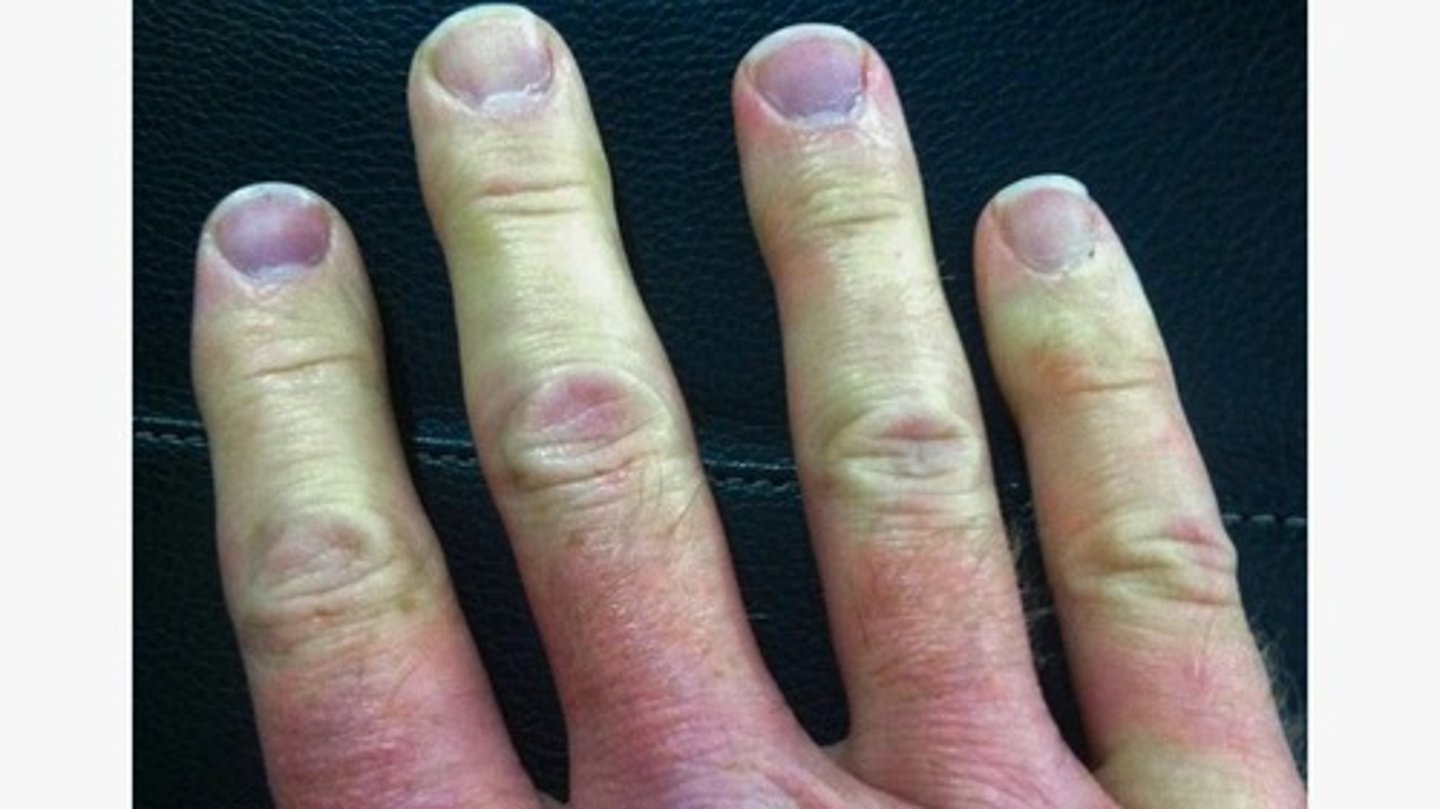
Does Reynard's Phenomenon occur more in men or women?
Think about it. Does rheumatoid arthritis present more in males or females? Remember, we discussed earlier it presents more in females. So, Reynard's phenomenon occurs more in females than males.
What is the pharmacological treatment for articular symptoms of rheumatoid arthritis?
DMARD medications (Disease modifying anti rheumatic drugs)
Examples of this would be: Methotrexate and Hydroxychloroquine (Hydroxy). Both of these are immunosuppressive drugs that work on the bone marrow.
Knowing that Methotrexate is a immunosuppressive agent, what are some nursing considerations we would make when administering/giving patient education regarding these drugs?
-Monitor for infection
+One rise in a temp can be extremely dangerous for patients
-This medication is a vesicant
+Large bore (central line)
+Infuse slowly
+Dilute
What type of drug is hydroxy?
An antimalarial drug; however it does still an immunosuppressant.
What are some labs we would watch for hydroxy?
-Kidney
+Creatinine and BUN
-Liver
+ALT, AST
Regarding both rheumatoid arthritis drugs we just covered, what is their MOA?
They work by suppressing the bone marrow.
When a drug suppresses the bone marrow, what does that do to your body?
Keep in mind the role of the bone marrow in your body; it is responsible for your immune response. By suppressing your bone marrow you suppress (remember suppress, not stop) your WBC's, B cells, etc. This lowers your immune response. Which makes sense since rheumatoid arthritis is an autoimmune disease.
What are some other things to keep in mind when we are talking about drugs that suppress the bone marrow?
-Low RBC's
-Platelets can be low (Thrombocytopenia)
-Low WBC's with infection
We would want to draw a CBC when patient is on these meds to assess for pancytopenia
What is pancytopenia?
deficiency of all three cellular components of the blood (red cells, white cells, and platelets).
What type of exam do we want our patients who are taking hydroxy? It's regarding a black box warning.
Annual eye exams; this drug can cause retinal damage. What can happen with retinal damage? Patients can go blind.
What can be administered to combat some of the complications of bone marrow suppression? Think lower RBC effect like Anemia.
Colony stimulating factors; for RBC's we can give erythropoietin. Remember, colony stimulating factors will tell immature stem cells what to be.
What's another drug we can use to treat articular symptoms?
NSAIDS; indicated for pain
+Monitor liver function
+Increased risk of ulcers (take meds with food)
How do we treat extra articular manifestations of rheumatoid arthritis?
We treat the symptom; anemia we might give iron, weight loss-change diet, etc.
What are some physical presentations that we might see in rheumatoid arthritis?
-Contractures
-Ulnar deviation
-Deformities in fingers
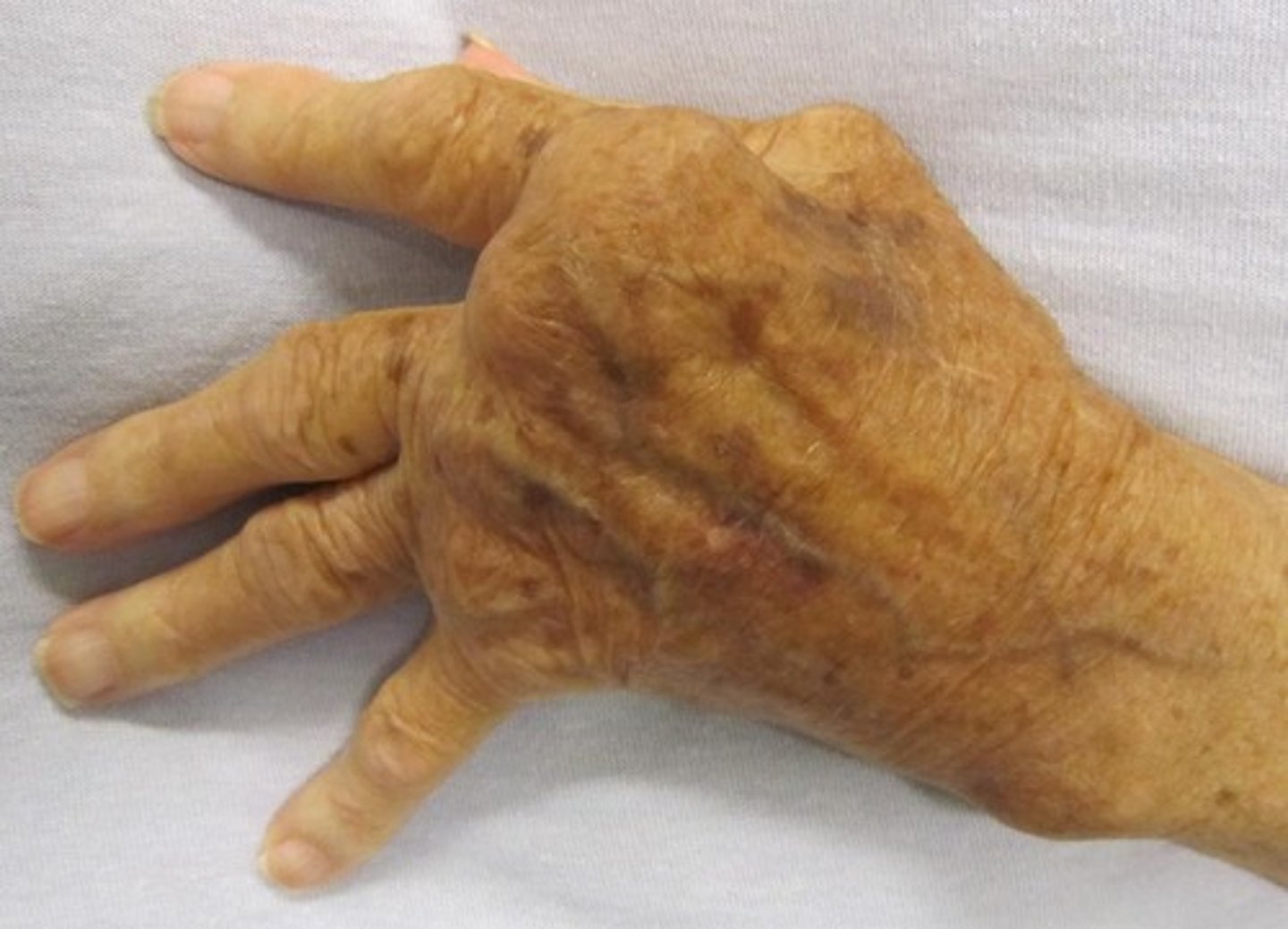
What is ulnar deviation?
Fingers kind of bend towards the ulnar side of your hand. Here is a picture so you can kind of get an idea of how it looks like.
Which drug is used to cure rheumatoid arthritis?
There is no cure.
What kind of disease is Lupus?
An autoimmune disease
What gender does Lupus affect?
Mostly women
Which type of cell does Lupus specifically affects?
B cells
How does Lupus affect your B cells?
It causes the B cells to overproduce antibodies. Remember B cells are responsible for the creation of Plasma cells and Memory cells. The Plasma cells are responsible for the production of your antibodies. The overproduction of antibodies means that there are more things (antigens) being attacked in the body
What organs does lupus affect?
It can affect all of them; the large release of antigens can actually clog up systems in your body.
What are the two types of "phases" of Lupus?
Acute and chronic
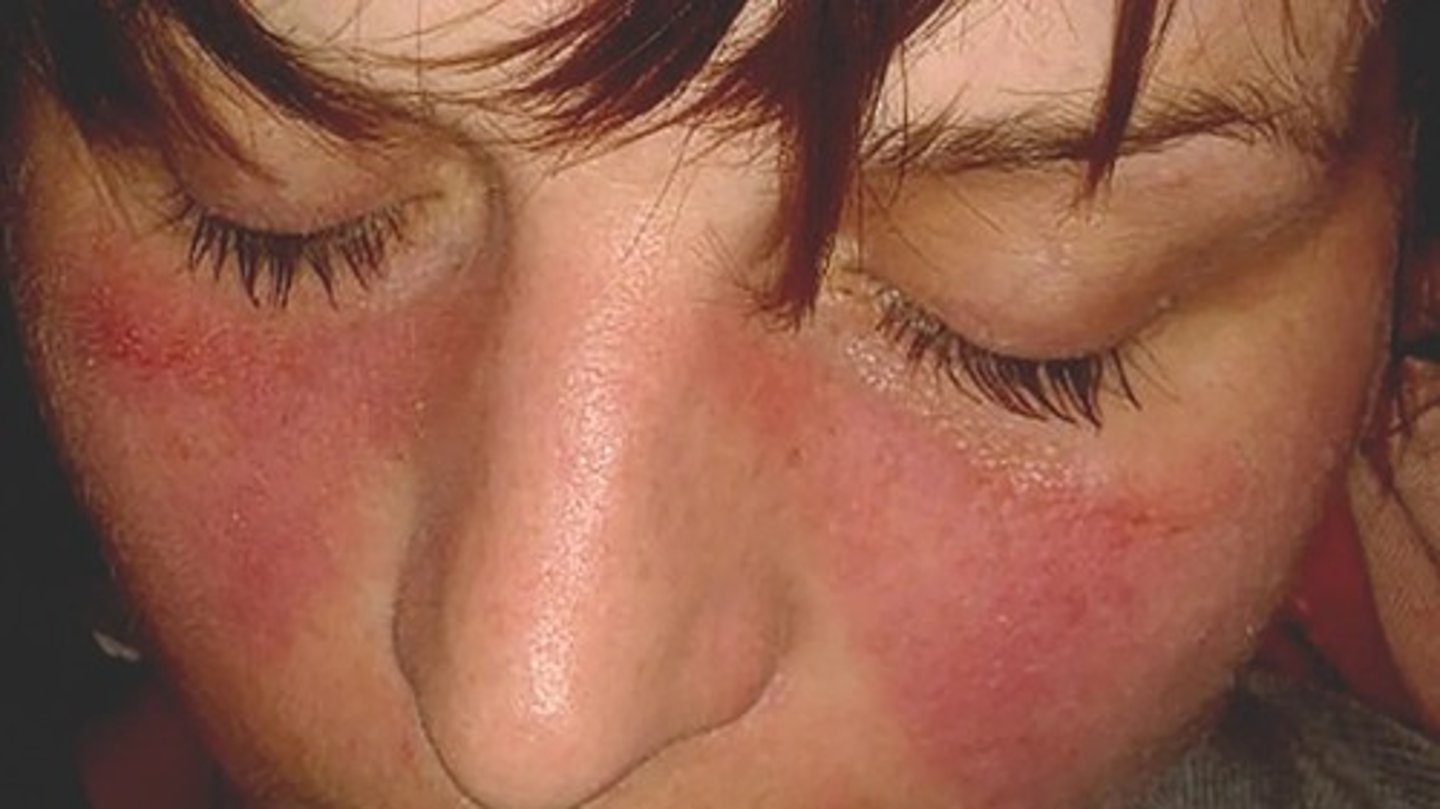
What is a specific s/s of Lupus you would see?
Butterfly rash on the face is something we see in Lupus
*We would also see photosensitivity and skin lesions
So keep that in mind when providing nursing education. How would we protect patients from the sun?
What happens during an acute phase of Lupus?
Think of it as a flare up; we see manifestations of the disease here.
What causes an acute reaction in Lupus?
-Stress (stress reduction techniques)
-Sickness
-Dehydration
-Prolonged exposure to sunlight
What can exacerbate the skin rashes of a patient with Lupus?
The sun; remember they are photosensitive.
What happens during the chronic phase of Lupus?
This is the dormant phase where a patient is asymptomatic. You can think of it as being in "Remission."
When a patient is in the acute phase of Lupus, what are some s/s they may present with?
Keep in mind that this disease can affect all systems.
-We might see heart palpitations (antigens are clogging up vessels)
-Joint pain or stiffness in the morning
-Nephritis (glomerulus are being clogged up)
-May also present with Raynard's disease
-Splintered hemmorhages
How do we diagnose lupus?
There are 4 criteria over a period of time. You don't need to know the specific criteria, just know it exists.
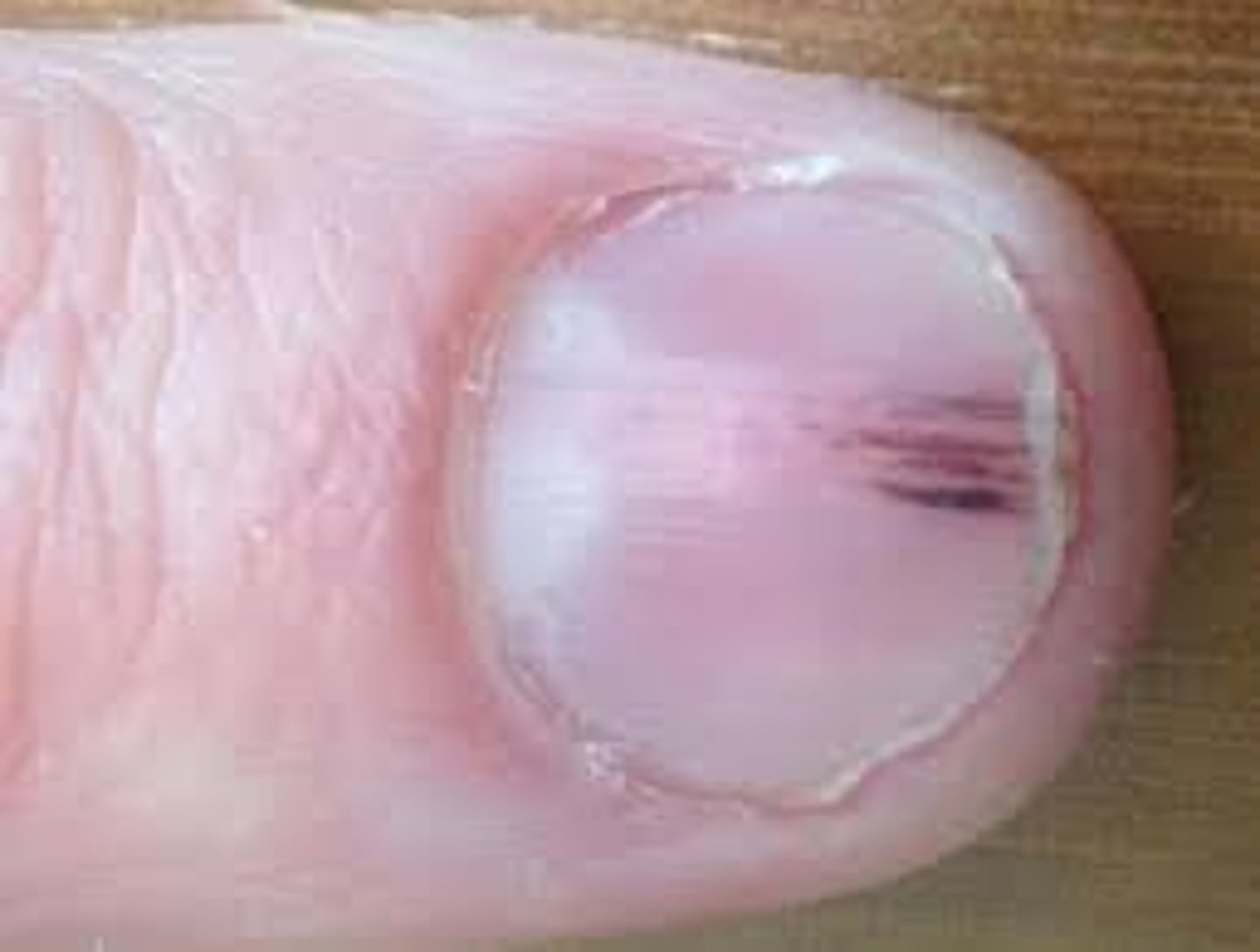
What are splintered hemorrhages?
These are little streaks of blood under a patient's nail bed. This is a reason why it's important to assess all aspects of patient in head to toe.
What are pharmacological treatments for lupus?
Hydroxy and Methotrexate (same as Rheumatoid arthritis)
-Topical corticosteroids (for butterfly rash)
What is the growth of new blood vessels to feed tumors?
Angiogenesis
What is programmed cell death?
Apoptosis
What does benign mean?
non-cancerous
What does malignant mean?
cancerous
What is the term for spreading of cancer?
Metastasis
What is the term for the lowest point of absolute WBC count?
Nadir; it can get as low as 0
In Palliative care, what are we doing?
We treat symptoms, we don't actually cure the disease.
What is the second leading cause of deaths in the US?
Cancer
Does cancer statistically affect men or women more?
Men
What is the most common cancer for men and women in the US?
Lung
What age range does 75 percent of cancer affect?
Age 55 and older
What are the different types of cancer we need to know about?
Carcinoma
Sarcoma
Myeloma
Lymphoma
Leukemia
What body system does carcinoma affect?
Epithelial tissue
What body system does sarcoma affect?
Connective/supporting tissue. Ex. would be your bones
What does myeloma affect?
plasma cells (the ones in charge for releasing antibodies)
What does lymphoma affect?
Lymphocytes
What does leukemia affect?
white blood cells, bone marrow cells
With benign cells, what type of cells do you have?
Well differentiated cells
With malignant cells, what type of cells do you have?
Undifferentiated cells
What is the growth pattern of benign cells?
It's localized and stays in its own area
What is the growth pattern of malignant cells?
It moves to surrounding tissue (invades)
What is the rate of growth for benign cancer cells?
Slow
What is the rate of growth for malignant cancer cells?
Can vary from slow to fast. Depends on the type of cancer.
Which type of cancer metastizes?
Malignant
What is the number one risk factor for cancer?
Smoking; remember lung cancer is the most common
Does second hand smoking increase your risk of cancer?
Yes, it's actually just as bad if not worse.
What is a risk factor for skin cancer?
Prolonged sunlight exposure
What is the criteria for assessing genetic risk of cancer?
If you have two or more first degree relatives with cancer you are more at risk.
Also if the family has a rare cancer (such as cervical cancer)
What is a first degree risk?
Parent-child relationship
What are some things that increase risk of cancer?
-Elevated LDL levels
-Too much red meat
-Alcohol consumption
-Having elevated estrogen levels
What is primary prevention?
This is treating the disease process (prevention)
What is secondary prevention?
Your screenings
What is tertiary prevention?
Monitoring and preventing symptoms after patient has come down with whatever ailment
What is our way of assessing for skin cancer? (Hint: ABCDE)
A: Asymmetry
B: Border (look for irregularity, is it fuzzy or indistinct?)
C: Color (benign are usually light to medium brown, darker indicates it penetrated deeper, and white areas are suspicious)
D: Diameter (anything greater than 6 mm is considered suspicious)
E: Evolving (do they grow or stay the same size over time?)
What is the primary way of preventing skin cancer?
Minimizing your exposure to the sun
-So you'd want to wear protective clothing, be in shade, wear sunscreen, and remember that water/snow reflects the sun and magnifies it.
At what time is it best to avoid sunlight in the prevention of skin cancer?
10 am to 4 pm (10-4 or okay to remember)
What type of sunscreen should you use when exposed to the sun?
SPF of 15 or higher
How often should you use sunscreen?
Generously 20 minutes prior to sun exposure. Reapply every 2 hours or immediately after swimming.
How often should you examine your skin in the prevention of skin cancer?
Every month
What are the 3 different types of biopsies?
-Incisional
-Excisional
-Needle
Just remember that we are looking at a piece of tissue and examining it for cancer cells.
What are the 3 types of cancer-related surgery?
-Primary: they go in and remove the tumor itself
-Prophylactic surgery: this is where a person may opt to get a surgery to remove a part of their body to reduce chances of cancer (like prophylactic mastectomy for breast cancer). Might be indicated for a history or markers
-Palliative surgery: we treat symptoms associated with cancer to help with comfort.
What does external radiation do for cancer?
Radiation helps shrink the tumor outside of the body.
What is internal radiation?
Little plaques or seeds are placed near the tumor in hopes of shrinking the tumor. This would be considered harder on the body because surgery is involved.
Are people who receive radiation more or less susceptible to infection?
More susceptible; they need to be careful and try to not be around sick people.
What are side effects of radiation?
- alopecia
-dry skin
-stomatitis
-dry mouth
-fatigue
What is patient education regarding alopecia?
-Go on ahead and shave head
-Try on wigs or extensions prior to radiation or before shaving head so it isn't a surprise for themselves or to family (can get used to it)
What are some considerations for patients with dry skin?
Skin can go dry, flaky, or even discolored. Encourage use of lotions and protecting from sun
What is stomatitis?
inflammation of the oral mucosa
What are protective measures we can do for patients who are being administered internal radiation?
-Limit visitors to patients
-Pregnant staff/visitors don't need to come in contact with them
-Patients should be in a private room
What are the 3 different goals of chemotherapy?
-Reduce the tumor
-Treat the tumor-Know this more than the others
-Destroy the tumor
What are some considerations regarding chemotherapy?
-They are vesicants
What are the meds we need to know for chemotherapy?
Psychlophosphamide (Cytoxan)
Vincristine (Oncovin)
What is a consideration regarding our chemo drugs?
Suppress the bone marrow-like all immunosuppressive drugs. We are trying to sort of shut down our immune response that is unable to distinguish self vs non-self. Suppression in bone marrow lowers RBC, WBC, and platelet count. So keep those in mind for the next question.
What are complications/side effects of chemotherapy?
-Extravasation (chemotherapy are vesicants)
-Can cause GI upset (So watch F&E)
-Fatigue
-Patient has a lower chance of getting pregnant
-Foggy brain
What might we want to practice when considering fatigue in patients with chemo?
-Cluster care (doing all care at once)
-Breaks in between ADL
-Educate to plan day out
-Patients may be on bed rest
What equipment should we wear when preparing or administering chemotherapy drugs?
-Double layer of powder-free gloves. Inner glove under cuff and outer over cuff
-Wear a long sleeve disposable gown
-N-95 or respirator
-Eye and face protection
-Emergency spill kit
Also be sure to wash your hand