mark p barrow mass spec
 Call Kai
 Learn
Learn Practice Test
 Spaced Repetition
 Match
Match Flashcards
 Knowt Play
1/37

There's no tags or description
Looks like no tags are added yet.
Name | Mastery | Learn | Test | Matching | Spaced | Call with Kai | Chat |
|---|
No analytics yet
Send a link to your students to track their progress
38 Terms
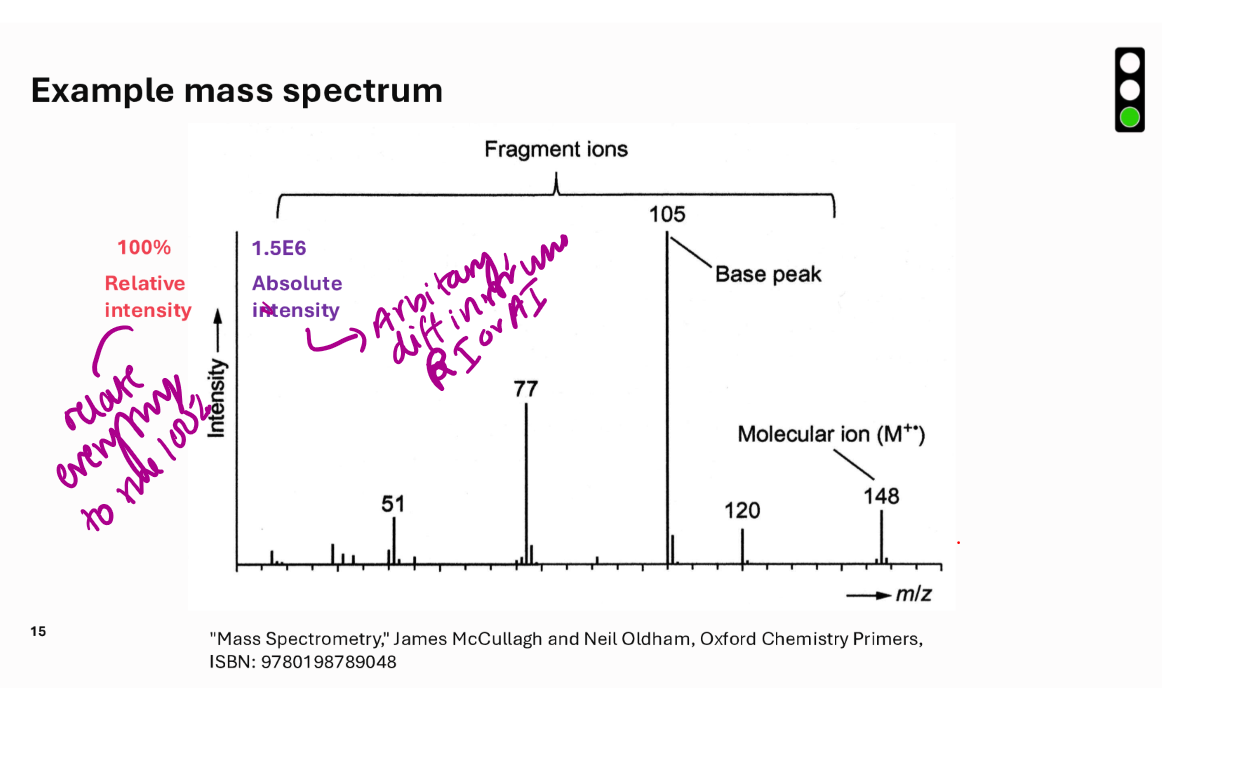
what does mass spec measure
analyse sample : single or mixture
need gas phase ions
measures mass to charge ratio (m/z) not mass
what is m/z
m is mass measured in daltons or unified atomic mass (u),
1 uor Da is 1.6 × 10^-27kg. no need to rmbr
z is charge of ratio
q is total charge in coloumb.
q= z x e
where e is elementary charge
what does mass spectra shhow or measure
intensity or abundance as function of m/z
what is zeroeth order
dont call it mass spec, spec involves absorption of electromagnetic radiation
difference between relative intensity and absolute intensity and whats molecular ion and base peak
intesntiy: how many ions reached detector
absolute This is the actual number of ions detected.
Relative intensity
Mass spectra are never usually plotted using absolute intensity.
Instead, the tallest peak is set equal to 100%
Everything else is compared to that.
3) base peak
assigned to 100 percent of intensity
molecular ion: original molecule losing one electron
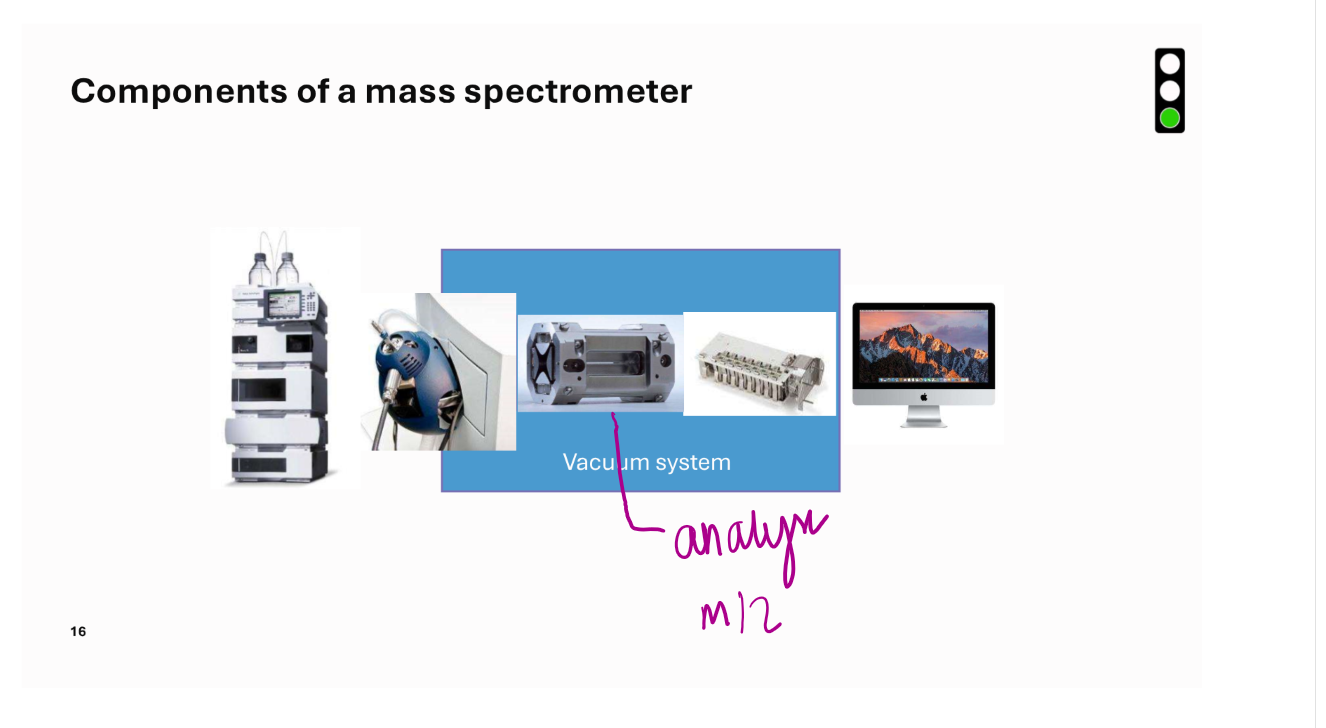
components of mass spectrometer
sample inlet
ionisation method
analyser
detection
data system
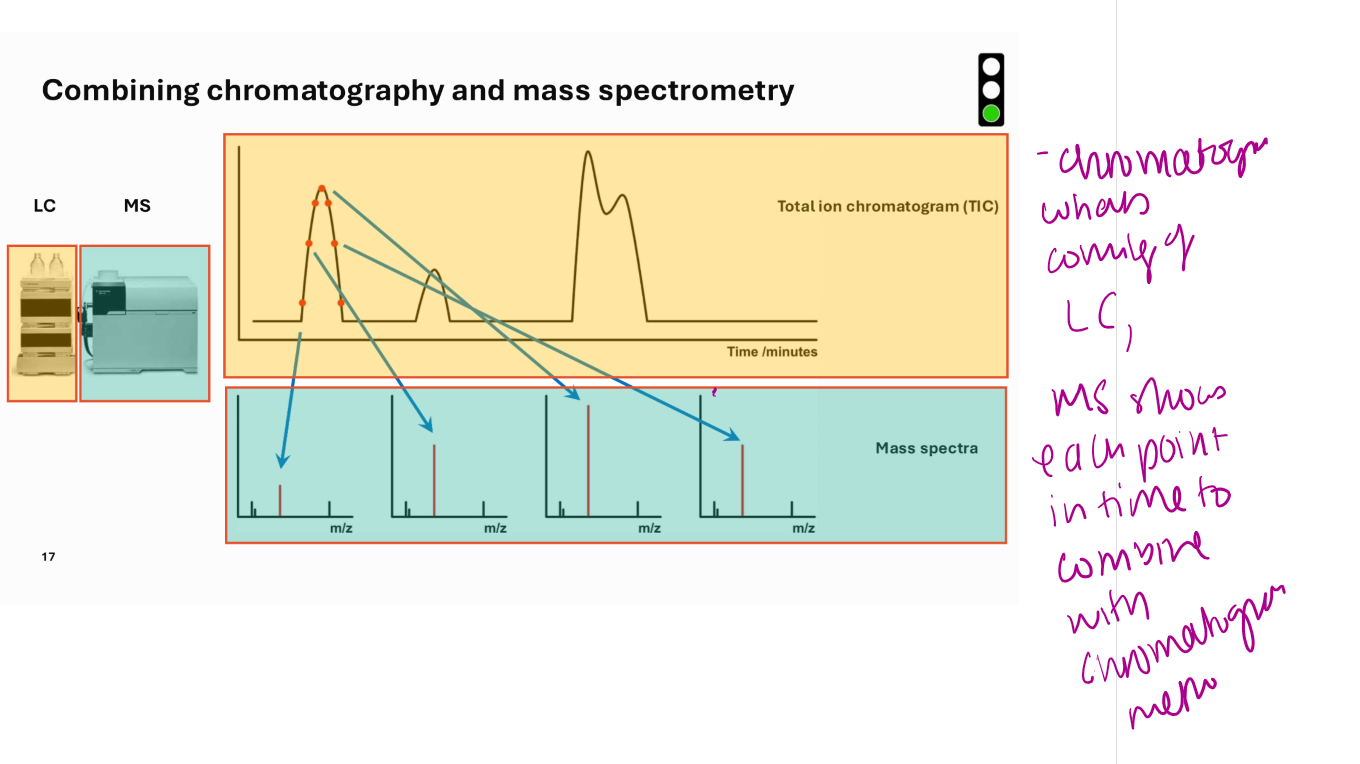
how do you combine LC and mass spec
why are vacuum systems needed in mass spec
vacuum needed for ions to pass thru mass spec, need to avoid collision between ions and gas
atmospheric (1 atm)
what are isotopes
same number electron, different neutron so will have diff mass to charge ratio. often called isotopologues
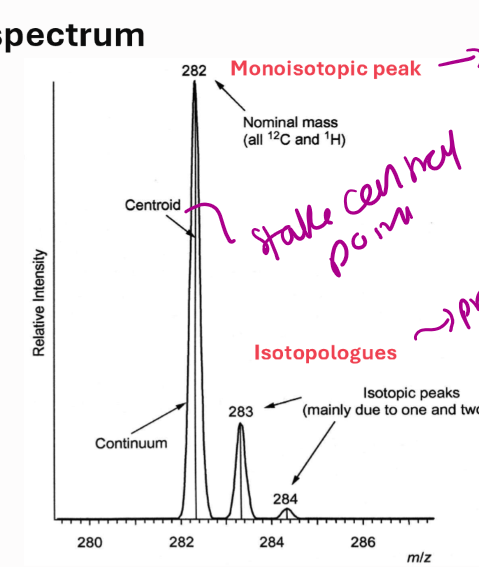
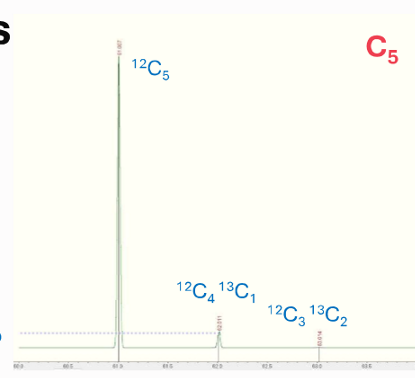
whats shown here
monoiso= no heavy isotope
isotopologues = isotopes
different ways of c5 shwon
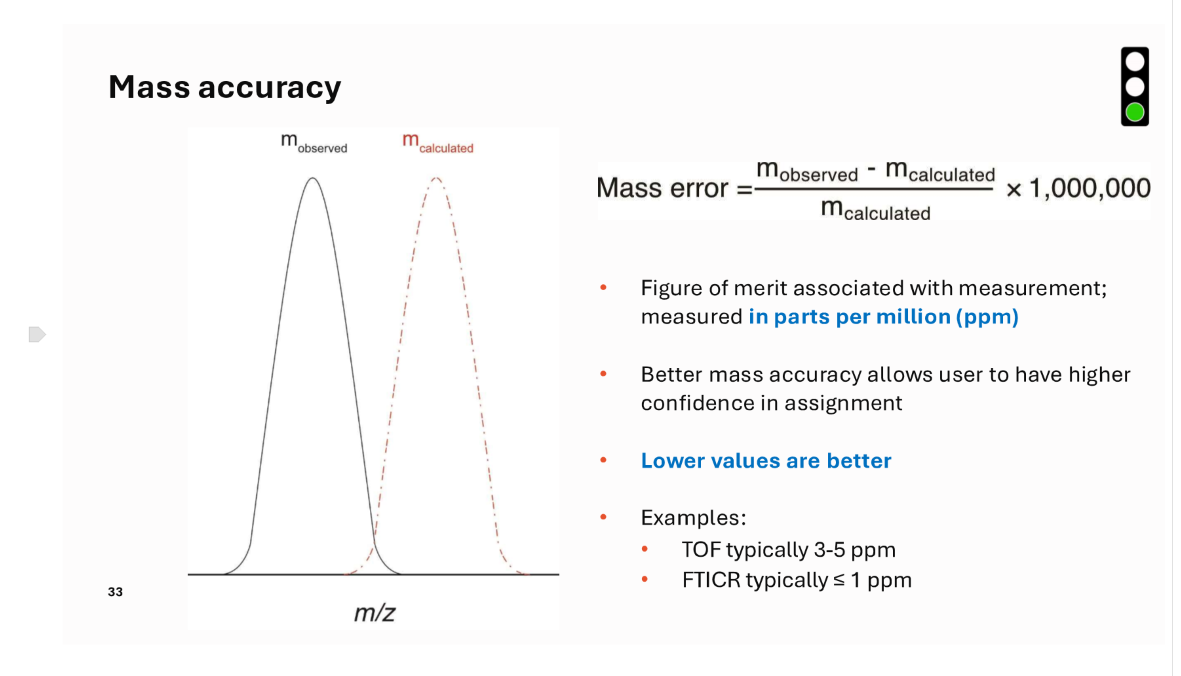
whats mass error and its equation
mass observed- mass calculated/m calc x 1,000,000
its a figure of merit, better mass allows to have higher confidence in assignment
llower values are better (ppm)
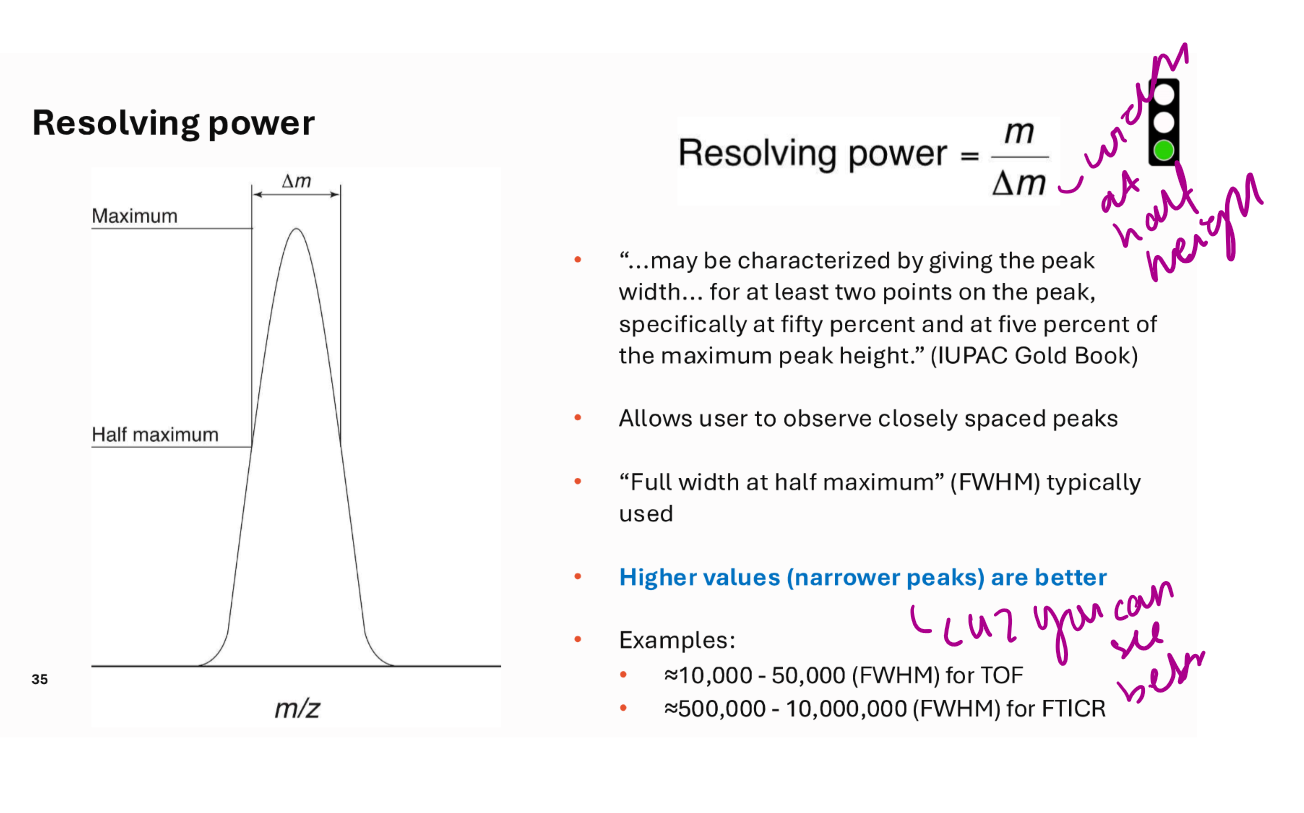
whats resolving power and its equation
m/ change in m m being width
allows to observe closely spaced peaks
higher values are better (narrow)
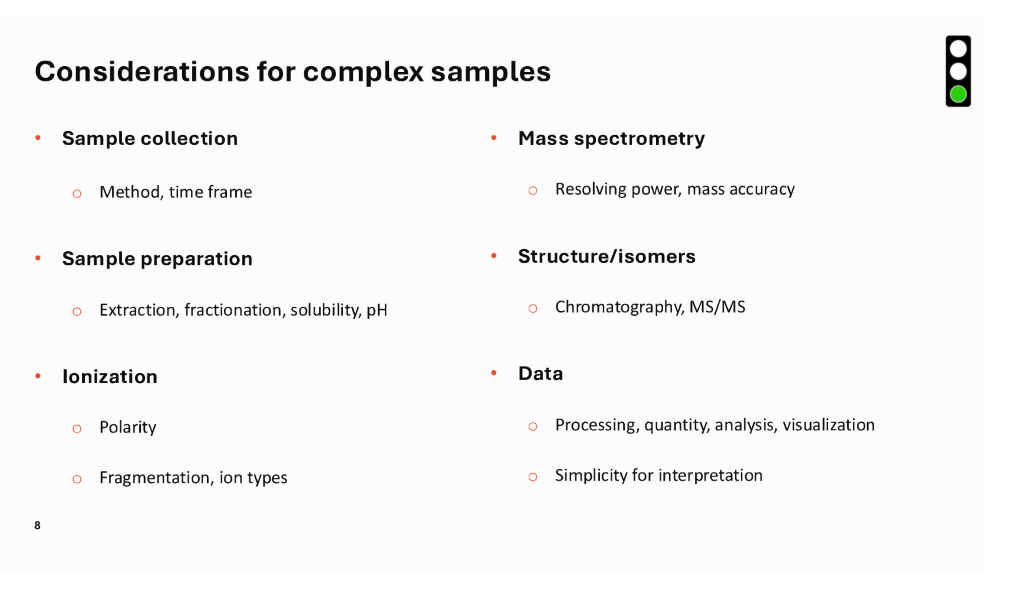
theres 6 types of sampling in mass spec what is it
sample collection
sample preperation
ionisation
mass spec
structure / siomers
data
for archaelogist samples, what to need to be wary of
value of samples
contamination
ethical consideration
limted sample amount
destructive sampling
pro and con of grab sampling
pro:simple
considers heterogeny
con: specific location depth
time to ravel
scope of citizen science
represents snapshot
pro and con of environmental monitoring : passive sampling
pro:
easy to deploy , useful to remote location
power not required
less labour
con:
using membrane?
hours days week requried
samples over period of time but suitable for low level
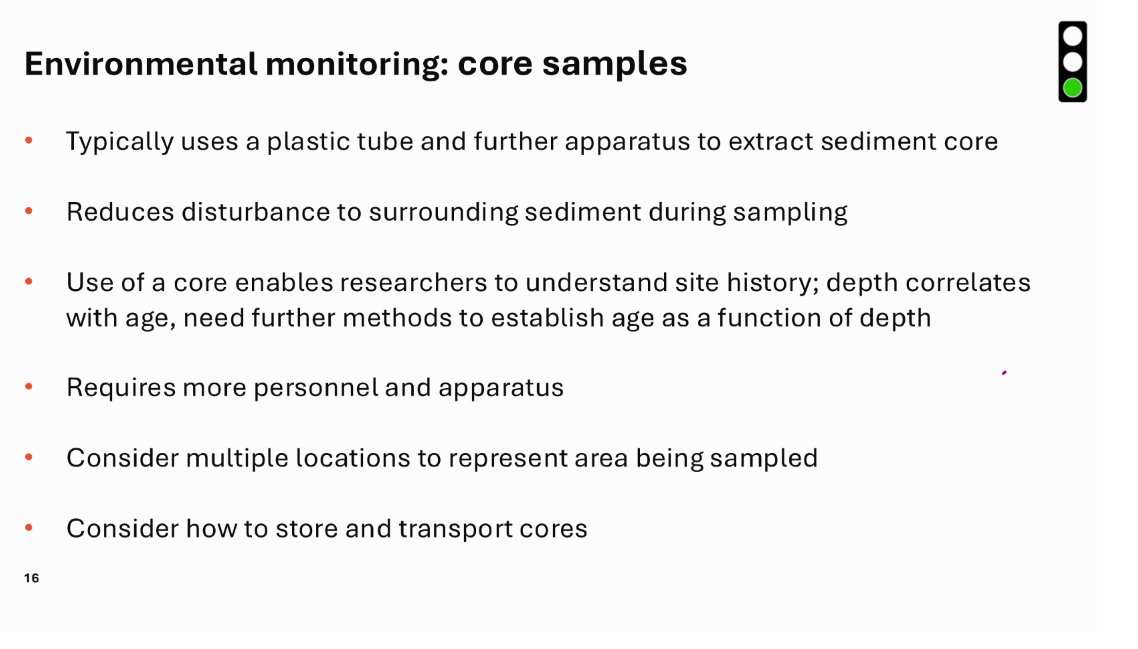
how to get core samples in envrionemtnal sampling
use plastic tube extract sediment core,
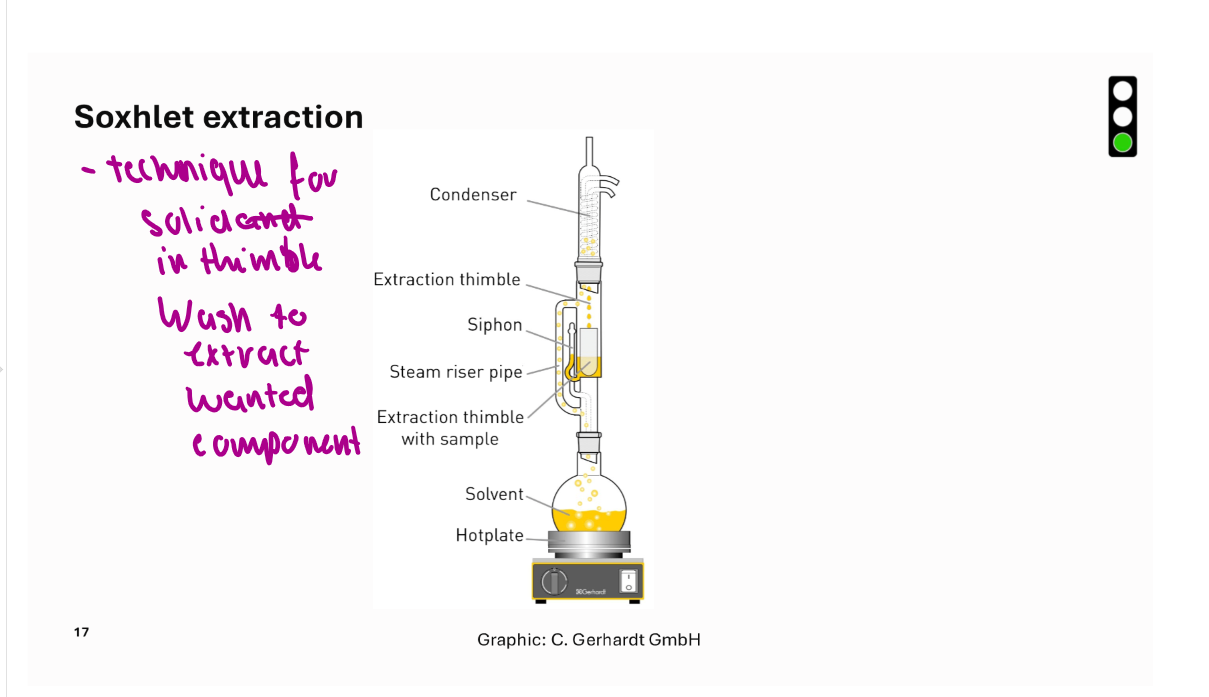
whats soxhlet extraction and its key features
solid sample in thimble, cycles of washing and repeated vaporisation, high exctraction efficacy
whats the concentration of electrospray ionization
0.01 uM for single compounds
0.01-0.1 um for complex mistures
you need to consider different additives for different ionisation methods
what can help with ESI
MALDI
acid for positive ion elecropsray esi
and base for negative ion electrospray esi
matrix for maxtrix assisted laser desorption MALDI
DOPANT such as toluene for atmosphereic pressure photoionisation
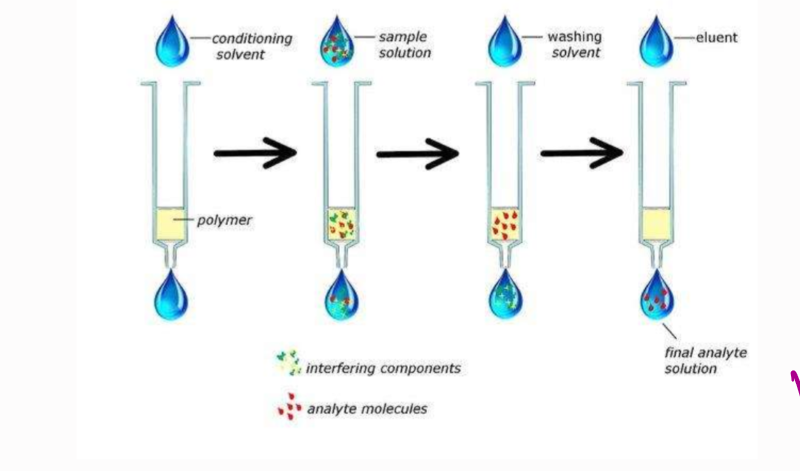
steps for SPE solid phase exctraction
conditioning
loading
washing
elution
method to extract sodium out
what happens in LLE liquid liquid extraction
extract liquids from eachother by adding immiscible solvent and seperate layers and get the one you need
When would these methods be needed
ESI
APPI
LDI
MALD
EI
EI ionisation for hard gas phase
Atmospheric pressure photoionisation for intact large molecules
laser desorption ldi for soft condensed phase
maldi for soft
and ESI
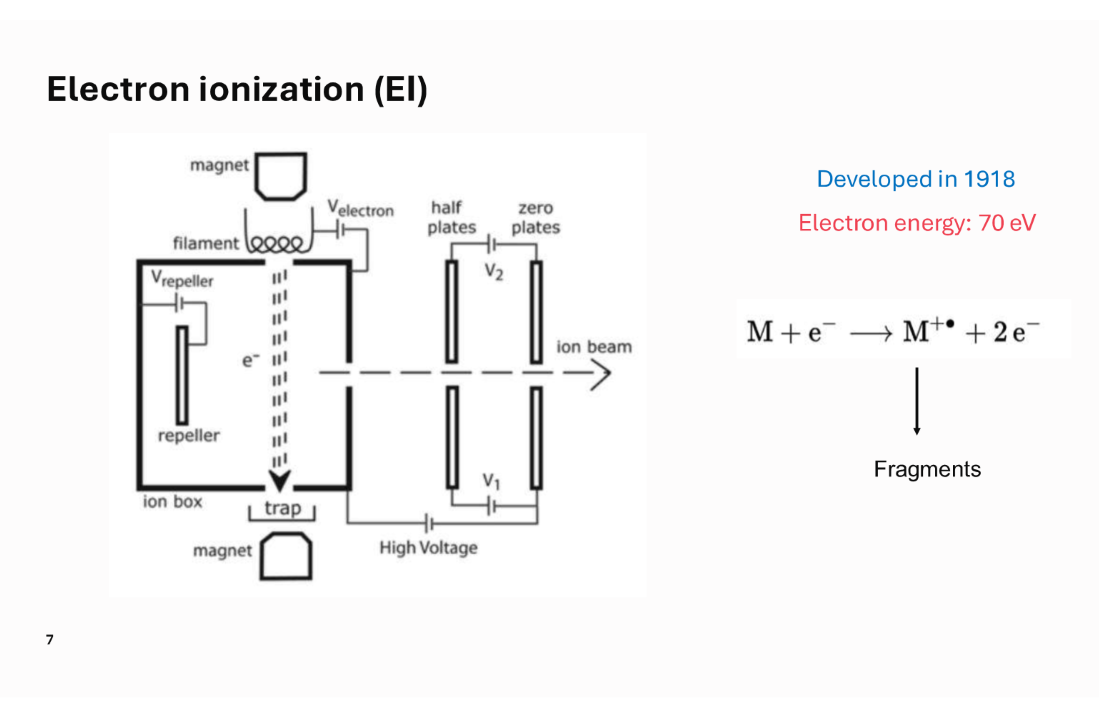
what does electron ionisation look like and its formula
typically operated at 70eV
EI is not suitable for what type
peptides, proteins and other biomolecules
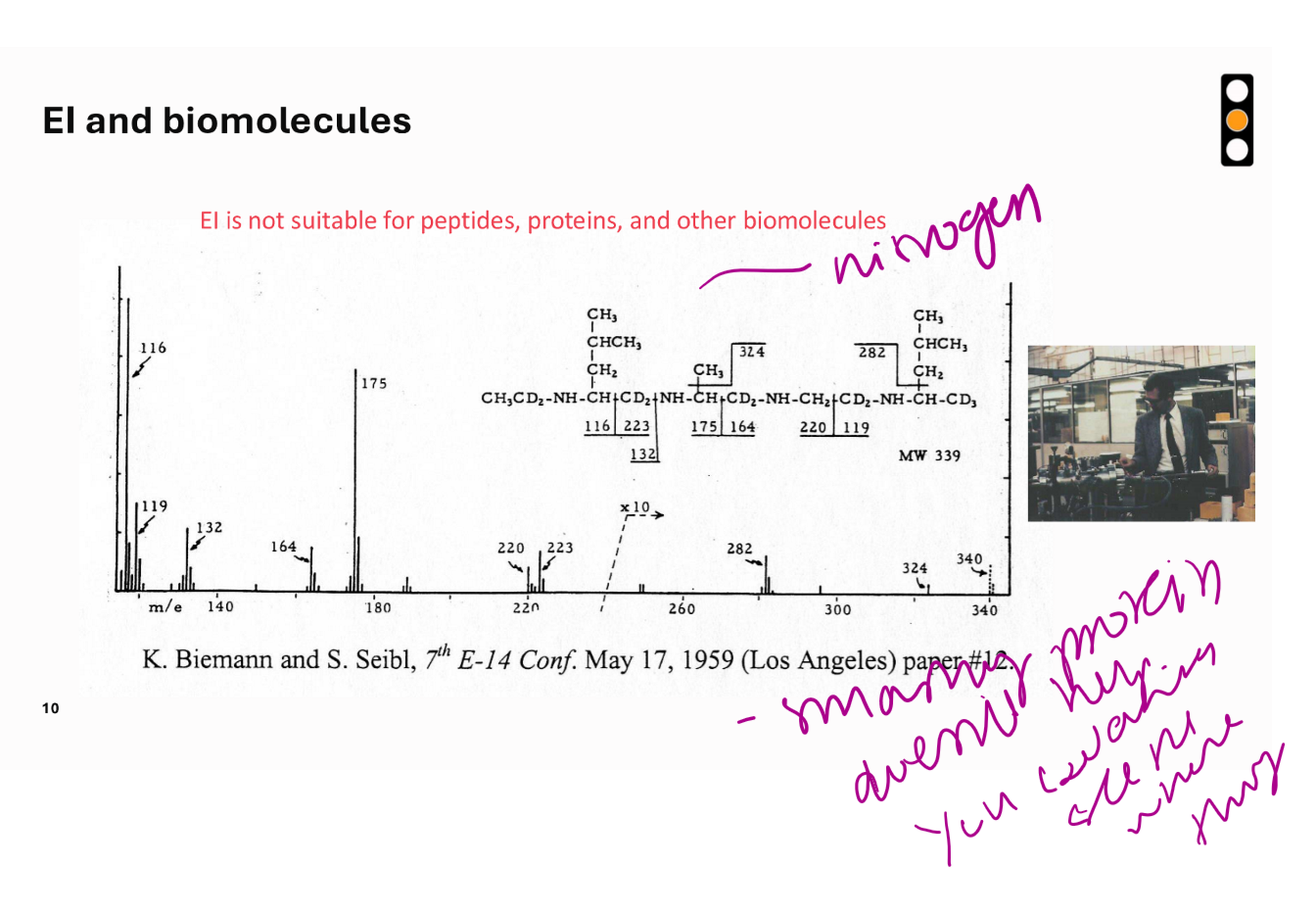
whats maldis key features
soft ionisation technique
uses laser
ions observed are typically protonated
[M+H}+
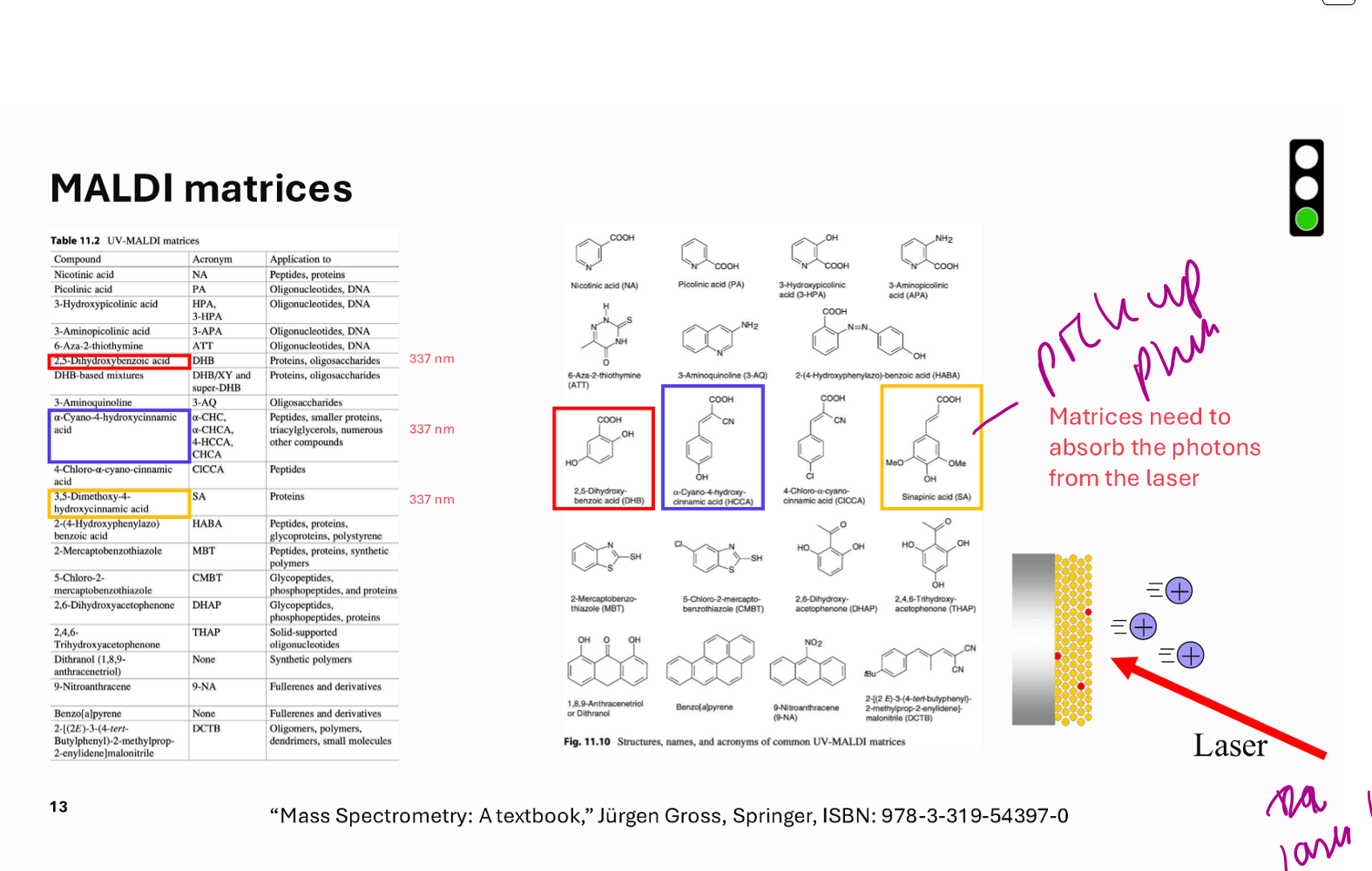
maldi uses either CHC, SA, DHB, when do we use what for what
CHC is forsmall peptides
SA for large proteins
DHB for proteins or carbohydrates
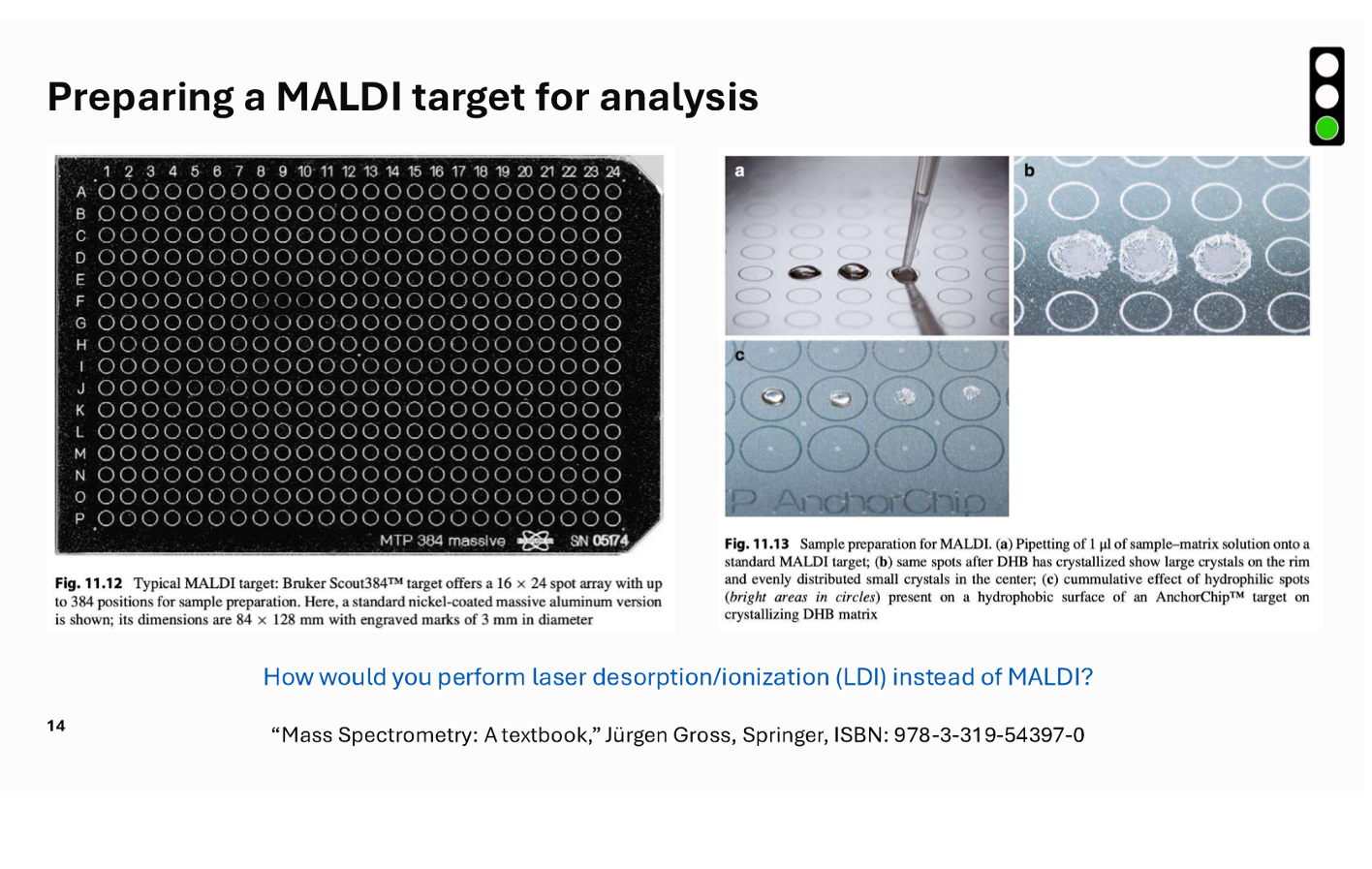
how do we prepare maldi target for analysis
you put them in a spot tray
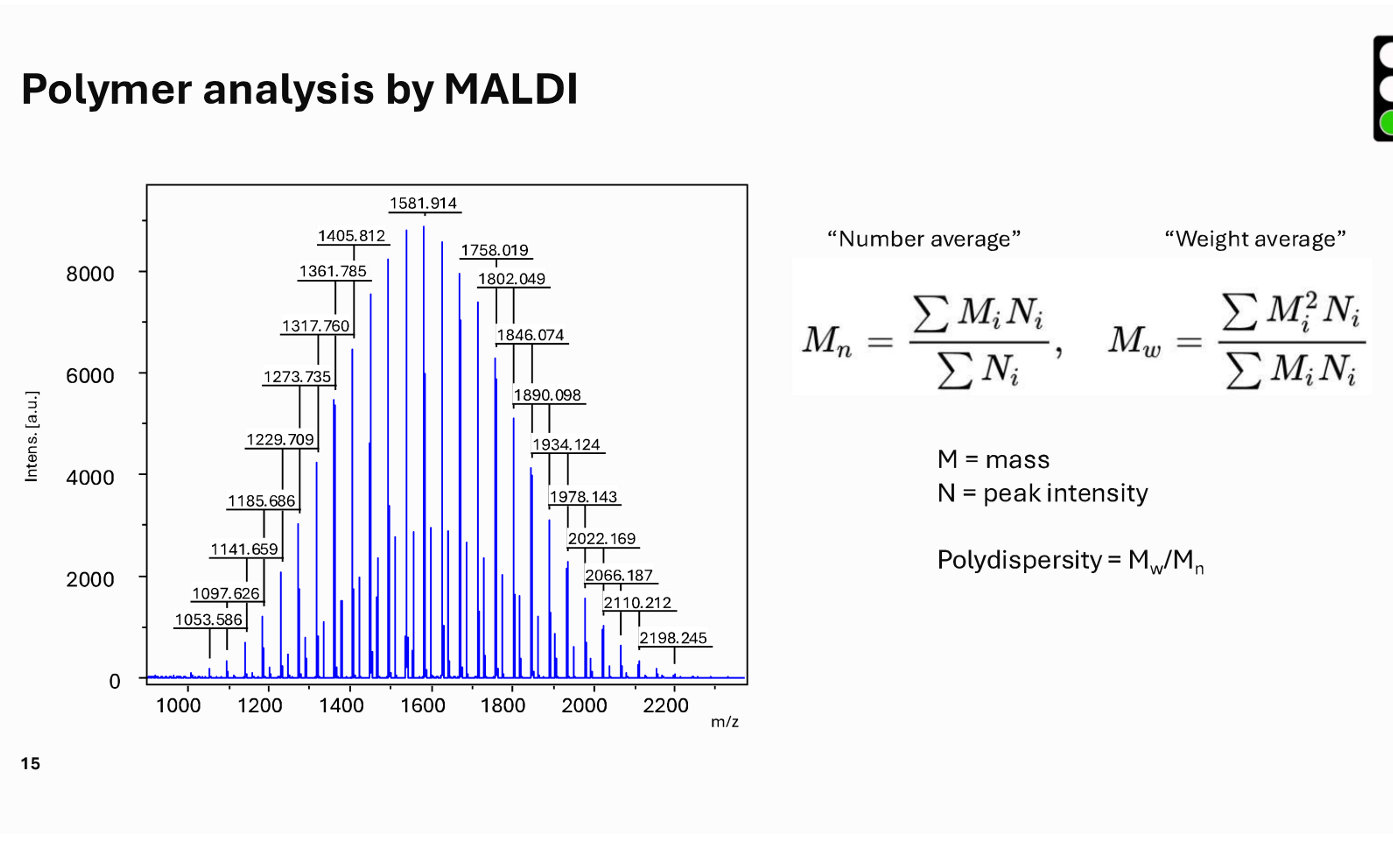
number average and weight average formula
ESI key features
soft ionisation,
useful for many biomolecular
good snesibility
can multiply charges
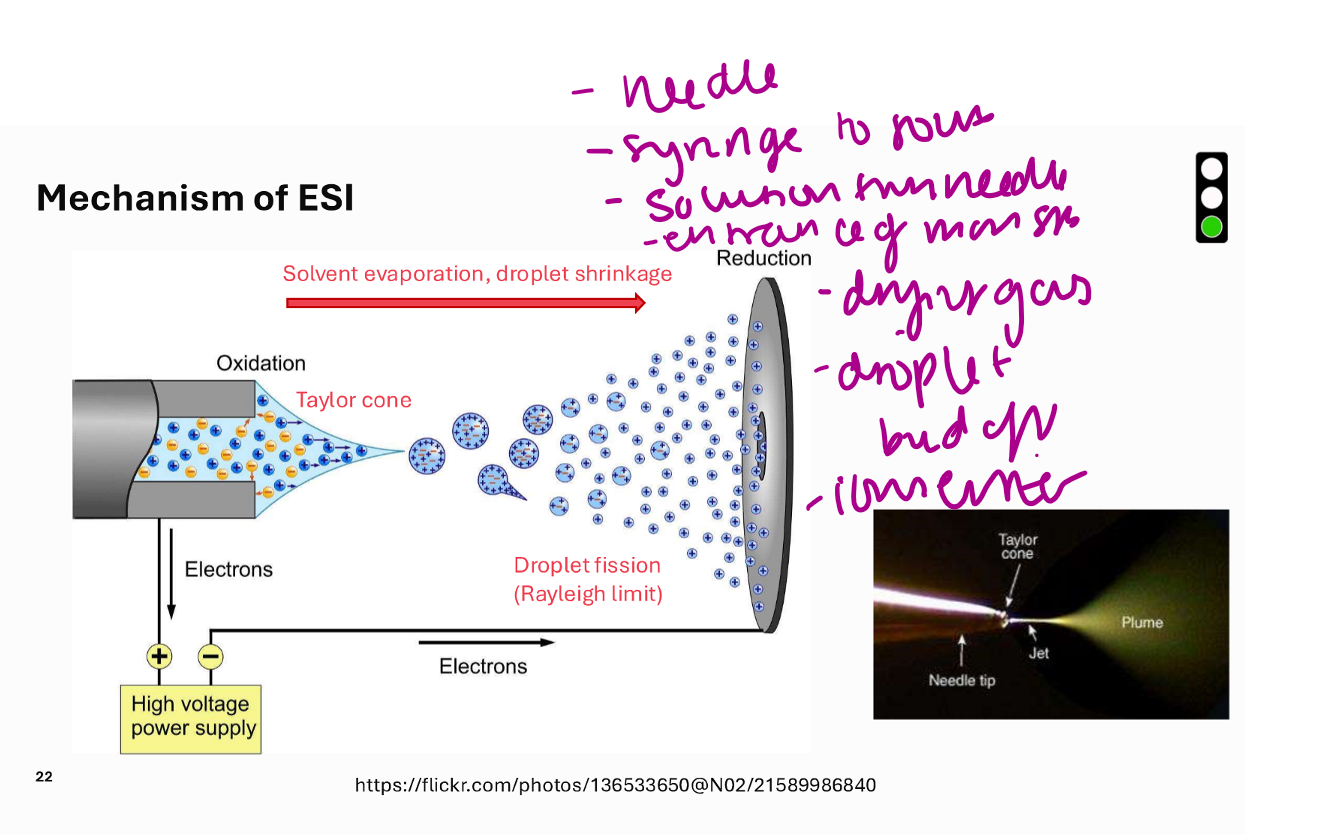
mechanism of ESI
Needle.
syringe
soltuion then needle
entrance of mass spec
dry if gas
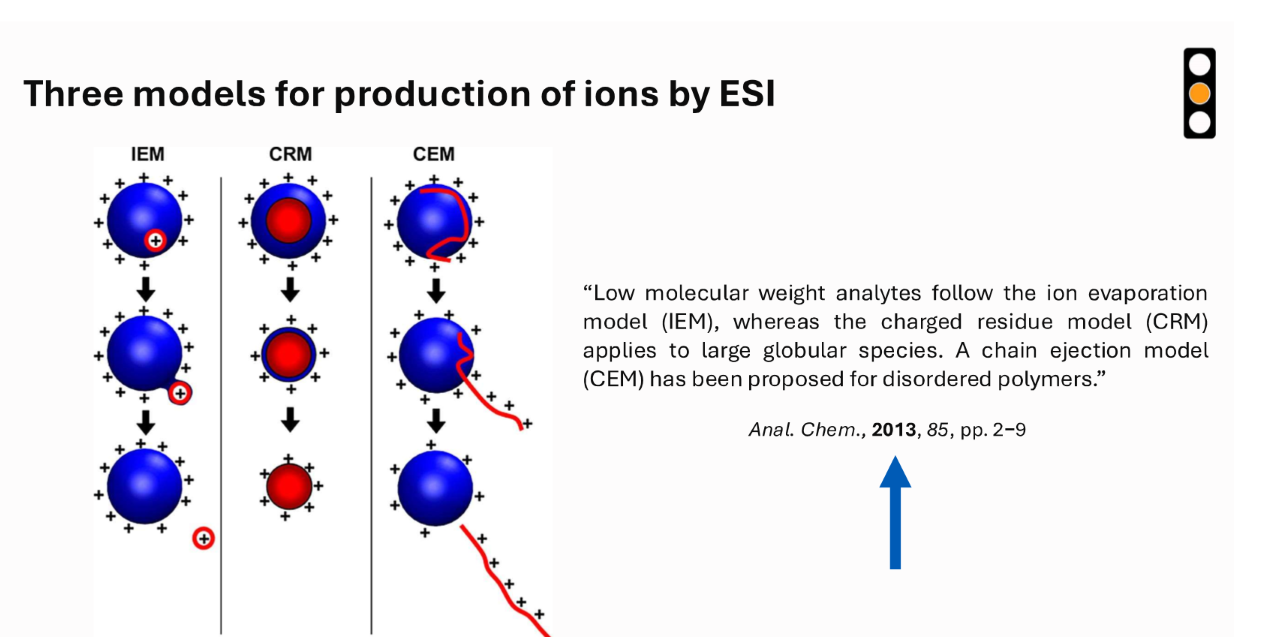
what are the 3 models for production of ions by ESI
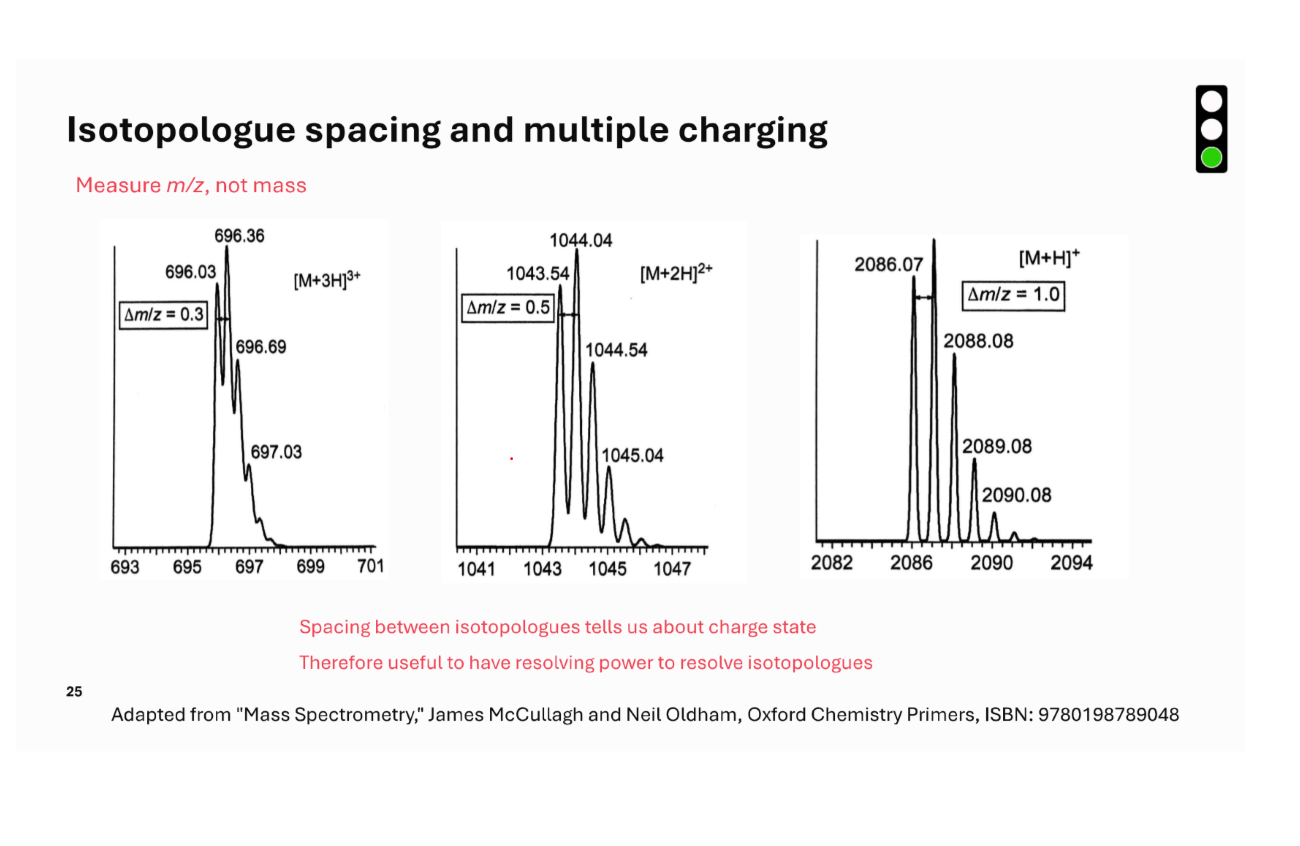
Why does isotope spacing change?
Mass spectrometers measure mass-to-charge ratio (m/z), not mass.
Each isotope (e.g. one ¹³C instead of ¹²C) increases the mass by about 1 Da.
That 1 Da increase is divided by the charge:
Δ(m/z)=1z\Delta(m/z)=\frac{1}{z}Δ(m/z)=z1
Therefore:
1+ ion → spacing = 1.0 m/z
2+ ion → spacing = 0.5 m/z
How can you determine the charge state from isotope peak spacing?
Measure the distance between two neighbouring isotope peaks.
z=1/change over M
Peak spacing | Charge |
|---|---|
1.0 | 1+ |
0.5 | 2+ |
0.33 | 3+ |
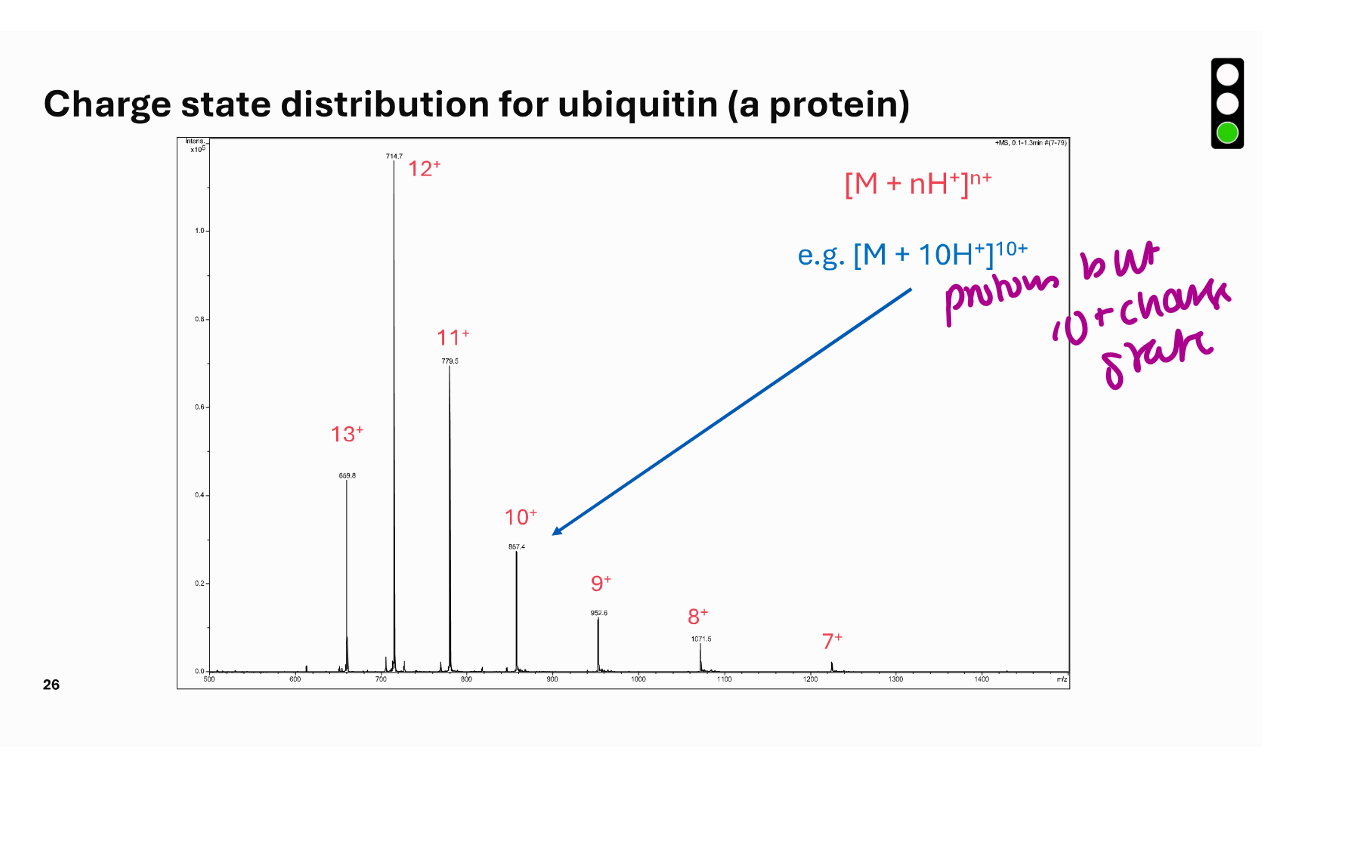
whats it showing
This means:
M = protein (ubiquitin)
+10H = ten protons added
Overall charge = 10+
So the mass spectrometer measures
protein mass+10H
instead of just the protein mass.
The same protein can gain different numbers of protons (e.g. 7+, 8+, 9+, 10+), giving different m/z values and therefore multiple peaks.
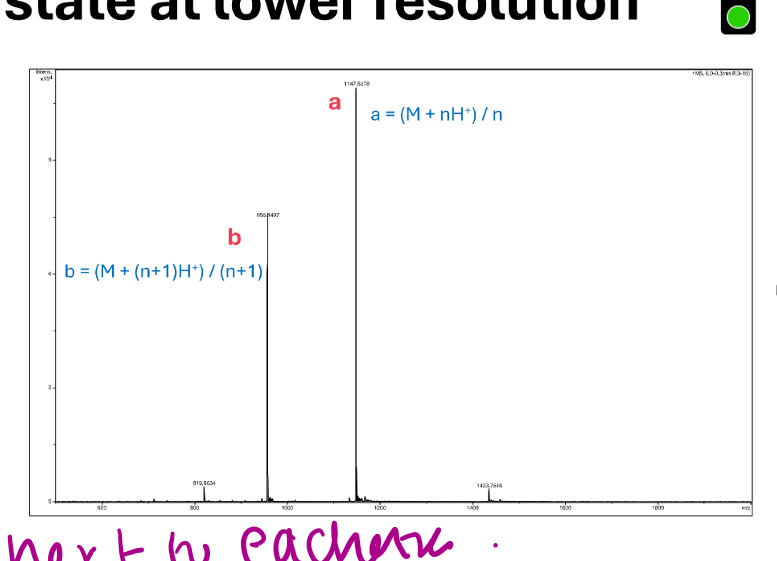
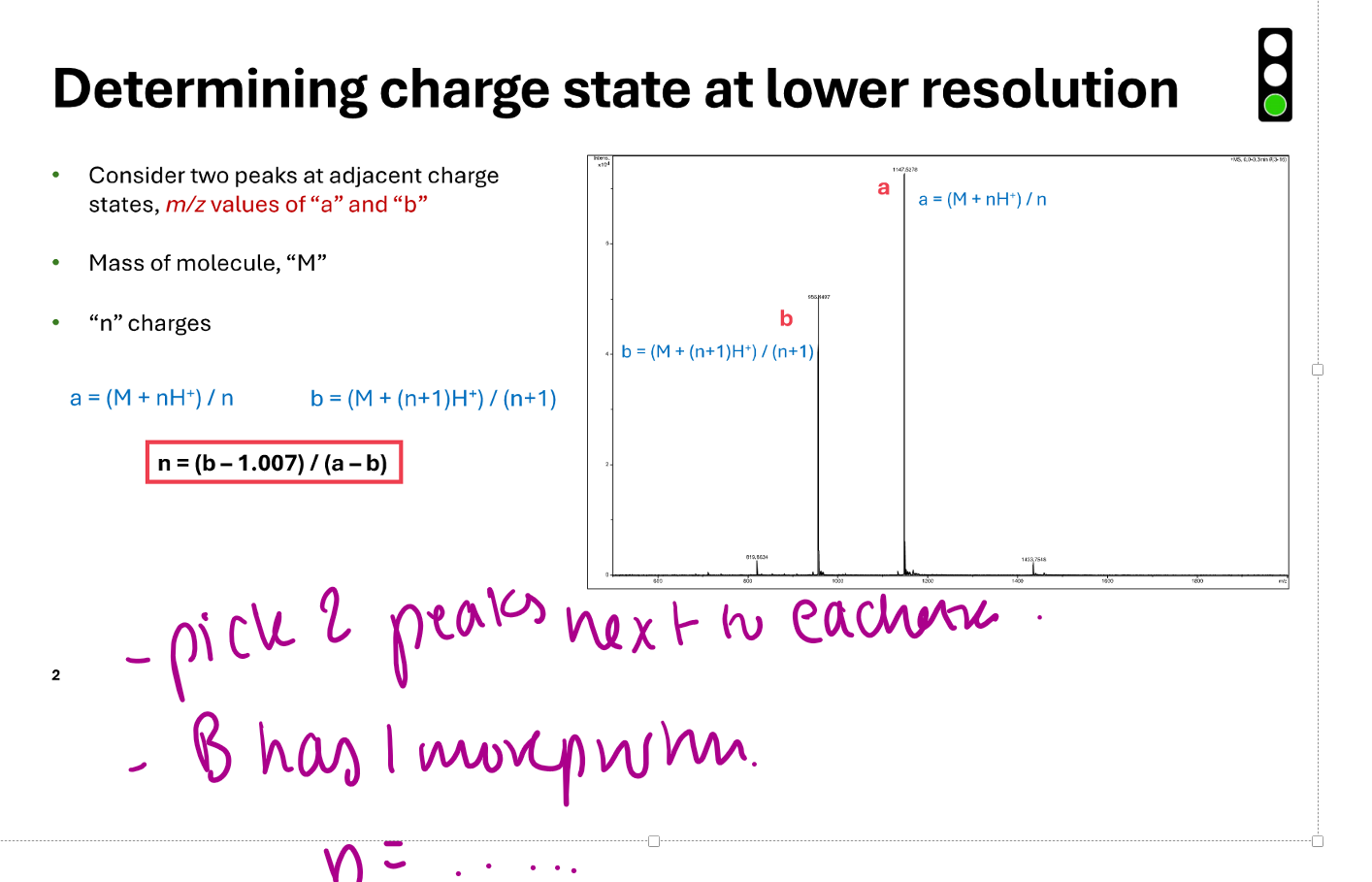
how would you determine n
key features of APPI
soft ionisation
include UV lamp
higher flow rates than ESI
can form radicals