Chapter 10 Bony Thorax, Sternum, Ribs Questions
 Studied by 0 people
 Call Kai
 Learn
Learn Practice Test
 Spaced Repetition
 Match
Match Flashcards
 Knowt Play
1/81

There's no tags or description
Looks like no tags are added yet.
Name | Mastery | Learn | Test | Matching | Spaced |
|---|
No study sessions yet.
82 Terms
The suprasternal, manubrial, or jugular notch all correspond to the level of:
A) T2-3
b) T1
c) T4-5
d) C7
a. T2-3
pg. 356: The jugular notch is at a level of T2-T3.
The xiphoid process corresponds to the vertebral level of:
A) T7
B) T9-10
C) T4-5
D) L1-2
B) T9-10
pg. 356: the xiphoid process corresponds to the level of T9-T10
What is the primary term for the superior margin of the sternum?
A) Sternal notch
B) Manubrial notch
C) Suprasternal notch
D) Jugular notch
D) Jugular notch
pg. 356: the uppermost border of the manubrium is easy to palpate and is called the jugular notch. Another secondary name for this area is the suprasternal or manubrial notch.
At approximately what age does the xiphoid process become totally ossified?
A) 12 years old
B) 21 years old
C) 40 years old
D) The xiphoid process never becomes ossified.
C) 40 years old
pg. 356: the xiphoid process is composed of cartilage during infancy and youth, and usually does not become totally ossified until about the age of 40 years old.
Which of the following structures connects the anterior aspect of the ribs to the sternum?
A) Costocartilage
B) Sternal tendons
C) Costovertebral joints
D) Costotransverse joints
A) Costocartilage
pg. 357: the anterior ribs do not unite directly to the sternum but do so with a short piece of cartilage termed costocartilage.
The sternal angle is a palpable landmark at the level of:
A) T4-5
B) T2-3.
C) T7.
D) T9-10.
A) T4-5
pg. 356: the sternal angle is at the level of the intervertebral disk space between T4 and T5 for an average adult.
Which pair of ribs attaches to the sternum at the level of the sternal angle?
A) First
B) Second
C) Third
D) Fourth and fifth
B) Second
pg. 357: the second costocartilage connects to the sternum at the level of the sternal angle.
In the erect adult bony thorax, the posterior or vertebral end of a typical rib is ____ higher than or more superior to the anterior portion.
A) 1 to 2 inches (2.5 to 5 cm)
B) 3 to 5 inches (8 to 13 cm)
C) 6 to 8 inches (15 to 20 cm)
D) 10 to 12 inches (25 to 30 cm)
B) 3 to 5 inches (8 to 13 cm)
pg. 357: The posterior or vertebral end of a typical rib is 3" to 5" higher than the anterior or sternal end.
Which of the following ribs is considered to be a false rib?
A) Seventh
B) First
C) Ninth
D) None of the above
C) Ninth
pg. 357:
Ribs 1-7 are true ribs
Ribs 8 to 12 are false ribs
Ribs 11 & 12, which are also false ribs, are termed floating ribs because they are not connected anteriorly.
Which of the following statements is true about floating ribs?
A) They do not possess a head
B) They do not possess a costovertebral joint.
C) They do not possess costocartilage.
D) They are ribs 8 through 12.
C) They do not possess costocartilage.
pg. 357: the last two pairs of false ribs (11 & 12) are unique in that they do not possess costocartilage. The term floating ribs can be used to designate these two pairs of ribs.
The widest aspect of the bony thorax generally occurs at the level of:
A) the eleventh and twelfth ribs.
B) T7.
C) the sternoclavicular joints.
D) the eighth or ninth ribs.
D) the eighth or ninth ribs.
pg. 358: the bony thorax is typically widest at the lateral margins of the eighth or ninth ribs.
What is the joint classification and type of movement for the sternoclavicular joints?
A) Cartilaginous with diarthrodial (ginglymus) movement
B) Synovial with diarthrodial (gliding) movement
C) Synovial with amphiarthrodial, limited movement
D) Cartilaginous with synarthrodial or no movement
B) Synovial with diarthrodial (gliding) movement
pg. 358: the sternoclavicular joints are synovial joints, containing articular capsules that permit a plane of motion, or gliding motion, and are therefore termed diarthrodial joints.
What is the joint classification and type of movement for the costotransverse joint?
A) Cartilaginous with diarthrodial (ginglymus) movement
B) Synovial with diarthrodial (plane) movement
C) Synovial with amphiarthrodial, limited movement
D) Cartilaginous with synarthrodial or no movement
B) Synovial with diarthrodial (plane) movement
pg. 358: synovial joints with articular capsules lined by synovial membrane, which allow plane or gliding motion, and are therefore diarthrodial.
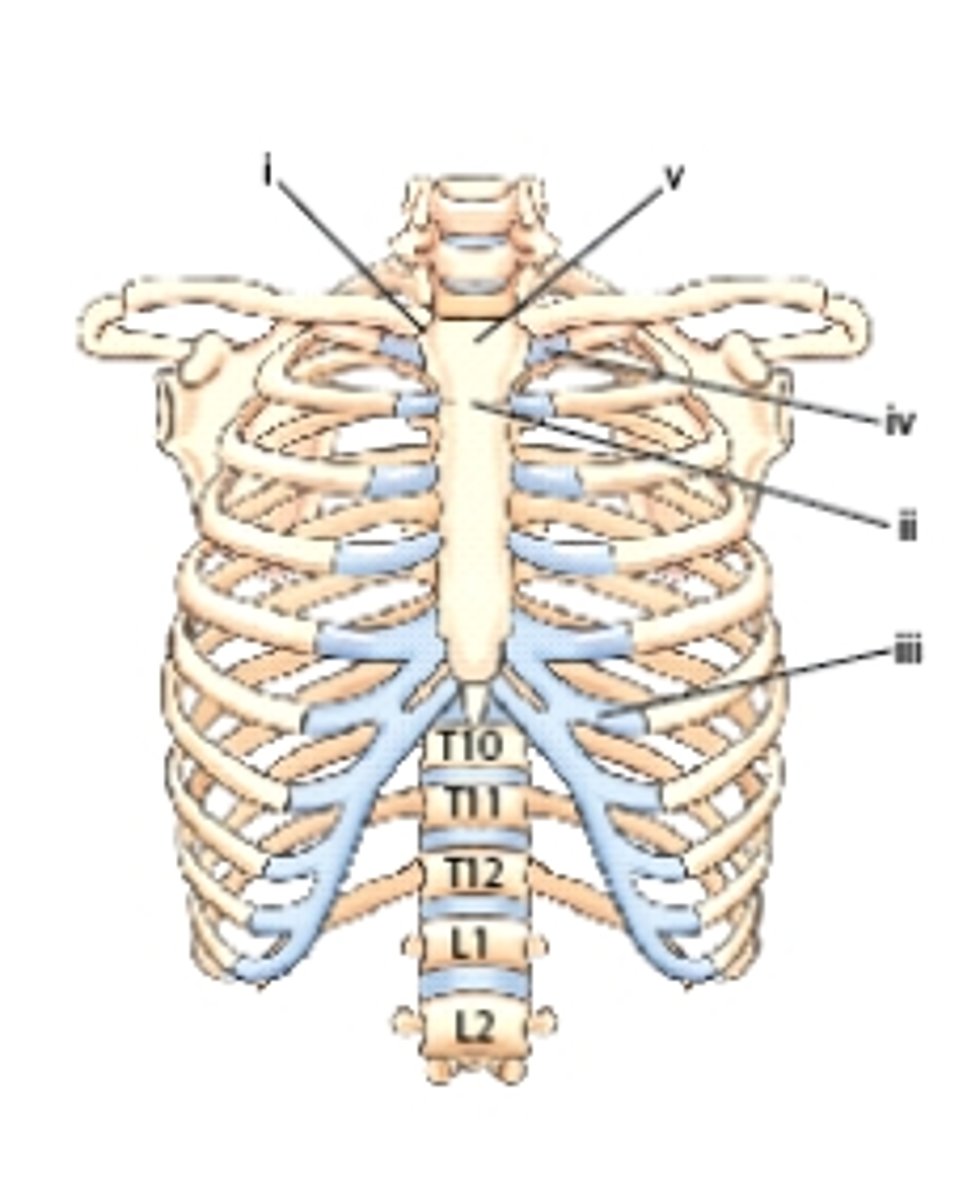
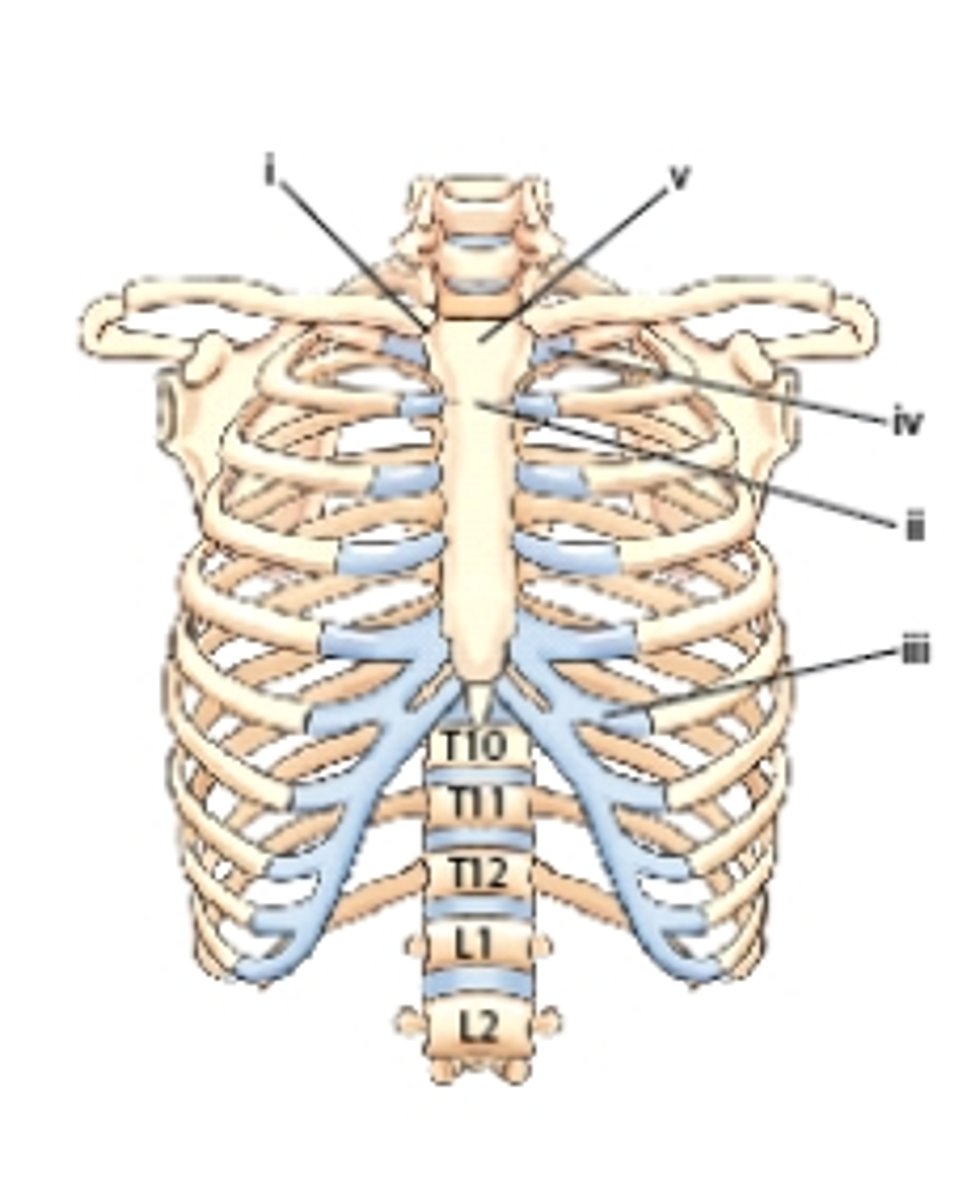
What is the name of the part labeled "i" in this figure?
A) Facet for the first rib
B) Body
C) Sternoclavicular joint
D) Sternal angle
C) Sternoclavicular joint
pg. 356: see figures 10. and 10.3
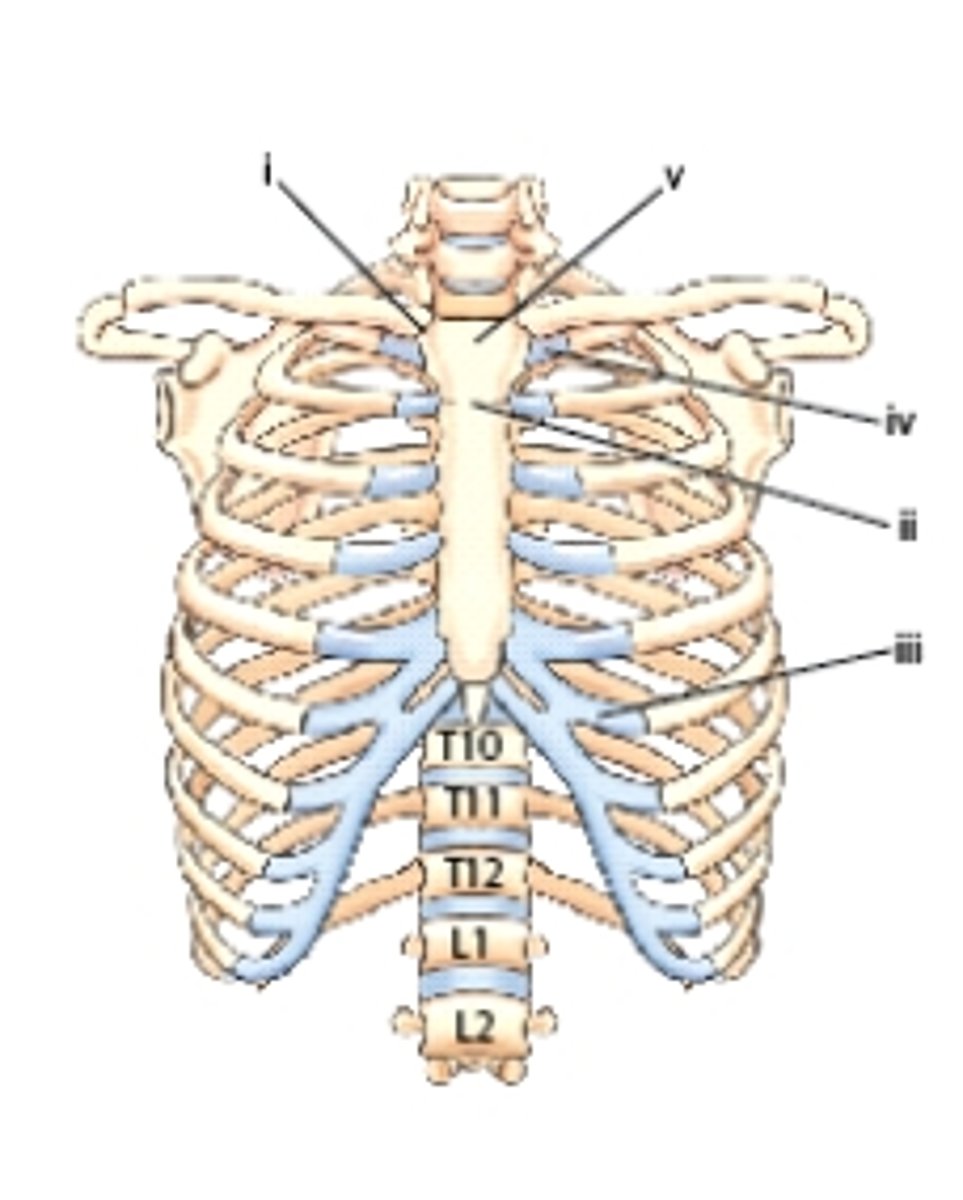
What is the name of the part labeled "ii"?
A) Xiphoid process
B) Body
C) Sternoclavicular joint
D) Sternal angle
D) Sternal angle
pg. 356: see figures 10. and 10.3
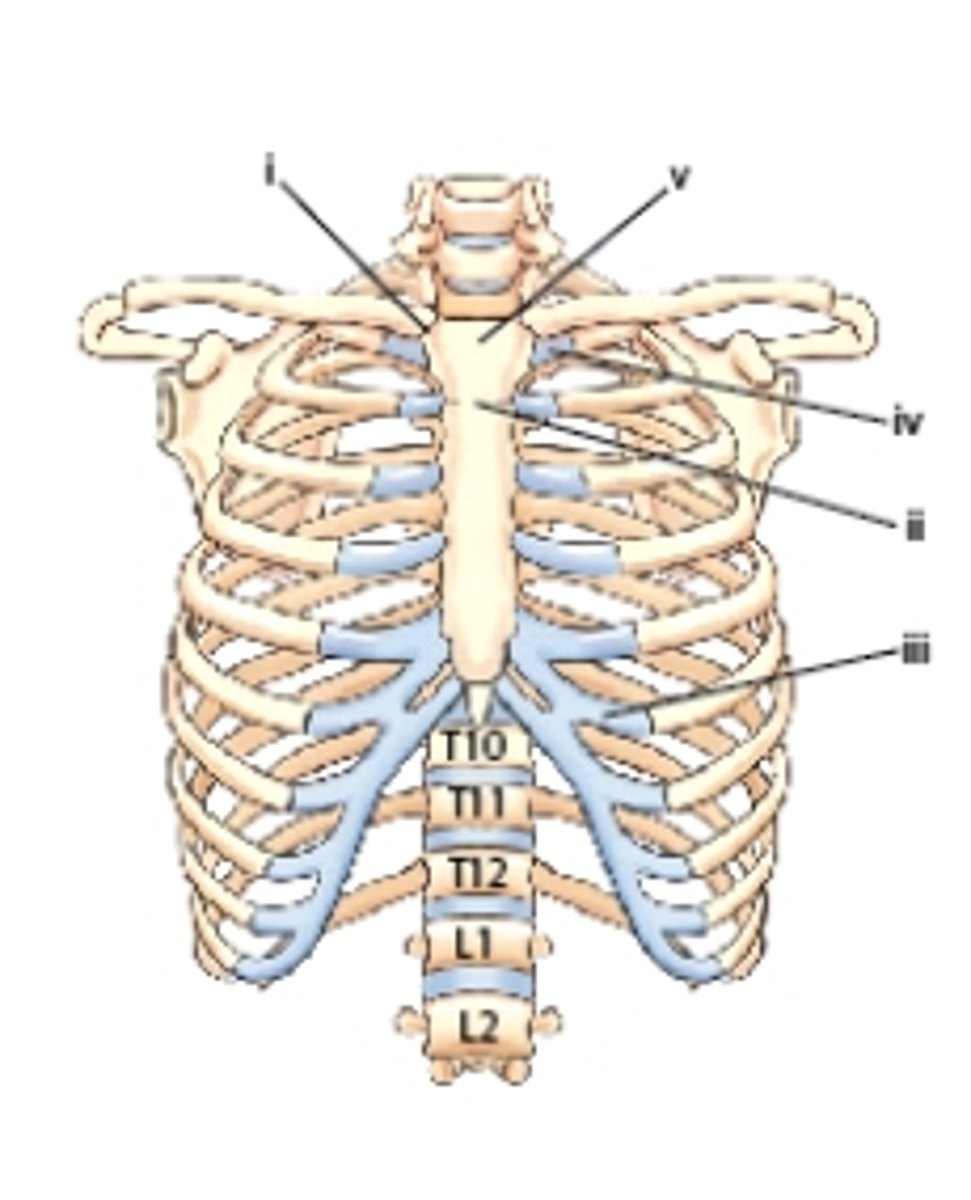
The structure labeled "iii" is the costocartilage:
A) of the tenth rib.
B) portion of the first false rib.
C) of the last true rib.
D) of the sixth rib.
D) costocartilage of the sixth rib
pg. 356: see figures 10. and 10.3
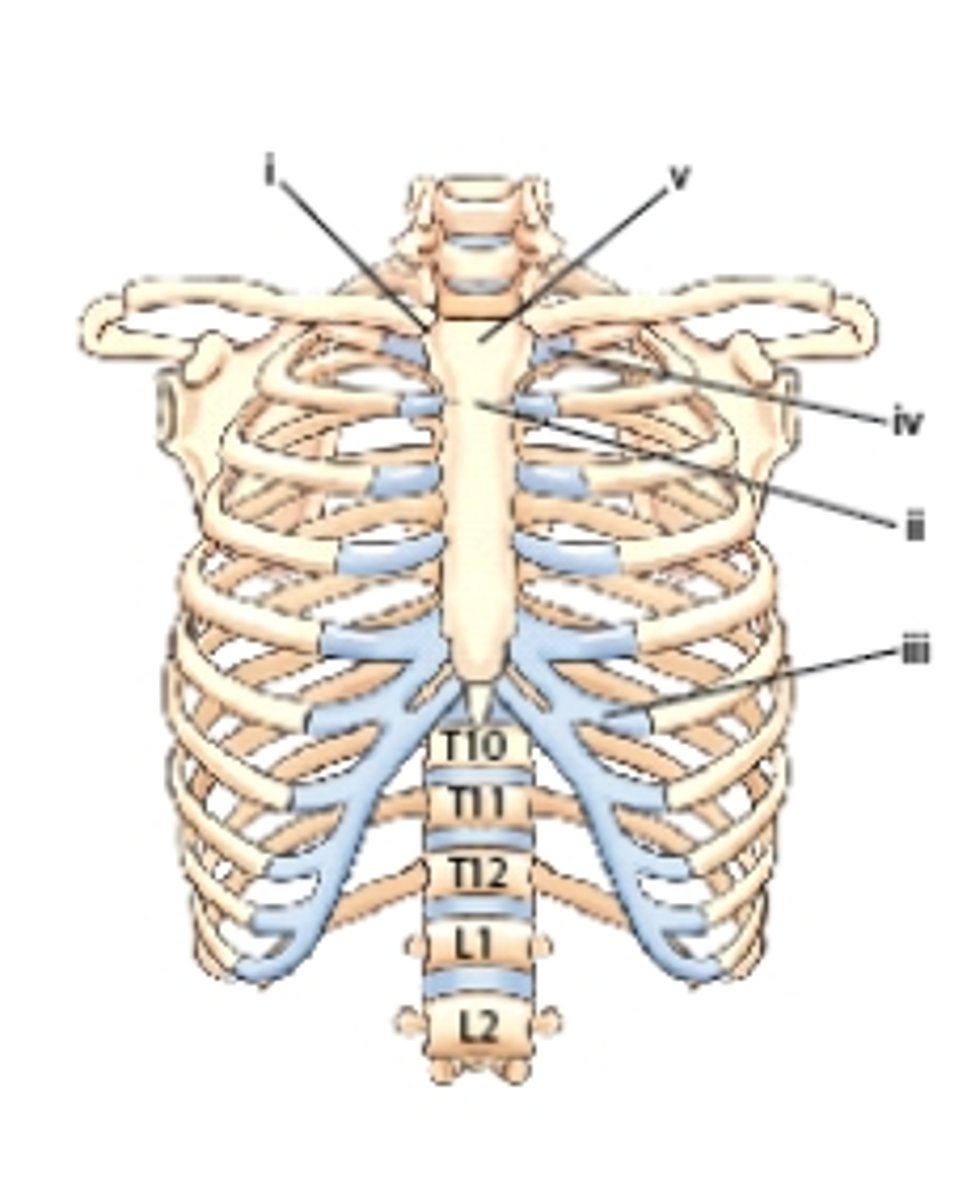
What is the name of the part labeled "iv"?
A) Facet for the sternum attachment
B) Head of the sternum
C) Facet for the second rib attachment
D) Costocartilage for the first rib attachment
D) Costocartilage for the first rib attachment
pg. 356: see figures 10. and 10.3
What is the name of the structure labeled "v"?
A) Head
B) Body
C) Manubrium
D) Xiphoid process
C) Manubrium
pg. 356: see figures 10. and 10.3
Which aspect of the rib articulates with the thoracic vertebral body?
A) Neck
B) Tubercles
C) Head
D) Facets
C) Head
pg. 357: The vertebral end of a rib consists of a head which articulates with one or two thoracic vertebral bodies
Which ribs are considered to be true ribs?
A) First only
B) First through seventh ribs
C) First through ninth ribs
D) Eleventh and twelfth ribs
B) First through seventh ribs
pg. 357: ribs 1 to 7 are termed true ribs.
Which of the following techniques is most effective in preventing lung markings from obscuring the sternum on an oblique projection?
A) Use a high kV.
B) Oblique as much as needed to not superimpose the sternum over the hilum region.
C) Decrease the source image receptor distance (SID) to magnify the sternum.
D) Use an orthostatic (breathing) technique.
D) Use an orthostatic (breathing) technique.
pg. 359: a breathing technique may be used for radiographic examination of the sternum. A breathing technique involves the patient taking shallow breaths during the exposure. This technique is also referred to as an orthostatic technique. If performed properly, the lung markings overlying the sternum will become obscured, whereas the image of the sternum will remain sharp and well defined.
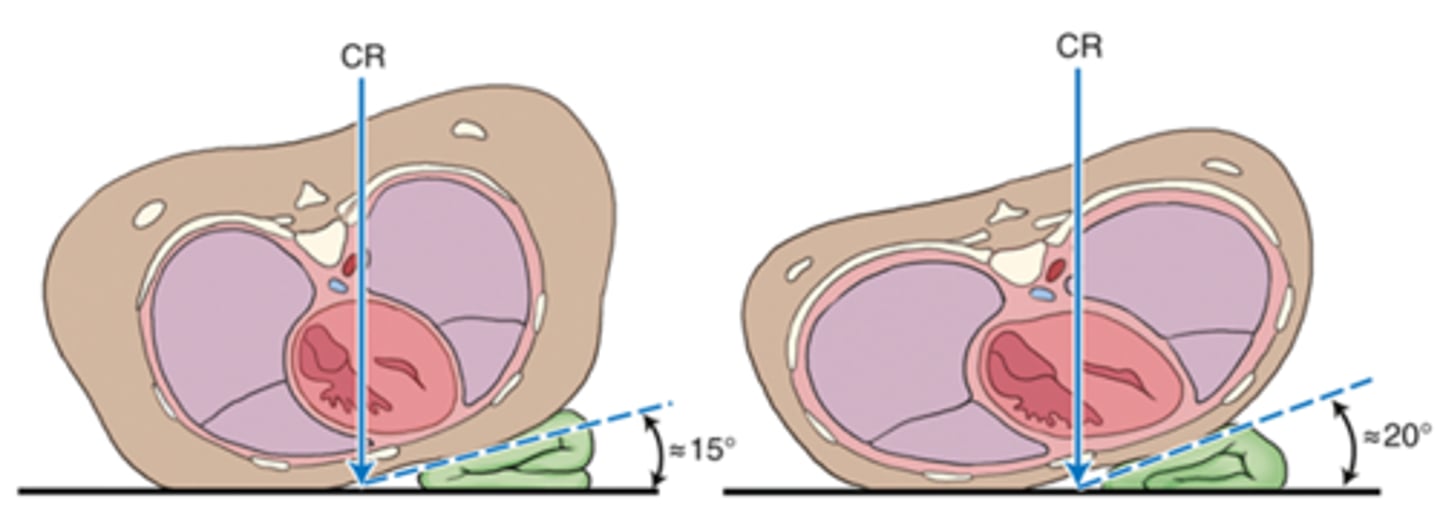
Why is the RAO sternum preferred to the LAO position?
A) The RAO produces less magnification of the sternum.
B) The RAO projects the sternum over the shadow of the heart.
C) The RAO reduces dose to the thyroid gland.
D) The RAO projects the sternum away from the hilum and heart.
B) The RAO projects the sternum over the shadow of the heart.
pg. 359: The patient is rotated into a 15° to 20° right anterior oblique (RAO) position to shift the sternum just to the left of the thoracic vertebrae and into the homogeneous heart shadow.
Which of the following statements is true about radiography of ribs located above the diaphragm?
A) Suspend breathing upon inspiration.
B) Perform the study with the patient recumbent.
C) Use an analog kV range of 85 to 95.
D) Always include an anteroposterior (AP) projection as part of the routine.
A) Suspend breathing upon inspiration.
pg. 360: Suspend respiration and expose on inspiration
- Perform the study with the PT erect, gravity assists in lowering the diaphragm.
- Use an analog kV range of 70 to 80
- You don't always use an AP projection - the decision to do an AP or PA projection is dependent upon the area of injury (posterior or anterior ribs) and putting the side of interest closest to the IR.
Which of the following positions will best demonstrate the axillary portion of the left ribs?
A) AP
B) Posteroanterior (PA)
C) Left posterior oblique (LPO)
D) LAO
C) Left posterior oblique (LPO)
pg. 371: Posterior oblique positions = affected side toward IR. Anterior oblique positions = affected side away from IR
pg. 372: To demonstrate the axillary portion of the right ribs, perform a RPO or LAO. To demonstrate the axillary portion of the left ribs, perform an LPO or RAO position.
pg. 361: Select the projections that will place the area of interest closest to the IR and rotate the spine away from the area of interest.
Which of the following positions will best demonstrate the axillary portion of the right ribs?
A) AP
B) PA
C) LAO
D) RAO
C) LAO
pg. 371: Posterior oblique positions = affected side toward IR. Anterior oblique positions = affected side away from IR
pg. 372: To demonstrate the axillary portion of the right ribs, perform a RPO or LAO. To demonstrate the axillary portion of the left ribs, perform an LPO or RAO position.
pg. 361: Select the projections that will place the area of interest closest to the IR and rotate the spine away from the area of interest.
Which of the following conditions may occur with trauma to the ribs?
A) Airway obstruction of the trachea
B) Pneumonia
C) Hemothorax
D) Pulmonary embolus
C) Hemothorax
pg. 361: Trauma to the bony thorax may result in injury to the respiratory system, and patients may require erect AP and lateral projections of the chest to rule out a possible pnuemothorax, hemothorax, pulmonary contusion, or other chest pathology.
What is the recommended degree of obliquity for an RAO projection of the sternum for an asthenic (thin-chested) type of patient?
A) 20°
B) 15°
C) 30°
D) 10°
A) 20°
pg. 359: a patient with a shallow or thin chest requires more rotation than a patient with a deep chest to cast the sternum away from the thoracic spine.
Hypersthenic patient has a greater AP measurement and requires less rotation (15°)
Asthenic patient has a decreased AP and requires more rotation (20°).
Which position can replace the RAO of the sternum if the patient cannot lie prone?
A) LAO
B) Left lateral decubitus
C) LPO
D) RPO
C) LPO
pg. 364: adaptation - this can be obtained in an LPO position if the patients condition does not permit an RAO position. Also, if the patient cannot be rotated, an oblique image may be obtained by angling the CR 15° to 20° across the right side of the patient to project the sternum lateral to the vertebral column, onto the heart shadow.
LPO: patient faces away from the board, left posterior side is against the IR, CR is 1” to the right of the midline of the patient.
What is the recommended SID for the lateral sternum position?
A) 40 inches (102 cm)
B) 44 inches (113 cm)
C) 46 inches (117 cm)
D) 60 to 72 inches (152 to 183 cm)
D) 60 to 72 inches (152 to 183 cm)
pg. 365: an SID of 40" in the minimum SID that should be used, but 60" to 72" is recommended to reduce magnification of the sternum caused by increased OID.
Where is the CR centered for a PA projection of the sternoclavicular joints?
A) At the level of the vertebra prominens (T1)
B) At the level of the sternal angle (T4-5)
C) Three inches (7 cm) distal to the vertebra prominens (T2-3)
D) At the level of the thyroid cartilage (T9)
C) Three inches (7 cm) distal to the vertebra prominens (T2-3)
pg. 366: CR perpendicular, centered to the level of T2-T3, or 3" (7 cm) distal to the vertebrae prominens (spinous process of C7).
How much rotation and which oblique position are required to best demonstrate the left sternoclavicular joints?
A) 10° to 15° LAO
B) 35° to 45° LAO
C) 10° to 15° RAO
D) 5° to 10° RAO
A) 10° to 15° LAO
pg. 367: anterior oblique positions (RAO, LAO) - best visualizes the sternoclvicular joint on the downside.
A 10° to 15° rotation in an anterior oblique position will rotate the SC joint across the spine to the opposite side; thus, and RAO will best demonstrate the right or downside SC joint. The LAO position will best demonstrate the left SC joint.
LAO: patient prone, the left side is down touching the IR, and right side is rotated up 10° to 15°.
RAO: patient prone, the right side is down touching the IR, and left side is rotated up 10° to 15°.
Which two projections must be taken for an injury to the right anterior, upper ribs?
A) PA and LAO
B) PA and RAO
C) AP and RAO
D) AP and LPO
A) PA and LAO
pg. 371:
Right anterior pain = side of interest is the right anterior aspect of the ribs
PA puts the anterior side (side of interest) closest to the IR.
Anterior injury = rotate away from the side of interest because its anterior pain, therefore patient is in a LAO position.
LAO = right side anterior pain, plus rotating away from the affected side puts the patient into an LAO
Which two projections must be taken for an injury to the left posterior, lower ribs?
A) AP and LPO
B) AP and RAO
C) PA and LPO
D) PA and RAO
A) AP and LPO
pg. 371:
Left posterior pain = side of interest is the left posterior aspect of the ribs
AP - puts posterior side (side of interest) closest to the IR
Posterior injury = rotate toward the side of interest because its posterior pain, therefore patient is in a LPO position.
LPO position - left sided posterior pain plus rotating toward the affected side puts the patient into an LPO.
What kV range (digital systems) is recommended for an AP projection of the ribs found below the diaphragm?
A) 75 to 85 kV
B) 60 to 65 kV
C) 65 to 75 kV
D) 70 to 80 kV
A) 75 to 85 kV
pg. 360: digital kV = 80 ± 5
Which disease or condition may be associated with postoperative complications of open heart surgery?
A) Spondylitis
B) Osteoblastic metastases
C) Osteomyelitis
D) Flail chest
C) Osteomyelitis
pg. 363: Osteomyelitis - this localized or generalized infection of bone and marrow can be associated with postoperative complications of open heart surgery, which requires the sternum to be split. The most common cause of osteomyelitis is a bacterial infection.
Fracture of adjacent ribs in two or more places with associated pulmonary injury is known as a(n) _____ rib injury.
A) compound
B) flail chest
C) acute
D) compression
B) flail chest
pg. 363: flail chest - this fracture of adjacent ribs in two or more places is caused by blunt trauma and is associated with underlying pulmonary injury.
The radiographic appearance of the erosion of bony rib margins is a possible indication of:
A) osteomyelitis.
B) osteoblastic metastases.
C) spondylolysis.
D) osteolytic metastases.
A) osteomyelitis.
pg. 363: Osteomyelitis radiographic appearance - erosion of bony margins.
Which of the following conditions, if severe, often requires a decrease adjustment of manual exposure factors?
A) Osteoblastic metastases
B) Osteomyelitis
C) Flail chest
D) None of the above
D) None of the above
pg. 363
Osteoblastic metastases = proliferative bony lesions of increased density = none, or decrease of exposure factors depending on severity.
Osteomyelitis = no change in exposure factors
Flail chest = no change in exposure factors
Osteolytic metastases = destructive lesions = none, or increase of exposure factors depending on severity.
A congenital defect characterized by anterior protrusion of the lower sternum and xiphoid process is termed:
A) pectus excavatum.
B) flail chest.
C) pectus carinatum.
D) sternal protrusion.
C) pectus carinatum.
pg. 363: pectus carinatum - this congenital defect is characterized by anterior protrusion of the lower sternum and xiphoid process. It is usually a benign condition but could lead to cardiopulmonary complications in rare cases.
Which condition of the sternum is often termed "funnel chest"?
A) Pectus excavatum
B) Flail chest
C) Pectus eruptus
D) Pectus deforminens
A) Pectus excavatum
pg. 363: Pectus excavatum - also referred to as funnel chest, this deformity is characterized by a depressed sternum.
The condition flail chest is most commonly caused by:
A) pneumothorax.
B) emphysema.
C) blunt trauma.
D) congenital heart defect.
C) blunt trauma.
pg. 363: flail chest - this fracture of adjacent ribs in two or more places is caused by blunt trauma and is associated with underlying pulmonary injury.
A radiograph of an RAO sternum reveals that it is partially superimposed over the spine. What must be done to eliminate this problem during the repeat exposure?
A) Perform an LPO projection instead of an RAO.
B) Angle the CR 5° to 10° laterally to the sternum.
C) Increase rotation of the body.
D) Increase kV.
C) Increase rotation of the body.
pg. 364: correct rotation is demonstrated by visualizing the sternum alongside the vertebral column with no superimposition by vertebrae. No distortion of sternum due to excessive rotation of the thorax.
i.e. the sternum should be just offset from the spine – if this distance is large, then we are over rotated. If the sternum is sitting on the spine partially, then the patient is under rotated.
A radiograph of a lateral projection of the sternum reveals that the patient's ribs are superimposed over the sternum. What needs to be done to correct this problem during the repeat exposure?
A) Increase the SID.
B) Angle the CR 5° anterior.
C) Ensure that the patient is not rotated.
D) Increase the kV.
C) Ensure that the patient is not rotated.
pg. 365: correct position with no rotation demonstrates the following:
- no superimposition of hermi, shoulders, or soft tissue on sternum.
- entire sternum with no superimposition of ribs.
- lower aspect of the sternum not obscured by breasts.
A radiograph of an RAO projection of the sternum demonstrates excessive lung markings obscuring the sternum. A 1-second exposure time and an orthostatic (breathing) technique were used. Which of the following will produce a more diagnostic image of the sternum?
A) Ensure that the patient is not breathing during the exposure.
B) Increase the exposure time; decrease the mA.
C) Decrease the kV; increase the mA or time.
D) Initiate exposure on deeper inspiration.
B) Increase the exposure time; decrease the mA.
pg. 364: orthostatic breathing technique requires a minimum of a 3-second exposure time and a low mA to produce blurring of overlying vascular structures.
A PA radiograph of the sternoclavicular (SC) joints demonstrates unequal distance from the SC joints to the midline of the spine. The left SC joint is farther from the sternum than the right. What specific positioning error is present on this radiograph?
A) Slight right rotation (right side toward the image receptor)
B) Slight left rotation (left side toward the image receptor)
C) Tilt of the upper thorax
D) Excessive angulation of the CR
A) Slight right rotation (right side toward the image receptor)
pg. 366-367: In an RAO, the patients right side is closest to the IR, therefore their left is farthest from the IR. In this situation, the patient is rotated too far to the right for the PA projection.
The SC joint that appears farther from the spine = the side rotated away from the IR (the side lifted).
Here, the left SC joint is farther from the midline → meaning the left side is farther from the IR, so the right side is closer to the IR.
A young female patient from the emergency department (ED) is brought to radiology for rib examination. She is able to sit up or stand for the procedure. She indicates that the region of pain is to the right anterior-to-mid axillary region. Which rib projections should be performed to minimize the effective dose to this patient?
A) PA and RPO
B) AP and RPO
C) PA and RAO
D) PA and LAO
D) PA and LAO
pg. 371:
Right anterior pain = side of interest is the right anterior aspect of the ribs
PA puts the anterior side (side of interest) closest to the IR.
Anterior injury = rotate away from the side of interest because its anterior pain, therefore patient is in a LAO position.
LAO = right side anterior pain, plus rotating away from the affected side puts the patient into an LAO
A patient enters the ED with an injury to the left anterior lower ribs. Which of the following projections should be taken to demonstrate the involved area?
A) AP and LAO
B) PA and RAO
C) AP and LPO
D) PA and LAO
B) PA and RAO
pg. 371:
Left anterior pain = side of interest is the left anterior aspect of the ribs
PA puts the anterior side (side of interest) closest to the IR.
Anterior injury = rotate away from the side of interest because its anterior pain, therefore patient is in a RAO position.
RAO = left side anterior pain, plus rotating away from the affected side puts the patient into an RAO
An ambulatory patient enters the ED with a possible injury to the right upper posterior ribs. Which of the following positioning routines should be taken to demonstrate the involved area?
A) Erect PA and LPO
B) Erect AP and RPO
C) Recumbent AP and RPO
D) Erect PA and LAO
B) Erect AP and RPO
pg. 360: Above Diaphragm = take the radiograph erect.
pg. 371:
Right posterior pain = side of interest is the right posterior aspect of the ribs
AP - puts posterior side (side of interest) closest to the IR
Posterior injury = rotate toward the side of interest because its posterior pain, therefore patient is in a RPO position.
RPO position - right sided posterior pain plus rotating toward the affected side puts the patient into an RPO.
A patient enters the ED with blunt trauma to the sternum. The patient is in great pain and cannot lie prone on the table or stand erect. Which of the following positioning routines would be best for the sternum examination in this situation?
A) RPO and lateral recumbent projections
B) AP and horizontal beam lateral projections
C) LPO and horizontal beam lateral projections
D) LPO and lateral recumbent projections
C) LPO and horizontal beam lateral projections
pg. 364: adaptation - RAO can be obtained in an LPO position if the patients condition does not permit an RAO position.
pg. 365: the lateral image can be obtained with the use of a horizontal x-ray beam with the patient in the supine position if the patient's condition warrants this modification.
A patient enters the ED with trauma to the bony thorax. The initial radiographs reveal that there are fractured ribs and a possible pneumothorax of the left thorax. The physician orders a chest study to confirm the pneumothorax; however, the patient cannot stand. Which of the following positions would best demonstrate the pneumothorax?
A) Left lateral decubitus
B) Right lateral decubitus
C) Ventral decubitus
D) Dorsal decubitus
B) Right lateral decubitus
pg. 361: If the patient cannot assume the erect position and the presence of air-fluid levels must be ruled out, an image obtained with a horizontal beam with the patient in a decubitus position should be included.
pg. 97: radiograph may be taken as a right or left lateral decubitus.
For possible fluid in the pleural cavity (pleural effusion), the suspected side should be down.
For possible small amounts of air in the pleural cavity (pneumothorax) the affected side should be up.
Initial PA projections of the SC joints indicate a possible bony defect involving the right SC joint. The vertebral column is preventing a clear view of it. Which of the following projections will demonstrate the right SC joint without superimposition over the spine?
A) Horizontal beam lateral
B) LAO
C) RAO
D) Erect lateral projection
C) RAO
pg. 367: the RAO visualizes the right SC joint, and the LAO visualizes the left SC joint
RAO: patient prone, the right side is down touching the IR, and left side is rotated up 10° to 15°.
What is the minimum number of ribs that must be demonstrated for a unilateral rib study above the diaphragm?
A) Ribs 1 through 6
B) Ribs 1 through 8
C) Ribs 1 through 9
D) All ribs must be demonstrated.
C) Ribs 1 through 9
pg. 360: states that on the upper, we should suspend on inspiration to project the diaphragm below the ninth or tenth ribs on full inspiration.
pg. 368: above diaphragm - ribs 1-9 should be visualized.
A radiograph of an RAO projection of the ribs demonstrates the left axillary ribs are foreshortened, whereas the right side is elongated. Which of the following is the most likely reason for this radiographic outcome?
A) The patient requires more rotation to the right.
B) An LAO was performed rather than the RAO position.
C) The technologist should have performed a PA projection to demonstrate the left axillary ribs, not an RAO.
D) CR angulation was incorrect.
B) An LAO was performed rather than the RAO position.
pg. 372: to demonstrate the axillary portion of the right ribs perform an RPO or LAO position. To demonstrate the axilalry portion of the left ribs, perform an LPO or RAO.
An LAO would demonstrate the side that is away from the IR, which would be the right side. This would lead to foreshortening of the left side.
A patient with metastatic disease in the ribs comes to radiology following a nuclear medicine scan. The radiologist orders a right, upper posterior rib study. Which of the following positioning factors should be followed for this specific study?
A) Perform positions erect if the patient's condition permits.
B) Exposure on full expiration.
C) Include the RPO position as part of the positioning routine.
D) Both A and C are correct.
D) Both A and C are correct
pg. 360:
Uppers - take the radiograph erect if the patient is able to stand or sit.
Pg. 371:
Posterior right rib study = side of interest is the posterior right aspect of the ribs.
AP - puts posterior side (side of interest) closest to the IR
RPO will demonstrate the axillary portion of the right ribs.
Which of the following positioning considerations does NOT apply for a study of the lower ribs?
A) Perform positions recumbent.
B) Use a digital kV range between 65 and 70 kV.
C) Exposure on full expiration.
D) Both A and B are incorrect.
B) Use a digital kV range between 65 and 70 kV.
pg. 360: Below diaphragm
- take the radiographs with the patient recumbent
- suspend respiration and expose on expiration.
- select a medium, kV range (analog: 70-80; digital 80 ± 5)
Which bone classification are ribs?
A) flat
B) long
C) short
D) irregular
A) flat
pg. 9: flat bones consist of two plates with cancellous bone and bone marrow between them. Examples of flat bones are the bones that make up the calveria, sternum, ribs, and scapulae.
Which radiographic position best demonstrates the sternum projected within the heart shadow?
A) LAO
B) LPO
C) RAO
D) RPO
c. RAO
pg. 359: Because the thoracic spine is so dense, it is almost impossible to see the sternum in a true PA or AP projection. Therefore, the patient is rotated in a 15° to 20° right anterior oblique (RAO) to shift the sternum just to the left into the homogeneous heart shadow.
How should the central ray be directed for the oblique position to best demonstrate the sternum?
A) perpendicularly
B) 15º caudal
C) 15º cephalic
D) 20º caudal
a. perpendicularly
pg. 364: the CR is perpendicular to the IR, directed to the center of the sternum (1" left of the midline, and midway between the jugular notch and xiphoid process)
Which procedure should be performed for the lateral projection of the sternum?
A) rotate the shoulders forward
B) ask the patient to take slow, shallow breaths
C) raise both arms and rest forearms on top of the head
D) increase the source-to-image receptor distance to 72"
D) increase the source-to-image receptor distance to 72"
pg. 365:
- Shoulders and arms drawn back
- Suspend respiration on inspiration
- SID of 60" to 70" is recommended to reduce magnification of the sternum caused by increased OID.
How should the central ray be directed and centered for the PA projection for bilateral sternoclavicular joints?
a. perpendicular to T3
b. perpendicular to T7
c. angled medially 15º, entering at T3
d. angled cephalically 15º, entering at T7
a. perpendicular to T3
pg. 366: CR perpendicular, centered to the level of T2-T3
To most effectively demonstrate injured anterior ribs numbers 5 and 6 on the right side, which two projections should be included as part of the series?
a. PA and PA oblique with the patient LAO
b. PA and PA oblique with the patient RAO
c. AP and AP oblique with the patient LPO
d. AP and AP oblique with the patient RPO
a. PA and PA oblique with the patient LAO
pg. 371:
Right anterior pain = side of interest is the right anterior aspect of ribs 5 & 6.
PA puts the anterior side (side of interest) closest to the IR.
Anterior injury = rotate away from the side of interest because its anterior pain, therefore patient is in a LAO position.
LAO = right side anterior pain, plus rotating away from the affected side puts the patient into an LAO
To most effectively demonstrate injured posterior ribs numbers 5 and 6 on the left side, which two projections should be included as part of the series?
a. PA and PA oblique with the patient LAO
b. PA and PA oblique with the patient RAO
c. AP and AP oblique with the patient LPO
d. AP and AP oblique with the patient RPO
c. AP and AP oblique with the patient LPO
pg. 371:
Left posterior pain = side of interest is the left posterior aspect of ribs 5 & 6
AP - puts posterior side (side of interest) closest to the IR
Posterior injury = rotate toward the side of interest because its posterior pain, therefore patient is in a LPO position.
LPO position - left sided posterior pain plus rotating toward the affected side puts the patient into an LPO.
Which two projections best demonstrate injured posterior ribs numbers 10, 11 & 12 on the right side?
a. AP and AP oblique with the patient LPO
b. AP and AP oblique with the patient RPO
c. PA and PA oblique with the patient LPO
d. PA and PA oblique with the patient RPO
b. AP and AP oblique with the patient RPO
pg. 371:
Right posterior pain = side of interest is the right posterior aspect of ribs 5 & 6
AP - puts posterior side (side of interest) closest to the IR
Posterior injury = rotate toward the side of interest because its posterior pain, therefore patient is in a RPO position.
RPO position - right sided posterior pain plus rotating toward the affected side puts the patient into an RPO.
Which radiographic position best demonstrates the posterior 11th rib on the right side without vertebral superimposition?
a. LAO
b. LPO
c. RAO
d. RPO
d. RPO
pg. 372: To demonstrate the axillary portion of the right ribs, perform an RPO or LAO position.
Right posterior pain = side of interest is the right posterior aspect of the 11th rib = RPO
Which radiographic position best demonstrates the anterior 6th rib on the left side without vertebral superimposition?
a. LAO
b. LPO
c. RAO
d. RPO
c. RAO
pg. 372: To demonstrate the axillary portion of the left ribs, perform and LPO or RAO position.
Left anterior pain = side of interest is the left anterior aspect of the 6th rib = RAO
What is the proper name for that structure commonly called the "breastbone"?
a. scapula
b. sternum
c. manubrium
d. xiphoid process
b. sternum
For the AP projection demonstrating ribs above the diaphragm, when should respiration be suspended and what effect will that have on the diaphragm?
a. on full inspiration; will depress the diaphragm
b. on full inspiration; will elevate the diaphragm
c. on full expiration; will depress the diaphragm
d. on full expiration; will elevate the diaphragm
a. on full inspiration; will depress the diaphragm
pg. 360: Above diaphragm - suspend respiration and expose on inspiration. This should project the diaphragm below the ninth or tenth ribs on full inspiration.
For the AP projection demonstrating ribs below the diaphragm, when should respiration be suspended and what effect will that have on the diaphragm?
a. on full inspiration; will depress the diaphragm
b. on full inspiration; will elevate the diaphragm
c. on full expiration; will depress the diaphragm
d. on full expiration; will elevate the diaphragm
d. on full expiration; will elevate the diaphragm
pg. 360: Below diaphragm - suspend respiration and expose on full expiration. This should allow the diaphragm to rise to the level of the seventh or eighth posterior ribs, providing a uniform density for below diaphragm ribs.
When performing the AP projection to demonstrate ribs below the diaphragm, with reference to the patient, how should the image receptor be positioned?
a. center the image receptor at the level of L3
b. center the image receptor at the level of iliac crests
c. lower border of the image receptor at the level of L3
d. lower border of the image receptor at the level of iliac crests
d. lower border of the image receptor at the level of iliac crests
pg. 370: IR centered to CR (bottom of IR at iliac crest)
Which projection best demonstrates the axillary portion of ribs?
a. AP projection
b. PA projection
c. Lateral projection
d. AP oblique projection
d. AP oblique projection
pg 371: Oblique positions will demonstrate the axillary portion of the ribs that is not well seen on the AP-PA projections.
Which of the following evaluation criteria pertains to the AP oblique projection for ribs?
a. trachea should be seen in the midline of the thorax
b. heart and mediastinum should be seen in the center of the image
c. axillary portion of the ribs of interest should be free of superimposition
d. sternal ends of the clavicles should be equidistant from the vertebral column
c. axillary portion of the ribs of interest should be free of superimposition
pg. 372: the axillary portion of the ribs under examination is projected without self super-imposition.
Which of the following articulates with the articular facets located just lateral to the jugular notch?
a. ribs
b. clavicles
c. sternal body
d. xiphoid process
b. clavicles
pg. 356: the medial aspect of each clavicle articulates with the lateral aspect of the manubrium of the sternum at the clavicular notch, and is called the sternoclavicular joint.
Where on the sternum is the jugular notch located?
a. lateral border of the body
b. lateral border of the manubrium
c. superior border of the body
d. superior border of the manubrium
d. superior border of the manubrium
pg. 356: the uppermost border of the manubrium is easy to palpate and is called the jugular notch.
Which part of the sternum is located at the level of T10?
a. body
b. angle
c. manubrium
d. xiphoid process
d. xiphoid process
pg. 356: The xiphoid process corresponds to the level of T9-T10
Which classification refers to ribs that have no anterior attachments?
a. true
b. primary
c. floating
d. secondary
c. floating
pg. 357: Ribs 11 & 12 are termed floating ribs because they are not connected anteriorly.
Which pairs of ribs are classified as true ribs?
a. first 7 pairs
b. pairs 8, 9 and 10
c. pairs 8, 9, 10, 11 & 12
d. the last 2 pairs
a. first 7 pairs
pg. 357: Ribs 1 to 7 are term,ed true ribs.
Which articulation is formed in part with a head of a rib?
a. costosternal
b. costovertebral
c. costotransverse
d. sternoclavicular
b. costovertebral
pg. 358: see table 10.1
Costovertebral joints - between heads of ribs and thoracic vertebrae
With which structures do heads of ribs articulate?
a. cartilage of adjacent ribs
b. lateral borders of the sternum
c. demifacets of thoracic vertebrae
d. transverse processes of thoracic vertebrae
c. demifacets of thoracic vertebrae
pg. 357: The vertebral end of a rib consists of a head which articulates with one or two thoracic vertebral bodies
pg. 298: Each thoracic vertebrae has a facet or demifacet on each side of the body. Each facet or combination of two demifacets accepts the head of a rib to form a costovertebral joint.
Which of the following landmarks can be palpated to locate the upper margin of the sternum on the obese patient?
A) Vertebra prominens
B) Sternal angle
C) Jugular notch
D) Thyroid cartilage
C) Jugular notch
pg. 362: the easiest landmark to locate through palpation is the jugular notch. Use this landmark for sternum and rib positioning to determine the upper boarder of the sternum, SC joints, and ribs.
Which analog kV range is recommended for an AP study of the ribs found below the diaphragm?
A) 85 to 90 kV
B) 60 to 65 kV
C) 65 to 75 kV
D) 70 to 80 kV
D) 70 to 80 kV
pg. 360: medium kV (analog = 70 to 80)
Which costocartilage attaches to the sternum at the level of the sternal angle?
A) First
B) Second
C) Third
D) Fourth and fifth
B) Second
pg. 357: the second costocartilage connects to the sternum at the level of the sternal angle.
What is the joint space between the manubrium and body of sternum called?
A) Sternal notch
B) Costocartilage
C) Sternal angle
D) SC joint
C) Sternal angle
pg. 356: the lower end of the manubrium joins the body of the sternum to form a palpable prominence, the sternal angle (manubriosternal joint)