PAPER 1 BIOLOGY MISTAKES
 Call Kai
 Learn
Learn Practice Test
 Spaced Repetition
 Match
Match Flashcards
 Knowt Play
1/17

There's no tags or description
Looks like no tags are added yet.
Name | Mastery | Learn | Test | Matching | Spaced | Call with Kai | Chat |
|---|
No analytics yet
Send a link to your students to track their progress
18 Terms

It is recommended that all children are given a measles vaccination.
Give evidence from Figure 1 to support the recommendation.
Include data from Figure 1 in your answer.
a lower percentage of vaccinated children have severe measles
Severe Disease is 42% higher in unvaccinated children
A student investigated osmosis in pieces of potato.
This is the method used.
Cut a piece of potato into a cube.
Record the mass of the cube.
Place the cube into a beaker containing 0.4 mol/dm salt solution.
After some time, remove the cube and record the mass.
Calculate the change in the mass of the cube.
Repeat steps 1 to 5 using two more different concentrations of salt solution.
Evaluate the student's method.
You should include how the student could improve the validity of their results.
Strengths:
all potato pieces used were cubes
mass was recorded before and after
Improvements
remove skin or peel the potato
(because) skin (may still be) present
blot / dry cube before measuring mass
(because) cube will have excess water on surface

Calculate the rate of photosynthesis at 20 °C.
Give your answer to 3 significant figures.
Give the unit.
10/43
= 0.23255...
0.233
(unit) bubbles per second
Explain the difference in the rate of photosynthesis at 40 °C compared with the rate of photosynthesis at 10 °C.
rate / photosynthesis is faster / higher (at 40 °C)
reactants / particles / molecules / enzymes have greater (kinetic) energy
(so) collide more frequently
Describe one way the method could be changed to obtain more accurate results for the rate of photosynthesis.
Collect Gas/Oxygen in a gas syringe
Describe two ways the gardener could identify a plant disease.
reference to a gardening manual / website / app
take (infected plants) to a laboratory/scientist/expert
Explain why plants may develop yellow leaves.
a shortage of magnesium (ions)
which causes chlorosis
Give one other function of blood plasma.
To Transport/carry hormones/carbon dioxide
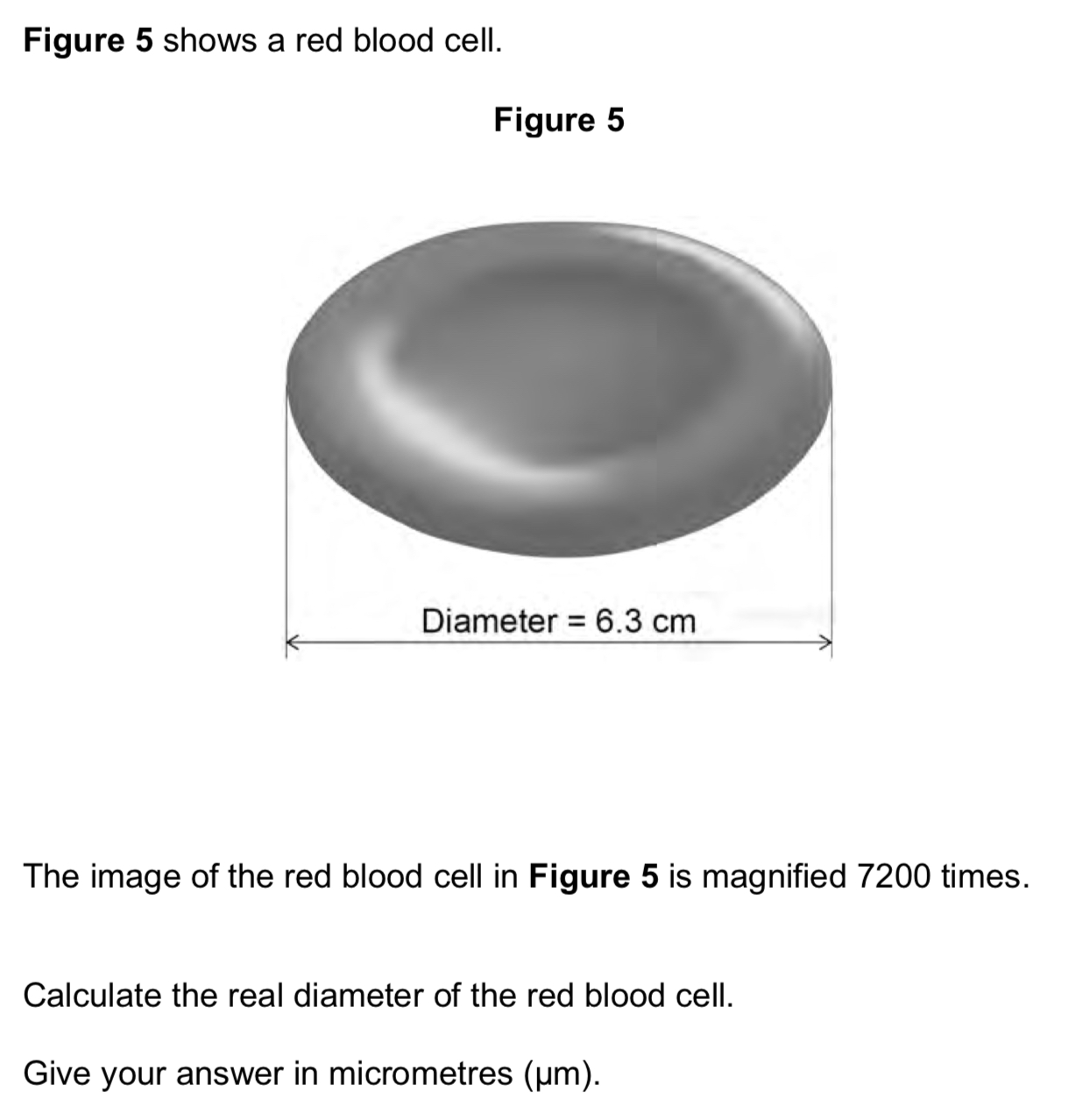




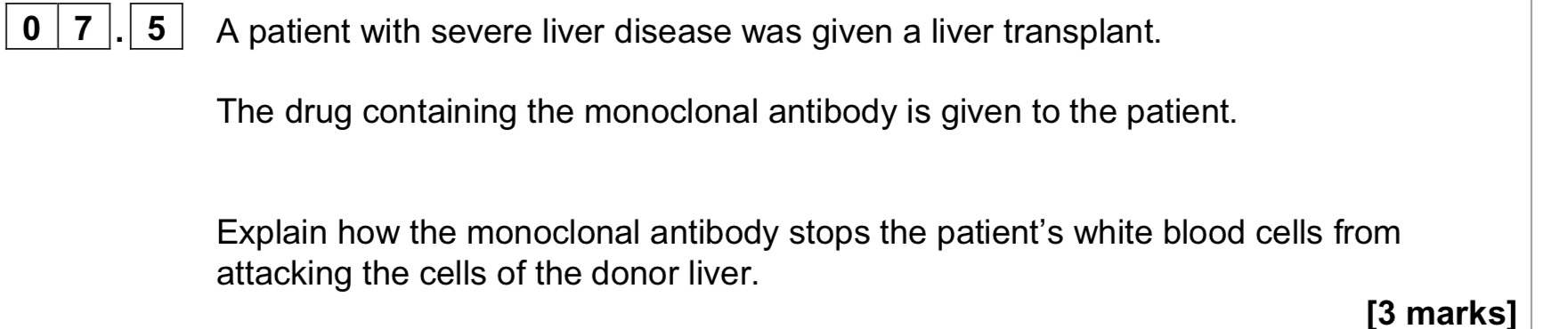

Explain why a person with severe liver disease has difficulty digesting fats.
less / no bile produced (by liver) so less / no emulsification of fats
(so) fats not made into small(er) droplets
(so) surface area (of fat) not increased
(so) lipase cannot digest fat as quickly / much (due to smaller surface area)
less / no bile produced (by liver) so acid not neutralised
(because) bile is alkaline
(so) lipase or small intestine not at optimum pH
(so) lipase denatures
(so) lipase cannot digest fat as quickly / much (due to reduced
/ incorrect pH)
Give two features of a yeast cell that are not found in a bacterial cell.
any two from:
nucleus
vacuole
mitochondria

Compare the effectiveness of the antibiotics shown in Figure 11.
antibiotic A
• A is least / less effective
because A starts to reduce the number of bacteria latest
antibiotic B
B is more effective than A
B is less effective than C
because B starts to reduce the number of bacteria after C
antibiotic C
• C is most / more effective
because C starts to reduce the number of bacteria soonest