Chem term 3
 Call Kai
 Learn
Learn Practice Test
 Spaced Repetition
 Match
Match Flashcards
 Knowt Play
1/110

There's no tags or description
Looks like no tags are added yet.
Name | Mastery | Learn | Test | Matching | Spaced | Call with Kai | Chat |
|---|
No analytics yet
Send a link to your students to track their progress
111 Terms
Write a balanced chemical eq. for photosynthesis? Exo or endo?
6CO2 (g) + 6H2O (l) → C6H12O6 (s) + 6O2 (g)
Endo - storing energy light energy transformed into chemical
Using chlorophyll to capture sunlight
+2803 kJ mol
Write a balanced chemical eq. for aerobic respiration? Exo/endo?
C6H12O6 + 6O2 → 6CO2 + 6H2O
Exo - releasing energy
-2803 kJ mol
What are the products of complete/partial/incomplete combustion?
Complete: Fuel (g) + Plenty O2 (g) ➔ CO2 (g) + H2O (l)
Partial: Fuel + Limited O2 (g) ➔ CO (g) + H2O (l)
Incomplete: Fuel + Very Little O2 ➔ C (s) (soot - carbon) + H2O (l)
WRITE DELTA H!!!
What are the 4 marks for a thermochemical equation?
Correct species
Fully balanced
States of matter
ΔH
What are renewable energy sources?
Wind
Biodiesel
Bioethanol
Sunlight
How can you tell if its galvanic/electrolytic cell?
Galvanic - connected to load
Electrolytic - connected to an external power source (e.g. battery or direct current power supply)
In what directions do electrons flow in electrolytic/galvanic?
ALWAYS - Anode to cathode
How do I do pH/pOH calcs? What abt with polyprotic acids - multiple acidic protons?
pH = -log[H+]
[H+] = 10-pH (mol/L)
pOH = -log[OH-]
[OH-] = 10-pOH (mol/L)
pH + pOH = 14
Stoichiometric ratios - multiply the given concentration by the number of acidic protons/hydroxide ions (formula uses conc. of protons/hydroxide ions not acid/base conc.)
What is a weak base/acid?
Partially ionises in water/aqueous solution (not fully)
What is a strong base/acid?
Fully ionises in water/aqueous solutions
What is the charge of clay particles? What are they?
NEGATIVE - prevents sedimentation to the bottom of solution - stay suspended hence why coagulation is needed to disable negative charge - form stabilised colloidal suspensions due to repulsive negative charges
Alluminosilicate
What form do nutrients have to be in for plants?
Aqueous - water carrying nutrients up by roots - non-aqueous nutrients can become aqueous by cation exchange
SOLUBLE FORM
What property gives a large surface area in zeolites?
Microporous - lots of negative sites for cation exchange to occur
Why can some elements be reduced into metals by oxygen but others require other reducing agents?
Higher on the activity series - reduced more readily into a metal
Others require a more potent reducing agent
Why does increased CO2 in the atmosphere lead to higher average global temperatures? What is the enhanced greenhouse effect?
Greenhouse gas such as CO2 - absorb the infared radiation (IR) that re-radiates into the atmosphere from Earth’s surface - re-emit the IR back toward the Earth and stop it from escaping - trapping heat - increasing global temperatures - contributing to climate change
Result of greater levels of ghg in the atmosphere - increases the amount of heat trapped - thus increasing global temp - contributing to climate change
How is ozone concentration influenced by solar radiation (UV)?
Nitrogen dioxide in the Earth’s atmosphere photo-dissociates in the presence of high levels of solar radiation (UV) to form nitric oxide and a highly-reactive oxygen radical.
NO2 (UV goes on top of the arrow)→ NO + O
This oxygen radical reacts with oxygen in the air to form ozone
O2 + O → O3
HENCE OZONE CONCENTRATIONS PEAK AFTER MIDDAY - higher UV levels
What is the process by which tryglycerides are converted into biodiesel?
Transesterification
What reactants can convert triglycerides into biodiesel?
Short chain alcohols - methanol
How do I get full marks on SHE q.?
Structure answer before writing -
Point and evidence (1 mark) - statistics/identify a strong piece of evidence
Link to society in at least 1 way and explanation (1 mark)
IF 4 MARKS DOUBLE UP ON BOTH
What is ocean acidification?
pH of ocean lowered - more acidic - due to increased levels of CO2 in the atmosphere
CO2 dissolves in ocean CO2 (g) ➔ CO2 (aq)
The aqueous CO2 reacts with water to form carbonic acid
CO2 + H2O ⇌ H2CO3
The acid partially ionises in water to form H+ ions
H2CO3 + H2O ⇌ H+ HCO3-
HCO3- + H2O ⇌ H + CO32-
How does the formation of nitrogen dioxide occur?
N2 + O2 ➔ 2NO - nitric oxide which is further oxidised to form (energetic event natural - lightning/bushfires or unnatural - car engine (energetic event needs to be able to break strong triple bond between N2 - very stable - requires high activation energy)
2NO + O2 ➔ 2NO2 - hence nitrogen dioxide concentrations peak after nitric oxide levels
What are the harmful effects of photochemical smog?
HUMANS:
Lung tissue lining damage - increases the effect of asthma/bronchitis
Increased heart attack risk
PLANTS:
Enter pores during photosynthesis - make more susceptible to disease
Strong bonds in carbon chains of polymers degraded by photochemical smong - losing elasticity
What are consequences of the enhanced greenhouse effect?
Contributes to global warming - increasing rate of weather disasters like cyclones, floods, droughts
Species extinction - those that cannot adapt to the changing weather
What are ways that a person can reduce emissions of CO2 and methane or NO?
Drive less - carpool or public transport
Less consumption of red meat
Minimise houshold waste by purchasing products with minimal packaging
Turn off appliances when they are not in use - to reduce energy consumption =
Under what conditions are nitrogen oxides formed?
High-temperature engines/furnaces/bushfires - as these gases (N2/ O2) coexist in the atmosphere with little or no reaction between them
What is a harmful effect of high concentrations of NO in troposphere?
Reacts with haemoglobin - reducing oxygen transport to cells for aerobic respiration - rate of respiration decreases - reduced organ function
What is photochemical smog? What gives rise to it?
A mixture of harmful gasses visible above cities (e.g. NO2 - brown + O3)
Dense populations - lots of cars - lots of combustion engines forming the gases that make up the smog
What are the harmful effects of ozone?
Respiratory irritant
Reacts with tires causing degradation or cracking - shortening tire life - costs to replace (ozone-cracking)
Causes plant stoma to close - prevents gas exchange- limiting photosynthesis
How do catalytic converters work?
EXPENSIVE - precious metals are used
Positioned between engine and exhaust
Device fitted to motor vehicle exhaust systems - contains metal or ceramic substrate coated with thin layer of precious metals (Pt, Pd, Rh) - catalysts
Reduction of NO to N2 - Transformation of CO and unburnt hydrocarbons in vehicle exhaust gas into CO2 + water
2NO + 2CO ➔ N2 + 2CO2
2CO + O2 ➔ 2CO2
Less harmful gases are expelled from the vehicle - reducing nitrogen oxide/carbon monoxide emissions
What are features of catalytic converters that increase ROR?
Porous - high surface area - increases frequency of productive collisions - greater proportion of NO and CO converted to N2 and CO2 per unit time
As engine warms with use - increase in temp of the catalytic surface - kinetic energy of the substrate particles increases - more frequent productive collisions - greater proportion of NO and CO converted to N2 and CO2 per unit time
How does the formation of ground-level ozone occur on sunny days?
2NO + O2 ➔ 2NO2 - hot surface provides the energy required to oxidise NO
NO2 (UV - catalyst)➔ NO + O - photocatalytically decomposes NO2 into oxygen radical (valence electron that is highly reactive)
O + O2 ➔ O3
Oxygen radical reacts with oxygen gas forming ozone at ground level
What is a negative effect of ocean acidification?
Reduces available carbonate ions for calcifying aquatic organisms - they cant build shells and skeletons - increases their risk of infectious disease/predation - can destabilise ocean food web - loss of marine biodiversity
Why does decreased pH of ocean reduce available carbonate ions?
Ocean acidification reduces carbonate ions because the excess hydrogen ions (H+) produced by dissolving CO2 in seawater react with and consume free carbonate ions to form bicarbonate ions (HCO3-).
H+ + CO32- ⇌ HCO3-
The system shifts forward to consume the excess hydrogen ions and minimise the change in concentration, which inadvertently depletes the free carbonate ions.
How is petroleum formed? What are examples?
Formed by the anaerobic decomposition of dead organisms under constant heat/ highpressure in the Earth’s crust occurs over 100s of millions of years
What are the 2 primary uses of petroleum and natural gas?
Fuel - substance consumed to generate energy
Feedstock - the raw material, either natural or recycled, supplied to a machine or industrial processing plant to produce energy, fuel, or finished goods
What are the advantages/disadvantages of using fossil fuels as fuels?
Advantages:
Currently aundant - accessible
High energy density
Disadvantages:
Non-renewable with finite reserves
Combustion releases ghg such as CO2
What are the advantages/disadvantages of using fossil fuels as feedstock?
Advantages:
Currently aundant - accessible
Disadvantages:
Extraction and transportation release ghg such as CO2, contributing to global warming and climate change
Why are fossil fuels non-renewable?
Reserves are being depleted rapidly, although fossil fuels are still being formed in nature, the rate of formation is extremely slow
Humans are using fossil fuels at a rate faster than the reserves can be replenished.
How can sunlight be converted into electricity? Advantages/disadvantages?
Photovoltaic cells/solar cells
Advantages:
The sun is an inexhaustible source of renewable energy
No ghg emissions when operating
Disadvantages:
Expensive to purchase and install
Production releases ghg
Power output fluctuates with light intensity
How can wind be used as a renewable energy source?
Wind - the difference in temp between air above land and sea drives the winds
Wind turbines convert wind’s kinetic energy into electrical energy - the large blades capture kinetic energy of the wind and a turbine and generator transform it into electricity
Uses wind to spin a turbine - that drives a generator - producing electricity
What are the acid-base reactions you should remember?
Carbonate + acid ➔ salt + H2O + CO2
Hydroxides + acid ➔ salt + H2O
Metal oxide + acid ➔ salt
What are the layers of the atmosphere?
Troposphere - lowest, densest level - harmful gases produced by human activity tend to stay here
Stratosphere
Mesosphere
Thermosphere
Exosphere
What is a harmful effect of nitrogen dioxide regarding health?
Respiratory irritant - forms acid in lungs, eyes etc.
When is nitrogen dioxide more concentrated in the atmosphere?
Before and after work - people driving - combustion engines operating - biggest culprit of NO2 emissions
Explain the carbon cycle?

What is a fuel?
Substance - molecules store significant amounts of energy - released in a controlled way by combustion
Exist in reduced form - may be oxidised to release energy
What is electricity?
Flow of electrons from an area of hgih potential to low potential
How is electricity typically generated?
Spinning the turbine - drives the generator - produces electricity
How is hydroelectric electricity made?
Uses water - to spin a turbine - that drives a generator - produces electricity
How is coal, oil, and natural gas used to make electricity?
Use fuel - to boil water and make steam - spins a turbine - that drives a generator - produces electricity
How is nuclear energy used for electricity?
Nuclear fission to boil water and make steam - spins a turbine - drives a generator - produces electricity
How is geothermal energy used for electricity?
Use heat from the Earth to boil water and make steam - spin the turbine - drive the generator - produces electricity
How do emerging fusion reactors produce electricity?
Heat from fusion boils water and makes steam - spins the turbine - drives a generator - produces electricity
What are the 2 exceptions to the spin the turbine etc. concept for electricity production?
DIRECT ELECTRON DISPLACEMENT
Solar energy - photovoltaics or photovoltaic cells (solar panels) capture sunlight to make electricity directly - no turbine
Step 1 (The Input): Photons of light energy are absorbed by electrons in the valence band of the semiconductor (silicon).
Step 2 (The Action): This energy excites the electrons, causing them to break free and move to the conduction band, leaving behind positive "holes".
Step 3 (The Output): The internal electric field (at the p-n junction) forces these free electrons to flow in one direction through an external circuit, generating a direct current (DC).
Batteries - direct conversion of chemical to electrical (galvanic/flow/fuel cells)
What are biofuels? Advantages/disadvantages?
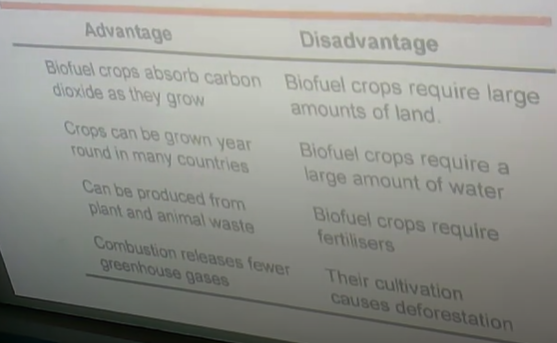
Made from biomass (e.g. plant waste from farmers) - using hydrocarbons from organic stuff to make fuels - bioethanol/biodiesel
How is bioethanol produced? What reactions do I need to remember?
Biofuel - plants use solar energy to turn oxidised carbon in the atmosphere (CO2) into energy-rich, highly reduced molecules, like glucose and cellulose by photosynthesis
6CO2 (g) + 6H2O (l) → C6H12O6 (s) + 6O2 (g)
nC6H12O6 → (C6H10O5) + nH2O - condensation reaction
Biomass produced by plants (cellulose) can be converted into simple sugars (glucose) by hydrolysis
(C6H10O5) + nH2O → nC6H12O6
Aqueous glucose solutions are fermented using enzymes in yeast and other microorganisms to (anaerobic process - no oxygen) produce bioethanol
C6H12O6 → 2CO2 + 2C2H5OH
How is biodiesel produced? What reactions do I need to remember?
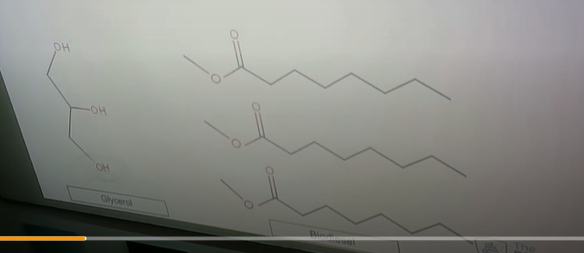
Plants produce oils - triglycerides - turned into biodiesel by transesterification
Ester - with rlly long fatty acid chain - where the energy is stored
Swapping the alcohol of glycerol - backbone of the triglyceride - for a short-chain alcohol (usually methanol)

What is molar enthalpy of combustion?
Amount of heat released/absorbed when 1 mole of fuel is completely combusted
Why is carbon monoxide not a desired product - hence we prefer complete combustion?
Toxic - binds to haemoglobin in the blood of animals/people - stops oxygen from circulating around the body
Carbon monoxide binds to the same active site on hemoglobin as oxygen, permanently blocking oxygen from attaching and preventing its transport around the body.
SACE Key Terms Used:
Active site / Binding site: The exact spot where oxygen is supposed to go.
Hemoglobin: The protein in red blood cells that carries oxygen.
Preventing transport: Stopping oxygen from circulating.
What is a harmful effect of soot - hence we prefer complete combustion?
Potent carciogens that cause cancer
Respiratory illness in animals
Dark coloured particles absorb incoming solar radiation in the atmosphere and surface - enhances greenhouse effect
What are the combustion formulas that I need to know?
Q (Total heat of system J) = m (mass of water g) c (specific heat capacity J/g/℃) ΔT (temp change ℃)
ΔH (kJ mol) = Q (kJ)/n (mol)
What is simple calorimetry? What are the errors associated with this? How to fix, explain what bomb calorimetry is?
Determines the energy released in the combustion of fuels
A mass of fuel is weighed, combusted - heat from the reaction is transferred to a known mass of water - remaining mass of fuel is weighed - calculations
Heat loss from water/flame to the environment
Incomplete combustion - not enough oxygen
Bomb calirometry - insulated to prevent heat loss - combustion chamber is submerged in water - all energy from reaction transferred to the water - source of pure oxygen means that there is a low chance that the fuel will be incompletely combusted
What unit conversions do I need?

What does a galvanic cell consist of? What are the saying you should remember?
2 chambers
Electrodes - electrons flow from anode (-) (more reactive metal) to cathode (+) (less reactive metal) - in a discharging galvanic cell
Salt bridge - to maintain electrical neutrality in both half-cells and complete the internal circuit
Wire connecting the electrodes - allow flow of electrons
Electrolytes in cell chambers

AN OX/RED CAT - half eq. reduction and oxidation
OIL RIG
What are the common oxidation states?
H+
O2-
Group 1 (+ 1)
Group 2 (+ 2)
Halogens (-1)
Gas e.g. H2 - 0 or metal e.g. Na 0
How do I do redox eq.?
Balance everything thats not O & H
Balance O with H2O
Balance H with H+
e-
Combine - electrons equal for both half eq. - cancel out electrons
What is metal displacement?
Type of redox reaction - transfer of electrons - only occurs if there are positions for electrons to occupy i.e. metal has to have a charge
More reactive metal - displaces less reactive metal in a compound
Split into redox half eq. - then balance
What do the metals on the reactivity series react with?

Top ones - hard to reduce but easy to oxidise - wont find metals of it naturally
Second group - displaces H2 gas from steam - forms hydroxides
Found in native states - not inclined to react
What does reducing into a metal mean?
Forming solid metal from salt
What is discharging vs. recharging?
producing electricity
giving electricity to reverse the process (electrolytic cell) - non spontaneous - external power source forces electrons back toward the more reactive metal
AN OX RED CAT - still applies but anode (+) cathode (-)
ELECTRONS FLOW REVERSES
What are fuel cells?
Direct conversion of chemical to electrical - uses organic stuff like methanol or hydrogen gas
Oxidise fuel WITHOUT combustion

Fuels/oxidisers - constantly pumped into cell - hence cell can run so long as u pump fuel and oxidiser - waste products removed via exhaust
What are the advantages/ disadvantages of fuel cells?
Advantages:
No greenhouse gas emissions during operation - only H2 fuel cells
Will function continuously if fuel and oxygen are supplied
Can run on renewable fuels like hydrogen and ethanol
Waste products are removed during operation
Disadvantages:
Upfront costs are high- platinum catalyst (precious metal) to operate at a feasible temp - adds costs not associated with traditional galvanic cells
High purity fuels increase operating costs
What are flow cells?
Anolyte: The electrolyte solution containing the dissolved reactants pumped past the anode (negative electrode).
Catholyte: The electrolyte solution containing the dissolved reactants pumped past the cathode (positive electrode).
External Storage Tanks:
Where the bulk of the anolyte and catholyte are kept. This means the cell's energy capacity is determined strictly by the size of the storage tanks.
Ion-Selective Membrane: Separates the two half-cells to prevent the anolyte and catholyte from mixing directly, while allowing specific ions to pass through to complete the internal circuit.
What are the advantages/ disadvantages of flow cells?
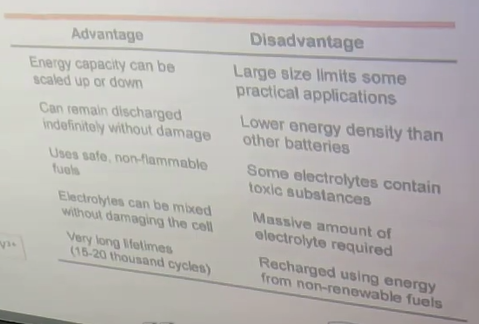
Fuel cells need to be kept runnning to be usuable over a long period
What has the highest energy density of any fuel?
Hydrogen - waste products is water - no ghg emissions when using this
How can hydrogen gas be produced?
Obtained from steam methane reforming, where steam is reacted with methane from natural gas at high temperatures - needs high temps - gotten by burning fossil fuels - which isnt very sustainable
H2O + CH4 → 3H2 + CO
Electrolysis of water - can be expensive tho
What is potable water?
Safe for consumption
Explain the water treatment process.
Saltwater - desalination - removing salt
Coagulation - neutratlises charges on silicate particles forming large particles that will settle or be filtered with positive charged particles i.e. alluminium sulphate
Flocculation - process of agitation that encourages the larger particles to flocculate (form clumps) into masses large enough to settle or to be filtered out from the solution (floc is removed from the solution)
Sedimentation - floc settles as a sediment - removed
Filtration - water passes thru several filters that remove impurities
Disinfection - treated with a disinfectant to kill microorganisms - chemical agent e.g. chlorine/ozone/chlorine oxides or UV (sunburn the pathogens to death)
Storage - treated drinking water is stored in tanks to deliver water effectively during periods of increased domestic/rural consumption
What is turbidity?
Hazyness of water/blocks light more suspended solids (clays) - turbid water
What is hard water? What issues does it create?
Contains high mineral content (Ca2+ and Mg2+)
Soap scum - reduces efficacy of soaps
soaps are soluble because they have sodium/potassium heads - dissociates forms an ion (carboxylate ion) - calcium preferentially binds to soap molecule - do not dissolve - occupied in an ionic bond so it won’t do ion-dipole with polar water - precipitates out as solid - soap scum
Scale - calcium carbonate - solubility decreases at high temperatures - forcing it to precipitate out as solid calcium calcium - blocks drains etc. (hot-water appliances) - endothermic
SOFTENING WATER REDUCES THESE ISSUES
What are zeolites?
Hydrated alluminosilicates - cation exchange surfaces - can soften water using this
NEGATIVE
Why is desalination good/bad?
Can make potable water
Reduces reliance on freshwater
Always available
Reliable production
Energy infensive
Expensive
Waste products (brine)
How can water be desalinated?
Thermal distillation
Boil the water - collect water as vapour - salt is left behind
Reverse osmosis
Non-spontaneous movement of water from an area of high concentration to an area of low contration through a semi-permeable membrane - by applying pressure to the concentration side
EXPENSIVE BOTH AS ARE ENERGY INTENSIVE
What are the reactions u have to rmbr with chlorination?
Disinfection - hypochlorous acid is used to disinfect water - oxidant - kills pathogens (bacteria/microbes)
Chlorine reacts with water to form hypochlorous acid
Cl2 (g) + 2H2O ⇌ HClO (aq) + Cl- + H3O+
WE USE HYPOCHLORITES (e.g. sodium hypochlorite) - easy to store and handle compared to chlorine gas
What is soil?
Mix of in/organic materials on the surface of the Earth (i.e. aluminosilicates, decaying organic matter like leaves) - groundwater
What is the main way that nitrogen is made available to plants? Why do they need nitrogen?
Amino acids/protein synthesis
WHOLE REACTION OCCURS IN ATMOSPHERE
Lightning strikes - energetic event - cause nitrogen gas and oxygen - form NO
N2 + O2 ➔ 2NO - reactive can be further oxidised by environment
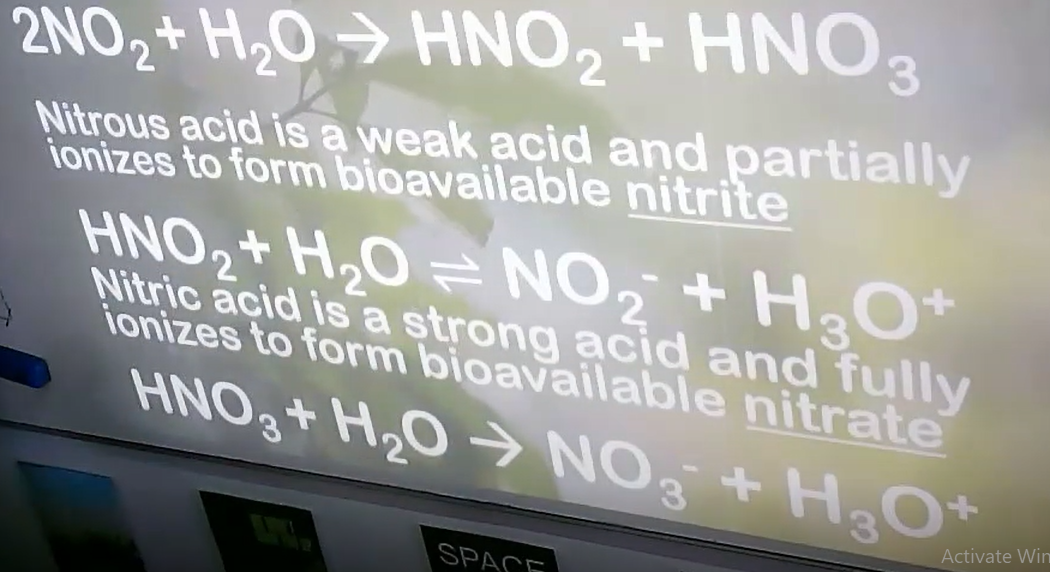
2NO + O2 ➔ 2NO2 - not super bioavailable (non-metal oxide - acidic)
NO2 + H2O ➔ HNO3 + HNO2 - rains down as acid rain - bioavailable form - enter ground water - dissociate forming ions
What is the other way of nitrogen-fixing?
Nitrogen-fixing bacteria - a plant can have nitrogen fixing bacteria on its root
Take atmospheric oxygen - turn it into a bioavailable form
Nitrifying bacteria in soil turn ammonia/ammonium into nitrate ions
What kind of salts are always soluble?
Ammonium, Potassium, Sodium
What kind of salts are generally insoluble?
Carbonates
What are synthetic fertilisers?
They replace macronutrients such Nitrogen, potassium, phosphorus that are either absent or lacking in the soil - make land arable (suitable for growing plants)
Explain eutrophication
Excessive nutrients enter natural waterway - causes algal blooms - forms thick mat on the surface of the waterway
Blocks sunlight - preventing photosynthesis of aquatic plants in the waterway - reduces oxygen as a product of photosynthesis- decreasing dissolved oxygen levels
Harms aquatic life - results in reduction of aquatic species i.e. fish
Why are aluminosilicates negatively charged?
S and O - silicon and oxygen

How do I find the charge of silicate ion?
Silicon +4
O -2
Al +3
Mg +2
Why is clay important for soils?
Clays are hydrated silicates or aluminosilicates - NEGATIVE - cation exhange in soils
What is CEC?
Cation exchange capacity (mol/kg) - how many mols of + charge can be adsorbed per kg of clay - might be divided if +2 charge - higher CEC - better soil as it holds more nutrient value
How does acidic rain affect soil?
H+ displaces nutrients e.g. calcium - calcium becomes aqueous - but it can be washed away by the rainwater not necessarily good for plants - soil is rich in protons (not nutritionally valuable) but lacking the nutrient that became aqueous
If it displaces aluminium ions - excess aluminium ions taken up into palnts - leads to aluminium toxicity in plants - or Mg/Ca deficiency in plants
How does excess soil salinity affect plants?
Strips the soil of nutrients - sodium ions displace nutritious ions
What do I need to know about soil sodicity
The Core Problem: Too Much Sodium
Soil particles (clay) naturally have a negative charge.
Healthy soil has lots of calcium ions (Ca²⁺) stuck to it, which acts like a bridge to glue clay particles together into healthy clumps.
Sodic soil means there are too many sodium ions (Na⁺) stuck to the clay instead.
2. The Chemistry: Dispersion
Because Na⁺ only has a +1 charge (compared to Ca²⁺ which has +2), it is not as effective at bridging the clay particles together.
When the soil gets wet, the sodium ions cause the clay particles to push away from each other and separate.
This separation is called dispersion. The soil turns into a muddy, structureless soup that blocks air and water from getting to plant roots.
3. The Fix: Adding Gypsum (Le Chatelier's Principle)
This is the main chemical reaction you need to explain in an exam. To fix sodic soil, farmers add gypsum (calcium sulfate, CaSO₄).
Gypsum dissolves in the soil water, releasing a high concentration of Ca²⁺ ions.
According to Le Chatelier's principle, this sudden flood of Ca²⁺ forces a chemical equilibrium shift.
The Ca²⁺ ions knock the Na⁺ ions off the clay and take their place.
The displaced Na⁺ ions are then washed (leached) away by rain, and the calcium restores the healthy soil structure.
How are the compounds that are hard to reduce made into pure metals?
Top of the activity series - Molten electrolysis (no water present)- cant use aqueous electrolysis method - water is preferentially reduced - causing the formation of oxygen and hydrogen gas at the anode and cathode
High melting points for these salts - requires intense heating - very expensive - takes a lot of electrons - therefore a lot of electricity to force current into the ions and feed them electrons
IF doing it with NaCl
No oxygen present for it to react once it forms metal - explode
Cl will turn into Cl2 - toxic needs to be handled safely
For the low/medium reactivity metals on the reactivity series what method would be best?
Carbothermic reduction (using C-carbon or CO - reducing agent at high temperatures) - carbon can take on the oxygens to form CO2 and leave behind a metal - uncharged - lower purity metals
CHEAPER - less energy intensive than molten electrolysis